Anthropologist Answers Evolution Questions
Released on 09/15/2026
I'm anthropologist Agustin Fuentes.
Let's answer your questions from the internet.
This is Human Evolution Support.
[upbeat music]
r/AskScience asks,
How long have humans been anatomically the same
as humans today?
What do we mean by anatomically the same?
One could ask, Well, what about our bodies is unique?
What does nothing else have?
Well, if you look at everything,
it's pretty much just our chin,
which is sort of ridiculous.
We are the only species with a chin,
but the chin doesn't make us human.
How long have we had chins?
It may be 300,000 years.
How long have we had bodies that look like this?
Maybe a little bit older.
How long have bodies like this been the only thing around?
About 40 or 50,000 years.
When did anatomically modern humans, that is, other humans,
fossils that look just like us, first show up?
Around 300,000 years ago,
but it doesn't mean that we, poof, emerged then.
Tough-Win-2254 asks,
Was there ever a first human?
If not, then how do we become humans?
It's important to realize
that there wasn't some point where, you know,
300,000 years ago, an archaic Homo sapiens
or a Homo erectus-like gave birth,
and it was a Homo sapiens.
That's not the way it works.
What happens is there's a whole bunch of populations
of Homo erectus or Homo erectus-like stuff
that changed a little bit over time.
And once they've changed enough, that is, whole populations,
hundreds, thousands, tens of thousands of individuals,
once they changed enough, we're like,
Ooh, that's not like it was 100,000 years ago.
It's different enough.
We're going to call it Homo sapiens now.
That's the way evolution works.
Gradually, over time, stuff changes.
That's evolution.
Ashuntiethebee asks,
Do y'all think monogamy is really natural,
or are we just forcing it?
Okay, so let me give you the short answer.
Humans are monogamish.
When we say monogamy, we tend to think about marriage
and law stuff and cultural ideologies.
No, deep in our past, humans didn't get married.
Deep in our past, humans didn't make
some kind of formal pronouncement of this one
and this one come together.
What they did do was come together frequently in pairs
and really care for one another
and sometimes break up and find other pairs.
Usually, when people think about monogamy,
though, they're talking about sex, right?
Social mammals use sex not just for reproduction,
but actually for social relationships.
Primates, man, do they have sex a lot.
A lot of primates have more sex outside
of reproduction than inside reproduction.
And when it comes to humans, well,
we're pretty much the sex champions of the primate world.
Well, it turns out, in primates
and in mammals in general, the more social you are,
the more you rely on everyone else in your group
and have interesting connections
and relations to them, the more sex you have.
Is monogamy the way we're naturally designed?
No.
Monogamy in the sense of strong pair bonds
between two individuals happens a lot.
It's very frequent for humans.
But is attraction and sexual interaction
exclusive within that pair bond?
No.
Everyone who's pair-bonded knows they're attracted
to other people too.
That's part of the way we primates are.
We love sociality.
Sometimes we cluster together in throuples.
Sometimes we have these extended families
which have great connections
and really complex relationships.
The bottom line is humans bond in incredibly powerful ways.
And in fact, that might be part of the story of our success.
D_yuvonne_marshall asks,
If we really came from monkeys,
then can someone please explain
to me why there are still monkeys?
We didn't come from monkeys.
Okay, it turns out we're primates; monkeys are primates.
About 35 million years ago,
those living monkeys today and us shared a common ancestor.
So deep in time, there was this ancestral primate;
monkeys emerged from one branch,
we emerged from another branch.
We did not come from monkeys.
We and monkeys are cousins.
Here's a question from the DebateEvolution subreddit.
So did we evolve from Neanderthals or what?
Walk me through the family tree.
I think we can do that.
So let's think about human evolution,
not so much as a family tree,
but sort of a family shrub, right?
So down at the beginning here, those roots are,
let's say, six, seven,
eight million years ago, ape-like things.
From this, we get sort of this branch
and then this branch and then this branch.
We've got Australopithecus afarensis.
Australopithecus afarensis,
or Lucy, represents a cluster of hominids,
and we think this is the sort of basal cluster
to these three big lineages, right,
these three parts of human evolution.
So one of the parts of human evolution that's not us,
but closely related, are those that we call paranthropists
or the robust australopithecines.
These relatives, ancestors/relatives, have really big teeth,
had bodies that were big and small,
but were different enough that we're like,
Those are some branches of the family shrub that's not us.
And then we've got this sort of other lineage over here,
which, you know, is characterized by this thing we call
Australopithecus africanus that looks a lot like Lucy,
but has some changes, a little bit sort of more slender,
maybe a little bit more like us, but it's not us yet.
And then 2.8 million years ago
or so, Homo habilis, the emergence of the genus Homo.
Now, we think it might have come from this branch,
probably didn't come from this branch,
might have come straight up as a third branch
from Australopithecus afarensis.
Once we get up into this stuff, the genus Homo, us,
we start to get some really cool, fascinating relatives.
These are the Neanderthals, the Denisovans,
and by the last million years or so,
we get this large cluster of members
of the genus Homo, our ancestors here.
So, for example, we get Homo erectus
or Homo ergaster by about 1.5 million years ago,
which, really interestingly, is this individual right here.
What's really fascinating
is that we have this incredible diversity of ancestors,
of populations, of relatives.
And by about, I'd say, 30,000, 20,000 years ago, just us.
So here's the human family shrub.
Well, where are the lines?
Like, exactly who connects to who?
So probably all of us
connect back to Australopithecus afarensis or Kenyanthropus.
Anyway, something in this three-to four-million-year period
is probably the ancestor of all the rest of us.
Then we've got all of these different kinds of humans.
So which one of these different humans
is directly the ancestor to us?
All of them?
So it turns out
that there's not one population, one species,
or one of these that gave rise to humans.
Humans look like we're a mixture genetically, behaviorally,
culturally, of a number of different populations, groups,
maybe even different species
that lived over the last million years.
So there's not one line from here to here or here to here.
How can we be evolved from all these different things?
Well, think of humans as a mutt, right?
You can think of dogs as sort of a standard dog.
You can actually mix together a whole bunch of dogs
that look really different and pretty much get dog
after a few generations.
Humans are that way too.
So all of these different humans
living 300,000, 200,000, 150,000, 50,000 years ago,
different groups moving around, mating, fighting,
getting together, breaking apart,
all of that has contributed to us today.
That's why humans are sort of a composite species.
We're a bit of our history, every one of us.
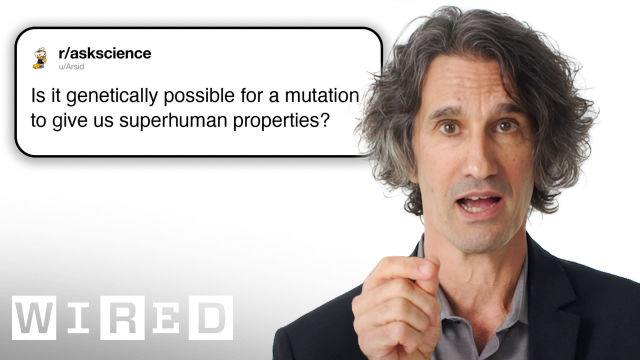
Arsid asks, Is it genetically possible for a mutation
to occur that would give us superhuman properties?
Something like Spider-Man or the X-Men?
Oh, that would be so cool, but it's not going to happen.
That's not the way genetics and bodies work.
So I wish this X-Men thing was a possibility,
like one change in the gene
and I could grow out Wolverine claws or something like that.
It's not going to happen
because development doesn't just, poof, happen, like,
as your bones develop, they develop in particular ways,
and they have constraints, right?
So I might develop joined fingers,
but I'm not going to develop an extra finger
that has a titanium claw that sticks out
or a bone claw or something like that.
And you can't have one change
that changes the whole game plan, right?
It takes hundreds of thousands or millions of years.
So one might think,
Well, wasn't there a mutation in some ape-like ancestor
that made him stand up and start walking?
No.
It turns out, like,
early ape-like ancestors 10, 14 million years ago
were already sort of standing on their hind limbs
in the trees and moving around.
And then, a few million years later,
started to use the ground a little more,
and over millions of years, that slowly changed
what bodies look like and hands and feet.
The point is there's no mutation
that immediately changes you.
Evolution takes time.
Even if you get some really important genetic shifts,
those genetic shifts could be invisible, nothing happens,
or they could take years and generations
before any change occurs.
By the way,
there is one interesting aside here about the X-Men.
So there is a species that's like us
but not us, Homo naledi.
It's related to us.
They lived about a quarter of a million years ago
in this Rising Star Cave system in South Africa.
They're really fascinating.
Well, one of the main researchers on that project
was sitting next to someone very major in the comics world,
and they began talking on a plane a number of years ago.
And the result of that was a comic,
and you can go check this out in X-Men Origins,
that the X-Men actually didn't come from the same ancestors
that we did, that, in fact,
something called Australopithecus sediba
lived about two million years ago,
sort of emerged into a human,
but a human with a slightly different ancestry.
So in that argument,
X-Men are not just that they have some mutation,
but, in fact,
they have slightly different ancestors than we do.
Next question.
From the Human Evolution subreddit,
Is the concept that meat caused
the expansion of human brain false?
Yeah.
Okay, what's really fascinating is this is what I was taught
as a student and as a scientist,
and this is what I've published and written about sometimes.
It's changed now.
We used to think that to get this big brain growth,
you need a lot of protein.
Early on, when our brains are really starting to first grow,
that first big jump
from the australopithecines or other things,
it doesn't look like we're eating that much meat.
And so we have to ask,
Well, where's that coming from?
Well, carbohydrates, so roots and tubers,
a lot of other small animals,
the whole punchline that meat is why we got big brains
and became human, that's not true.
Meat's always been an important part of our diet.
It's become more important in our diet,
especially for children, but meat is not why we're human,
it's not why our brains grew, and it's not why we're smart.
@DaleSparrow asks,
Did ancient humans just eat a shit load of roots?
Yes.
Not just, but they did eat a lot of roots.
Roots and tubers,
the underground storage organs of plants,
are really important in our evolution.
But you know what else is important?
Honey, right?
It looks like insects and bees' honey
might have really shaped our evolutionary history
and gave us access to protein and things like that.
You know what else is important?
Lots of small animals,
lots of small animals that we could catch and eat.
You know what else is important?
Big animals.
When we finally figured out
how to hunt big animals, all of that.
At some point, not that long ago, right?
10, 15,000 years ago, 8,000 years ago,
humans went from gathering, hunting
and killing things, catching fish, gathering whatever fruits
or berries are out there, to messing with the plants,
messing with the animals, and creating new types of it.
We call this domestication.
Everything you are eating now is pretty much domesticated,
is recreated over the last few thousand years
to look like it does now.
Is that better or worse?
I don't know.
What's really incredible about humans,
and this is probably really old for our species,
we don't just eat, right?
We create diets, cuisines, and life.
For humans, eating is not just about nutrition;
it's also about culture and enjoyment.
Cauliflowernice,
@adultswim Primal is a documentary about early humans,
exclamation point.
Someone proved me wrong @primal.
Okay, it's not a documentary about early humans,
but Primal's cool.
Yeah, it's wrong with dinosaurs
and some other things like that,
but what's cool about Primal
is it puts us in touch with our ancestors.
It puts us in touch with other ways to be human.
And here we have a clip from Primal
depicting the main character fishing.
Fishing, how long have humans fished?
Two million years ago,
or almost two million years ago,
in East Africa, we have one of the first evidences
of butchering of an animal.
And what is it?
It's a giant catfish.
How did they catch that giant catfish?
They probably jumped into this river
and grabbed this catfish
and then processed it, chopped it up, and sliced it.
We've been fishing a long time, and fishing matters to us.
Standard-Ad-868 asks,
How did blue eyes spread if it was recessive?
Well, it's not a simple dominant-recessive,
so there's a whole bunch of genes,
20-plus at least, that go into eye color.
But you're right, blue eyes are pretty rare.
Blue eyes can show up
with particular genetic and developmental combinations.
They've shown up in populations in Northern Europe
and populations in Australia
and populations actually in Africa, around the world.
So blue eyes are rare, but they show up.
But that gets to the bigger question.
These little things that change about humans, why?
For example, many people today get their third molar
taken out because it's all crunched in the back there.
That's not because there's a problem with the third molar;
it's just that our jaw is starting to change.
It's actually getting a little bit smaller
as our heads got sort of globular and big, right?
So there's only a limited amount of bone tissue there.
And so, as your jaw shrinks, you crowd that third molar.
VikingHair wants to know,
Could Neanderthals and Homo sapiens talk with each other?
Yes, they could.
Clearly, Neanderthals and humans around that time
could speak, and they could interact.
Well, if they could talk to each other,
what do they sound like?
Well, some people have argued
that the Neanderthals had this high-pitched voice
that is something like this, right?
This skull, this shape, had something about it,
maybe in the neck and the bones of the body,
that made it speak very high.
Now, let's think about this for a minute.
We would have to look at the bones in the neck
and sort of the soft tissue of the larynx
and a variety of other things.
This is a Neanderthal, right?
And this is a human.
Actually, when we compare these,
they're not huge differences.
If you think about it, if you travel around the planet
and talk to all of the eight billion humans,
there's going to be a lot of voices
and a lot of things going on.
So did they talk to each other?
Probably.
Maybe they used sign language.
Maybe they grunted at each other.
Maybe they spoke the same language.
I don't know yet, but it probably wasn't one going ahh,
and the other going rahrah.
Xsoyaaa asks, How did the first humans create tools
when they didn't have tools to create tools with?
Okay, the first tools are stone tools.
Stone tools are made out of stones.
So what do you need to make a stone tool?
Well, you need to be smart enough
or have this insight that inside this stone is a tool.
So what do you need?
You need one stone and another stone,
and you bring them together and you hit them together
carefully and with foresight, and you create a stone tool.
So what's really fascinating is not
what tools did we use to make tools,
but rather when did we figure out
that inside a rock was a tool
and figure out that picking up another rock
and hitting that rock in particular ways and doing it again
and again would get us something like this.
That's the interesting question.
These are called handaxes
because you hold them with your hand
and sort of cut or chop things.
These are made in the last million years
or so, 750,000 years ago, 600,000 years ago.
And what they are is a rock, so Homo erectus,
Homo ergaster, one of those humans
living around this time period sat on a big rock
and spent hours and hours knocking off little pieces
on both sides to create a sharp edge and a beautiful form.
They're way more symmetrical
and way more work than is necessary to cut or chop or poke.
Why did our ancestors
not only learn how to make stone tools, right,
but then make really beautiful ones,
sometimes not even using them, just making them
and putting them in big piles?
Stone tools are not just tools; they're also social symbols.
Amillionbuchs asks, We are getting closer
and closer to becoming the humans from 'WALL-E, '
and I'm so scared.
LOL.
No, we're not.
WALL-E's an example of what happens
to human bodies if, like in the movie, you stop walking,
you stop moving, you just start gorging your face.
That's not evolution, right?
That sort of getting immobile and gigantic
and blah, drooling, that's actually a capacity
that human bodies have right now.
Evolution works on existing variation slowly, usually.
So what's going to change in humans?
I don't know.
Our genetic frequencies are changing
right now and have been changing.
You won't see any of that because that's all on the inside.
Maybe our resistance to viruses is changing.
We know that's true.
So our head's going to get big
or our eyes going to get gigantic?
No, none of that's going to happen.
WALL-E is not a threat, evolutionarily speaking.
WALL-E is a threat if we don't change our ways,
wising up and start taking care of ourselves and the planet.
Axelle17 asks, Are hobbits real?
Yes, they are.
Not the Lord of the Rings hobbits,
but it turns out probably about 75 to 200,000 years ago
on the island of Flores in what is today Indonesia,
a bunch of humans or human close ancestors
or relatives called Homo floresiensis lived.
Homo floresiensis was a hobbit.
It was a very, very small little human
with big feet, which is awesome.
And they ran around, and guess what they had to deal with?
Komodo dragons.
So there's a little teeny hobbit human
fighting off gigantic lizards, hunting big rats
and little mini elephants.
It's like Middle-earth on the island of Flores.
Homo floresiensis was only about three and a half,
maybe four feet tall.
They were really small.
Why so small?
Well, we think they're the product of something
we call island dwarfism.
So when you look at islands around the world,
big animals show up on islands
and get smaller, like elephants get teeny.
There's, like, little pony-sized elephants.
There's other animals that are really small,
and they get to islands and they get bigger.
Well, what we think happened
is probably a million or more years ago,
as humans moved around the planet,
or actually human ancestors,
some of them got to the island of Flores,
and they stayed there.
And over time, on that island,
they shrunk down and got really small.
And they did pretty well for more than 100,000 years.
And interestingly, humans show up on Flores
around the same time that the hobbits disappear.
Why?
We don't know.
Did they interact?
We don't know.
Matteassierra asks, Who invented kissing?
Who was the first person to find out that touching lips
could help spark chemistry?
So humans are probably the only creature
that kisses in association
with sort of sexual arousal the way we do.
Other animals sort of put their lips together.
For example, any of you watching this who have a dog,
your dog is trying to get its tongue and its mouth
on your mouth all the time.
That's because that's a common exchange for canines, right?
They love to lick each other in the mouth
and share the microbiome.
That's not kissing, right?
We call it kissing, but for the dog, it's like,
Hey, hello.
Here's all the spit from my mouth
so that we're part of the same pack.
That's not what human kissing.
We're not trying to exchange spit
to be part of the same pack.
We're actually kissing because it feels really good.
So chimpanzees, right?
Here's the skull.
Chimpanzees have these big old lips
that are incredibly flexible, so they can smooch
and move their lips and all kinds of things,
but they don't have lips like ours
that are sort of tied around our face and connected,
and they don't have the same kind of nerve structures.
So why did I just go around that?
Because it turns out that part of the reason
kissing is important for humans
is the shape of our face, the shape of our mouths,
and the shape of our lips.
But why kiss? I mean, why do that?
Well, it turns out humans love to look at each other, right?
Face-to-face contact.
When we meet someone, the first thing we do
is look at their eyes.
We look at their face.
We're really interested in what's going on here.
And then, when you get close to someone,
you love to touch them.
And guess where on your face
is one of the most filled with nerve endings
and very sensitive sort of areas of tissue?
The lips.
So it turns out putting lips together,
especially if you throw in tongue
and other things like that,
actually is really sensorily powerful.
You really feel it.
But then there's a problem.
Not all people all over the planet
even today kiss regularly.
A lot of cultures kiss each other on greetings
or kiss on the side of the mouth.
Why do we kiss?
We kiss because we can.
Why is kissing fun?
Kissing is fun
because the way our face and nerves are designed.
Do all humans kiss?
No.
Do we need to kiss to spark chemistry?
No.
Does kissing spark chemistry?
Yep.
Justinalphabet asks,
The earliest human skeletons had spears in their rib cages.
Do you think mankind will ever
learn to get along peacefully?
The earliest human ancestors
did not have spears in their rib cages.
Spears came a lot later.
But what's really interesting is that we do find
evidence throughout human history
of one human ancestor hitting the other in the head
and killing them, maybe, but it's not that common.
We don't see one group attacking another group
with regularity and lethality
until between about 10 and 20,000 years ago.
Then we start to see it more and more commonly.
And in the last eight or 7,000 years, warfare,
two groups coming together
and just trying to kill each other, does emerge.
Clearly, fighting and aggression is deep in our history.
It's part of our capacity.
Warfare, however, is fairly recent.
Humans have a capacity
for incredible violence and aggression
and for incredible caretaking and collaborating.
Notsowinner57 asks,
Why do we as humans look so different
from one another compared to other animals?
Good question.
Because if you weren't a human,
if you weren't in some culture today
that makes a big deal about skin color
or hair type or clothes,
you wouldn't think humans look that different at all.
If you came down from outer space
and you looked, you'd be like,
Oh man, these are all the same.
If you were to look just at human DNA,
all humans are 99.9% identical.
If you'd look at the DNA
from a white-tailed deer in Michigan
and that same deer in New Jersey, right?
Same species, not that far apart,
those two deer would be more separate,
more different from one another genetically
than any two humans in the entire planet.
It turns out contemporary humans, Homo sapiens sapiens,
us around today, all eight billion of us,
are the last living human species.
But if you take a look around, 400,000 years ago,
five, six, 700,000 years, a million years ago,
there were multiple human populations,
probably multiple human species,
a lot more variation than there is today.
So bottom line, yeah, there's a lot of variation in humans,
but under the skin and as being human,
we're all pretty much the same.
Goltz20707 asks,
Question for those knowledgeable in the field.
Did early humans actually live in caves,
or were they special-use spaces?
And it's just that the artifacts left in caves
are better preserved than those left out in the open?
Yes.
The answer is yes all the way around.
It looks like some humans and human ancestors
did, in fact, live in caves,
that is, they spent a lot of time there.
Most did not.
And yes, something in a cave has a better chance
of being preserved than something outside in the open.
But given all of that, let me just tell you,
being in caves is fascinating
because being in caves, especially if you have fire,
you got to think about smoke,
you got to think about wind patterns.
Being in caves,
you have to sort of deal with other things like cave bears
and other things that want to live in those caves,
and you got to keep them out.
And also, when humans and human ancestors use caves,
they didn't just, like, go sit in a cave.
They actually manipulated those caves and changed them.
For example, more than 200,000 years ago
in this cave in France,
you have to go way to the back of the cave.
There's evidence that Neanderthals took
a bunch of stalactites and stalagmites,
the ones from the bottom and the top,
broke them, and then laid them out in a circle
and then built a fire in the middle of that circle
and used this for generations.
And cave paintings.
For some reason, humans go all over the place
and crawl into really difficult places
and paint on the walls.
I've been in one cave in Portugal.
We have to crawl through, turn upside down,
get on your back, and then look up like this,
and you see this beautiful horse up on the side.
What?
What's going on?
So yeah, they were sacred spaces too.
So humans lived there.
Yeah, they were symbolic and sacred spaces,
and yeah, stuff gets preserved better there.
That's why caves are so important in human evolution.
Vidit_shrimali27 asks,
If species like Homo neanderthalensis
had larger brains than us
and Homo erectus survived for nearly two million years,
why did they succumb to extinction
while Homo sapiens thrive?
There used to be a whole bunch of different kinds of humans.
They're all dead.
They all went extinct.
Why? What's going on?
Well, Neanderthals did have bigger brains
than us on average,
but a normal human brain ranges from 1,000 cubic centimeters
to 2,000 cubic centimeters.
That's 100% variation.
So having 100 cubic centimeters more or less
on us for Neanderthals really doesn't matter.
So Neanderthals did not really have bigger brains than us.
They were just a little bit bigger-bodied.
Homo, our genus, shows up about 2.8 million years ago.
In that time period, it divides
and moves around into different sort of populations
that look pretty different from one another in many ways.
What's really interesting, though, is all this variation,
all these different kinds of human,
they all go extinct at some point, and we made it.
Well, when I say we, that's not exactly right.
Don't think of all these other humans
as necessarily going extinct.
Think about them as leaving us little gifts,
little pieces of DNA, little bits of heritage
that make us who we are today.
So, I mean, a logical question to ask is,
How do we have genetics from different species, right?
Species that aren't us?
Well, first of all, species is a fuzzy category, right?
We don't know exactly 120,000 years ago
if a Homo sapiens and a Neanderthal walked by each other,
did they see each other as different species?
We knew they could have sex.
Clearly, we're carrying some of those genes.
So what we really should ask is not,
How do different species get together?
but, What does it mean to understand that we humans
are this composite?
We're this compilation of all these different populations,
of all this different variation from the past
that somehow has made it to today, not only made it,
but there are eight billion of us right now.
That is pretty impressive.
So whatever we did, we did okay.
What was it about us?
Sure, it's not the chin, right?
It's not the chin.
The chin did not make us survive.
Maybe it was our unbelievable ability to communicate
and to cooperate.
Maybe it was our ability to create trading networks
across hundreds of miles.
Maybe it was our ability
to care for one another a little bit more than others.
Maybe it was our ability to imagine new possibilities
and try to make them real.
All of those things are things we do,
but all of those things are probably things
that some of these guys did too.
Are we really that different,
or maybe are we just the luckiest hominin, not the best?
milkywomen asked,
How true is the idea of 'survival of the fittest'?
First off, it's important to point out
survival of the fittest we associate with Darwin,
but Darwin didn't use that phrase in the first edition
of On the Origin of Species.
He did in the second edition and moving forward.
Why?
Well, he got sort of pushed to use it
because it sounds cool, right?
People love survival of the fittest
because they think it means if you're bigger or faster
or meaner or fight more, you win.
That is not how evolution works.
Not usually.
Some animals, being faster is better.
Other animals, being smarter is better.
Other animals, being slower is better.
One of the biggest problems with this idea
of survival of the fittest
is that we think about guys in that way, right?
Like the alpha male, the guy who looksmaxxes
and gets the women and does everything.
Okay, let's actually deconstruct that for just one second.
So alpha male comes from terms about wolves,
a pack of wolves.
There's not an alpha male.
There's a male and a female who breed.
They're the sort of, like, center of the group,
and they breed,
and the other ones help them raise the young,
and they hang out, and they're all together,
and they communicate and cooperate and collaborate.
Basically, someone made up this notion of alpha male
as this dude who's at the top of everything.
It turns out, for most of human evolution,
and even today, if there's one dude who's really aggressive
and bothering everyone
and pushing them around, what happens?
That dude gets tossed out of the group.
There are eight billion humans on the planet
right now, so we are definitely fit.
Are we the fittest?
That we'll have to wait and see.
Peteragro asks,
Where did the first humans come from?
How did they spread across the planet?
We're Homo sapiens, so genus Homo, species sapiens.
The genus Homo has about two and a half million,
almost three million years of history.
We originate in Africa, sub-Saharan Africa,
and over the last two and a half million years or so
have spread all around Africa and the rest of the world.
If you want to say,
Well, where's the first fossil that looks just like us
that we're going to call that the first human?
That's probably around 300,000 years ago in North Africa,
in what is today Morocco.
It looks very similar to other stuff,
but a little bit different.
Has a chin and some other stuff.
There's others about 180,000 years ago in East Africa,
and then more recently we find them in Central Asia,
Southeast Asia, Europe, and Australia.
Humans do a lot of things,
but what they really do well is move and mate and hang out.
So no easy answer, but there are two fun ones.
One, humans begin in Africa
and spread around the world over the last two million years.
Two, humans begin in Africa
and spread around the world about 300,000 years.
Either one, totally good.
From the Explain Like I'm Five subreddit comes a question,
Why are human kids so useless for so long
compared to almost every other animal?
So imagine all of you have seen the wildlife show
where a giraffe gives birth, right?
This giraffe gives birth,
the baby drops out, and then, you know, seven minutes later
it's running across the savanna.
That's really impressive.
Human babies, we give birth,
you have the baby, what does the baby do?
They can't even lift their head for weeks.
What's going on there?
That's actually part of the secret of being human.
It turns out that humans have stretched out
that infancy and childhood in a way
that allows us extra time to grow.
The human brain at birth is only 40% of its adult size.
That's the smallest of any mammal.
So most of our brain grows
outside in the world, interacting with other humans.
Why? Culture.
It's hard to learn how to be human,
and our bodies and our brains need to be in interaction,
be together with others.
And so, how do we extend out that childhood?
We do a lot of caretaking, right?
The story, It takes a village to raise a child,
that is true.
One person can do it, but it's really hard.
Our bodies, our lives,
whether you're male or female, young or old,
our bodies are geared towards grabbing those kids,
holding onto them, and taking care of them.
Why do humans have this really long childhood?
That's because it takes a long time to be human,
and part of that is being together with others.
Parking_Bid9954 asks,
Were the average Neanderthal man stronger than modern man?
Maybe.
Depends on which modern man you're talking about.
Humans are incredibly variable.
On average, Neanderthals were a little bit stockier
than most humans today,
but humans 15,000 years ago were a little bit stockier
than most humans are today.
Part of it is their overall lives
were a little more stressed out.
They had to use their bodies for a lot more things.
More and more, as humans require less body use,
we get a little bit of reduction, right?
That is so we can move the bone tissue around.
For example, now that we pretty much pre-cook
or pre-chew all of our food, right,
processed food, canned food, cooked food, actually,
we really don't need much power up here in the jaw.
And what we've seen is our jaws and teeth
have gotten a little bit smaller.
MirnaArroyodrph asks, random thought of the day:
Considering the amount of Neanderthal mitochondrial DNA
we have, can it be that Neanderthal women
just found Homo sapiens males cuter, leaner, more charming?
No, we have no idea what happened when Neanderthals
and humans got together,
aside from the fact
that sometimes they had sex and offspring.
Did they find each other cuter?
Were they repulsed by one another?
Were they intrigued by one another?
I don't know. I wish I had a time machine.
But what we do know is that humans and Neanderthals
somehow more than once got together and had a baby.
Coreysjill asks, In hunter-gatherer societies,
were gender roles really as rigid as they are taught
in textbooks and depicted in pop culture?
First of all, when we look at even recent sort of societies,
let's say 5,000 years ago,
I can look at the bone chemistry, right?
And I can show you that men and women on average
as adults were eating slightly different foods.
That suggests some kind of real
different sort of patterns, right?
Or we can show that, like, right arms and left arms
are different in men, but not in women,
which shows a different kind of sort of behavior
around agriculture or something like that.
But when we go back in time, we don't see that.
When we look at male and female bodies,
it's really hard to find identifiable differences.
Well, people say, Men hunt.
Well, we see in Neanderthals and in earlier humans,
both males and females have the same kind of broken bones.
They seem to have the same kind of sort of stature
and thick, strong muscles.
So it's just not clear.
The manosphere wants us to believe
that evolution shows men are this way
and women are this way.
And you know what?
It's just not true.
It's a little more complicated and much more interesting.
Eric_von_doom asks,
Sometimes I think
about how human beings have been around for 300,000 years,
but recorded history only goes back 5,000 years.
So there's 295,000 years
that are just completely unaccounted for.
Not true.
We have great accounting.
First of all,
recorded history goes back more than 5,000 years.
We have hundreds of thousands of years of evidence
of humans building stuff, making things,
creating things, and leaving them.
500,000 years ago in East Africa, human ancestors,
Homo erectus or one of the other species,
carved up these big chunks of wood
and put them together like Lincoln Logs, right?
Other ones, 128,000 years ago,
made little perforated holes in shells
and strung them around their necks.
And 65 or 70,000 years ago,
humans on the island of what is today Sulawesi, right,
climbed into a cave and painted a pig and a hand print.
Humans decided to take pigments, to add water and spit
and other stuff to ochre, to these mineral pigments,
and paint their bodies and paint the walls.
So don't just hold on to writing.
Writing is recent.
The really interesting stuff, the amazing stuff,
is what our ancestors built and left for us to discover.
So those are all the questions for today.
Thank you for watching.
[upbeat music]

Gordon Ramsay Answers Cooking Questions From Twitter

Ken Jeong Answers Medical Questions From Twitter

Bill Nye Answers Science Questions From Twitter

Blizzard's Jeff Kaplan Answers Overwatch Questions From Twitter

Nick Offerman Answers Woodworking Questions From Twitter

Bungie's Luke Smith Answers Destiny Questions From Twitter

Jackie Chan & Olivia Munn Answer Martial Arts Questions From Twitter

Scott Kelly Answers Astronaut Questions From Twitter

LaVar Ball Answers Basketball Questions From Twitter

Dillon Francis Answers DJ Questions From Twitter

Tony Hawk Answers Skateboarding Questions From Twitter

Jerry Rice Answers Football Questions From Twitter

Garry Kasparov Answers Chess Questions From Twitter

U.S. Olympic and Paralympic Athletes Answer Olympics Questions From Twitter

Neuroscientist Anil Seth Answers Neuroscience Questions From Twitter

Blizzard's Ben Brode Answers Hearthstone Questions From Twitter

John Cena Answers Wrestling Questions From Twitter

The Slow Mo Guys Answer Slow Motion Questions From Twitter

Bill Nye Answers Even More Science Questions From Twitter

James Cameron Answers Sci-Fi Questions From Twitter

Best of Tech Support: Bill Nye, Neil DeGrasse Tyson and More Answer Science Questions from Twitter

Riot Games' Greg Street Answers League of Legends Questions from Twitter

Riot Games' Greg Street Answers Even More League of Legends Questions from Twitter

PlayerUnknown Answers PUBG Questions From Twitter

Liza Koshy, Markiplier, Rhett & Link, and Hannah Hart Answer YouTube Creator Questions From Twitter

NCT 127 Answer K-Pop Questions From Twitter

Neil deGrasse Tyson Answers Science Questions From Twitter

Ken Jeong Answers More Medical Questions From Twitter

Bon Appétit's Brad & Claire Answer Cooking Questions From Twitter

Bang Bang Answers Tattoo Questions From Twitter

Ed Boon Answers Mortal Kombat 11 Questions From Twitter

Nick Jonas and Kelly Clarkson Answer Singing Questions from Twitter

Penn Jillette Answers Magic Questions From Twitter

The Russo Brothers Answer Avengers: Endgame Questions From Twitter

Alex Honnold Answers Climbing Questions From Twitter

Sloane Stephens Answers Tennis Questions From Twitter

Bill Nye Answers Science Questions From Twitter - Part 3

Astronaut Nicole Stott Answers Space Questions From Twitter

Mark Cuban Answers Mogul Questions From Twitter

Ubisoft's Alexander Karpazis Answers Rainbow Six Siege Questions From Twitter

Marathon Champion Answers Running Questions From Twitter

Ninja Answers Fortnite Questions From Twitter

Cybersecurity Expert Answers Hacking Questions From Twitter

Bon Appétit's Brad & Chris Answer Thanksgiving Questions From Twitter

SuperM Answers K-Pop Questions From Twitter

The Best of Tech Support: Ken Jeong, Bill Nye, Nicole Stott and More

Twitter's Jack Dorsey Answers Twitter Questions From Twitter

Jodie Whittaker Answers Doctor Who Questions From Twitter

Astronomer Jill Tarter Answers Alien Questions From Twitter

Tattoo Artist Bang Bang Answers More Tattoo Questions From Twitter

Respawn Answers Apex Legends Questions From Twitter

Michael Strahan Answers Super Bowl Questions From Twitter

Dr. Martin Blaser Answers Coronavirus Questions From Twitter

Scott Adkins Answers Martial Arts Training Questions From Twitter

Psychiatrist Daniel Amen Answers Brain Questions From Twitter

The Hamilton Cast Answers Hamilton Questions From Twitter

Travis & Lyn-Z Pastrana Answer Stunt Questions From Twitter

Mayim Bialik Answers Neuroscience Questions From Twitter

Zach King Answers TikTok Questions From Twitter

Riot Games Answers League of Legends Questions from Twitter

Aaron Sorkin Answers Screenwriting Questions From Twitter

Survivorman Les Stroud Answers Survival Questions From Twitter

Joe Manganiello Answers Dungeons & Dragons Questions From Twitter

"Star Wars Explained" Answers Star Wars Questions From Twitter

Wizards of the Coast Answer Magic: The Gathering Questions From Twitter

"Star Wars Explained" Answers More Star Wars Questions From Twitter

VFX Artist Answers Movie & TV VFX Questions From Twitter

CrossFit Coach Answers CrossFit Questions From Twitter

Yo-Yo Ma Answers Cello Questions From Twitter

Mortician Answers Cadaver Questions From Twitter

Babish Answers Cooking Questions From Twitter

Jacob Collier Answers Music Theory Questions From Twitter

The Lord of the Rings Expert Answers More Tolkien Questions From Twitter

Wolfgang Puck Answers Restaurant Questions From Twitter

Fast & Furious Car Expert Answers Car Questions From Twitter

Former FBI Agent Answers Body Language Questions From Twitter

Olympian Dominique Dawes Answers Gymnastics Questions From Twitter

Allyson Felix Answers Track Questions From Twitter

Dr. Michio Kaku Answers Physics Questions From Twitter

Former NASA Astronaut Answers Space Questions From Twitter

Surgeon Answers Surgery Questions From Twitter

Beekeeper Answers Bee Questions From Twitter

Michael Pollan Answers Psychedelics Questions From Twitter

Ultramarathoner Answers Questions From Twitter

Bug Expert Answers Insect Questions From Twitter

Former Cult Member Answers Cult Questions From Twitter

Mortician Answers MORE Dead Body Questions From Twitter

Toxicologist Answers Poison Questions From Twitter

Brewmaster Answers Beer Questions From Twitter

Biologist Answers Biology Questions From Twitter

James Dyson Answers Design Questions From Twitter

Dermatologist Answers Skin Questions From Twitter

Dwyane Wade Answers Basketball Questions From Twitter

Baker Answers Baking Questions from Twitter

Astrophysicist Answers Questions From Twitter

Age Expert Answers Aging Questions From Twitter

Fertility Expert Answers Questions From Twitter

Biological Anthropologist Answers Love Questions From Twitter

Mathematician Answers Math Questions From Twitter

Statistician Answers Stats Questions From Twitter

Sleep Expert Answers Questions From Twitter

Botanist Answers Plant Questions From Twitter

Ornithologist Answers Bird Questions From Twitter

Alex Honnold Answers MORE Rock Climbing Questions From Twitter

Former FBI Agent Answers MORE Body Language Questions From Twitter

Waste Expert Answers Garbage Questions From Twitter

Garbage Boss Answers Trash Questions From Twitter

J. Kenji López-Alt Answers Cooking Questions From Twitter

Veterinarian Answers Pet Questions From Twitter

Doctor Answers Gut Questions From Twitter

Chemist Answers Chemistry Questions From Twitter

Taste Expert Answers Questions From Twitter

Paleontologist Answers Dinosaur Questions From Twitter

Biologist Answers More Biology Questions From Twitter

Biologist Answers Even More Biology Questions From Twitter

ER Doctor Answers Injury Questions From Twitter

Toxicologist Answers More Poison Questions From Twitter

Energy Expert Answers Energy Questions From Twitter

BBQ Pitmaster Answers BBQ Questions From Twitter

Neil Gaiman Answers Mythology Questions From Twitter

Sushi Chef Answers Sushi Questions From Twitter

The Lord of the Rings Expert Answers Tolkien Questions From Twitter

Audiologist Answers Hearing Questions From Twitter

Marine Biologist Answers Shark Questions From Twitter

Bill Nye Answers Science Questions From Twitter - Part 4

John McEnroe Answers Tennis Questions From Twitter

Malcolm Gladwell Answers Research Questions From Twitter

Financial Advisor Answers Money Questions From Twitter

Stanford Computer Scientist Answers Coding Questions From Twitter

Wildlife Vet Answers Wild Animal Questions From Twitter

Climate Scientist Answers Earth Questions From Twitter

Medical Doctor Answers Hormone Questions From Twitter

James Hoffmann Answers Coffee Questions From Twitter

Video Game Director Answers Questions From Twitter

Robotics Professor Answers Robot Questions From Twitter

Scam Fighters Answer Scam Questions From Twitter

Forensics Expert Answers Crime Scene Questions From Twitter

Chess Pro Answers Questions From Twitter

Former FBI Agent Answers Body Language Questions From Twitter...Once Again

Memory Champion Answers Questions From Twitter

Neuroscientist Answers Illusion Questions From Twitter

Immunologist Answers Immune System Questions From Twitter

Rocket Scientists Answer Questions From Twitter

How Vinyl Records Are Made (with Third Man Records)

Neurosurgeon Answers Brain Surgery Questions From Twitter

Therapist Answers Relationship Questions From Twitter

Polyphia's Tim Henson Answers Guitar Questions From Twitter

Structural Engineer Answers City Questions From Twitter

Harvard Professor Answers Happiness Questions From Twitter

A.I. Expert Answers A.I. Questions From Twitter

Pizza Chef Answers Pizza Questions From Twitter

Former CIA Chief of Disguise Answers Spy Questions From Twitter

Astrophysicist Answers Space Questions From Twitter

Cannabis Scientist Answers Questions From Twitter

Sommelier Answers Wine Questions From Twitter

Mycologist Answers Mushroom Questions From Twitter

Genndy Tartakovsky Answers Animation Questions From Twitter

Pro Card Counter Answers Casino Questions From Twitter

Doctor Answers Lung Questions From Twitter

Paul Hollywood & Prue Leith Answer Baking Questions From Twitter

Geneticist Answers Genetics Questions From Twitter

Sneaker Expert Jeff Staple Answers Sneaker Questions From Twitter

'The Points Guy' Brian Kelly Answers Travel Questions From Twitter

Master Chef Answers Indian Food & Curry Questions From Twitter

Archaeologist Answers Archaeology Questions From Twitter

LegalEagle's Devin Stone Answers Law Questions From Twitter

Todd McFarlane Answers Comics Questions From Twitter

Reptile Expert Answers Reptile Questions From Twitter

Mortician Answers Burial Questions From Twitter

Eye Doctor Answers Eye Questions From Twitter

Computer Scientist Answers Computer Questions From Twitter

Neurologist Answers Nerve Questions From Twitter

Hacker Answers Penetration Test Questions From Twitter

Nutritionist Answers Nutrition Questions From Twitter

Experts Predict the Future of Technology, AI & Humanity

Doctor Answers Blood Questions From Twitter

Sports Statistician Answers Sports Math Questions From Twitter

Shark Tank's Mark Cuban Answers Business Questions From Twitter

Marvel’s Spider-Man 2 Director Answers Video Game Questions From Twitter

Criminologist Answers True Crime Questions From Twitter

Physicist Answers Physics Questions From Twitter | Tech Support

Chess Pro Answers More Questions From Twitter

The Police's Stewart Copeland Answers Drumming Questions From Twitter | Tech Support

Ancient Rome Expert Answers Roman Empire Questions From Twitter

Mathematician Answers Geometry Questions From Twitter | Tech Support

Toy Expert Answers Toy Questions From Twitter | Tech Support

Pepper X Creator Ed Currie Answers Pepper Questions From Twitter

Mineralogist Answers Gemstone Questions From Twitter | Tech Support

Jacob Collier Answers Instrument & Music Theory Questions From Twitter | Tech Support

Mechanical Engineer Answers Car Questions From Twitter

Dermatologist Answers More Skin Questions From Twitter | Tech Support

Egyptologist Answers Ancient Egypt Questions From Twitter

Cardiologist Answers Heart Questions From Twitter | Tech Support

Marine Biologist Answers Fish Questions From Twitter | Tech Support

Real Estate Expert Answers US Housing Crisis Questions | Tech Support

Paleoanthropologist Answers Caveman Questions From Twitter | Tech Support | WIRED

Zack Snyder Answers Filmmaking Questions From Twitter | Tech Support

Survivalist Answers Survival Questions From Twitter | Tech Support

Celebrity Trainer Answers Workout Questions From Twitter | Tech Support

Primatologist Answers Ape Questions From Twitter | Tech Support

Psychiatrist Answers Mental Health Questions From Twitter | Tech Support

Maya Expert Answers Maya Civilization Questions From Twitter | Tech Support

Biomedical Scientist Answers Pseudoscience Questions From Twitter

Violinist Answers Violin Questions From Twitter

Lando Norris & Oscar Piastri Answer Formula 1 Questions From Twitter

Medievalist Professor Answers Medieval Questions From Twitter

Stock Trader Answers Stock Market Questions From Twitter

Pyrotechnician Answers Fireworks Questions From Twitter

Storm Chaser Answers Severe Weather Questions From Twitter

Professor Answers Ancient Greece Questions From Twitter

AI Expert Answers Prompt Engineering Questions From Twitter

Etiquette Expert Answers Etiquette Questions From Twitter

'Pod Save America' Hosts Answer Democracy Questions From Twitter

Roller Coaster Engineer Answers Roller Coaster Questions From Twitter

Urban Designer Answers City Planning Questions From Twitter

Joey Chestnut Answers Competitive Eating Questions From Twitter

Aerospace Engineer Answers Airplane Questions From Twitter

Microbiologist Answers Microbiology Questions From Twitter

Viking Age Expert Answers Viking Questions From Twitter

Volcanologist Answers Volcano Questions From Twitter

Private Investigator Answers PI Questions

Neuroscientist Answers Emotion Questions

Historian Answers Wild West Questions

Linguist Answers Word Origin Questions

Historian Answers Witchcraft Questions

Scammer Payback Answers Scam Questions

Urban Designer Answers More City Planning Questions

Historian Answers Pirate Questions

Cult Deprogrammer Answers Cult Questions

Historian Answers Samurai Questions

Demographics Expert Answers Population Questions

Air Crash Investigator Answers Aviation Accident Questions

Arctic Explorer Answers Polar Expedition Questions

Presidential Historian Answers Presidency Questions

Pregnancy Doctor Answers Pregnancy Questions

Paleontologist Answers Extinction Questions

Football Historian Answers Football Questions

Biomedical Scientist Answers New Pseudoscience Questions

Psychologist Answers Couples Therapy Questions

Clinical Pharmacist Answers Pharmacology Questions

Historian Answers Renaissance Questions

Dungeon Master Brennan Lee Mulligan Answers DnD Questions

Surgeon Answers Transplant Questions

Keanu Reeves Answers Motorcycle Questions With Gard Hollinger

History Professor Answers Dictator Questions

Professor Answers AI Questions

Comedian Matteo Lane Answers Stand-Up Questions

Professor Answers Supply Chain Questions

LegalEagle's Devin Stone Answers Criminal Law Questions

Doctor Answers Physical Therapy Questions

Historian Answers Cold War Questions

Cheating Expert Answers Casino Cheating Questions

Sexuality Professor Answers Dating Questions

Cybersecurity Expert Answers Hacking History Questions

Farmer Answers Farming Questions

Entomologist Answers Insect Questions

Boating Expert Answers Boat Questions

Film Historian Answers Old Hollywood Questions

Professor Answers Neurodiversity Questions

Paleontologist Answers Fossil Questions

David Guetta Answers DJ Questions

Law Professor Answers Supreme Court Questions

Astrobiologist Answers Astrobiology Questions

Political Scientist Answers China Questions

Biomedical Scientist Answers More Pseudoscience Questions

Nuclear Historian Answers Nuclear War Questions

Teacher Answers Teacher Questions

CEO Answers Startup Questions

Harvard Professor Answers Middle East Questions

Jon Batiste Answers Piano Questions

Immigration Lawyer Answers Immigration Questions

Neurosurgeon Answers Brain-Computer Interface Questions

Historian Answers Latin American History Questions

Engineering Professor Answers Electric Car Questions

Language Expert Answers English Questions

Historian Answers Folklore Questions

Historian Answers Native American Questions

Economics Professor Answers Great Depression Questions

Historian Answers Revolution Questions

Max Verstappen Answers F1 Driver Questions

Mercedes CEO Answers F1 Team Principal Questions

Alex Honnold Answers Rock Climbing Questions

Army Historian Answers World War II Questions

Doctor Answers Vaccine Questions

Professor Answers Coding Questions

Historian Answers Victorian England Questions

Hideo Kojima Answers Hideo Kojima Questions

Doctor Answers Longevity Questions

Professor Answers Television History Questions

Jacques Torres Answers Chocolatier Questions

Astronomer Answers Cosmos Questions

Supply Chain Expert Answers Chinese Manufacturing Questions

Professor Answers Olympic History Questions

Paralympian Answers Paralympics Questions

Olympian Answers Figure Skating Questions

Collectibles Expert Answers Collectibles Questions

Your Rich BFF Vivian Tu Answers Personal Finance Questions

Voice Acting Legend Jim Cummings Answers Voice Acting Questions

Finance Professor Answers Investing Questions

F1 Chief Mechanic Answers F1 Car Questions

Doctor Answers Women's Health Questions

Doctor Answers Surrogacy Questions

Former Deputy National Security Advisor Answers Geopolitics Questions

Professional Birder Answers Birding Questions

Self Defense Expert Answers Self Defense Questions

Home Inspector Answers House Safety Questions

Harvard Professor Answers Iran War Questions

Harvard Professor Answers Iranian Government Questions

Harvard Professor Answers Iranian History Questions

Caltech Professor Answers Robotics Questions

Doctor Answers Lung Questions

Architect Answers Architecture Questions

Cybersecurity Expert Answers Hacking Questions

Hardware Architect Answers Microchip Questions

Medical Historian Answers History of Medicine Questions

Tom Scott Answers Content Creator Questions

Investigative Genealogist Answers DNA Questions

History Professor Answers Industrial Revolution Questions

Taylor Fritz Answers Tennis Questions

Bernie Sanders Answers Oligarchy Questions

History Professor Answers Corruption Questions

Forest Ecologist Answers Tree Questions

Ms. Rachel Answers Parenting Questions

Ex-FBI Agent Answers Heist Questions

Physicist Brian Greene Answers Quantum Physics Questions

Economist Answers U.S. Economy Questions

Psychiatrist Answers Psychedelic Therapy Questions

Expert Answers How Schools Work Around The World

Herpetologist Answers Snake Questions

Child Psychologist Answers Parenting Questions

Anthropologist Answers Evolution Questions