Presidential Historian Fact Checks US History Slop
Released on 10/09/2026
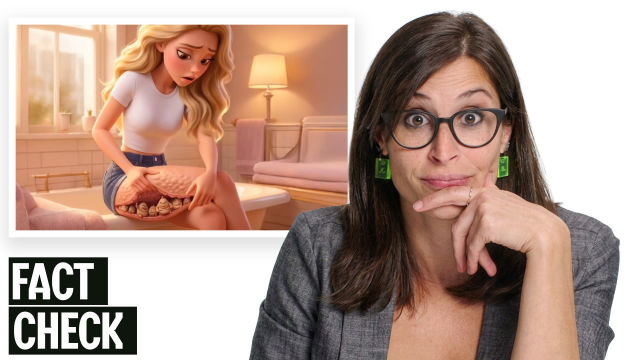
Okay, what he's eating here is all wrong.
Washington had very few teeth left.
God, there's so much wrong with this video.
How do I even wanna start?
I'm Lindsay Chervinsky.
I'm the Executive Director
of the George Washington Presidential Library,
and let's roast some AI slop.
What up, America?
It's Andrew Jackson.
I founded the Democrat Party
and chose the jackass as our mascot.
So this is Andrew Jackson.
He was the first president that identified
as a Democratic Party candidate.
The label Democratic first emerged
with Democratic-Republicans, which was the party
that Thomas Jefferson created in the 1790s.
Over time, that party evolved,
and eventually Republican was dropped
and just Democratic Party emerged,
largely to support Andrew Jackson in the election of 1828.
He is widely recognized as the first president
of the Democratic Party.
Jackson started the Democrat Party to appeal
to the common man.
Democrats today sometimes give him credit for that,
but only after calling him an evil white bigot.
The Democratic Party that supported Jackson
was unique for the time in that white suffrage
had expanded during the 1820s.
Previously, only white men of property could vote.
And over the 1820s,
various states dropped that property restriction.
However, as this video notes, Andrew Jackson was a bigot.
He continued to buy and sell enslaved people
from the White House.
He oversaw the forced relocation
of Native peoples from the Southeast
to farther west into the interior,
and even by the standards of the day,
was considered to be a racist.
We were by far the pro-slavery party
all the way through the Civil War.
The Democratic Party had support
in both the North and the South prior to the Civil War,
but was largely seen as the pro-slavery party.
In fact, the Republican Party that emerged in the 1850s
was created as the anti-slavery party
and largely found its support in the North.
After the war, we cleaned up our act
and supported the North's reconstruction efforts.
Totally kidding.
We doubled down on racism and became the party of the Klan.
After the Civil War, the Democratic Party only existed
in the South and largely was responsible
for the creation of the Ku Klux Klan
to fight against Black suffrage.
The Democratic Party and the Republican Party
start to flip-flop their issues
and their voters at the turn of the 20th century.
The Republican Party started to take on the identity
as the pro-business party, and the Democratic Party
remained largely a stronghold in the South.
The Democratic Party of Franklin D. Roosevelt
did start to shift that identity.
FDR won in a landslide in 1932,
thanks largely to the Great Depression
and offering what he called
a New Deal for the American people.
People lost trust in markets,
so I wheeled in to drastically expand
communism across the country,
and Democrats been hooked ever since.
President Franklin D. Roosevelt
was intensely anti-communist.
The policies he put forward, things like Social Security,
jobs programs to try and get people back to work,
or banking regulation to ensure that people's savings
were not wiped out, are a part of our society today
and we don't consider to be communist.
He did not advocate for actual communist policies,
things like federal takeover of businesses or industry.
Up until this point, Blacks had always voted Republican,
as they were the party that freed the slaves.
But after FDR's New Deal, Blacks swung 75% Democrat.
No, some Black voters were interested
in Franklin D. Roosevelt's policies,
but they also continued to support Republicans
all the way up through President
Eisenhower's administration.
This was a complete realignment,
not because of civil rights, but because of economics.
That's wrong.
The alignment that happened with Black voters
was almost completely because of the Democratic Party's
support for civil rights
and the Republican opposition to civil rights.
At this moment in the 1960s,
you see a great realignment of voters
and you see a great realignment
of geographic support for the parties.
The South became a bastion of Republican support.
We pushed segregation throughout the South
and filibustered the 1964 Civil Rights Act for 75 days.
This scene is actually a combination
of two different historic moments.
It looks like this is referring to the enforcement
of Brown v. Board of Education in Little Rock,
when a number of students were escorted
into school through the use of military force.
And this is perhaps Governor Orval Faubus,
who was the Democratic governor of Arkansas at the time.
It also is referring to the filibuster
of the Civil Rights Act, that was Strom Thurmond.
Most of the officials that actually filibustered
the civil rights bills were not Democratic Party officials.
They were people that had lived in the South,
but they switched their party affiliation.
While Strom Thurmond was initially a Democrat,
he ultimately switched parties and became a Republican.
When the Civil Rights Acts were passed
under President Lyndon B. Johnson,
Democrats largely controlled Congress.
The most important thing to know
is that over the course of American history,
there have usually been two parties,
but those parties have evolved
and shifted from the very beginning.
They've traded positions, they've traded voters,
they've traded bases of geographic support.
Okay, next video.
Okay guys, I know it's kind of a dick move,
but we're about to sneak up on the British
the morning after Christmas.
So there's a lot that's right about this scene.
The weather would have been terrible.
There would have been ice in the water.
And in fact, Washington did decide to attack the Hessians,
which were German troops that were hired by the British
in Trenton the day after Christmas,
because he thought he would be able to catch them unawares.
There's also some stuff that's wrong.
Washington would not have been in this type of boat.
There would have been a particular type of boat
that was flat on the bottom and had high sides
so that it could carry a lot,
like horses and cannons, across the river.
They also would have been dressed much more warmly.
It was a snowstorm, and Washington would have needed a coat.
All right, that's where the perverts are
still sleeping in their tents.
The Hessians were actually stationed in Trenton.
They had taken over homes and buildings,
and they took over one of the university halls
of what would become Princeton University.
So they were not in tents.
That was the Americans.
Who's on the run now? [bleep]
In the 18th century, when troops surrendered,
they often did parade.
However, there are a couple of problems with this scene.
They definitely wouldn't have had their hands up,
they had already surrendered.
They also wouldn't have been wearing these uniforms.
The Hessians, because they were a separate type of troop,
would have had their own uniform and their own hats.
These look much more like the American uniforms
that the Continental Army would have been wearing.
We straight scraping these fools.
This is our house now.
No one has claims to these lands but us.
Seriously, I can't think of anyone else.
This is supposed to be a joke about the Native Americans,
but Washington actually saw Native nations
as other sovereign entities.
And once he became president,
he often invited representatives from Native nations
to come meet with him and conduct diplomacy.
And those treaties were actually designed
to protect Native lands from white settlers.
They didn't always work because Washington
didn't necessarily have the military power
to block white settlement, but he did think of them
as foreign nations to be treated with respect.
We just defeated the British at Yorktown,
and Cornwallis is such a [bleep],
he won't even come out to greet me.
That's actually true.
Cornwallis didn't want to surrender to Washington,
so he made his number two come out.
And in return, Washington refused to accept the surrender
and made one of his subordinates accept the flag.
We really owe you one, France.
Will you help us with our revolution now?
Absolutely not. [laughs]
That's also true.
So Washington understood that the United States
had no business getting into the war
between France and Great Britain that broke out in 1793,
and he found a way to remain neutral,
much to France's displeasure.
Well, we did it.
The people want me to be king now,
but homie don't play that.
I'll just go down as the best president you ever had.
This is a really important part of the message,
because a lot of people did want Washington
to serve for the rest of his life, and he refused to.
He thought it was really important
that the concept of peaceful transfer of power
started while he was alive.
Okay, next video.
I'm Andrew Jackson, and I'm bat[bleep] crazy.
So Andrew Jackson did kind of have this reputation
of being a little bit volatile
and really difficult to work with.
So while they wouldn't necessarily have used that language,
the essence is kind of correct.
I single-handedly won the War of 1812.
Small problem here.
The Battle of New Orleans
was a huge victory for the Americans,
but it actually occurred a couple of weeks
after the end of the War of 1812.
The Treaty of Ghent, which was signed in Ghent
between the United States and Great Britain, ended the war,
but it took a while for news of that
to actually get back to the United States.
So while it was really nice to have those bragging rights,
the battle actually didn't have any impact
on the outcome of the war.
If you said something I didn't like,
we stepped outside and had a duel.
This guy said, My wife queefed too loud in bed.
So while Andrew Jackson was known for having duels,
and he actually did have two,
this was obviously not the language
that the duel was fought over.
The first duel that he fought was over a court dispute,
and the second was over his wife.
There were rumors that they were bigamists,
that she was not actually divorced before they got married,
and Jackson was really sensitive
about any slight to her reputation.
And that duel, he actually fatally killed
the person that he was dueling against.
He also received a gunshot wound,
which went very close to his heart,
and he lived with that bullet in his chest
for the rest of his life.
So what made this remarkable is by the 19th century,
dueling was illegal in most places,
and so it was scandalous for Jackson to have participated
and actually killed people in these duels.
Most what were called affairs of honor
didn't actually end up as duels,
and people were able to find a way out
that allowed both people to have their reputations intact.
And most duels were not actually fatal,
which again is why it increased
Jackson's reputation as kind of a crazy person.
Back in my day, I made a few controversial decisions,
but hey, we've moved on, right?
Now we've got this beauty right out here on the trail.
So here, Andrew Jackson is referring to the forced removal
of Native Americans from their tribal homelands.
This is often called the Trail of Tears.
It led to the death and destruction
of many Native communities.
Needless to say, this is not something
that either Native peoples
or many Americans have moved on from.
Moving on.
[Narrator] Eisenhower was on a golf trip
in Palm Springs, California on February 20th, 1954.
After dinner that night, he reportedly made
an unscheduled trip to Edwards Air Force Base
to meet with extraterrestrial beings.
This conspiracy that President Eisenhower met with aliens
largely comes from the fact that his diary
was silent that night about what he was doing.
However, it is much more likely
that President Eisenhower took the trip
to meet with a dentist
to repair a cracked crown on one of his teeth.
He'd been having trouble with that crown
and it was reported for several days,
and there is absolutely no evidence that he met with aliens.
[Narrator] The very next morning,
he attended a church service in Los Angeles.
Could it be that what Eisenhower experienced
the night before shook him so deeply to his core
that he had to reconsider his beliefs?
No, President Eisenhower was a devout Christian
and regularly attended church whenever he was able to.
The most important thing to know about alien conspiracies
is that the government is actually really bad
at keeping secrets.
The number of people that would have been involved
in this treaty, that would have been involved in this trip,
the pilots of the plane, it is very hard
for that many people to actually keep a secret.
Just keep in mind how many people
would have had to stay quiet.
Next.
I am Henry Kissinger, born in 1923 in Germany.
My Jewish family fled the Nazis in 1938 to the USA.
Henry Kissinger was born in Germany,
and throughout the course of his entire life,
he retained a German-Austrian accent.
This accent sounds pretty British to me.
In 1969, President Nixon appointed me
National Security Advisor, and in 1973,
I became Secretary of State.
My diplomatic efforts contributed to ending the Vietnam War.
Henry Kissinger was the architect
of the secret expansion of the Vietnam War
into Laos and Cambodia.
He authorized, along with President Nixon,
the bombing of supply lines
that were supplying the Vietnamese during the war.
Many critics were concerned that this was unconstitutional
because Congress had not in any way authorized
the expansion of violence into two nations
that the United States had never declared war against.
He remained a highly controversial figure
because he was often an advocate
for increasing military force and using that force
somewhat indiscriminately around the globe.
Next.
Hi, I'm Sophia.
I'm from the future.
[Thomas] I am busy.
You're writing the most important document
in American history.
I am aware.
We're seeing Thomas Jefferson here
writing the Declaration of Independence.
The only problem is that when Thomas Jefferson wrote
the Declaration of Independence, he was only 33 years old,
which is both a little bit terrifying
and also very different than the old man pictured here.
You brought mac and cheese and french fries to America.
I brought the recipes.
James Hemings cooked them.
That's actually true.
James Hemings was a French-trained chef
and was responsible for bringing
a bunch of recipes to the United States,
including mac and cheese.
Most people give you the credit.
Most people are wrong.
He was the talent. He was enslaved.
Jefferson looks shocked here
that James Hemings was enslaved,
but that shouldn't have been a surprise at all.
Thomas Jefferson owned and enslaved
hundreds of people over the course of his life,
including many members of the Hemings family.
Sally Hemings was James Hemings' sister,
and both Sally and James were with Jefferson in France,
where James would have received his training as a cook.
Sally Hemings, while she was in France,
became Thomas Jefferson's enslaved mistress,
and ultimately went back with him to the United States
and bore him several children.
Okay, let me move on.
The Statue of Liberty was a gift from France,
and it would have been wrapped in a large tricolor flag.
There would have also been enormous celebrations
and a naval parade in New York Harbor.
However, the main thing to know
is that when the Statue of Liberty was created,
it was made of copper.
So it ultimately became green over time,
but when it was first unveiled,
it would have been like a shiny copper penny.
The guy in the video down on the left
is dressed with a traditional French military hat,
which would have been fairly similar
to what French generals would have worn at the time.
A lot of the elements of this celebration
were a callback to the alliance
between the French and Americans during the Revolution,
and that was really what the gift was all about.
Next.
I just became president and I'm low-key cooked,
and I don't even know what I'm supposed to do
or what I'm supposed to say.
Didn't think I'd make it this far.
I just applied as a joke.
This is a major inaccuracy,
because George Washington was the only person
that could become the first president, and everyone knew it.
In fact, at the Constitutional Convention,
when the delegates were discussing the presidency,
they had trouble getting into the details
'cause it was awkward to have those conversations
in front of George Washington.
Once it became clear that there was gonna be a constitution
and there was gonna be a presidency,
he knew how the election was going to go,
and he was the only president that was elected unanimously.
Hey, chat, we got some W-Eats here:
ribeye and mashed potatoes.
Okay, what he's eating here is all wrong.
When Washington became president,
he had very few teeth left.
There wasn't modern dentistry,
and he didn't have very good dental genes to begin with.
So he mostly would have worn dentures
when he was out in public,
and they were incredibly uncomfortable
and nearly impossible to eat with.
So he typically preferred soft foods.
So in this case, the mashed potatoes
wouldn't be wrong necessarily,
but the ribeye would have been impossible for him to chew.
So I've been stuck inside signing papers for hours.
Had to get some fresh air.
This is supposed to be the President's House
in Philadelphia, where Washington spent
most of his presidency.
But Philadelphia at the time
was incredibly dense in its population.
In fact, Philadelphia during Washington's presidency
was just as dense as New York City just before the pandemic.
So there were no big gardens behind the President's House,
there were no beautiful flowers.
It was a really tightly compact urban space.
Let's see the next one.
Boy, George Washington here,
back at it with another day in the life vlog.
Today's rations are bussin,'
just some locally sourced organic berries
foraged from the woods.
3 out of 10, pretty mid.
This is a great depiction of the war,
because the rations at times were quite limited,
especially during the winter months.
And in fact, Washington regularly
had to send troops out to forage from the local forest
or communities to try and find sustenance.
Just finished filming an unboxing video
with this new 6-pounder from France.
They sent it for free.
Something about a sponsorship.
This is great, because France did actually send
a bunch of munitions to the United States
before they were official allies,
and often didn't charge for those arms
because they had been longtime foes of the British
and were very happy to see the British brought down a notch.
A couple of other things about this scene
that's really interesting: next to the cannon is Henry Knox,
who was the Major General of artillery
under the Continental Army,
and he was known for being particularly rotund,
so that's a pretty good detail.
However, you can see the way
they have the cannonballs lined up, that's wildly dangerous,
and they would have never stored ammunition in that way.
Get ready with me to catch this dub.
No cap, a well-tied sash is the key to battlefield rizz.
This is a really funny bit of history,
because George Washington actually received
the General Braddock's sash during the Seven Years' War
after Braddock was killed in battle.
As he was dying, Braddock gave Washington his sash
as an indication that he was now in charge.
And while he was in charge,
Washington organized a really important retreat,
which saved a great deal of the soldiers
under the British forces.
However, by the time the Revolution came around,
Washington felt that sashes were too aristocratic,
and so he actually had them done away with
among the American Officer Corps.
Well, that is all for today.
Thanks for coming along with me.
Remember to like and follow for more 1776 content.
See ya.
This is probably a pretty good depiction
of how Washington would have looked at the end of the war.
Most people think of him as having gray hair
and sort of being an old man,
but when Washington took command
of the Continental Army in 1775, he was only 43 years old,
and he actually had reddish-brown hair.
And that's really important,
because how do we think about a military hero?
How do we think about someone leading an army?
Having that sort of young, vigorous image
makes a big difference.
Okay, that's all the AI slop for today.
[light music]
Starring: Lindsay Chervinsky

Egyptologist Fact Checks Egyptian History Slop

Anthropologist Fact Checks Stone Age Slop

Psychiatrist Fact Checks AI Slop

Biomedical Scientist Fact Checks Pseudoscience Slop

Presidential Historian Fact Checks US History Slop

President Donald Trump Smiles As Madison Square Garden Crowd Boos Him At NBA Finals Game

Siri Is Finally Ready To Get Personal

Great White Shark Filmed By Diver In Mediterranean Sea

The Rivian R2 Is A Make-Or-Break Car For Rivian

Weezer Answer The Web's Most Searched Questions