MS NOW President Talks Beating Fox Using The Influencer Playbook
Released on 09/10/2026
The thing about television
and why I've wanted to build my career there
and loved it so much is it is literally
the definition of a team sport.
There is no thing that you can do in TV on your own.
I don't care how brilliant or great you are,
if you don't have your 20 to 30 to 40
closest friends helping you,
it's not gonna make it on TV.
And when did you join MSNBC?
Give me the timeline.
Yeah, let me remember the timeline.
I think it was around,
it was right before the midterms in 2022.
So I had grown up at CNN.
I spent more than 20 years there.
I left earlier in 2022.
And some folks that I knew and really respected
reached out from then MSNBC.
And they talked about one of those jobs
that kinda has a lotta running room
and it's kinda like a little ambiguous,
but in the best way.
And I thought, Yeah, let's check it out.
I started at MS, then NBC,
running their digital businesses,
basically all their nonlinear businesses.
And it gave me a real opportunity
to learn the building and learn the place,
but also think about what are the missed opportunities
that we could take advantage of in the next few years.
And at some point in your tenure,
you took on the whole thing.
Yes.
And what did you feel like,
because this is driving towards this subscription offering
that you're launching,
what were those big opportunities,
those big challenges that you identified
when you looked at the whole portfolio
and thought to yourself like,
Ugh, what are we gonna do here?
What were you trying to solve for?
So one of the things that immediately struck me
when I came over was the fandom.
So I had worked in other newsrooms.
I have friends who work in other newsrooms.
I love the news and love what we do,
but I had never worked at a place
where the audience really sees themselves as fans,
and fans of a deep, deep connection to talent.
So it's the kinda thing,
it was immediately clear to me when I joined MS,
it was also at the same time Jen Psaki joined,
and we had known each other a little from a previous life.
So, we went out into the field together
and just did a few kinda pretty straightforward
kinda field reporting pieces.
And I've walked through the airports over my career
with a lotta different anchors and news types of people.
I've never had the experience
of walking through with Jen.
And that's why she was a great fit for MS.
She was someone that you could see people were behind
and were rooting for and had a deeper connection with.
And I think when you think about Rachel Maddow
and how she lands and how when a book...
I mean, you're very close to this industry.
If you talk to anyone in publishing
and ask them where they would ideally
like to debut their book,
I think most of them would say the Rachel Maddow Show.
And there's a reason for that.
The audience loyalty and engagement
with Rachel has been proven over decades.
It's funny, when she shares a WIRED story
on social media,
the traffic to that story and the engagement
on her social around WIRED is crazy.
I can tell you firsthand looking at the analytics,
like, you can feel it, you can see it.
It's remarkable.
And I want to ask you more about talent in a minute,
but that brings me to a great place to mention
this membership program that you're launching.
So I'm gonna read from the press release,
which I very rarely do,
but you will offer, quote,
New opportunities for members to interact directly
with the brand's trusted journalists,
exclusive community features to engage with each other,
a new roster of contributors and experts,
original creator content,
new verticals that explore how news
and politics impacts everyday life,
and 24/7 access to live streams and linear programming.
So you guys have been busy.
But in layman's terms,
if someone's listening to this or watching this
and they're an MS NOW viewer,
they watch it on TV sometimes,
they see it on social,
what should they expect from this?
What are they getting that they're not already getting
by, you know, having cable TV?
I wanna answer your question directly,
but I just don't wanna assume your audience
is the MS NOW audience.
So if you'll allow me 30 seconds-
Fair. Give us your best pitch.
I wanna just step back and reintroduce MS NOW.
We launched as a brand,
a new brand, around 18 months ago,
and people traditionally see us as this cable channel.
And that's great.
We have a huge cable audience.
We're actually right now the number two most watched channel
in all of cable,
not all of cable news,
all of cable.
So that's ahead of ESPN, HGTV, TBS, TNT.
Who's number one?
Fox. I see. Okay.
We might talk more about that later.
But that's just one piece of our business.
We have right now a digital business
before we even launch what we're launching this week
that has more uniques than places like Axios
and Politico, the Atlantic.
People spend more time with us digitally
than places like the Washington Post and NPR.
And then, on YouTube,
we have been quite efficient at building out our presence
in that space.
So, we have more clicks on YouTube than ABC News,
NBC News, and CBS News combined.
So I say all of that to say we are starting
from a position of strength,
and then I'll come back to answer your question.
What we are excited about
and why we're launching this product
is all those digital things I just mentioned.
We don't have a way to catch all those people
if they're not gonna be watching cable.
So the purpose of this membership is twofold.
It's one, taking our current super fans
that watch us on linear and giving them more.
So what are they gonna get?
They're gonna get direct access to our talent.
Seven days a week, at noon,
and at 6:00 PM,
if you are a member of the MS NOW community,
you can hop on and directly interact
with one of our anchors or one of our reporters.
On Monday, it's gonna be Rachel Maddow.
And then you go through the week,
you're gonna hear from Michael Steele,
you're gonna hear from Jen Psaki,
you're gonna hear from Rev, Reverend Al Sharpton.
You're gonna hear from the people
that you know and love from watching them on MS NOW
and have the opportunity to ask them your question directly,
and not just interact with our talent,
but also interact with each other.
So when we started this process
around a year and a half ago,
we didn't just kinda sit in a conference room and think,
Hmm, let's make like another commodity news app.
Because let's be honest,
a lot of that already exists.
What we did was actually start from a place
of product research.
So we went out to 18,000 people.
We did surveys,
we did in-person interviews,
and we have spent the last year and a half
taking that research and getting to where we are this week.
And where we are this week is just the beginning.
What I most want people to know
is what you see this week
will look vastly different six months from now
and a year from now,
if we're doing our jobs right.
What we need to do is build and learn
and test and add investment and expand where we need to,
but not really think that we're gonna get it all right
on day one, but give ourselves that latitude.
I'm curious about the imperative here,
maybe, if that's the right word.
Is the goal to pull linear viewers onto digital,
or is it to better engage the digital audience, or both?
It's both.
So, all those people consuming us on YouTube,
on digital, on social, in audio,
we have done some research.
90% of those people do not regularly consume us
on linear television.
So a big function of this product is to say,
Hey, you're watching YouTube videos all the time
of Lawrence O'Donnell.
Maybe you're not someone who's gonna be a cable subscriber.
Okay.
But can you come join our community in another capacity?
Can we create a product that entices you
to be part of an MS NOW community,
even if you're someone who's reluctant
to become a cable customer?
So we're trying to do both and,
and create two slightly different use cases.
Your audience and your intended audience.
I was wondering,
I would say that for the average person,
if you ask them like Fox News, MS NOW,
who do those networks reach?
Who do those brands reach?
I would say Fox News reaches Republicans,
and that's who has it on TV,
that's who's going to that website.
I would say MS NOW reaches progressives,
Democrats, left leaning people.
Is that a stated goal for you
or do you want that tent to be bigger?
It sounds like you want to welcome people
from all political affiliations,
but I wanna hear that from you.
I'm curious.
Yeah, is the audience for MS NOW different
than the audience for Fox?
Of course it is.
There's probably like a small amount of overlap,
but not a lot, and that's okay.
But we wanna be a place.
I'll just give you an example.
When I think forward to election night,
I gotta say, I think there's nowhere I'd rather hang out
on election night than at our table
with Rachel, and Nicole, and Lawrence,
and Chris, and Michael, and everyone.
Like, we try to do is be smart,
respect our audience, and be a fun place.
And a place where, again,
Michael Steele is a big part of our election night.
He was chairman of the Republican National Committee.
So, we have a broad range of views,
but I think they all fall under that pro-democracy banner.
Are you competitive?
Do you wanna beat Fox?
Do you wanna see that number one?
Do you think about that?
Look, I am a pretty competitive person.
I think I just see who our competition is
as wider than kinda like that typical cable landscape.
I wanna build a great product right now
and have a large membership community,
and I wanna make sure that we are competing
on every battleground.
And that is, yes, absolutely on cable,
yes on digital, yes on YouTube, yes in audio.
I think that because of the life that this brand's lived
under previous ownership pre-spin,
there were times when our wings were clipped a little
from a business perspective.
If I was sitting in the seats of the leadership team at NBC,
I might have made the same decisions.
That model, when you're working for a very large,
very successful company that NBCUniversal and Comcast are,
they need to look at the whole company
and figure out where best to invest their dollars.
So what they did makes sense for them.
But now we're lucky to be a part of Versant,
where MS NOW is a very successful part of Versant,
and Versant has several pieces of their portfolio
that we are lucky enough that generate a lot of cash.
What is Versant?
For someone who might not know what Versant is,
what is Versant?
Yeah, Versant is the spinoff,
so a spinout, of NBCUniversal.
So, for folks that weren't following along day by day,
around 18 months ago,
NBCUniversal spun out a series of businesses.
Those include what is now MS NOW,
CNBC, brands like E!,
you know, Live from the Red Carpet, all of that,
and then Golf.
So it's a variety of businesses across media.
We are now part of a company that is incentivized
to invest the money that we earn as MS NOW back into MS NOW.
We're just no longer part of a company
that has to invest in theme parks
and other things that for that company
that made a lotta sense.
But for Versant,
it makes more sense to allow MS NOW to invest in ourselves.
You've mentioned a few times
that you are a real behemoth on cable television.
I mean, number two to Fox, et cetera.
I don't think it's a secret
that cable news audiences are declining.
And I'm gonna ask this in the bluntest possible way.
You know, that's an older audience,
significantly older than a digital one.
What do you do when they die?
How are you thinking about that?
So I think I am not blind to the long term challenges.
That's why we are investing in digital and building quickly.
But do I think the cable business right now
for MS NOW is quite healthy?
I do.
And do I have a lot of respect for our audience
who comes and joins us every morning,
noon, and night?
And we have one of the highest loyalty engagement numbers
in all of television.
Our average viewer, average,
watches nine hours a week.
That is a lot of MS NOW on TV.
[chuckles] That's a lot of- [chuckles]
That's a lot.
So do I, like, wake up in a panic
in the middle of the night?
No.
Do I know there are long-term challenges?
Yes.
That's why we're launching a DTC product.
What do you wake up at night worrying about?
I mean, I think for anyone listening,
just if you're not aware,
working in media and journalism is hard,
it's a hard business,
and these are really difficult transformations
to try to undertake and to undertake successfully.
What's the hardest part of this for you right now?
What I wake up with angsty about sometimes is,
you know, I know we have this guest or that guest coming up,
but I grew up in this school of TV of the upgrade.
Like, how can we upgrade?
How can we make it better?
What is the better question?
What is the better way in?
I might be old school when I say this,
but I think content wins always every single race.
And if you have the thing,
it's gonna do you far more than all sorts
of other marketing dollars and product,
and all those things are incredibly important to get right.
But at the end of the day,
if your content isn't excellent.
Yeah, you're in trouble.
I wanna ask more about talent.
We talked about it a bit at the top.
You do have some real sort of fandom magnets.
I think one of the biggest challenges in publishing today,
especially on digital, is that it is so noisy.
There is so much competition.
It's not just news,
but it's everything on someone's Instagram feed.
It's everything on their TikTok.
It's, you know, recipe videos
and random influencers and so on and so forth.
How do you encourage your journalists,
your talent, to break through that in a digital context?
You know, when I think about...
I'll just pick on Chris Hayes for a minute here,
because there's almost no time that I talk to Chris Hayes,
that I don't then hang up the phone
or walk out of his office and think to myself like,
That guy's brain is huge.
Like I just learned 17 things
that I didn't even think of something there.
And I think that's the answer to your question
of how do you break through?
Every brand and every place in media
has to figure out what their breakthrough is.
Look, there's people who want to break through
by showing cat videos all day.
There's people who wanna break through
by writing outrageous headlines
that aren't really based in facts.
Where I want MS NOW to break through is being brainiacs,
is coming to the table with something
that is intellectually interesting,
that is showing me something or teaching me something
or adding value to a news story
in a way I hadn't thought about it before,
of drawing on their experience,
decades of experience working in the room,
you know, being in the room where it happened.
So what I ask each of our hosts to do is think,
where can you add value?
And then, how can you make sure,
and this is on all of us,
how are we showing up with the audience
in a way that they can see the value,
in a way that they understand
that what you're bringing to the table
is different than some random person
with, you know, 1% of the experience
or thought that you spent your day.
I mean, again, just going back to Chris,
you know, Ari, the same way,
like, these guys write their shows.
They're not just the talking head
who's showing up and grabbing a script.
If You call one of them a couple hours before their show,
they are sitting there tapping it out,
framing it out, and I think it shows.
I think when you watch what they have to say,
it is differentiated because they rolled up their sleeves
and gave of themselves to the audience.
What has the experience been like of transitioning
some of the maybe more TV comfortable talent
that you have who are accustomed to doing a cable news show,
and saying to them,
Now you do these interactive sessions with our audience,
or you're going to.
Now you do TikTok.
Now you participate in these other parts of the ecosystem.
What has that been like for you as the boss,
and maybe not to speak for them,
and I realize I'm asking you to talk about your employees
on the show, but for them as talent
and as figureheads for this brand?
Yeah, one of my rules is don't do anything
that feels weird for you.
And what I mean by that is
if you in your own life don't use TikTok,
I don't recommend trying to become a TikToker.
Like, it's gonna land weird.
You know, like, we've seen it.
So what I have encouraged our shows,
our hosts, everyone in the MS NOW family
is don't try to be everywhere.
Don't try to be everything.
Try to do where it feels organic
and native to you and your talents
and your audience and where you actually spend time,
because I think that's where you find success.
I mean, a great example,
Simone Sanders is fantastic at TikTok and Instagram,
because she grew up in those spaces
and knows those audiences.
That might not be the same for Lawrence O'Donnell.
Lawrence O'Donnell is a huge hit on YouTube.
So we don't need to make everyone famous on every platform.
We need to be smart and thoughtful
and intentional about where people can succeed.
What has Trump 2.0 been like for you guys over there?
I mean, have you seen an audience bump?
Have you seen fatigue?
And how are you thinking about breaking through
on that story?
I mean, the challenge with the story of Trump 2.0
is that there are a thousand stories a day.
How are you thinking about reaching your audience
in a way that can grab them and hold them on that?
Yeah, what I want our audience to know
is that we are who we are and we're proud of who we are,
and you can come to us on any platform at any time
and trust that you are getting our best reporting
and our best analysis without fear.
And we haven't talked about it yet,
but as part of the spin,
we also had to build our entire own newsroom.
What we tried to do is build our newsroom knowing
the moment and not trying to,
again, we're not trying to be commodity news.
We're trying to build an absolutely kick-ass DC newsroom,
and I think we've done that.
We started to break a lot of news in DC.
Sudeep Reddy, who is our DC bureau chief there,
came from Politico and The Wall Street Journal
and has just assembled a really, really strong team.
So what we're trying to do is win
where our audience wants more.
And those, the basic pillars of that
are White House, Congress, justice, courts,
all of that is one bucket, national security.
And then, we hired Shauna Thomas,
who is just like- She's great.
big, big, big brain,
and came from CBS,
and before that NBC,
and just like one of the smartest people
that understands how politics and media
kinda work together.
She's our political director,
and she is building a team of killers to cover,
we're already covering 2026,
but really 2028.
You guys, I mean, one of the very few media brands
in growth mode right now.
It's impressive.
Speaking of, I'm curious about the Ellison,
Warner Brothers, Discovery merger,
combine CNN and CBS under one owner, of course,
you know, CBS at the very least under
the leadership of Barry Weiss.
I wanna know sort of big picture your concerns
about that possibility in particular.
I'm also curious about what it means for MS NOW
when you sort of look at that possibility.
Is that potentially...
Is this consolidation maybe good for you?
Like, does this help you even if the broader implications
of it are in some ways troubling?
Like, walk me through your calculus on that.
Yeah, so in a functioning healthy democracy,
you need a very healthy free and fair press.
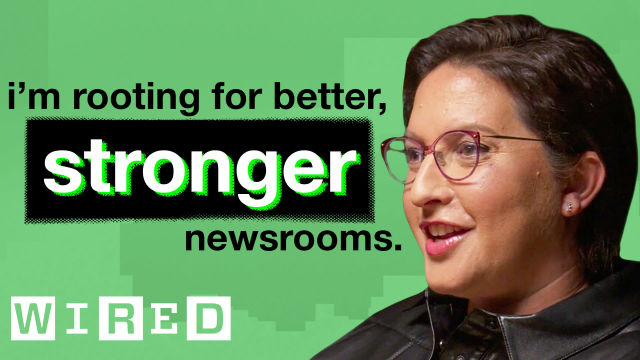
So I am only and always rooting
for better, stronger newsrooms.
I worked most of my career at CNN,
and while they might be technically
a competitor arrival now,
the world is a better place with a stronger CNN.
I would agree.
Rebecca, thank you so much for being here.
This was great.
Thank you for the opportunity.
[light music]
Starring: Rebecca Kutler

Bobbi Althoff's Success Is No Accident

Josh Johnson on Comedy and Mental Health in the Age of Social Media

Antony Blinken on National Cybersecurity and an Evolving State Department

Alfonso Cuarón Examines The Language of Cinema & Television

Tim Cook Discusses The Past, Present, and Future of Apple

When Tech and Entertainment Collide: A Conversation with Zack Snyder

New Beginnings: A Conversation with Mira Murati

NVIDIA’s Global Takeover: A Conversation with Jensen Huang

Carrying the Torch: A Conversation with Phil Wizard

Jen Easterly On The Future of Cybersecurity and Her Agency's Survival

Bill Gates on His Early Years & The Inspiration Behind 'Source Code: My Beginnings'

Yuval Noah Harari Sees the Future of Humanity, AI, and Information

Bluesky CEO Jay Graber On Building A Better Social Ecosystem

Demis Hassabis On The Future of Work in the Age of AI

Bryan Johnson Wants To Live Forever

EJAE on KPop Demon Hunters and Her Journey to Success

Palantir CEO Alex Karp On Government Contracts, Immigration, and the Future of Work

The Big Interview: ‘LegalEagle’ On The Best And Worst Cinematic Legal Representations

The Big Interview: Silicon Valley Is Spending Millions to Stop One of Its Own

Chris Hayes on How Your Attention Gets Monetized

MS NOW President Talks Beating Fox Using The Influencer Playbook