Gallery: WIRED Space Photo of the Day 2013
Photos by NASA/JPL-Caltech/UCLA01trifidneb
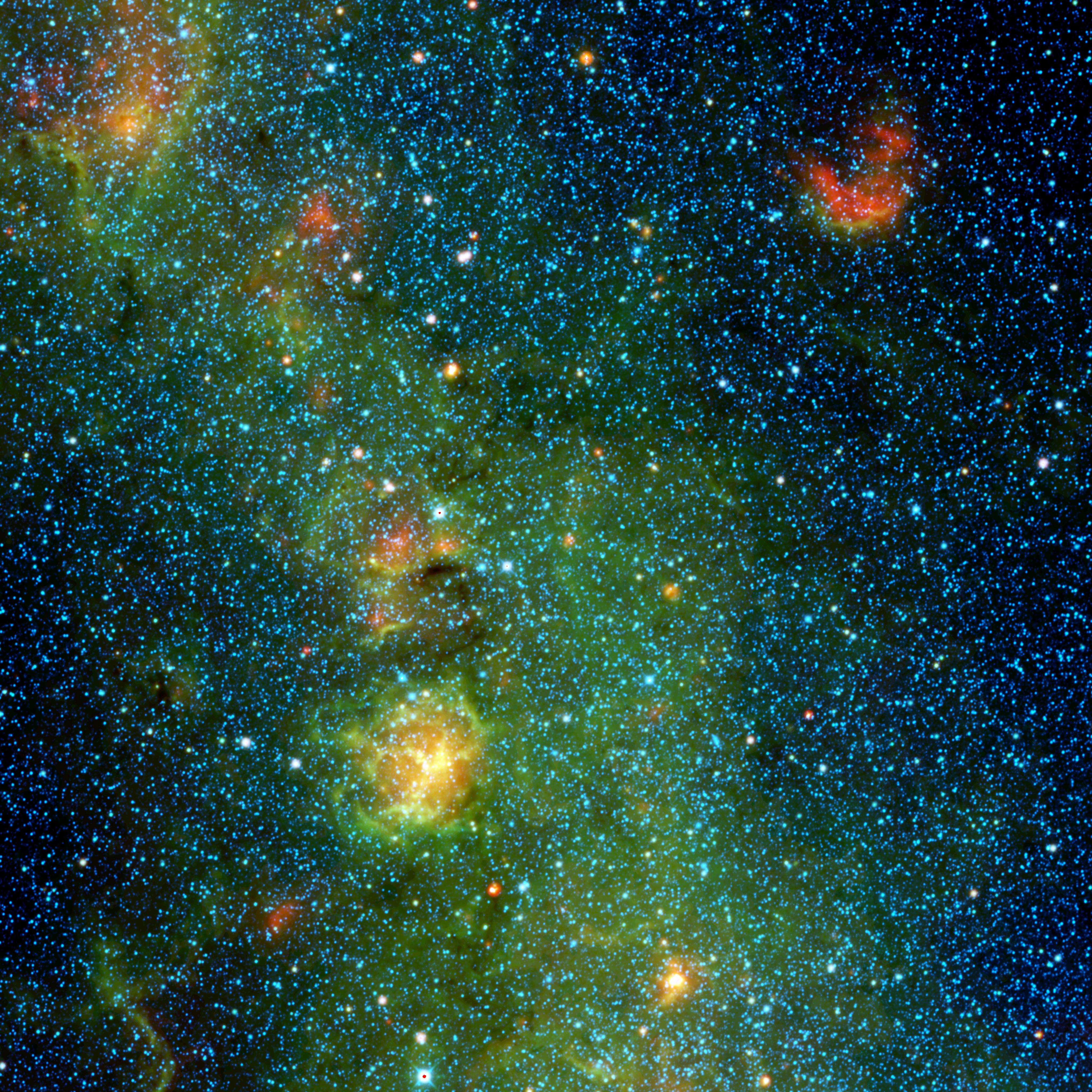
A storm of stars is brewing in the Trifid nebula, as seen in this view from NASA's Wide-field Infrared Survey Explorer, or WISE. The stellar nursery, where baby stars are bursting into being, is the yellow-and-orange object dominating the picture. Yellow bars in the nebula appear to cut a cavity into three sections, hence the name Trifid nebula. Colors in this image represent different wavelengths of infrared light detected by WISE. The main green cloud is made up of hydrogen gas. Within this cloud is the Trifid nebula, where radiation and winds from massive stars have blown a cavity into the surrounding dust and gas, and presumably triggered the birth of new generations of stars. Dust glows in infrared light, so the three lines that make up the Trifid, while appearing dark in visible-light views, are bright when seen by WISE. The blue stars scattered around the picture are older, and they lie between Earth and the Trifid nebula. The baby stars in the Trifid will eventually look similar to those foreground stars. The red cloud at upper right is gas heated by a group of very young stars. The Trifid nebula is located 5,400 light-years away in the constellation Sagittarius. Blue represents light emitted at 3.4-micron wavelengths, and cyan (blue-green) represents 4.6 microns, both of which come mainly from hot stars. Relatively cooler objects, such as the dust of the nebula, appear green and red. Green represents 12-micron light and red, 22-micron light. Caption: [NASA](http://www.jpl.nasa.gov/spaceimages/details.php?id=PIA17834)
Photos by NASA/JPL-Caltech02curiosityanseladams
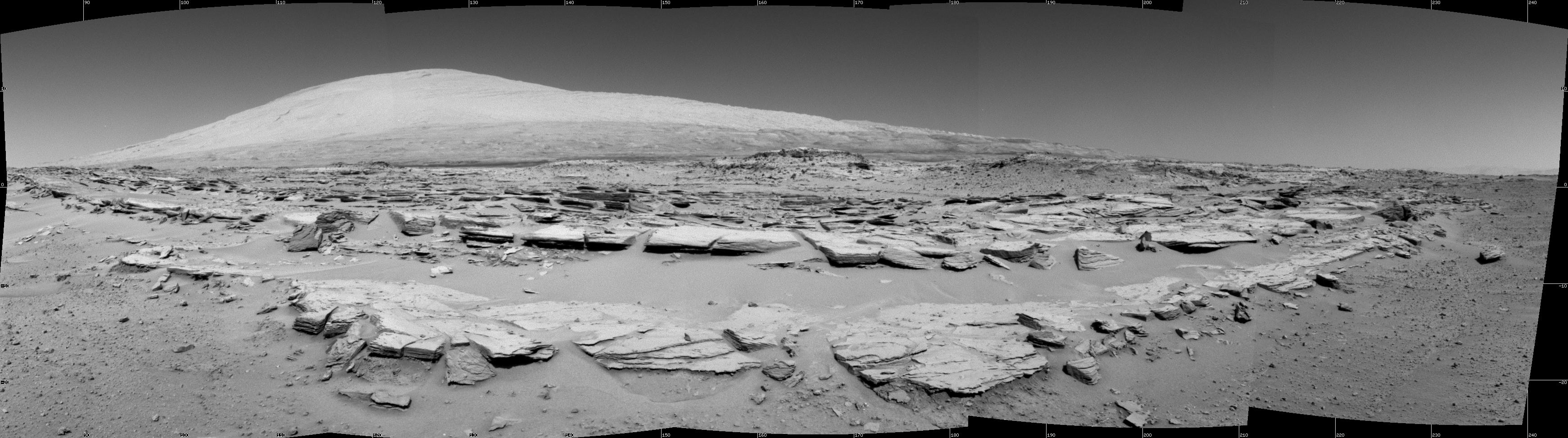
This landscape scene photographed by NASA's Curiosity Mars rover shows rows of rocks in the foreground and Mount Sharp on the horizon. Curiosity's Navigation Camera (Navcam) took the component images for this mosaic during a pause in driving on the 548th Martian day, or sol, of the rover's work on Mars (Feb. 19, 2014). The Sol 548 drive covered 328 feet (100 meters). Images taken from orbit and used in planning the rover's route toward lower slopes of Mount Sharp had piqued researchers interest in the striations on the ground that are formed by these rows of rocks. This particular outcrop is called "Junda." Similar striations are apparent on other patches of ground along the planned route. The view is centered toward south-southeast and spans about 160 degrees. It is presented as a cylindrical projection. Caption: [NASA/JPL](http://www.jpl.nasa.gov/spaceimages/details.php?id=PIA17947)
03366633main-stephq-1920-full
Stephan's Quintet, a compact group of galaxies discovered about 130 years ago and located about 280 million light years from Earth, provides a rare opportunity to observe a galaxy group in the process of evolving from an X-ray faint system dominated by spiral galaxies to a more developed system dominated by elliptical galaxies and bright X-ray emission. Being able to witness the dramatic effect of collisions in causing this evolution is important for increasing our understanding of the origins of the hot, X-ray bright halos of gas in groups of galaxies. Caption: [NASA](http://www.nasa.gov/multimedia/imagegallery/image_feature_1408.html)
04This galaxy contains a gargantuan jet blasting away from a central supermassive black hole.
Just weeks after NASA's Chandra X-ray Observatory began operations in 1999, the telescope pointed at Centaurus A (Cen A, for short). This galaxy, at a distance of about 12 million light years from Earth, contains a gargantuan jet blasting away from a central supermassive black hole. Since then, Chandra has returned its attention to this galaxy, each time gathering more data. And, like an old family photo that has been digitally restored, new processing techniques are providing astronomers with a new look at this old galactic friend. This new image of Cen A contains data from observations, equivalent to over nine and a half days worth of time, taken between 1999 and 2012. In this image, the lowest-energy X-rays Chandra detects are in red, while the medium-energy X-rays are green, and the highest-energy ones are blue. As in all of Chandra's images of Cen A, this one shows the spectacular jet of outflowing material - seen pointing from the middle to the upper left - that is generated by the giant black hole at the galaxy's center. This new high-energy snapshot of Cen A also highlights a dust lane that wraps around the waist of the galaxy. Astronomers think this feature is a remnant of a collision that Cen A experienced with a smaller galaxy millions of years ago. The data housed in Chandra's extensive archive on Cen A provide a rich resource for a wide range of scientific investigations. For example, researchers published findings in 2013 on the point-like X-ray sources in Cen A. Most of these sources are systems where a compact object - either a black hole or a neutron star - is pulling gas from an orbiting companion star. These compact objects form by the collapse of massive stars, with black holes resulting from heavier stars than neutron stars. The results suggested that nearly all of the compact objects had masses that fell into two categories: either less than twice that of the Sun, or more than five times as massive as the Sun. These two groups correspond to neutron stars and black holes. This mass gap may tell us about the way massive stars explode. Scientists expect an upper limit on the most massive neutron stars, up to twice the mass of the Sun. What is puzzling is that the smallest black holes appear to weigh in at about five times the mass of the Sun. Stars are observed to have a continual range of masses, and so in terms of their progeny's weight we would expect black holes to carry on where neutron stars left off. Although this mass gap between neutron stars and black holes has been seen in our galaxy, the Milky Way, this new Cen A result provides the first hints that the gap occurs in more distant galaxies. If it turns out to be ubiquitous, it may mean that a special, rapid type of stellar collapse is required in some supernova explosions. Caption: [Chandra Telescope Team](http://chandra.si.edu/photo/2014/cena/)
Photos by NASA/JPL/University of Arizona05hirisedunes
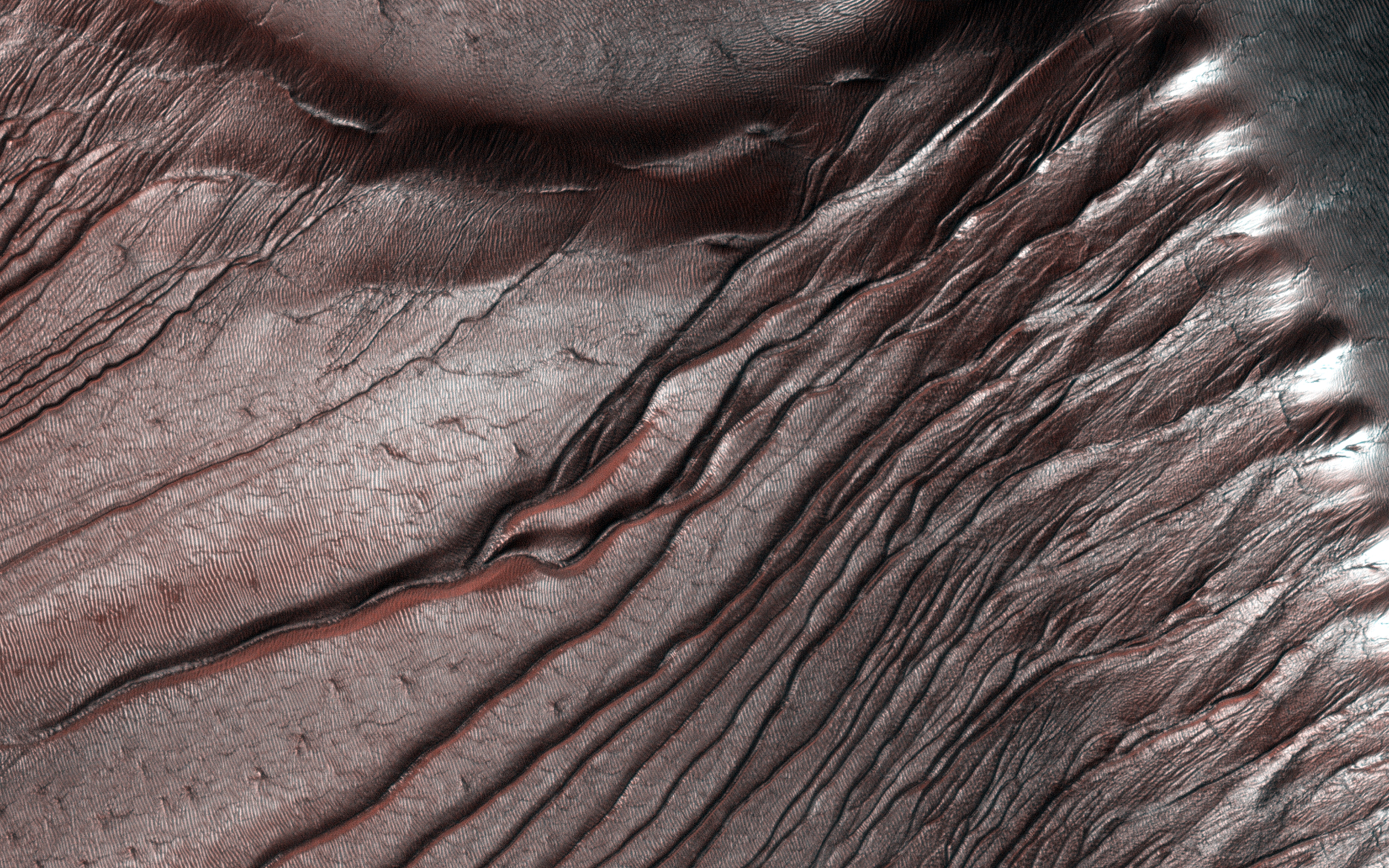
Russell Crater dunes are a favorite target for HiRISE images not only because of their incredible beauty, but for how we can measure the accumulation of frost year after year in the fall, and its disappearance in the spring. The frost is, of course, carbon dioxide ice that often sublimates (going directly from a solid to a gas) during the Martian spring. HiRISE takes images of the same areas on Mars in order to study seasonal changes like this. In an area like Russell Crater--a very ancient impact crater about 140 kilometers in diameter--we can follow changes in the terrain by comparing images taken at different times. This helps give us a better understanding of active processes on the Red Planet. Caption: [HirRISE Science Team](http://hirise.lpl.arizona.edu/ESP_034234_1255)
Photos by NASA/JPL-Caltech/MSSS06dingogap
This scene combines images taken by the left-eye camera of the Mast Camera (Mastcam) instrument on NASA's Curiosity Mars rover during the midafternoon, local Mars solar time, of the mission's 526th Martian day, or sol (Jan. 28, 2014). The sand dune in the upper center of the image spans a gap, called "Dingo Gap," between two short scarps. The dune is about 3 feet (1 meter) high. The nearer edge of it is about 115 feet (35 meters) away from the rover's position when the component images were taken, just after a Sol 526 drive of 49 feet (15 meters). The image has been white-balanced to show what the rocks would look like if they were on Earth. A version with 200-centimeter (79-inch) scale bars is available as Figure A. Caption: [NASA](http://photojournal.jpl.nasa.gov/catalog/PIA17766)
Photos by Solar Dynamics Observatory/NASA07Xflare-20140107
The largest sunspot group of the solar cycle unleashed a large (X1.2 class) flare just when it was facing right towards Earth (Jan. 7, 2014). The flare was associated with a coronal mass ejection that was heading in our direction and could generate some bright aurora here when it impacts our magnetosphere. More flares are expected from this magnetically complex region in the next week or so: stay tuned! These images were produced using a combination of two wavelengths of extreme ultraviolet light. *Caption: [NASA/SDO](http://sdo.gsfc.nasa.gov/gallery/main/item/479)*
Photos by ESA/NASA, Acknowledgement: Nick Rose08hubbleexplodestar
Floating at the center of this new Hubble image is a lidless purple eye, staring back at us through space. This ethereal object, known officially as \[SBW2007\] 1 but sometimes nicknamed SBW1, is a nebula with a giant star at its center. The star was originally twenty times more massive than our sun, and is now encased in a swirling ring of purple gas, the remains of the distant era when it cast off its outer layers via violent pulsations and winds. But the star is not just any star; scientists say that it is destined to go supernova. Twenty-six years ago, another star with striking similarities went supernova — SN 1987A. Early Hubble images of SN 1987A show eerie similarities to SBW1. Both stars had identical rings of the same size and age, which were travelling at similar speeds; both were located in similar HII regions; and they had the same brightness. In this way SBW1 is a snapshot of SN1987a's appearance before it exploded, and unsurprisingly, astronomers love studying them together. At a distance of more than 20 000 light-years it will be safe to watch when the supernova goes off. If we are very lucky it may happen in our own lifetimes. *Caption: [NASA](http://www.flickr.com/photos/gsfc/11874010546/)*
09snm82spitzer
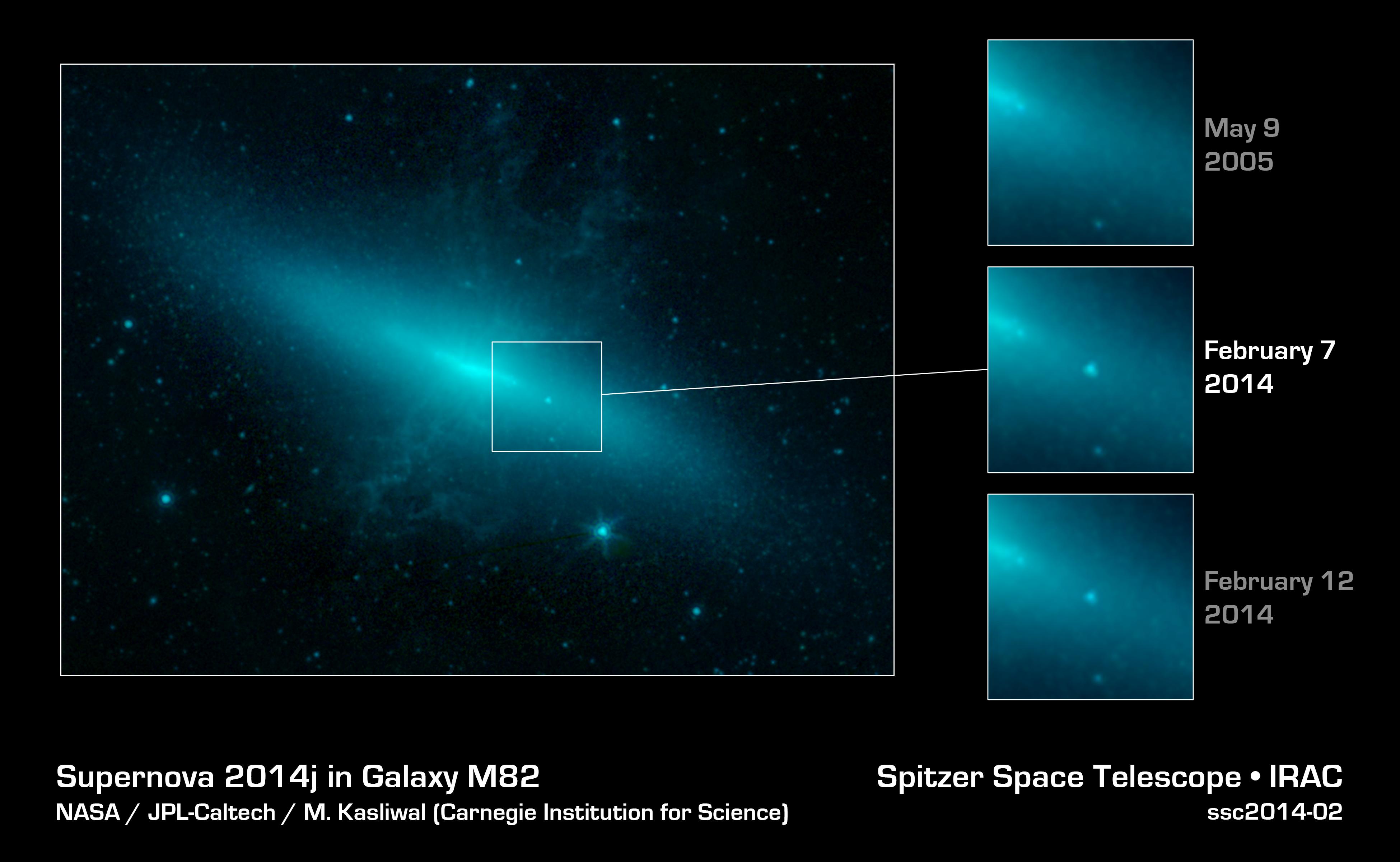
The closest supernova of its kind to be observed in the last few decades has sparked a global observing campaign involving legions of instruments on the ground and in space, including NASA's Spitzer Space Telescope. This image shows Spitzer's view of the supernova's host galaxy, M82 or the "Cigar galaxy," on three separate dates: May 9, 2005; February 7, 2014; and February 12, 2014. The observations from February 7 reveal the presence of a bright spot -- the supernova -- not present in the prior observations. By February 12, the supernova has started to dim somewhat from its peak brightness in the first week of February. The supernova, dubbed SN 2014J, was first spotted by human observers on January 21, 2014. SN 2014J is glowing very brightly in the infrared light that Spitzer sees. The telescope was able to observe the supernova before and after it reached its peak brightness. Such early observations with an infrared telescope have only been obtained for a few Type Ia supernovas in the past. Dust in the M82 galaxy partially obscures observations in optical and high-energy forms of light. The infrared light that Spitzer sees in, however, can pass through this dust, allowing astronomers to peer directly into the heart of the aftermath of the stellar explosion. Caption: [NASA](http://www.jpl.nasa.gov/spaceimages/details.php?id=PIA17847)
Photos by NASA/JPL-Caltech/MSSS10drivingonmars
This look back at a dune that NASA's Curiosity Mars rover drove across was taken by the rover's Mast Camera (Mastcam) during the 538th Martian day, or sol, of Curiosity's work on Mars (Feb. 9, 2004). The rover had driven over the dune three days earlier. For scale, the distance between the parallel wheel tracks is about 9 feet (2.7 meters). The dune is about 3 feet (1 meter) tall in the middle of its span across an opening called "Dingo Gap." This view is looking eastward. The image has been white balanced to show what the Martian surface materials would look like if under the light of Earth's sky. A version with raw color, as recorded by the camera under Martian lighting conditions, is available as Figure 1. Caption: [NASA/JPL](http://photojournal.jpl.nasa.gov/catalog/PIA17944)
11northerngalaxies
NGC 2276 and NGC 2300 are "boundary" targets in that they are the northernmost objects in the New General Catalog of space stuff. Being this close to the north celestial pole (and Polaris) makes them challenging targets for equatorial telescopes. NGC 2276 is a beautiful spiral galaxy that is punctuated by pink star forming regions. In fact it has one of the highest rates of star formation that has been measured. Its neighbor, NGC 2300, appears as a regular elliptical galaxy that shows some evidence of shells (and perhaps former structure). Together these make a wonderful contrast at the boundaries of space and time. From my southern-mid-latitude the celestial pole is a mere 32 degrees above the horizon. Which means that although this field is always available- it is never high in the sky the challenges the telescope to point at it. Finally the field also contains some of the foreground galactic cirrus (IFN) that pervade these high declinations. Perhaps you can see hints of it at the bottom left. P.S. As far as I know, my statement is correct concerning NGC 2276 being the northernmost NGC object. The more famous cluster of NGC 188 is just a bit farther south. Let me know if I am mistaken. Caption: Adam Block
Photos by NASA/JPL/Space Science Institute12flyingover
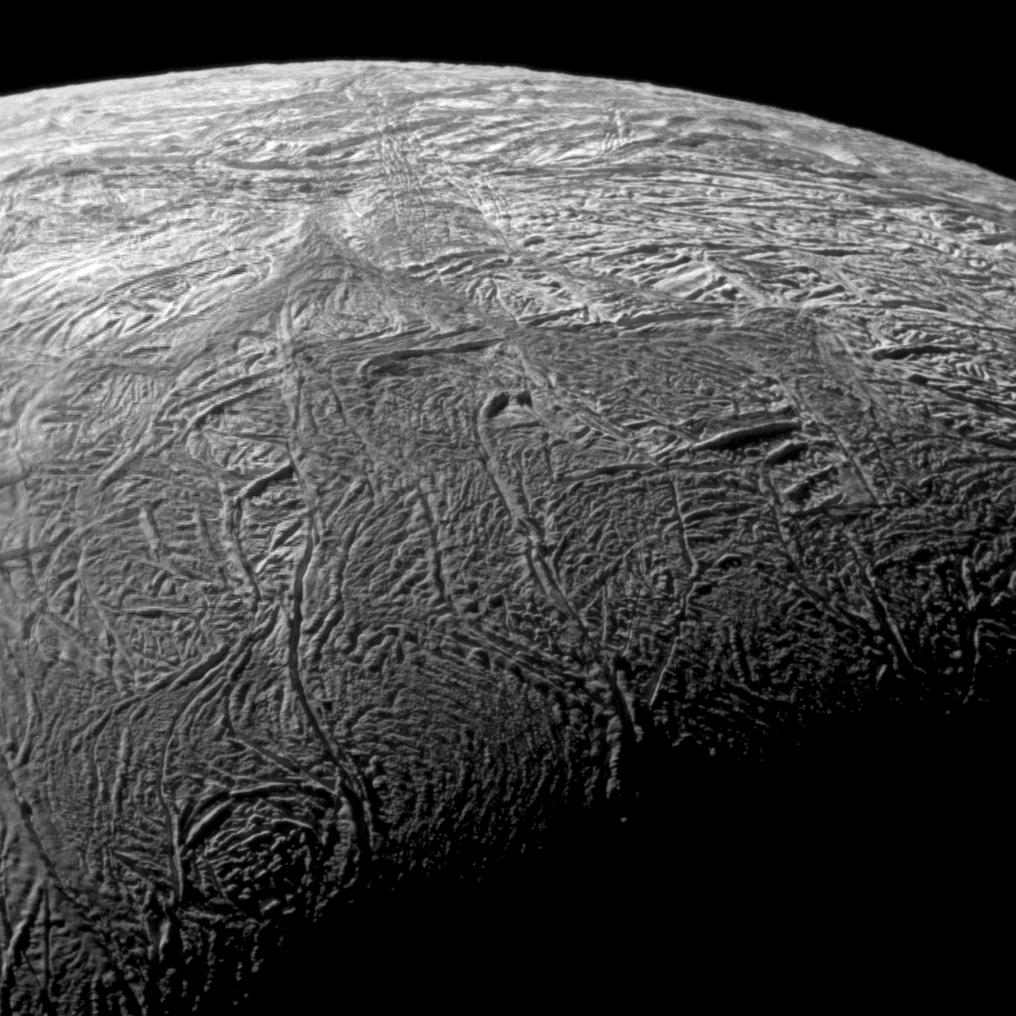
This wide-angle image shows the south polar region of Saturn's moon Enceladus and outlines the area covered by the high-resolution mosaic combining data from the imaging science subsystem and composite infrared spectrometer aboard NASA's Cassini spacecraft. The outlined area focuses on Baghdad Sulcus, a fracture in the south polar region. Cassini captured the data for this wide-angle image during the spacecraft's close flyby of the moon Nov. 21, 2009. This image and others from that flyby are among the best visible light images Cassini will capture of the region around the "tiger stripes," -- the fissures that spray icy particles, water vapor and organic compounds -- compounds, before the moon's south polar region enters winter darkness for the coming years. This wide-angle view shows not only Baghdad Sulcus, but also other nearby fractures. Lit terrain seen here is on the leading hemisphere and Saturn-facing side of Enceladus (504 kilometers, 313 miles across). The south pole lies in shadow near the bottom middle of the image. The wide-angle view was acquired at a distance of approximately 2,000 kilometers (1,200 miles) from Enceladus and at a sun-Enceladus-spacecraft, or phase, angle of 114 degrees. Scale in the wide-angle view is 116 meters (381 feet) per pixel. Caption: [Cassini Solstice Team](http://photojournal.jpl.nasa.gov/catalog/PIA11697)
Photos by NASA/JPL-Caltech/GSSR13asteroid2006DP14-full
A collage of radar images of near-Earth asteroid 2006 DP14 was generated by NASA scientists using the 230-foot (70-meter) Deep Space Network antenna at Goldstone, Calif., on the night of Feb. 11, 2014. Delay-Doppler radar imaging revealed that the asteroid is about 1,300 feet (400 meters) long, 660 feet (200 meters) wide, and shaped somewhat like a big peanut. The asteroid's period of rotation is about six hours. The asteroid is of a type known as a "contact binary" because it has two large lobes on either end that appear to be in contact. Previous radar data from Goldstone and the Arecibo Observatory in Puerto Rico has shown that at least 10 percent of near-Earth asteroids larger than about 650 feet (200 meters) have contact binary shapes like that of 2006 DP14. The data were obtained over an interval of 2.5 hours as the asteroid completed about half a revolution. The resolution is about 60 feet (19 meters) per pixel. The data were obtained on Feb. 11 between 9:03 a.m. and 11:27 p.m. PST (12:03 a.m. to 2:27 a.m. EST on Feb. 12). At the time of the observations, the asteroid's distance was about 2.6 million miles (4.2 million kilometers) from Earth. That is about 11 times the average distance between Earth and its moon. The asteroid's closest approach to Earth occurred on Feb. 10, at a distance of about 1.5 million miles (2.4 million kilometers). Radar is a powerful technique for studying an asteroid's size, shape, rotation state, surface features and surface roughness, and for improving the calculation of asteroid orbits. While this asteroid would appear as no more than a point of light to optical telescopes, using planetary radar scientists are able to discern the physical characteristics of the asteroid and measure its exact distance from Earth. But, in order to point the enormous 230-foot (70-meter) dish antenna in the precise direction of the asteroid, numerous professional and amateur astronomers assisted in the days leading up to Feb. 11 by supplying observational data to help pinpoint the location. Radar measurements of asteroid distances and velocities often enable computation of asteroid orbits much further into the future than if radar observations weren't available. Caption: [NASA/JPL](http://www.jpl.nasa.gov/news/news.php?release=2014-060)
Photos by NASA14tritonneptune
This dramatic view of the crescents of Neptune and Triton was acquired by Voyager 2 approximately 3 days, 6 and one-half hours after its closest approach to Neptune (north is to the right). The encounter put the spacecraft on a couse plunging southward at an angle of 48° to the plane of the ecliptic. This direction, combined with the current season of southern summer in the Neptune system, gives this picture its unique geometry. The spacecraft was at a distance of 4.86 million km (3 million miles) from Neptune when these images were taken so the smallest detail discernible is approximately 90 km (56 miles). Color was produced using images taken through the narrow-angle camera's clear, orange and green filters. Neptune does not appear as blue from this viewpoint because the forward scattering nature of its atmosphere is more important than its absorption of red light at this high phase angle (134°). Caption: [NASA](http://solarsystem.nasa.gov/multimedia/display.cfm?Category=Historical&IM_ID=2146)
15blackholespin
Multiple images of a distant quasar are visible in this combined view from NASA's Chandra X-ray Observatory and the Hubble Space Telescope. The Chandra data, along with data from ESA's XMM-Newton, were used to directly measure the spin of the supermassive black hole powering this quasar. This is the most distant black hole where such a measurement has been made, as reported in our press release. Gravitational lensing by an intervening elliptical galaxy has created four different images of the quasar, shown by the Chandra data in pink. Such lensing, first predicted by Einstein, offers a rare opportunity to study regions close to the black hole in distant quasars, by acting as a natural telescope and magnifying the light from these sources. The Hubble data in red, green and blue shows the elliptical galaxy in the middle of the image, along with other galaxies in the field. The quasar is known as RX J1131-1231 (RX J1131 for short), located about 6 billion light years from Earth. Using the gravitational lens, a high quality X-ray spectrum - that is, the amount of X-rays seen at different energies - of RX J1131 was obtained. The X-rays are produced when a swirling accretion disk of gas and dust that surrounds the black hole creates a multimillion-degree cloud, or corona near the black hole. X-rays from this corona reflect off the inner edge of the accretion disk. The reflected X-ray spectrum is altered by the strong gravitational forces near the black hole. The larger the change in the spectrum, the closer the inner edge of the disk must be to the black hole. The authors of the new study found that the X-rays are coming from a region in the disk located only about three times the radius of the event horizon, the point of no return for infalling matter. This implies that the black hole must be spinning extremely rapidly to allow a disk to survive at such a small radius. This result is important because black holes are defined by just two simple characteristics: mass and spin. While astronomers have long been able to measure black hole masses very effectively, determining their spins have been much more difficult. These spin measurements can give researchers important clues about how black holes grow over time. If black holes grow mainly from collisions and mergers between galaxies they should accumulate material in a stable disk, and the steady supply of new material from the disk should lead to rapidly spinning black holes. In contrast if black holes grow through many small accretion episodes, they will accumulate material from random directions. Like a merry go round that is pushed both backwards and forwards, this would make the black hole spin more slowly. he discovery that the black hole in RX J1131 is spinning at over half the speed of light suggests that this black hole has grown via mergers, rather than pulling material in from different directions. These results were published online in the journal Nature. The lead author is Rubens Reis of the University of Michigan. His co-authors are Mark Reynolds and Jon M. Miller, also of Michigan, as well as Dominic Walton of the California Institute of Technology. Caption: [Chandra Telescope Team](http://chandra.harvard.edu/photo/2014/rxj1131/)
16abell74-2000
This image was obtained with the wide-field view of the Mosaic camera on the Mayall 4-meter telescope at Kitt Peak National Observatory. Abell 74 is an ancient planetary nebula. Because of its age it is a very faint target. Ancient planetary nebulae are often distorted in shape due to interactions with the interstellar medium. Interestingly, Abell 74 is remarkably symmetric despite its age. The image was generated with observations in the Hydrogen alpha (red) and Oxygen \[OIII\] (blue) filters. In this image, North is left, East is down. Caption: [NOAO](http://www.noao.edu/image_gallery/html/im1165.html) Please read NOAO's [Conditions of Use](http://www.noao.edu/image_gallery/copyright.html) before downloading
Photos by NASA, ESA, D. Jewitt (UCLA)17Asteroid P/2013 R3 breaks apart (labelled)
This series of images shows the asteroid P/2013 R3 breaking apart, as viewed by the NASA/ESA Hubble Space Telescope in 2013. This is the first time that such a body has been seen to undergo this kind of break-up. The Hubble observations showed that there are ten distinct objects, each with comet-like dust tails, embedded within the asteroid's dusty envelope. The four largest rocky fragments are up to 200 metres in radius, about twice the length of a football pitch. The dates on which the various observations were taken are marked at the bottom of each image, with frames from 29 October 2013, 15 November 2013, 13 December 2013, and 14 January 2014 respectively. The 14 January 2014 frame was not included in the science paper and is additional data. Caption: [Hubble Heritage Team](http://www.spacetelescope.org/images/heic1405b/)
Photos by NASA/JPL/University of Arizona18marsrepetition
A bright ice cap of frozen water covers the North Pole of Mars. In the winter, thin coverings of carbon dioxide and water frost covers this area and these frosts finally disappear at the end of the Martian spring season. In this image, the winter frosts are about to disappear and we can begin to see the surface features of the ice. The ice cap would be a bad place to get lost: it's one of the smoothest, flattest places on Mars so there are no landmarks visible. The surface features are gently rolling hummocks (or small mounds) and hollows about a meter (3 feet) in height and about 20 meters (60 feet) across. This monotonous landscape continues for hundreds of kilometers in every direction with this same repeating pattern. Scientists do not know what makes this pattern so uniform over such large distances; we acquire HiRISE images like this one to look for small differences in these icy features from one place to another. Understanding this surface can help us understand the current climate and meteorological conditions at the North Pole of the Red Planet. Caption: [Shane Byrne/HiRISE](http://hirise.lpl.arizona.edu/ESP_035295_2670)
Photos by ESA/MPS/DLR/IDA19Venus-glory
A rainbow-like feature known as a ‘glory’ has been seen by ESA’s Venus Express orbiter in the atmosphere of our nearest neighbour – the first time one has been fully imaged on another planet. Rainbows and glories occur when sunlight shines on cloud droplets – water particles in the case of Earth. While rainbows arch across wide swathes of the sky, glories are typically much smaller and comprise a series of coloured concentric rings centred on a bright core. Glories are only seen when the observer is situated directly between the Sun and the cloud particles that are reflecting sunlight. On Earth, they are often seen from aeroplanes, surrounding the shadow of the aircraft on the clouds below, or around the shadow of climbers atop misty mountain peaks. A glory requires two characteristics: the cloud particles are spherical, and therefore most likely liquid droplets, and they are all of a similar size. The atmosphere of Venus is thought to contain droplets rich in sulphuric acid. By imaging the clouds with the Sun directly behind the Venus Express spacecraft, scientists hoped to spot a glory in order to determine important characteristics of the cloud droplets. They were successful. The glory in the images here was seen at the Venus cloud tops, 70 km above the planet’s surface, on 24 July 2011. It is 1200 km wide as seen from the spacecraft, 6000 km away. From these observations, the cloud particles are estimated to be 1.2 micrometres across, roughly a fiftieth of the width of a human hair. The fact that the glory is 1200 km wide means that the particles at the cloud tops are uniform on this scale at least. The variations of brightness of the rings of the observed glory is different than that expected from clouds of only sulphuric acid mixed with water, suggesting that other chemistry may be at play. One idea is that the cause is the “UV-absorber”, an unknown atmospheric component responsible for mysterious dark markings seen in the cloud tops of Venus at ultraviolet wavelengths. More investigation is needed to draw a firm conclusion. Caption: [ESA](http://www.esa.int/Our_Activities/Space_Science/Venus_Express/Venus_glory)
20stellarcycle
In this stunning picture of the giant galactic nebula NGC 3603, the crisp resolution of NASA's Hubble Space Telescope captures various stages of the life cycle of stars in one single view. To the upper left of center is the evolved blue supergiant called Sher 25. The star has a unique circumstellar ring of glowing gas that is a galactic twin to the famous ring around the supernova 1987A. The grayish-bluish color of the ring and the bipolar outflows (blobs to the upper right and lower left of the star) indicates the presence of processed (chemically enriched) material. Near the center of the view is a so-called starburst cluster dominated by young, hot Wolf-Rayet stars and early O-type stars. A torrent of ionizing radiation and fast stellar winds from these massive stars has blown a large cavity around the cluster. The most spectacular evidence for the interaction of ionizing radiation with cold molecular-hydrogen cloud material are the giant gaseous pillars to the right of the cluster. These pillars are sculptured by the same physical processes as the famous pillars Hubble photographed in the M16 Eagle Nebula. Dark clouds at the upper right are so-called Bok globules, which are probably in an earlier stage of star formation. To the lower left of the cluster are two compact, tadpole-shaped emission nebulae. Similar structures were found by Hubble in Orion, and have been interpreted as gas and dust evaporation from possibly protoplanetary disks (proplyds). This true-color picture was taken on March 5, 1999 with the Wide Field Planetary Camera 2. Caption: [NASA](http://grin.hq.nasa.gov/ABSTRACTS/GPN-2000-000938.html)
Photos by NASA, ESA, D. Jewitt (UCLA)21Hubble and Chandra composite of ESO 137-001
This new Hubble image shows spiral galaxy ESO 137-001, framed against a bright background as it moves through the heart of galaxy cluster Abell 3627. This cluster is violently ripping the spiral’s entrails out into space, leaving bright blue streaks as telltale clues to this cosmic crime. This new Hubble image shows ESO 137-001, a galaxy located in the southern constellation of Triangulum Australe (The Southern Triangle) — a delicate and beautiful spiral galaxy, but with a secret. This image not only captures the galaxy and its backdrop in stunning detail, but also something more dramatic — intense blue streaks streaming outwards from the galaxy, seen shining brightly in ultraviolet light. These streaks are actually hot young stars, encased in wispy streams of gas that are being torn away from the galaxy by its surroundings as it moves through space. This violent galactic disrobing is due to a process known as ram pressure stripping — a drag force felt by an object moving through a fluid. The fluid in question here is superheated gas, which lurks at the centres of galaxy clusters. This image also shows other telltale signs of this process, such as the curved appearance of the disc of gas and dust — a result of the forces exerted by the heated gas. The cluster's drag may be strong enough to bend ESO 137-001, but in this cosmic tug-of-war the galaxy's gravitational pull is strong enough to hold on to the majority of its dust — although some brown streaks of dust displaced by the stripping are visible. Studying ram pressure stripping helps astronomers to better understand the mechanisms that drive the evolution of galaxies. For example, it will leave this galaxy with very little of the cold gas that is essential for star formation, rendering the galaxy effectively incapable of forming new stars. Caption: [Hubble Heritage Team](http://www.spacetelescope.org/news/heic1404/)
Photos by NASA/SDO22emergingflare
On Feb. 24, 2014, the sun emitted a significant solar flare, peaking at 7:49 p.m. EST. NASA's Solar Dynamics Observatory (SDO), which keeps a constant watch on the sun, captured images of the event. These SDO images from 7:25 p.m. EST on Feb. 24 show the first moments of this X-class flare in different wavelengths of light -- seen as the bright spot that appears on the left limb of the sun. Hot solar material can be seen hovering above the active region in the sun's atmosphere, the corona. Solar flares are powerful bursts of radiation, appearing as giant flashes of light in the SDO images. Harmful radiation from a flare cannot pass through Earth's atmosphere to physically affect humans on the ground, however -- when intense enough -- they can disturb the atmosphere in the layer where GPS and communications signals travel. Caption: [NASA](http://www.nasa.gov/content/first-moments-of-a-solar-flare-in-different-wavelengths-of-light/#.UxjCK-ddUuQ)
Photos by NASA/JPL-Caltech/Space Science Institute23pia17155-full
A nearly full Rhea shines in the sunlight in this recent Cassini image. Rhea (949 miles, or 1,527 kilometers across) is Saturn's second largest moon. Lit terrain seen here is on the Saturn-facing hemisphere of Rhea. North on Rhea is up and rotated 43 degrees to the left. The image was taken in visible light with the Cassini spacecraft narrow-angle camera on Sept. 10, 2013. The view was obtained at a distance of approximately 990,000 miles (1.6 million kilometers) from Rhea. Image scale is 6 miles (9 kilometers) per pixel. The Cassini-Huygens mission is a cooperative project of NASA, the European Space Agency and the Italian Space Agency. The Jet Propulsion Laboratory, a division of the California Institute of Technology in Pasadena, manages the mission for NASA's Science Mission Directorate, Washington, D.C. The Cassini orbiter and its two onboard cameras were designed, developed and assembled at JPL. The imaging operations center is based at the Space Science Institute in Boulder, Colo. Caption: [NASA](http://www.nasa.gov/jpl/cassini/saturn-moon-rhea-pia17155/#.UyC2ZFFdXAQ)
Photos by NASA/SDO/Goddard Space Flight Center24herecomesaflare
The sun emitted a mid-level solar flare, peaking at 6:34 p.m. EDT on March 12, 2014, and NASA's Solar Dynamics Observatory, or SDO, captured an image of it. Solar flares are powerful bursts of radiation. Harmful radiation from a flare cannot pass through Earth's atmosphere to physically affect humans on the ground, however -- when intense enough -- they can disturb the atmosphere in the layer where GPS and communications signals travel. To see how this event may impact Earth, please visit NOAA's Space Weather Prediction Center at http://spaceweather.gov, the U.S. government's official source for space weather forecasts, alerts, watches and warnings. This flare is classified as an M9.3 flare, just slightly weaker than the most intense flares, which are labeled X-class. The letters denote broad categories of strength, while the numbers provide more information. An M2 is twice as intense as an M1, an M3 is three times as intense, etc. This M9.3 flare was emitted by an active region — a magnetically strong and complex region on the sun's surface — labeled AR 11996. Updates will be provided as they are available on the flare and whether there was an associated coronal mass ejection, or CME, another solar phenomenon that can send solar particles into space and affect electronic systems in satellites and on Earth. Caption: [NASA](http://www.nasa.gov/content/goddard/20140313-mid-level-solar-flare-seen-by-nasas-sdo/index.html#.UyHpDVFdXAh)
Photos by Copyright Terry Hancock25M42-Horsehead-Belt Mosaic Terry Hancock-press version
Seen here is a jaw-dropping, amazing, stunning panorama that includes several of the most famous night sky objects, Orion's Belt and the surrounding molecular cloud. What could possibly be said to capture the sheer incredibleness of this image that isn't conveyed simply by looking at it? First of all, to set the scene, we're looking at the three stars in Orion's Belt, Alnitak, Alnilam and Mintaka, seen at left in the image. Just below Alnitak is the extremely recognizable Horsehead Nebula. Over on the right of the image is the gorgeous Orion's Nebula, visible to the naked eye as the middle star in Orion's sword. Both nebulas and the surrounding gas and dust are among the hottest regions of star formation that can be seen in the night sky. All of these objects have been studied for centuries, yielding insight in modern times into the life cycles of stars. This beautiful vista was created by Australian astrophotographer [Terry Hancock](http://www.downunderobservatory.com/). The data were captured in January, February and early March 2014 over eight nights from Hancock's home in Fremont, Michigan. Check out more of his work on his [Flickr page](http://www.flickr.com/photos/terryhancock/). Caption: WIRED Science
26uvtitansaturn
27redrectangles
I work on images like this for the thrill of discovery. Sure, there are Hubble Space Telescope images of this protoplanetary nebula... but what does it "really" look like using a small (by comparison) ground-based telescope and using full color (broad band) filters? I didn't know, but now I do. :) It is a tiny tiny thing; but it was wonderful to see it develop from the raw data to this rendered result. The central star is very bright and nearly overwhelms the interesting parts of the nebula. In addition to its size, the central star is a big challenge to tame. The overall shape of the nebula is a puzzle for astronomers to figure out. The leading theory suggests that bipolar, cone-shaped, and periodic outflows, when viewed in profile as we do, may give the shape we see. The intense red color still remains a bit of a mystery. *Caption: Adam Block*
ESA/Hubble & NASA Acknowledgement: Luca Limatola28dec-31-2013-2
Galactic Club ------------- This new Hubble image shows a handful of galaxies in the constellation of Eridanus (The River). NGC 1190, shown here on the right of the frame, stands apart from the rest; it belong to an exclusive club known as Hickson Compact Group 22 (HCG 22). There are four other members of this group, all of which lie out of frame: NGC 1189, NGC 1191, NGC 1192, and NGC 1199. The other galaxies shown here are nearby galaxies 2MASS J03032308-1539079 (centre), and dCAZ94 HCG 22-21 (left), both of which are not part of HCG 22. Hickson Compact Groups are incredibly tightly bound groups of galaxies. Their discoverer Paul Hickson observed only 100 of these objects, which he described in his HCG catalogue in the 1980s. To earn the Hickson Compact Group label, there must be at least four members — each one fairly bright and compact. These short-lived groups are thought to end their lives as giant elliptical galaxies, but despite knowing much about their form and destiny, the role of compact galaxy groups in galactic formation and evolution is still unclear. These groups are interesting partly for their self-destructive tendencies. The group members interact, circling and pulling at one another until they eventually merge together, signalling the death of the group, and the birth of a large galaxy. A version of this image was entered into the Hubble's Hidden Treasures image processing competition by contestant Luca Limatola. *Image: ESA/Hubble & NASA Acknowledgement: Luca Limatola \[[high-resolution](http://www.spacetelescope.org/static/archives/images/screen/potw1349a.jpg)\]* *Caption: [Hubble Heritage Team](http://www.spacetelescope.org/images/potw1349a/)*
Photos by ESA/DLR/FU Berlin (G. Neukum)29DB-TIFF
Large and small, hundreds of thousands of craters scar the surface of Mars, hollowed out by a multitude of asteroids and comets that impacted the Red Planet throughout its history. This image shows a region of the planet’s northern hemisphere known as Hephaestus Fossae – after the Greek god of fire – that was imaged by the high-resolution stereo camera on ESA’s Mars Express orbiter on 28 December 2007. The image has been coloured to indicate the elevation of the terrain: green and yellow shades represent shallow ground, while blue and purple stand for deep depressions, down to about 4 km. Scattered across the scene are a few dozen impact craters that cover a wide range of sizes, with the largest boasting a diameter of around 20 km. The long and intricate canyon-like features that resemble riverbeds are the phenomenal aftermath of the same fierce impacts that created the largest craters. When a small body such as a comet or an asteroid crashes at high speed into another object in the Solar System, the collision dramatically heats up the surface at the impact site. In the case of the large crater seen in this image, the heat produced by such a powerful smash melted the soil – a mixture of rock, dust and also, hidden deep down, water ice – resulting in a massive overflow that flooded the surrounding environment. Before drying up, this muddy fluid carved a complex pattern of channels while making its way across the planet’s surface. The melted rock–ice mixture also gave rise to the fluidised appearance of the debris blankets surrounding the largest crater. Based on the lack of similar structures near the small craters in this image, scientists believe that only the most powerful impacts – those responsible for forging the largest craters – were able to dig deep enough to release part of the frozen reservoir of water lying beneath the surface. Caption: [ESA](http://www.jpl.nasa.gov/spaceimages/details.php?id=PIA17834)
30barredspiral1300
The Hubble telescope captured a display of starlight, glowing gas, and silhouetted dark clouds of interstellar dust in this 4-foot-by-8-foot image of the barred spiral galaxy NGC 1300. NGC 1300 is considered to be prototypical of barred spiral galaxies. Barred spirals differ from normal spiral galaxies in that the arms of the galaxy do not spiral all the way into the center, but are connected to the two ends of a straight bar of stars containing the nucleus at its center. At Hubble's resolution, a myriad of fine details, some of which have never before been seen, is seen throughout the galaxy's arms, disk, bulge, and nucleus. Blue and red supergiant stars, star clusters, and star-forming regions are well resolved across the spiral arms, and dust lanes trace out fine structures in the disk and bar. Numerous more distant galaxies are visible in the background, and are seen even through the densest regions of NGC 1300. In the core of the larger spiral structure of NGC 1300, the nucleus shows its own extraordinary and distinct "grand-design" spiral structure that is about 3,300 light-years (1 kiloparsec) long. Only galaxies with large-scale bars appear to have these grand-design inner disks — a spiral within a spiral. Models suggest that the gas in a bar can be funneled inwards, and then spiral into the center through the grand-design disk, where it can potentially fuel a central black hole. NGC 1300 is not known to have an active nucleus, however, indicating either that there is no black hole, or that it is not accreting matter. *Caption: [Hubble Heritage Team](http://hubblesite.org/newscenter/archive/releases/2005/01/image/a/)*
31dec-30-2013
Lennon Crater ------------- Imagine some ejecta It isn't hard to do Terraced walls and impact melt Secondary craters too Imagine central peaks Rising above the floor... You may say I'm a complex crater But I'm not the only one Someday more will join us On the planet closest to the sun. Lennon crater was recently named to honor English musician/singer/songwriter John Lennon (1940-1980). This image was acquired as part of MDIS's high-resolution stereo imaging campaign. Images from the stereo imaging campaign are used in combination with the surface morphology base map or the albedo base map to create high-resolution stereo views of Mercury's surface, with an average resolution of 200 meters/pixel. Viewing the surface under the same Sun illumination conditions but from two or more viewing angles enables information about the small-scale topography of Mercury's surface to be obtained. *Image: NASA/Johns Hopkins University Applied Physics Laboratory/Carnegie Institution of Washington \[[high-resolution](http://messenger.jhuapl.edu/gallery/sciencePhotos/pics/EN0234915233M.map.jpg)\]* *Caption: [Mercury Messenger Team](http://messenger.jhuapl.edu/gallery/sciencePhotos/image.php?gallery_id=2&image_id=1315)*
32Officially known as 1E0102.2-7219, a supernova remnant in the Small Magellanic Cloud.
This image of the debris of an exploded star - known as supernova remnant 1E 0102.2-7219, or "E0102" for short - features data from NASA's Chandra X-ray Observatory. E0102 is located about 190,000 light years away in the Small Magellanic Cloud, one of the nearest galaxies to the Milky Way. It was created when a star that was much more massive than the Sun exploded, an event that would have been visible from the Southern Hemisphere of the Earth over 1000 years ago. Chandra first observed E0102 shortly after its launch in 1999. New X-ray data have now been used to create this spectacular image and help celebrate the ten-year anniversary of Chandra's launch on July 23, 1999. In this latest image of E0102, the lowest-energy X-rays are colored orange, the intermediate range of X-rays is cyan, and the highest-energy X-rays Chandra detected are blue. An optical image from the Hubble Space Telescope (in red, green and blue) shows additional structure in the remnant and also reveals foreground stars in the field. The Chandra image shows the outer blast wave produced by the supernova (blue), and an inner ring of cooler (red-orange) material. This inner ring is probably expanding ejecta from the explosion that is being heated by a shock wave traveling backwards into the ejecta. A massive star (not visible in this image) is illuminating the green cloud of gas and dust to the lower right of the image. This star may have similar properties to the one that exploded to form E0102. Analysis of the Chandra spectrum gives astronomers new information about the geometry of the remnant, with implications for the nature of the explosion. The spectrum - which precisely separates X-rays of different energies - shows some material is moving away from Earth and some is moving toward us. When the material is moving away, its light is shifted toward the red end of the spectrum due to the so-called Doppler effect. Alternatively, when material is moving toward us, the light is bluer because of the same effect. Caption: [Chandra Telescope Team](http://chandra.harvard.edu/photo/2009/e0102/)
Photos by ESA/NASA/SOHO33swirlycme
A coronal mass ejection, or CME, is seen on Jan. 14, 2014, erupting away from the sun in this image from the ESA/NASA Solar and Heliospheric Observatory. The sun is obscured to make the dimmer solar atmosphere more visible. The bright image in the top right is Venus. *Caption: [NASA](http://www.nasa.gov/content/goddard/soho-captures-jan-14-2014-cme/#.Uta2oWRDtRg)*
34dec-29-2013
Earth and Moon from Mars ------------------------ The HiRISE instrument would make a great backyard telescope for viewing Mars, and we can also use it at Mars to view other planets, such as Jupiter. This is an image of Earth and the Moon, acquired at 5:20 a.m. MST on 3 October 2007, at a range of 142 million kilometers, which gives the HiRISE image a scale of 142 km/pixel and an Earth diameter of about 90 pixels and a Moon diameter of 24 pixels. The phase angle is 98 degrees, which means that less than half of the disks of the Earth and Moon have direct illumination. We could image Earth/Moon at full disk illumination only when they are on the opposite side of the sun from Mars, but then the range would be much greater and the image would show less detail. On the day this image was taken, the Japanese Kayuga (Selene) spacecraft was en route from the Earth to the Moon, and has since returned spectacular images and movies. On the Earth image we can make out the west coast outline of South America at lower right, although the clouds are the dominant features. These clouds are so bright, compared with the Moon, that they are saturated in the HiRISE images. In fact, the RED-filter image was almost completely saturated, the blue-green image had significant saturation, and the brightest clouds were saturated in the IR image. This color image required a fair amount of processing to make a nice-looking release. The Moon image is unsaturated but brightened relative to Earth for this composite. The lunar images are useful for calibration of the camera. *Image: NASA/JPL/University of Arizona \[[high-resolution](http://www.uahirise.org/images/2008/details/cut/PSP_005558_0940_cut_b.jpg)\]* *Caption: [Alfred McEwen and Eric Eliason](http://www.uahirise.org/releases/earthmoon.php)*
Photos by NASA/JPL-Caltech/Univ. of Ariz.35324650main-spitzerA-20090403
One of our closest galactic neighbors shows its awesome beauty in this image from NASA's Spitzer Space Telescope. M33, also known as the Triangulum Galaxy, is a member of what's known as our Local Group of galaxies. Along with our own Milky Way, this group travels together in the universe, as they are gravitationally bound. In fact, M33 is one of the few galaxies that is moving toward the Milky Way despite the fact that space itself is expanding, causing most galaxies in the universe to grow farther and farther apart. When viewed with Spitzer's infrared eyes, this elegant spiral galaxy sparkles with color and detail. Stars appear as glistening blue gems (several of which are actually foreground stars in our own galaxy), while dust rich in organic molecules glows green. The diffuse orange-red glowing areas indicate star-forming regions, while small red flecks outside the spiral disk of M33 are most likely distant background galaxies. But not only is this new image beautiful, it also shows M33 to be surprising large – bigger than its visible-light appearance would suggest. With its ability to detect cold, dark dust, Spitzer can see emission from cooler material well beyond the visible range of M33's disk. Exactly how this cold material moved outward from the galaxy is still a mystery, but winds from giant stars or supernovas may be responsible. M33 is located about 2.9 million light-years away in the constellation Triangulum. This is a three-color composite image showing infrared observations from two of Spitzer instruments. Blue represents combined 3.6- and 4.5-micron light and green shows light of 8 microns, both captured by Spitzer's infrared array camera. Red is 24-micron light detected by Spitzer's multiband imaging photometer. Caption: [NASA](http://www.nasa.gov/mission_pages/spitzer/multimedia/spitzerA-20090403.html)
36darkcolorfulstars
This wide-field view shows a dark cloud where new stars are forming along with cluster of brilliant stars that have already burst out of their dusty stellar nursery. This cloud is known as Lupus 3 and it lies about 600 light-years from Earth in the constellation of Scorpius (The Scorpion). It is likely that the Sun formed in a similar star formation region more than four billion years ago. This view was created from images forming part of the Digitized Sky Survey 2. *Caption: [ESO](http://www.eso.org/public/images/eso1303c/)*
37dec-28-2013
Titan's Northern Lakes ---------------------- This colorized mosaic from NASA's Cassini mission shows the most complete view yet of Titan's northern land of lakes and seas. Saturn's moon Titan is the only world in our solar system other than Earth that has stable liquid on its surface. The liquid in Titan's lakes and seas is mostly methane and ethane. The data were obtained by Cassini's radar instrument from 2004 to 2013. In this projection, the north pole is at the center. The view extends down to 50 degrees north latitude. In this color scheme, liquids appear blue and black depending on the way the radar bounced off the surface. Land areas appear yellow to white. A haze was added to simulate the Titan atmosphere. Kraken Mare, Titan's largest sea, is the body in black and blue that sprawls from just below and to the right of the north pole down to the bottom right. Ligeia Mare, Titan's second largest sea, is a nearly heart-shaped body to the left and above the north pole. Punga Mare is just below the north pole. The area above and to the left of the north pole is dotted with smaller lakes. Lakes in this area are about 30 miles (50 kilometers) across or less. Most of the bodies of liquid on Titan occur in the northern hemisphere. In fact nearly all the lakes and seas on Titan fall into a box covering about 600 by 1,100 miles (900 by 1,800 kilometers). Only 3 percent of the liquid at Titan falls outside of this area. Scientists are trying to identify the geologic processes that are creating large depressions capable of holding major seas in this limited area. A prime suspect is regional extension of the crust, which on Earth leads to the formation of faults creating alternating basins and roughly parallel mountain ranges. This process has shaped the Basin and Range province of the western United States, and during the period of cooler climate 13,000 years ago much of the present state of Nevada was flooded with Lake Lahontan, which (though smaller) bears a strong resemblance to the region of closely packed seas on Titan. *Image: NASA/JPL-Caltech/ASI/USGS \[[high-resolution](http://photojournal.jpl.nasa.gov/jpeg/PIA17655.jpg)\]* *Caption: [NASA/JPL](http://photojournal.jpl.nasa.gov/catalog/PIA17655)*
Photos by NASA/JPL38venussurface
This false color Magellan image shows a portion of Leda Planitia (plains) in the northern hemisphere of Venus, centered at 41 degrees north latitude, 52 degrees east longitude. The area is 220 kilometers (135 miles) wide and 275 kilometers (170 miles) long. This image was produced from Magellan radar data collected in Cycle 2 of the mission. Cycle 2 was completed January 15, 1992. The area was not imaged during the first cycle because of superior conjunction when the sun was between the Earth and Venus, preventing communication with the spacecraft. This image contains examples of several of the major geologic terrains on Venus and illustrates the basic stratigraphy or sequence of geologic events. The oldest terrains appear as bright, highly-fractured or chaotic highlands rising out of the plains. This is seen in the upper left, or northwest, quadrant of the image. The chaotic highlands, sometimes called tessera, may represent older and thicker crustal material and occupy about 15 percent of the surface of Venus. The circular ring structure in the lower left of the image is probably an impact crater. This 40 kilometer (25 miles) diameter crater has been given a proposed name, Heloise, after the French physician who lived from about 1098 to 1164 A.D. The crater was formed by the impact of an asteroid sometime before the plains lavas embayed and covered the region. The plains surround and embay the fractured highland tessera. Plains are formed by fluid volcanic flows that may have once formed vast lava seas which covered all the low lying surfaces. Plains comprise more than 80 percent of the surface of Venus. The most recent activity in the region is volcanism that produced the radar bright flows best seen in the upper right quadrant of the image. Those flows are similar to the darker plains volcanics, but apparently have more rugged surfaces that more efficiently scatter the radar signal back to the spacecraft. Thus the geologic sequence is early fracturing of the tessera, flooding by extensive plains lavas and scattered, less extensive individual flows on the plains surface. Impact cratering occurs throughout geologic history and provides a rough estimate of the time scale. Craters larger than a few kilometers in diameter form on Venus, as they do on Earth, at the rate of about one per million years, with smaller impacts much more frequent than larger ones. The simulated hues are based on color images recorded by the Soviet Venera 13 and 14 spacecraft. *Caption: [NASA](http://photojournal.jpl.nasa.gov/catalog/PIA00105)*
ESO39dec-27-2013
Bok Globule ----------- This view of the dark cloud B68, a so-called Bok globule, is a false-colour composite based on a visible (here rendered as blue), a near-infrared (green) and an infrared (red) image. Since the light from stars behind the cloud is only visible at the longest (infrared) wavelengths, they appear red. *Image: ESO \[[high-resolution](http://www.eso.org/public/archives/images/screen/eso0102b.jpg)\]* *Caption: [ESO](http://www.eso.org/public/images/eso0102b/)*
Photos by NASA, ESA, E. Sabbi (STScI)40cosmicwebtarantula
This new Hubble image shows a cosmic creepy-crawly known as the Tarantula Nebula in infrared light. This region is full of star clusters, glowing gas, and thick dark dust. Created using observations taken as part of the Hubble Tarantula Treasury Project (HTTP), this image was snapped using Hubble's Wide Field Camera 3 (WFC3) and Advanced Camera for Surveys (ACS). The Hubble Tarantula Treasury Project (HTTP) is scanning and imaging many of the many millions of stars within the Tarantula, mapping out the locations and properties of the nebula's stellar inhabitants. These observations will help astronomers to piece together an understanding of the nebula's skeleton, viewing its starry structure. *Caption: [Hubble Heritage Team](http://www.spacetelescope.org/images/heic1402a/)*
41dec-26-2013
Saturn Moon Shadows ------------------- This close-up view of Saturn's disc captures the transit of several moons across the face of the gas giant planet. The giant orange moon Titan — larger than the planet Mercury — can be seen at upper right. The white icy moons that are much closer to Saturn, hence much closer to the ring plane in this view, are, from left to right: Enceladus, Dione, and Mimas. The dark band running across the face of the planet slightly above the rings is the shadow of the rings cast on the planet. This picture was taken with Hubble's Wide Field Planetary Camera 2 on 24 February 2009, when Saturn was at a distance of roughly 1.25 billion kilometres from Earth. Hubble can see details as small as 300 kilometres across on Saturn. *Image: NASA, ESA and the Hubble Heritage Team (STScI/AURA). Acknowledgment: M. Wong (STScI/UC Berkeley) and C. Go (Philippines) \[[high-resolution](http://spaceinimages.esa.int/var/esa/storage/images/esa_multimedia/images/2009/03/hubble_-_heic0904f/9570433-3-eng-GB/Hubble_-_heic0904f.jpg)\]* *Caption: [ESA](http://spaceinimages.esa.int/Images/2009/03/Hubble_-_heic0904f)*
Photos by NASA/JPL-Caltech/Space Science Institute42saturnsmalestrom
The vortex at Saturn's north pole -- seen here in the infrared -- takes on the menacing look of something from the imagination of Edgar Allan Poe. But really, of course, it's just another example of the amazing, mesmerizing meteorology on Saturn. The eye of the immense cyclone is about 2,000 kilometers (1,250 miles) wide, 20 times larger than most on Earth. This view is centered on clouds at 89 degrees north latitude, 109 degrees west longitude. North is up and rotated 33 degrees to the left. The image was taken with the Cassini spacecraft narrow-angle camera on June 14, 2013 using a spectral filter sensitive to wavelengths of near-infrared light centered at 750 nanometers.The view was acquired at a distance of approximately 476,000 miles (766,000 kilometers) from Saturn and at a Sun-Saturn-spacecraft, or phase, angle of 45 degrees. Image scale is 3 miles (5 kilometers) per pixel. *Caption: [Cassini Solstice Team](http://photojournal.jpl.nasa.gov/catalog/PIA17145)*
43dec-25-2013
Curiosity Wheel --------------- The left-front wheel of NASA's Curiosity Mars rover shows dents and holes in this image taken during the 469th Martian day, or sol, of the rover's work on Mars (Nov. 30, 2013). The image was taken by the Mars Hand Lens Imager (MAHLI) camera, which is mounted at the end of Curiosity's robotic arm. By that sol, Curiosity had driven 2.78 miles (4.47 kilometers). An uptick in the pace of wear and tear on the rover's wheels in the preceding few weeks appears to be correlated with driving over rougher terrain than during earlier months of the mission. Routes to future destinations for the mission may be charted to lessen the amount of travel over such rough terrain. *Image: NASA/JPL-Caltech/MSSS \[[high-resolution](http://photojournal.jpl.nasa.gov/jpeg/PIA17751.jpg)\]* *Caption: [NASA/JPL](http://photojournal.jpl.nasa.gov/catalog/PIA17751)*
44pinwheelgalaxy
The vibrant magentas and blues in this Hubble image of the barred spiral galaxy M83 reveal that the galaxy is ablaze with star formation. The galactic panorama unveils a tapestry of the drama of stellar birth and death. The galaxy, also known as the Southern Pinwheel, lies 15 million light-years away in the constellation Hydra. This image is being used to support a citizen science project titled STAR DATE: M83. The primary goal is to estimate ages for approximately 3,000 star clusters. Amateur scientists will use the presence or absence of the pink hydrogen emission, the sharpness of the individual stars, and the color of the clusters to estimate ages. Participants will measure the sizes of the star clusters and any associated emission nebulae. Finally, the citizen scientists will "explore" the image, identifying a variety of objects ranging from background galaxies to supernova remnants to foreground stars. STAR DATE: M83 is a joint collaborative effort between the Space Telescope Science Institute and Zooniverse, creators of several citizen science projects including Galaxy Zoo, Planet Hunters, and the Andromeda Project (go to www.zooniverse.org to see the full list). The M83 project is scheduled to launch on Monday, January 13, 2014. People interested in exploring this remarkable image in more detail, and in directly participating in a science project, can visit http://www.projectstardate.org. *Caption: [Hubble Heritage Team](http://hubblesite.org/newscenter/archive/releases/2014/04/)*
45dec-24-2013
New NEOWISE Sky --------------- NASA's NEOWISE spacecraft opened its "eyes" after more than two years of slumber to see the starry sky with the same clarity achieved during its prime mission. This image of a patch of sky in the constellation Pisces is among the first taken by the revived spacecraft's infrared cameras, and shows the ultimate target: asteroids. Appearing as a string of red dots, an asteroid can be seen in a series of exposures captured by the spacecraft. The rocky body belongs to our solar system's main belt, a band of asteroids that orbits between Mars and Jupiter. NEOWISE is on the lookout for both main belt asteroids such as these, and especially for near-Earth objects (NEOs), which include asteroids and comets that pass relatively close to Earth. The asteroid is called Holda, or 872, and was discovered in 1917. The faint red streak in the image is an Earth-orbiting satellite passing above the NEOWISE spacecraft. NEOWISE originated as a mission called WISE, which was put into hibernation in 2011 upon completing its goal of surveying the entire sky in infrared light. WISE cataloged three quarters of a billion objects, including asteroids, stars and galaxies. In August 2013, NASA decided to reinstate the spacecraft on a mission to find and characterize more asteroids. JPL manages NEOWISE for NASA's Science Mission Directorate at the agency's headquarters in Washington. The Space Dynamics Laboratory in Logan, Utah, built the science instrument. Ball Aerospace & Technologies Corp. of Boulder, Colo., built the spacecraft. Science operations and data processing take place at the Infrared Processing and Analysis Center at the California Institute of Technology in Pasadena. Caltech manages JPL for NASA. *Image: NASA/JPL-Caltech \[[high-resolution](http://photojournal.jpl.nasa.gov/jpeg/PIA17811.jpg)\]* *Caption: [NASA/JPL](http://photojournal.jpl.nasa.gov/catalog/PIA17811)*
Photos by NASA46isssolarpanels
The sun shines through a truss-based radiator panel and a primary solar array panel on the Earth-orbiting International Space Station (ISS) in this photograph taken by an Expedition 38 crew member on Jan. 2, 2014. The crew on the ISS is awaiting the first commercial resupply mission to the ISS by Orbital Sciences, Orbital-1. Orbital Sciences will proceed with a 1:07 p.m. EST launch attempt of the Orbital-1 cargo resupply mission to the ISS today, Thursday, Jan. 9. Meanwhile, as more than 30 heads of space agencies from around the world gather in Washington Jan. 9-10 for an unprecedented summit on the future of space exploration, the Obama Administration has approved an extension of the ISS until at least 2024. *Caption: [NASA](http://www.nasa.gov/content/international-space-station-awaits-orbital-1-resupply-mission/#.Us74eGRDu3A)*
ESA/Hubble & NASAAcknowledgement: Gilles Chapdelaine47dec-23-2013
Stellar Sneeze -------------- Look at the bright star in the middle of this image. Achoo! It has just sneezed. This sight will only last for a few thousand years — a blink of an eye in the young star's life. If you could carry on watching for a few years you would realise it's not just one sneeze, but a sneezing fit. This young star is firing off salvos of super-hot, super-fast gas — Achoo! Achoo! — before it finally exhausts itself. These bursts of gas have shaped the turbulent surroundings, creating structures known as Herbig-Haro objects. These objects are formed from the star's energetic "sneezes". These salvos can contain as much mass as our home planet, and cannon into nearby clouds of gas at hundreds of kilometres per second. Shock waves form, such as the U-shape below this star. Unlike most other astronomical phenomena, as the waves crash outwards, they can be seen moving across human timescales. Soon, this star will stop sneezing, and grow up to be a star like the Sun. This region is actually home to several interesting objects. The star at the centre of the frame is a variable star named V633 Cassiopeiae, with Herbig-Haro objects HH 161 and HH 164 forming parts of the horseshoe-shaped loop emanating from it. The slightly shrouded star just to the left is known as V376 Cassiopeiae, another variable star that has succumbed to its neighbour's infectious sneezing fits; this star is also sneezing, creating yet another Herbig-Haro object — HH 162. Both stars are very young and are still surrounded by dusty material left over from their formation, which spans the gap between the two A version of this image was entered into the Hubble's Hidden Treasures image processing competition by contestant Gilles Chapdelaine. *Image: ESA/Hubble & NASA Acknowledgement: Gilles Chapdelaine \[[high-resolution](http://www.spacetelescope.org/static/archives/images/screen/potw1350a.jpg)\]* *Caption: [Hubble Heritage Team](http://www.spacetelescope.org/images/potw1350a/)*
48Swift-gc-2006-2013
Recent observations by NASA's Swift spacecraft have provided scientists a unique glimpse into the activity at the center of our galaxy and led to the discovery of a rare celestial entity that may help them test predictions of Albert Einstein's theory of general relativity. The Swift XRT team expects 2014 to be a banner year for the campaign. A cold gas cloud named G2, about three times the mass of Earth, will pass near Sgr A\* and already is being affected by tides from the black hole's powerful gravitational field. Astronomers expect G2 will swing so close to the black hole during the second quarter of the year that it will heat up to the point where it produces X-rays. If some of the cloud's gas actually reaches Sgr A\*, astronomers may witness a significant increase in activity from the black hole. The event will unfold over the next few years, giving scientists a front-row seat to study the phenomena. *Caption: [NASA](http://www.nasa.gov/press/2014/january/nasas-swift-catches-x-ray-action-at-milky-ways-center/#.Us2fGGRDu3A)*
49dec-22-2013
Moon Distortion --------------- The effects of the small moon Prometheus loom large on two of Saturn's rings in this image taken a short time before Saturn's August 2009 equinox. A long, thin shadow cast by the moon stretches across the A ring on the right. The gravity of potato-shaped Prometheus (86 km, or 53 miles across) periodically creates streamer-channels in the F ring, and the moon's handiwork can seen be on the left of the image. To learn more and to watch a movie of this process, see [PIA08397](http://photojournal.jpl.nasa.gov/catalog/PIA08397). The novel illumination geometry that accompanies equinox lowers the sun's angle to the ringplane, significantly darkens the rings, and causes out-of-plane structures to look anomalously bright and cast shadows across the rings. These scenes are possible only during the few months before and after Saturn's equinox, which occurs only once in about 15 Earth years. Before and after equinox, Cassini's cameras have spotted not only the predictable shadows of some of Saturn's moons, but also the shadows of newly revealed vertical structures in the rings themselves. Prometheus is overexposed in this image. Bright specks in the image are background stars. This view looks toward the northern, unilluminated side of the rings from about 28 degrees above the ringplane. The image was taken in visible light with the Cassini spacecraft narrow-angle camera on 30 July 2009. The view was acquired at a distance of approximately 1.8 million km (1.1 million miles) from Saturn and at a sun-Saturn-spacecraft, or phase, angle of 97 degrees. Image scale is 10 km (6 miles) per pixel. *Image: NASA/JPL \[[high-resolution](http://solarsystem.nasa.gov/multimedia/gallery/PIA12537.jpg)\]* *Caption: [Cassini Solstice Team](http://solarsystem.nasa.gov/multimedia/display.cfm?Category=Planets&IM_ID=16225)*
50hubblemag
This image of Abell 2744 is the first to come from Hubble's Frontier Fields observing programme, which is using the magnifying power of enormous galaxy clusters to peer deep into the distant Universe. Abell 2744, nicknamed Pandora's Cluster, is thought to have a very violent history, having formed from a cosmic pile-up of multiple galaxy clusters. Abell 2744 is the first of six targets for an observing programme known as Frontier Fields. This three-year, 840-orbit programme will yield our deepest views of the Universe to date, using the power of Hubble to explore more distant regions of space than could otherwise be seen, by observing gravitational lensing effects around six different galaxy clusters. *Caption: [Hubble Heritage Team](http://www.spacetelescope.org/images/heic1401a/)*
51dec-21-2013
Flickering RS Puppis -------------------- This festive NASA Hubble Space Telescope image resembles a holiday wreath made of sparkling lights. The bright southern hemisphere star RS Puppis, at the center of the image, is swaddled in a gossamer cocoon of reflective dust illuminated by the glittering star. The super star is ten times more massive than our Sun and 200 times larger. RS Puppis rhythmically brightens and dims over a six-week cycle. It is one of the most luminous in the class of so-called Cepheid variable stars. Its average intrinsic brightness is 15,000 times greater than our Sun's luminosity. The nebula flickers in brightness as pulses of light from the Cepheid propagate outwards. Hubble took a series of photos of light flashes rippling across the nebula in a phenomenon known as a "light echo." Even though light travels through space fast enough to span the gap between Earth and the Moon in a little over a second, the nebula is so large that reflected light can actually be photographed traversing the nebula. By observing the fluctuation of light in RS Puppis itself, as well as recording the faint reflections of light pulses moving across the nebula, astronomers are able to measure these light echoes and pin down a very accurate distance. The distance to RS Puppis has been narrowed down to 6,500 light-years (with a margin of error of only one percent). *Image: NASA, ESA, and the Hubble Heritage Team (STScI/AURA)-Hubble/Europe Collaboration Acknowledgment: H. Bond (STScI and Pennsylvania State University) \[[high-resolution](http://imgsrc.hubblesite.org/hu/db/images/hs-2013-51-a-print.jpg)\]* *Caption: [Hubble Heritage Team](http://hubblesite.org/newscenter/archive/releases/2013/51/image/a/)*
52snfactory
This image shows the remnant of Supernova 1987A seen in light of very different wavelengths. ALMA data (in red) shows newly formed dust in the centre of the remnant. Hubble (in green) and Chandra (in blue) data show the expanding shock wave. *Caption: [ESO](http://www.eso.org/public/images/eso1401a/)*
53dec-20-2013
Eberswalde Delta ---------------- This image covers a portion of Eberswalde Crater on Mars, revealing a possible delta-lake transition. Water flowed into the crater through a series of tributary channels to the west of the crater and after the water entered, it formed a distributive network and partly filled the crater to form a lake (Eberswalde Crater is approximately 70 kilometers wide and 1.2 kilometers deep). The bright layers are part of the terminal scarp at the eastern edge of the delta. Some of the steeper slopes visible at the edge of the fan may be coarser-grained resistant channel ridges. The CRISM instrument on board the Mars Reconnaissance Orbiter has detected phyllosilicates (clays) in the bright layers. One of the ways clays form on Earth is when water erodes rock and makes fine particles which settle out of water; this often occurs in river deltas and lake beds. The delta in Eberswalde Crater and the detection of phyllosilicates provides evidence for possible persistent aqueous activity on Mars. *Image: NASA/JPL/University of Arizona \[[high-resolution](http://hirise.lpl.arizona.edu/images/wallpaper/2880/PSP_004000_1560.jpg)\]* *Caption: [Joannah Metz](http://hirise.lpl.arizona.edu/PSP_004000_1560)*
54BubbleNebula-2000
The Bubble Nebula (NGC7635) is one of three shells of gas surrounding the massive star BD+602522, the bright star near the center of the bubble. Energetic radiation from the star ionizes the shell, causing it to glow. About six light-years in diameter, the Bubble Nebula is located in the direction of the constellation Cassiopeia. The magenta wisps near the bottom-right of the image are an unexpected bonus—the wisps are the remnants of a supernova that exploded thousands of years ago. This is the first optical image of the supernova remnant, which was discovered at radio wavelengths by the Canadian Galactic Plane Survey in 2005. *Caption: [NOAO](http://www.noao.edu/image_gallery/html/im1029.html)* *Read NOAO [Conditions of Use](http://www.noao.edu/image_gallery/copyright.html) before downloading*
55dec-19-2013
Last Hurrah ----------- This image, taken by NASA's Hubble Space Telescope, shows the colorful "last hurrah" of a star like our Sun. The star is ending its life by casting off its outer layers of gas, which formed a cocoon around the star's remaining core. Ultraviolet light from the dying star makes the material glow. The burned-out star, called a white dwarf, is the white dot in the center. Our Sun will eventually burn out and shroud itself with stellar debris, but not for another 5 billion years. Our Milky Way Galaxy is littered with these stellar relics, called planetary nebulae. The objects have nothing to do with planets. Eighteenth- and nineteenth-century astronomers named them planetary nebulae because through small telescopes they resembled the disks of the distant planets Uranus and Neptune. The planetary nebula in this image is called NGC 2440. The white dwarf at the center of NGC 2440 is one of the hottest known, with a surface temperature of nearly 400,000 degrees Fahrenheit (200,000 degrees Celsius). The nebula's chaotic structure suggests that the star shed its mass episodically. During each outburst, the star expelled material in a different direction. This can be seen in the two bow tie-shaped lobes. The nebula also is rich in clouds of dust, some of which form long, dark streaks pointing away from the star. NGC 2440 lies about 4,000 light-years from Earth in the direction of the constellation Puppis. The image was taken Feb. 6, 2007 with Hubble's Wide Field Planetary Camera 2. The colors correspond to material expelled by the star. Blue corresponds to helium; blue-green to oxygen; and red to nitrogen and hydrogen. *Image: NASA, ESA, and K. Noll (STScI) \[[high-resolution](http://imgsrc.hubblesite.org/hu/db/images/hs-2007-09-a-full_jpg.jpg)\]* *Caption: [Hubble Heritage Team](http://hubblesite.org/newscenter/archive/releases/2007/09/image/a/)*
56jupitersnewredspot
NASA's Hubble Space Telescope gave astronomers their most detailed view yet of a second red spot that emerged on Jupiter in 2006. For the first time in history, astronomers have witnessed the birth of a new red spot on the giant planet, which is located half a billion miles away. The storm is roughly one-half the diameter of its bigger and legendary cousin, the Great Red Spot. Researchers suggest that the new spot may be related to a possible major climate change in Jupiter's atmosphere. *Caption: [Hubble Heritage Team](http://hubblesite.org/newscenter/archive/releases/solar%20system/2006/19/image/a/)*
57dec-18-2013
Wavelengths of the Sun ---------------------- This still image was taken from a new NASA movie of the sun based on data from NASA's Solar Dynamics Observatory, or SDO, showing the wide range of wavelengths – invisible to the naked eye – that the telescope can view. SDO converts the wavelengths into an image humans can see, and the light is colorized into a rainbow of colors. Yellow light of 5800 Angstroms, for example, generally emanates from material of about 10,000 degrees F (5700 degrees C), which represents the surface of the sun. Extreme ultraviolet light of 94 Angstroms, which is typically colorized in green in SDO images, comes from atoms that are about 11 million degrees F (6,300,000 degrees C) and is a good wavelength for looking at solar flares, which can reach such high temperatures. By examining pictures of the sun in a variety of wavelengths – as is done not only by SDO, but also by NASA's Interface Region Imaging Spectrograph, NASA's Solar Terrestrial Relations Observatory and the European Space Agency/NASA Solar and Heliospheric Observatory -- scientists can track how particles and heat move through the sun's atmosphere. *Image: NASA Goddard Space Flight Center \[[high-resolution](http://www.nasa.gov/sites/default/files/sdoargofd_rotorzoom_stand.3x3hw.02449.jpg)\]* *Caption: [NASA](http://www.nasa.gov/content/solar-dynamics-observatory-shows-suns-rainbow-of-wavelengths/#.UrHQyGRDu3A)*
Photos by ESA/DLR/FU Berlin (G. Neukum)58Phobos-in-3D
Mars Express HRSC (High Resolution Stereo Camera) image of Phobos taken on 9 January 2011 at a distance of 100 km with a resolution of 8.1 m/pixel. Use red-blue glasses to fully appreciate this image. Phobos is approximately 27 × 22 × 18 km and orbits Mars at a distance of 6000 km above the planet’s surface, or 9400 km from the centre of the planet. *Caption: [ESA](http://spaceinimages.esa.int/Images/2012/08/Phobos_in_3D)*
59dec-17-2013
Vesta's Aelia ------------- This colorful composite image from NASA's Dawn mission shows the flow of material inside and outside a crater called Aelia on the giant asteroid Vesta. The area is around 14 degrees south latitude. The images that went into this composite were obtained by Dawn's framing camera from September to October 2011. To the naked eye, these structures would not be seen. But here, they stand out in blue and red. The crater has a diameter of 2.7 miles (4.3 kilometers). The exact origin of the flow structures is unknown. A possible explanation is that the impact that produced the crater could have created liquid material with different minerals than the surroundings. The composite image was created by assigning ratios of color information collected from several color filters in visible light and near-infrared light to maximize subtle differences in lithology (the physical characteristics of rock units, such as color, texture and composition). The color scheme pays special attention to the iron-rich mineral pyroxene. *Image: NASA/JPL-Caltech/UCLAMPS/DLR/IDA \[[high-resolution](http://photojournal.jpl.nasa.gov/jpeg/PIA17661.jpg)\]* *Caption: [NASA/JPL](http://www.jpl.nasa.gov/spaceimages/details.php?id=PIA17661)*
Photos by NASA/GSFC/Arizona State University60chang-e3-FI-opening
Chang'e 3 landed on Mare Imbrium (Sea of Rains) just east of a 450 m diameter impact crater on 14 December 2013. Soon after landing, a small rover named Yutu (or Jade Rabbit in English) was deployed and took its first tentative drive onto the airless regolith. At the time of the landing LRO's orbit was far from the landing site so images of the landing were not possible. Ten days later on 24 December, LRO approached the landing site, and LROC was able to acquire a series of six LROC Narrow Angle Camera (NAC) image pairs during the next 36 hours (19 orbits). The highest resolution image was possible when LRO was nearly overhead on 25 December 03:52:49 UT (24 December 22:52:49 EST). At this time LRO was at an altitude of ~150 km above the site, and the pixel size was 150 cm. LROC NAC view of the Chang'e 3 lander (large arrow) and rover (small arrow) just before sunset on their first day of lunar exploration. LROC NAC M1142582775R, image width 576 m, north is up *Caption: [Mark Robinson](http://lroc.sese.asu.edu/news/index.php?/archives/849-Change-3-Lander-and-Rover-From-Above.html)*
ESA/Hubble & NASAAcknowledgements: Luca Limatola, Budeanu Cosmin Mirel61dec-16-2013
Pulsating Stellar Ghost ----------------------- This NASA/ESA Hubble Space Telescope image shows the planetary nebula NGC 2452, located in the southern constellation of Puppis. The blue haze across the frame is what remains of a star like our Sun after it has depleted all its fuel. When this happens, the core of the star becomes unstable and releases huge numbers of incredibly energetic particles that blow the star's atmosphere away into space. At the centre of this blue cloud lies what remains of the nebula's progenitor star. This cool, dim, and extremely dense star is actually a pulsating white dwarf, meaning that its brightness varies over time as gravity causes waves that pulse throughout the small star's body. A version of this image was entered into the Hubble's Hidden Treasures image processing competition by contestants Luca Limatola and Budeanu Cosmin Mirel. *Image: Luca Limatola, Budeanu Cosmin Mirel \[[high-resolution](http://spaceinimages.esa.int/var/esa/storage/images/esa_multimedia/images/2013/10/a_pulsating_stellar_relic/13055606-1-eng-GB/A_pulsating_stellar_relic.jpg)\]* *Caption: [ESA](http://spaceinimages.esa.int/Images/2013/10/A_pulsating_stellar_relic)*
Photos by NASA/SDO62quietsuncorona
This image, taken on Dec. 31, 2013 by the AIA instrument on NASA's Solar Dynamics Observatory at 171 Angstrom, shows the current conditions of the quiet corona and upper transition region of the Sun. *Caption: [NASA](http://www.nasa.gov/content/quiet-corona-and-upper-transition-region-of-the-sun/#.UscO5GRDu3B)*
63dec-15-2013
Pickering's Triangle -------------------- A wide-field image of Pickering's Triangle taken with the National Science Foundation's Mayall 4-meter telescope at Kitt Peak National Observatory. Pickering's Triangle is part of the Cygnus Loop supernova remnant, which includes the famous Veil Nebula. It is located about 1,500 light-years from Earth, in the constellation Cygnus, the Swan. Astronomers estimate that the supernova explosion that produced the nebula occurred between 5,000 to 10,000 years ago; the entire shell stretches more than six full Moons in width across the sky. This image was obtained in September 2007 by Travis Rector and Heidi Schweiker by combining two full pointings of the 64-megapixel NOAO Mosaic-1 imager mounted on the National Science Foundation's historic Mayall 4-meter telescope. *Image: T.A. Rector/University of Alaska Anchorage, H. Schweiker/WIYN and NOAO/AURA/NSF \[[high-resolution](http://www.noao.edu/image_gallery/images/d7/veil.jpg)\] Read NOAO [Conditions of Use](http://www.noao.edu/image_gallery/copyright.html) before downloading* *Caption: [NOAO](http://www.noao.edu/image_gallery/html/im1042.html)*
Photos by NASA/JPL-Caltech/WISE Team64The Heart and Soul nebulae are seen in this infrared mosaic from NASA’s Wide-field Infrared Survey Explorer, or WISE. The image covers an area of the sky over ten times as wide as the full moon, and eight times as high (5.5 x 3.9 degrees), in the const
The Heart and Soul nebulae are seen in this infrared mosaic from NASA’s Wide-field Infrared Survey Explorer, or WISE. The image covers an area of the sky over ten times as wide as the full moon, and eight times as high (5.5 x 3.9 degrees), in the constellation Cassiopeia. Located about 6,000 light-years from Earth, the Heart and Soul nebulae form a vast star-forming complex that makes up part of the Perseus spiral arm of our Milky Way Galaxy. The nebula to the right is the Heart, designated IC 1805 and named after its resemblance to a human heart. To the left is the Soul nebula, also known as the Embryo nebula, IC 1848, or W5. The Perseus arm lies further from the center of the Milky Way than the arm that contains our Sun. The Heart and Soul nebulae stretch out nearly 580 light-years across, covering a small portion of the diameter of the Milky Way, which is roughly 100,000 light-years across. The two nebulae are both massive star-making factories, marked by giant bubbles that were blown into surrounding dust by radiation and winds from the stars. WISE's infrared vision allows it to see into the cooler and dustier crevices of clouds like these, where gas and dust are just beginning to collect into new stars. These stars are less than a few million of years old -- youngsters in comparison to stars like the sun, which is nearly 5 billion years old. Also visible near the bottom of this image are two galaxies, Maffei 1 and Maffei 2. Both galaxies contain billions of stars and, at about 10 million light-years away, are well outside our Milky Way yet relatively close compared to most galaxies. Maffei 1 is the bluish elliptical object and Maffei 2 is the spiral galaxy. All four infrared detectors aboard WISE were used to make this image. Color is representational: blue and cyan represent infrared light at wavelengths of 3.4 and 4.6 microns, which is dominated by light from stars. Green and red represent light at 12 and 22 microns, which is mostly light from warm dust. Caption: [WISE Team](http://wise.ssl.berkeley.edu/gallery_Heart_Soul.html)
65dec-14-2013
Flight Over Triton ------------------ This simulated voyage over the surface of Neptune's large moon Triton was produced using topographic maps derived from images acquired by NASA's Voyager spacecraft during its August 1989 flyby. Triton was the last solid object visited by the Voyager 2 spacecraft on its epic 10-year tour of the outer solar system. Voyager mapped only the hemisphere that faces Neptune, but revealed a very young surface scarred by rising blobs of ice (diapirs), faults, and volcanic pits and lava flows composed of water and other ices. The video begins near the western edge of this hemisphere with an approach over cantaloupe terrain and two large smooth walled plains. The video tracks due east for roughly 1500 kilometers over a large province of volcanic pits, calderas and smooth plains. As can be seen in this video, Triton is locally very rugged (with pits and mounds that are typically a few hundred meters \[several hundred feet\] high), but has no large mountains or deep basins and regional relief is low. The lack of large topographic features is a consequence of Triton's high internal heat and the low strength of most ices. The video was produced by using a new topographic map of Triton, combined with a 1.65-kilometer resolution image mosaic. Topographic mapping was based on shape-from-shading analysis of the original Voyager images. Vertical relief has been exaggerated by a factor of 25 to aid interpretation. The raw data from which this product was developed were retrieved from the Planetary Data System's data archives. The Jet Propulsion Laboratory, a division of the California Institute of Technology in Pasadena, manages the mission for NASA's Science Mission Directorate, Washington, D.C. The Voyager spacecraft and its two onboard cameras were designed, developed and assembled at JPL. This video was processed by Paul Schenk (http://www.lpi.usra.edu/lpi/schenk/) at the Lunar and Planetary Institute. *Image: NASA/JPL/Universities Space Research Association/Lunar & Planetary Institute \[[high-resolution](http://photojournal.jpl.nasa.gov/archive/triton-x3c2.mp4)\]* *Caption: [NASA/JPL](http://photojournal.jpl.nasa.gov/catalog/PIA12187)*
66dec-13-2013
Smoky Rings in Space -------------------- The hazy and aptly named Fine Ring Nebula, shown here, is an unusual planetary nebula. Planetary nebulae form when some dying stars, having expanded into a red giant phase, expel a shell of gas as they evolve into white dwarfs. Most planetary nebulae are either spherical or elliptical in shape, or bipolar (featuring two symmetric lobes of material). But the Fine Ring Nebula — captured here by the ESO Faint Object Spectrograph and Camera mounted on the New Technology Telescope at the La Silla Observatory in Chile — looks like an almost perfect circular ring. Astronomers believe that some of these more unusually shaped planetary nebulae are formed when the progenitor star is actually a binary system. The interaction between the primary star and its orbiting companion shapes the ejected material. The stellar object at the centre of the Fine Ring Nebula is indeed thought to be a binary system, orbiting with a period of 2.9 days. Observations suggest that the binary pair is almost perfectly face-on from our vantage point, implying that the planetary nebula’s structure is aligned in the same way. We are looking down on a torus (doughnut shape) of ejected material, leading to the strikingly circular ring shape in the image. Planetary nebulae are shaped by the complex interplay of many physical processes. Not only can these celestial objects be admired for their beauty, but the study of precisely how they form their striking shapes is a fascinating topic in astronomical research. This image was made using multiple filters: light observed through B and O-III filters is shown in blue, V is shown in green, R is shown in orange, and H-alpha in red. The image is approximately 200 arcseconds across. *Image: ESO \[[high-resolution](http://www.eso.org/public/archives/images/screen/potw1131a.jpg)\]* *Caption: [ESO](http://www.eso.org/public/images/potw1131a/)*
67dec-12-2013
Crab Nebula Chemicals --------------------- This image shows a composite view of the Crab Nebula, an iconic supernova remnant in our Galaxy, as viewed by ESA's Herschel Space Observatory and the NASA/ESA Hubble Space Telescope. A wispy and filamentary cloud of gas and dust, the Crab Nebula is the remnant of a supernova explosion that was observed by Chinese astronomers in the year 1054. The image combines Hubble's view of the nebula at visible wavelengths, which was obtained using three different filters sensitive to the emission from oxygen and sulphur ions and is shown here in blue, with Herschel's far-infrared image, which reveals the emission from dust in the nebula and is shown here in red. While studying the dust content of the Crab Nebula with Herschel, a team of astronomers have detected emission lines from argon hydride (ArH+), a molecular ion containing the noble gas argon. This is the first detection of a noble-gas based compound in space. A comparison of the Herschel data with observations of the Crab Nebula performed at other wavelengths revealed that the regions where they had found ArH+ also exhibit higher concentrations of ions of argon (Ar+) and hydrogen molecules (H2). There, Ar+ can react with H2 forming argon hydride and atomic hydrogen. The Herschel image is based on data taken with the PACS instrument at a wavelength of 70 microns; the Hubble image is based on archival data from the Wide Field and Planetary Camera 2 (WFPC2). *Image: ESA/Herschel/PACS/MESS Key Programme Supernova Remnant Team; NASA, ESA and Allison Loll/Jeff Hester (Arizona State University) \[[high-resolution](http://sci.esa.int/science-e-media/img/5a/Herschel_Hubble_Crab_Nebula_1280.jpg)\]* *Caption: [ESA](http://sci.esa.int/herschel/53338-herschel-and-hubble-composite-image-of-the-crab-nebula/)*
68dec-11-2013
Super Sun Images ---------------- The region located between the surface of the sun and its atmosphere has been revealed as a more violent place than previously understood, according to images and data from NASA's newest solar observatory, the Interface Region Imaging Spectrograph, or IRIS. Solar observatories look at the sun in layers. By capturing light emitted by atoms of different temperatures, they can focus in on different heights above the sun's surface extending well out into the solar atmosphere, the corona. On June 27, 2013, IRIS, was launched, to study what's known as the interface region – a layer between the sun's surface and corona that previously was not well observed. Over its first six months, IRIS has thrilled scientists with detailed images of the interface region, finding even more turbulence and complexity than expected. IRIS scientists presented the mission's early observations at a press conference at the Fall American Geophysical Union meeting on Dec. 9, 2013. *Image: NASA/LMSAL/IRIS \[[high-resolution](http://www.nasa.gov/sites/default/files/prominence_final_copy.jpg?itok=LmFzD7ii)\]* *Caption: [NASA Goddard Spaceflight Center](http://www.nasa.gov/content/goddard/iris-provides-unprecedented-images-of-sun/#.Uqi_smRDu3A)*
69dec-10-2013
Earth and Moon from Juno ------------------------ This cosmic pirouette of Earth and our moon was captured by the Juno spacecraft as it flew by Earth on Oct. 9, 2013. *Video: NASA/JPL \[[high-resolution](http://www.youtube.com/watch?v=_CzBlSXgzqI&feature=youtu.be)\]* *Caption: [NASA/JPL](http://www.youtube.com/watch?v=_CzBlSXgzqI&feature=youtu.be)*
70dec-9-2013
Dark Stellar Nursery -------------------- Illuminated by the light of nearby stars, the nebula M-78 exhibits a ghostly appearance in this 10-minute exposure taken with a 6" refractor at the Siding Spring Observatory in Australia. Located in the constellation of Orion -- some1,600 light years from Earth -- this reflection nebula is known to contain more than 40 very young stars still in the process of formation. *Image: NASA/MSFC/MEO/Bill Cooke \[[high-resolution](http://www.nasa.gov/sites/default/files/styles/1920x1080_autoletterbox/public/stellar_nursery.jpg?itok=W1gJb75X)\]* *Caption: [NASA](http://www.nasa.gov/watchtheskies/stellar_nursery.html#.UqXy6WRDu3A)*
Chandra X-ray Observatory Center71dec-8-2013
Reaching for the Stars ---------------------- A small, dense object only twelve miles in diameter is responsible for this beautiful X-ray nebula that spans 150 light years. At the center of this image made by NASA's Chandra X-ray Observatory is a very young and powerful pulsar, known as PSR B1509-58, or B1509 for short. The pulsar is a rapidly spinning neutron star which is spewing energy out into the space around it to create complex and intriguing structures, including one that resembles a large cosmic hand. In this image, the lowest energy X-rays that Chandra detects are colored red, the medium range is green, and the most energetic ones are blue. Astronomers think that B1509 is about 1700 years old as measured in Earth's time-frame (referring to when events are observable at Earth) and is located about 17,000 light years away. Neutron stars are created when massive stars run out of fuel and collapse. B1509 is spinning completely around almost 7 times every second and is releasing energy into its environment at a prodigious rate - presumably because it has an intense magnetic field at its surface, estimated to be 15 trillion times stronger than the Earth's magnetic field. The combination of rapid rotation and ultra-strong magnetic field makes B1509 one of the most powerful electromagnetic generators in the Galaxy. This generator drives an energetic wind of electrons and ions away from the neutron star. As the electrons move through the magnetized nebula, they radiate away their energy and create the elaborate nebula seen by Chandra. In the innermost regions, a faint circle surrounds the pulsar, and marks the spot where the wind is rapidly decelerated by the slowly expanding nebula. In this way, B1509 shares some striking similarities to the famous Crab Nebula. However B1509's nebula is 15 times wider than the Crab's diameter of 10 light years. Finger-like structures extend to the north, apparently energizing knots of material in a neighboring gas cloud known as RCW 89. The transfer of energy from the wind to these knots makes them glow brightly in X-rays (orange and red features to the upper right). The temperature in this region appears to vary in a circular pattern around this ring of emission, suggesting that the pulsar may be precessing like a spinning top and sweeping an energizing beam around the gas in RCW 89. *Image: NASA/CXC/SAO/P.Slane, et al. \[[high-resolution](http://chandra.harvard.edu/photo/2009/b1509/b1509_lg.jpg)\]* *Caption: [Chandra telescope team](http://chandra.harvard.edu/photo/2009/b1509/)*
72dec-7-2013
Spiky Nebula ------------ With the cloudy weather views of the Universe have been hampered this past week. Here is a recently completed image of a colorful nebula that was captured before the winter weather arrived. Most interesting are some of the spiky appendages of the inner nebula. These are likely bi-polar outflows from newly formed stars embedded within the clouds. (You will need to see the largest image by clicking on the thumbnail to see this detail.) This field's vibrant color and complicated structures require a moment of viewing to fully appreciate. *Image: Adam Block/Mount Lemmon SkyCenter/University of Arizona \[[high-resolution](http://skycenter.arizona.edu/gallery/Nebulae/IC417)\]* *Caption: Adam Block*
73dec-6-2013
Saturn in Shadows ----------------- The shadows of Saturn's rings cast onto the planet appear as a thin band at the equator in this image taken as the planet approached its August 2009 equinox. The novel illumination geometry that accompanies equinox lowers the sun's angle to the ringplane, significantly darkens the rings, and causes out-of-plane structures to look anomalously bright and to cast shadows across the rings. These scenes are possible only during the few months before and after Saturn's equinox which occurs only once in about 15 Earth years. Before and after equinox, Cassini's cameras have spotted not only the predictable shadows of some of Saturn's moons, but also the shadows of newly revealed vertical structures in the rings themselves. The planet's southern hemisphere can be seen through the transparent D ring in the lower right of the image. The rings have been brightened by a factor of 9.5 relative to the planet to enhance visibility. This view looks toward the northern, unilluminated side of the rings from about 30 degrees above the ringplane. Images taken using red, green and blue spectral filters were combined to create this natural color view. The images were obtained with the Cassini spacecraft wide-angle camera on July 18, 2009 at a distance of approximately 2.1 million kilometers (1.3 million miles) from Saturn. Image scale is 122 kilometers (76 miles) per pixel. *Image: NASA/JPL/Space Science Institute \[[high-resolution](http://photojournal.jpl.nasa.gov/jpeg/PIA12708.jpg)\]* *Caption: [NASA/JPL](http://photojournal.jpl.nasa.gov/catalog/PIA12708)*
74dec-5-2013
Curiosity's 100,000th Shot -------------------------- Since landing on Mars in August 2012, NASA's Curiosity Mars rover has fired the laser on its Chemistry and Camera (ChemCam) instrument more than 100,000 times at rock and soil targets up to about 23 feet (7 meters) away. This mosaic of images from ChemCam's remote micro-imager camera show the rock, called "Ithaca," that received the 100,000th zapping, and 299 others. The scale bar at upper right is 1 centimeter (0.4 inch). The target was 13 feet, 3 inches (4.04 meters) from the top of Curiosity's mast, where the laser and remote micro-imager are mounted, when the rock was inspected during the 439th Martian day, or sol, of the rover's work on Mars (Oct. 30, 2013). The image shows scars from the 10 laser-targeted points labeled from point 1 to point 10. Each observation point received 30 laser shots. One of the 30 shots at point 1 was the 100,000th firing of the ChemCam laser. The vertical line of 10 points examined by ChemCam on Ithaca starts in a pitted lower coarser grained layer and crosses into a finer grained, smoother, upper layer. The chemical composition of the two layers appears to be very similar. *Image: NASA/JPL-Caltech/LANL/CNES/IRAP/UNM \[[high-resolution](http://photojournal.jpl.nasa.gov/jpeg/PIA17591.jpg)\]* *Caption: [NASA/JPL](http://photojournal.jpl.nasa.gov/catalog/PIA17591)*
Chandra X-ray Observatory Center75dec-4-2013
Youngest X-ray Binary --------------------- The youngest member of an important class of objects called X-ray binaries has been found using data from Chandra (blue) and the Australia Compact Telescope Array (purple). X-ray binaries consist of a dense object -- either a black hole or a neutron star -- in orbit with a star like the Sun. Researchers found that the neutron star in Circinus X-1 is less than 4,600 years old, making the X-ray binary much younger than any other known in the Milky Way. This discovery allows astronomers to study a critical phase after a supernova explosion and the birth of a neutron star. *Image: X-ray: NASA/CXC/Univ. of Wisconsin-Madison/S.Heinz et al; Optical: DSS; Radio: CSIRO/ATNF/ATCA \[[high-resolution](http://chandra.harvard.edu/photo/2013/cirx1/cirx1_lg.jpg)\]* *Caption: [Chandra Telescope Team](http://chandra.harvard.edu/photo/2013/cirx1/)*
76dec-3-2013
Titan and Vortex ---------------- The sunlit edge of Titan's south polar vortex stands out distinctly against the darkness of the moon's unilluminated hazy atmosphere. The Cassini spacecraft images of the vortex led scientists to conclude that its clouds form at a much higher altitude -- where sunlight can still reach -- than the surrounding haze. Titan (3,200 miles, or 5,150 kilometers across) is Saturn's largest moon. This view looks toward the trailing hemisphere of Titan. North on Titan is up and rotated 32 degrees to the left. The image was taken with the Cassini spacecraft narrow-angle camera on July 14, 2013 using a spectral filter sensitive to wavelengths of near-infrared light centered at 938 nanometers. The view was obtained at a distance of approximately 808,000 miles (1.3 million kilometers) from Titan and at a Sun-Titan-spacecraft, or phase, angle of 82 degrees. Image scale is 5 miles (8 kilometers) per pixel. *Image: NASA/JPL-Caltech/Space Science Institute \[[high-resolution](http://www.nasa.gov/sites/default/files/pia17139.jpg)\]* *Caption: [NASA](http://www.nasa.gov/content/sunlit-edge-of-saturns-largest-moon-titan/#.Up4wc2RDu3A)*
ESA/Hubble & NASA77dec-2-2013
Polar Ring Galaxy ----------------- This new Hubble image shows a peculiar galaxy known as NGC 660, located around 45 million light-years away from us. NGC 660 is classified as a "polar ring galaxy", meaning that it has a belt of gas and stars around its centre that it ripped from a near neighbour during a clash about one billion years ago. The first polar ring galaxy was observed in 1978 and only around a dozen more have been discovered since then, making them something of a cosmic rarity. Unfortunately, NGC 660’s polar ring cannot be seen in this image, but has plenty of other features that make it of interest to astronomers – its central bulge is strangely off-kilter and, perhaps more intriguingly, it is thought to harbour exceptionally large amounts of dark matter. In addition, in late 2012 astronomers observed a massive outburst emanating from NGC 660 that was around ten times as bright as a supernova explosion. This burst was thought to be caused by a massive jet shooting out of the supermassive black hole at the centre of the galaxy. *Image: ESA/Hubble & NASA \[[high-resolution](http://www.spacetelescope.org/static/archives/images/screen/potw1348a.jpg)\]* *Caption: [Hubble Heritage Team](http://www.spacetelescope.org/images/potw1348a/)*
78dec-1-2013
Jupiter from Mars ----------------- The HiRISE camera is the most powerful telescope to have left Earth orbit. As such, it is capable of some interesting astronomical observations. This image of Jupiter and its major satellites was acquired to calibrate the pointing and color response of the camera. An oversight in planning this unusual observation put the focus mechanism in the wrong location, blurring the image. This does not detract from the calibration objectives, but makes the raw image less aesthetic. To compensate, the image has been "sharpened" on the ground by Dennis Gallagher, the HiRISE chief optical designer. With this sharpening, and because Mars is closer to Jupiter than Earth is, this image has comparable resolution as the Hubble Space Telescope's pictures of Jupiter. The colors are not what is seen by the human eye because HiRISE is able to detect light with a slightly longer wavelength than we can (that is, the infrared). While there is no standard observation geometry, this image was acquired on 11 January 2007, 2102 spacecraft event time to be precise. *Image: NASA/JPL/University of Arizona \[[high-resolution](http://hirise.lpl.arizona.edu/images/2007/details/cut/PSP_002162_9030_RED.browse.jpg)\]* *Caption: [Laszlo Kestay](http://hirise.lpl.arizona.edu/jupiter.php)*
79nov-30-2013
Colorful Eagle Nebula --------------------- This wide-field image of the Eagle Nebula was taken at the National Science Foundation's 0.9-meter telescope on Kitt Peak with the NOAO Mosaic CCD camera. Located in the constellation of Serpens, the Serpent, the Eagle Nebula is a very luminous open cluster of stars surrounded by dust and gas. The three pillars at the center of the image, made famous in an image by the Hubble Space Telescope, are being sculpted by the intense radiation from the hot stars in the cluster. This image was created by combining emission-line images in Hydrogen-alpha (green), Oxygen \[O III\] (blue) and Sulfur \[S II\] (red). *Image: T.A.Rector (NRAO/AUI/NSF and NOAO/AURA/NSF) and B.A.Wolpa (NOAO/AURA/NSF) \[[high-resolution](http://www.noao.edu/image_gallery/images/d6/04086.jpg)\] Read NOAO [Conditions of Use](http://www.noao.edu/image_gallery/copyright.html) before downloading* *Caption: [NOAO](http://www.noao.edu/image_gallery/html/im0725.html)*
ESA/Hubble & NASAAcknowledgement: Luca Limatola80nov-29-2013
Wispy Irregular Galaxy ---------------------- This sprinkling of cosmic glitter makes up the galaxy known as ESO 149-3, located some 20 million light-years away from us. It is an example of an irregular galaxy, characterised by its amorphous, undefined shape — a property that sets it apart from its perhaps more photogenic spiral and elliptical relatives. Around one quarter of all galaxies are thought to be irregular-type galaxies. In this image taken with the NASA/ESA Hubble Space Telescope ESO 149-3 can be seen as a smattering of golden and blue stars, with no apparent central nucleus or arm structure. The surrounding sky is rich in other more distant galaxies, visible as small, colourful streaks and dashes. A version of this image was submitted to the Hubble's Hidden Treasures image processing competition by contestant Luca Limatola. *Image: ESA/Hubble & NASA Acknowledgement: Luca Limatola \[[high-resolution](http://www.spacetelescope.org/static/archives/images/screen/potw1347a.jpg)\]* *Caption: [Hubble Heritage Team](http://www.spacetelescope.org/images/potw1347a/)*
81nov-28-2013-2
ISON's Big Day -------------- In the early hours of Nov. 27, 2013, Comet ISON entered the field of view of the European Space Agency/NASA Solar and Heliospheric Observatory. In this picture, called a coronagraph, the bright light of the sun itself is blocked so the structures around it are visible. The comet is seen in the lower right; a giant cloud of solar material, called a coronal mass ejection or CME, is seen billowing out under the sun. Comet ISON, which began its trip from the Oort cloud region of our solar system, will reach its closest approach to the sun on Thanksgiving Day, skimming just 730,000 miles above the sun's surface. NASA is tracking Comet ISON's journey and hosting events to discuss what the public worldwide may see as the comet traverses the sun. For the latest news and information, visit www.nasa.gov/ison. *Image: ESA/NASA/SOHO \[[high-resolution](http://www.nasa.gov/sites/default/files/20131127_0807_c3_1024_soho.jpg)\]* *Caption: [NASA](http://www.nasa.gov/content/comet-ison-streams-toward-the-sun/#.UpYuCGRDu3A)*
ESO82nov-27-2013
Filaments of Death ------------------ The Large Magellanic Cloud is one of the closest galaxies to our own. Astronomers have now used the power of the ESO’s Very Large Telescope to explore NGC 2035, one of its lesser known regions, in great detail. This new image shows clouds of gas and dust where hot new stars are being born and are sculpting their surroundings into odd shapes. But the image also shows the effects of stellar death — filaments created by a supernova explosion (left). *Image: ESO \[[high-resolution](http://www.eso.org/public/archives/images/screen/eso1348a.jpg)\]* *Caption: [ESO](http://www.eso.org/public/images/eso1348a/)*
Chandra X-ray Observatory Center83nov-26-2013
Mach 1000 Shockwave ------------------- When a star explodes as a supernova, it shines brightly for a few weeks or months before fading away. Yet the material blasted outward from the explosion still glows hundreds or thousands of years later, forming a picturesque supernova remnant. What powers such long-lived brilliance? In the case of Tycho's supernova remnant, astronomers have discovered that a reverse shock wave racing inward at Mach 1000 (1000 times the speed of sound) is heating the remnant and causing it to emit X-ray light. "We wouldn't be able to study ancient supernova remnants without a reverse shock to light them up," says Hiroya Yamaguchi, who conducted this research at the Harvard-Smithsonian Center for Astrophysics (CfA). Tycho's supernova was witnessed by astronomer Tycho Brahe in 1572. The appearance of this "new star" stunned those who thought the heavens were constant and unchanging. At its brightest, the supernova rivaled Venus before fading from sight a year later. Modern astronomers know that the event Tycho and others observed was a Type Ia supernova, caused by the explosion of a white dwarf star. The explosion spewed elements like silicon and iron into space at speeds of more than 11 million miles per hour (5,000 km/s). When that ejecta rammed into surrounding interstellar gas, it created a shock wave - the equivalent of a cosmic "sonic boom." That shock wave continues to move outward today at about Mach 300. The interaction also created a violent "backwash" - a reverse shock wave that speeds inward at Mach 1000. "It's like the wave of brake lights that marches up a line of traffic after a fender-bender on a busy highway," explains CfA co-author Randall Smith. The reverse shock wave heats gases inside the supernova remnant and causes them to fluoresce. The process is similar to what lights household fluorescent bulbs, except that the supernova remnant glows in X-rays rather than visible light. The reverse shock wave is what allows us to see supernova remnants and study them, hundreds of years after the supernova occurred. "Thanks to the reverse shock, Tycho's supernova keeps on giving," says Smith. The team studied the X-ray spectrum of Tycho's supernova remnant with the Suzaku spacecraft. They found that electrons crossing the reverse shock wave are rapidly heated by a still-uncertain process. Their observations represent the first clear evidence for such efficient, "collisionless" electron heating at the reverse shock of Tycho's supernova remnant. The team plans to look for evidence of similar reverse shock waves in other young supernova remnants. These results have been accepted for publication in The Astrophysical Journal. *Image: X-ray: NASA/CXC/Rutgers/K. Eriksen et al.; Optical (starry background): DSS \[[high-resolution](http://www.cfa.harvard.edu/sites/www.cfa.harvard.edu/files/images/pr/2013-28/1/hires.jpg)\]* *Caption: [Harvard-Smithsonian CfA](http://www.cfa.harvard.edu/news/2013-28)*
84nov-25-2013
Anemic Spiral Galaxy -------------------- How far away is spiral galaxy NGC 4921? Although presently estimated to be about 310 million light years distant, a more precise determination could be coupled with its known recession speed to help humanity better calibrate the expansion rate of the entire visible universe. Toward this goal, several images were taken by the Hubble Space Telescope in order to help identify key stellar distance markers known as Cepheid variable stars. Since NGC 4921 is a member of the Coma Cluster of Galaxies, refining its distance would also allow a better distance determination to one of the largest nearby clusters in the local universe. The magnificent spiral NGC 4921 has been informally dubbed anemic because of its low rate of star formation and low surface brightness. Visible in the above image are, from the center, a bright nucleus, a bright central bar, a prominent ring of dark dust, blue clusters of recently formed stars, several smaller companion galaxies, unrelated galaxies in the far distant universe, and unrelated stars in our Milky Way Galaxy. *Image: Hubble Legacy Archive, ESA, NASA \[[high-resolution](http://www.nasa.gov/sites/default/files/ngc4921_colombari_3984.jpg)\]* *Caption: [NASA](http://www.nasa.gov/content/hubble-sees-anemic-spiral-ngc-4921/#.UpN5vWR4YWA)*
85nov-24-2013
Cubesat Release --------------- Three nanosatellites, known as Cubesats, are deployed from a Small Satellite Orbital Deployer (SSOD) attached to the Kibo laboratory’s robotic arm at 7:10 a.m. (EST) on Nov. 19, 2013. Japan Aerospace Exploration Agency astronaut Koichi Wakata, Expedition 38 flight engineer, monitored the satellite deployment while operating the Japanese robotic arm from inside Kibo. The Cubesats were delivered to the International Space Station Aug. 9, aboard Japan’s fourth H-II Transfer Vehicle, Kounotori-4. *Image: NASA \[[high-resolution](http://www.nasa.gov/sites/default/files/iss038e003872.jpg)\]* *Caption: [NASA](http://www.nasa.gov/content/cubesats-released-from-space-station-0/#.Uo-HK2R4YzU)*
86nov-23-2013
ISON and Encke -------------- Comet ISON entered the field of view of the HI-1 camera on NASA's Solar Terrestrial Relations Observatory, or STEREO, on Nov. 21, 2013, and the comet shows up clearly, appearing to still be intact. Comet ISON entered the view of NASA's Solar Terrestrial Relations Observatory on Nov. 21, 2013, where it can be seen with Earth, Mercury and comet 2P/Encke. Comet ISON appeared in the higher-resolution HI-1 camera on NASA's STEREO-A spacecraft. Dark "clouds" coming from the right are more dense areas in the solar wind, causing ripples in Comet Encke's tail. Using comet tails as tracers can provide valuable data about solar wind conditions near the sun. *Image: Karl Battams/NASA/STEREO/CIOC \[[high-resolution](http://svs.gsfc.nasa.gov/vis/a010000/a011400/a011422/)\]* *Caption: [Karen C. Fox/NASA](http://www.nasa.gov/content/nasa-releases-comet-ison-images-from-stereo/#.Uo-mUmR4YWD)*
Chandra X-ray Observatory Center87nov-22-2013
Milky Way Black Hole Jets ------------------------- New evidence has been uncovered for the presence of a jet of high-energy particles blasting out of the Milky Way's supermassive black hole known as Sagittarius A\* (Sgr A\*). This image of Sgr A\* and the region around it contains some of the data used in the study, with X-rays from Chandra (purple) and radio emission from the Very Large Array (blue). Jets of high-energy particles are found throughout the Universe on large and small scales. The likely discovery of a jet from Sgr A\* helps astronomers learn more about the giant black hole, including how it is spinning. *Image: X-ray: NASA/CXC/UCLA/Z.Li et al; Radio: NRAO/VLA \[[high-resolution](http://chandra.harvard.edu/photo/2013/sgra/sgra_lg.jpg)\]* *Caption: [Chandra Space Telescope](http://chandra.harvard.edu/photo/2013/sgra/)*
88nov-21-2013
Textured Mars Mesa ------------------ Also imaged by MRO's Context Camera, this observation shows one of two odd, rounded mesas with a knobby/pitted texture. This mesa may be the last remnants of a formerly more extensive geologic unit. Given the particular pitted texture, this formation could be ice-rich. High resolution images can greatly help to characterize the surface texture and allow us to compare other mid-latitude-type landforms, which may have some connection with ice and sublimation degradation processes. *Image: NASA/JPL/University of Arizona \[[high-resolution](http://hirise.lpl.arizona.edu/images/wallpaper/2880/ESP_033564_1405.jpg)\]* *Caption: [HiRISE Science Team](http://hirise.lpl.arizona.edu/ESP_033564_1405)*
89nov-20-2013
Bright Enceladus ---------------- Saturn's moon Enceladus reflects sunlight brightly while the planet and its rings fill the background of this Cassini view. Enceladus is one of the most reflective bodies in the solar system because it is constantly coated by fresh, white ice particles. This view looks toward the anti-Saturn side of Enceladus (504 kilometers, or 313 miles across). North on Enceladus is up and rotated 21 degrees to the left. This view looks toward the northern, sunlit side of the rings from just above the ringplane. The image was taken in visible light with the Cassini spacecraft narrow-angle camera on Dec. 21, 2010. The view was obtained at a distance of approximately 102,000 kilometers (63,000 miles) from Enceladus and at a Sun-Enceladus-spacecraft, or phase, angle of 16 degrees. Image scale is 612 meters (2,008 feet) per pixel. *Image: NASA/JPL/Space Science Institute \[[high-resolution](http://photojournal.jpl.nasa.gov/jpeg/PIA12753.jpg)\]* *Caption: [NASA](http://photojournal.jpl.nasa.gov/catalog/PIA12753)*
90nov-19-2013
Hot Sloshing Gas ---------------- Galaxies are social beasts that are mostly found in groups or clusters – large assemblies of galaxies that are permeated by even larger amounts of diffuse gas. With temperatures of 10 million degrees or more, the gas in galaxy groups and clusters is hot enough to shine brightly in X-rays and be detected by ESA’s XMM-Newton X-ray observatory. As galaxies speed through these gigantic cauldrons, they occasionally jumble the gas and forge it into lop-sided shapes. An example is revealed in this composite image of the galaxy group NGC 5044, the brightest group in X-rays in the entire sky. The group is named after the massive and bright elliptical galaxy at its centre, surrounded by tens of smaller spiral and dwarf galaxies. The galaxies are shown in a combination of optical images from the Digitized Sky Survey with infrared and ultraviolet images from NASA’s WISE and Galex satellites, respectively. Foreground stars are also sprinkled across the image. The large blue blob shows the distribution of hot gas filling the space between NGC 5044’s galaxies as imaged by XMM-Newton. From the X-ray observations, astronomers can also see the glow of iron atoms that were forged in stellar explosions within the galaxies of the group but streamed beyond. The distribution of iron atoms is shown in purple. Embedded within the hot gas are clouds of even more energetic plasma that emit radio waves – a reminder of the past activity of a supermassive black hole lurking at the centre of the group. These are the green filament extending from the central galaxy to the lower right and the larger green region to its lower left, which were imaged with the Giant Metrewave Radio Telescope, near Pune in India. The distribution of the intergalactic gas and its ingredients is asymmetric, with a larger splotch in the upper right part of the image and a smaller one in the lower left. Astronomers believe that gas in NGC 5044 is sloshing as a consequence of a galaxy that passed through it several millions of years ago. The culprit is the spiral galaxy NGC 5054, which is not visible here, instead hiding beyond its lower left corner. The transit of NGC 5054 through the centre of the group may have also caused the twisted shape of the radio-bright filament. This image was first published in the XMM-Newton Image Gallery in October 2013. The analysis is reported in the paper by E. O’Sullivan et al. “The impact of sloshing on the intra-group medium and old radio lobe of NGC 5044.” *Image: E. O’Sullivan & ESA \[[high-resolution](http://spaceinimages.esa.int/var/esa/storage/images/esa_multimedia/images/2013/11/hot_gas_sloshing_in_a_galactic_cauldron/13402010-1-eng-GB/Hot_gas_sloshing_in_a_galactic_cauldron.jpg)\]* *Caption: [ESA](http://spaceinimages.esa.int/Images/2013/11/Hot_gas_sloshing_in_a_galactic_cauldron)*
TRAPPIST/E. Jehin/ESO91nov-18-2013
ISON Approaching Sun -------------------- This new view of Comet C/2012 S1 (ISON) was taken with the TRAPPIST national telescope at ESO's La Silla Observatory on the morning of Friday 15 November 2013. Comet ISON was first spotted in our skies in September 2012, and will make its closest approach to the Sun in late November 2013. TRAPPIST has been monitoring comet ISON since mid-October, using broad-band filters like those used in this image. It has also been using special narrow-band filters which isolate the emission of various gases, allowing astronomers to count how many molecules of each type are released by the comet. Comet ISON was fairly quiet until 1 November 2013, when a first outburst doubled the amount of gas emitted by the comet. On 13 November, just before this image was taken, a second giant outburst shook the comet, increasing its activity by a factor of ten. It is now bright enough to be seen with a good pair of binoculars from a dark site, in the morning skies towards the East. Over the past couple of nights, the comet has stabilised at its new level of activity. These outbursts were caused by the intense heat of the Sun reaching ice in the tiny nucleus of the comet as it zooms toward the Sun, causing the ice to sublimate and throwing large amounts of dust and gas into space. By the time ISON makes its closest approach to the Sun on 28 November (at only 1.2 million kilometres from its surface — just a little less than the diameter of the Sun!), the heat will cause even more ice to sublimate. However, it could also break the whole nucleus down into small fragments, which would completely evaporate by the time the comet moves away from the Sun's intense heat. If ISON survives its passage near the Sun, it could then become spectacularly bright in the morning sky. The image is a composite of four different 30-second exposures through blue, green, red, and near-infrared filters. As the comet moved in front of the background stars, these appear as multiple coloured dots. *Image: TRAPPIST/E. Jehin/ESO \[[high-resolution](http://www.eso.org/public/archives/images/screen/potw1346a.jpg)\]* *Caption: [ESO](http://www.eso.org/public/images/potw1346a/)*
Chandra X-ray Observatory Center92nov-17-2013
Cassiopeia A in 3D ------------------ One of the most famous objects in the sky - the Cassiopeia A supernova remnant - will be on display like never before, thanks to NASA's Chandra X-ray Observatory and a new project from the Smithsonian Institution. A new three-dimensional (3D) viewer, being unveiled this week, will allow users to interact with many one-of-a-kind objects from the Smithsonian as part of a large-scale effort to digitize many of the Institutions objects and artifacts. Scientists have combined data from Chandra, NASA's Spitzer Space Telescope, and ground-based facilities to construct a unique 3D model of the 300-year old remains of a stellar explosion that blew a massive star apart, sending the stellar debris rushing into space at millions of miles per hour. The collaboration with this new Smithsonian 3D project will allow the astronomical data collected on Cassiopeia A, or Cas A for short, to be featured and highlighted in an open-access program -- a major innovation in digital technologies with public, education, and research-based impacts. To coincide with Cas A being featured in this new 3D effort, a specially-processed version of Chandra's data of this supernova remnant is also being released. This new image shows with better clarity the appearance of Cas A in different energy bands, which will aid astronomers in their efforts to reconstruct details of the supernova process such as the size of the star, its chemical makeup, and the explosion mechanism. The color scheme used in this image is the following: low-energy X-rays are red, medium-energy ones are green, and the highest-energy X-rays detected by Chandra are colored blue. Cas A is the only astronomical object to be featured in the new Smithsonian 3D project. This and other objects in the collection - including the Wright brothers plane, a 1,600-year-old stone Buddha, a gunboat from the Revolutionary War, and fossil whales from Chile -- were showcased in the Smithsonian X 3D event, taking place on November 13th and 14th at the Smithsonian in Washington, DC. In addition to new state-of-the-art 3D viewer, the public will be able to explore these objects through original videos, online tours, and other supporting materials. Cas A is the only supernova remnant to date to be modeled in 3D. In order to create this visualization, unique software that links the fields of astrophysics and medical imaging (known as "astronomical medicine") was used. Since its initial release in 2009, the 3D model has proven a rich resource for scientists as well as an effective tool for communicating science to the public. Providing this newly formatted data in an open source framework with finely-tuned contextual materials will greatly broaden awareness and participation for general public, teacher, student and researcher audiences. *Image: NASA/CXC/SAO \[[high-resolution](http://chandra.harvard.edu/photo/2013/casa/casa_lg.jpg)\]* *Caption: [Chandra Space Telescope](http://chandra.harvard.edu/photo/2013/casa/)*
93nov-16-2013
Galactic Dust Clouds -------------------- Galactic Cirrus billows and obscures the background Universe in this direction. NGC 7497 is seen through partly cloudy skies. These galactic clouds of dust are sculpted by the winds of nearby stars. They are relatively close to us (only hundreds of light years away) and there are few stars in the foreground to hinder of view of them. The color of the clouds is odd due to the fact they are illuminated mostly by diffuse galactic star light. *Image: Adam Block/Mount Lemmon SkyCenter/University of Arizona \[[high-resolution](http://skycenter.arizona.edu/gallery/Galaxies/NGC7497)\]* *Caption: Adam Block*
94nov-15-2013
Ismeniae Fossae --------------- This scene shows a section of Ismeniae Fossae that straddles the southern highlands–northern lowlands of Mars. The 2 km-wide curvilinear trough that runs through this image contains numerous parallel grooves and ridges comprising material from the trough walls and material that has been dragged along the floor by ancient glaciers and ice-rich flows. In the left portion of the scene the channel truncates a roughly 25 km-wide crater. Material in the crater walls has slumped down into the channel, smoothing over the grooved floor. Around this crater, and elsewhere in Ismeniae Fossae, clusters of circular to elliptical, partially interconnected depressions are observed. These may be either secondary impact craters from debris flung out by larger impact craters, or collapse pits caused by the sublimation of subsurface ice. The western portion of the 138 km-wide Moreux Crater is seen in the bottom right of the image. Numerous small dendritic valley systems west of the crater provide further evidence of water flowing in this region at some point in the Red Planet’s past, perhaps as water melting from the ice thought to have once covered this region. The image was taken by the High Resolution Stereo Camera on ESA’s Mars Express on 16 June 2013 (orbit 11709), with a ground resolution of about 20 m per pixel. The image centre is at approximately 40°N / 42°E. *Image: ESA/DLR/FU Berlin (G. Neukum) \[[high-resolution](http://spaceinimages.esa.int/var/esa/storage/images/esa_multimedia/images/2013/11/ismeniae_fossae/13394525-1-eng-GB/Ismeniae_Fossae.jpg)\]* *Caption: [ESA](http://spaceinimages.esa.int/Images/2013/11/Ismeniae_Fossae)*
NASA, ESA95nov-14-2013
Messier 15 Cluster ------------------ This cluster of stars is known as Messier 15, and is located some 35 000 light-years away in the constellation of Pegasus (The Winged Horse). It is one of the oldest globular clusters known, with an age of around 12 billion years. Both very hot blue stars and cooler golden stars can be seen swarming together in the image, becoming more concentrated towards the cluster's bright centre. Messier 15 is one of the densest globular clusters known, with most of its mass concentrated at its core. As well as stars, Messier 15 was the first cluster known to host a planetary nebula, and it has been found to have a rare type of black hole at its centre. This new image is made up of observations from Hubble's Wide Field Camera 3 and Advanced Camera for Surveys in the ultraviolet, infrared, and optical parts of the spectrum. *Image: NASA, ESA \[[high-resolution](http://www.spacetelescope.org/static/archives/images/screen/heic1321a.jpg)\]* *Caption: [Hubble Heritage Team](http://www.spacetelescope.org/images/heic1321a/)*
96nov-13-2013
Craters and Hollows ------------------- Today's image features several craters near the eastern edge of the Caloris basin. The larger craters have excavated low reflectance material, and both have hollows forming within their floors. Reddish deposits that exhibit a spectral signature similar to pyroclastics occur in the northeastern quadrant of this scene, suggesting that this region may have once been the site of explosive volcanism. This image was acquired as a targeted high-resolution 11-color image set. Acquiring 11-color targets is a new campaign that began in March 2013 and that utilizes all of the WAC's 11 narrow-band color filters. Because of the large data volume involved, only features of special scientific interest are targeted for imaging in all 11 colors. *Image: NASA/Johns Hopkins University Applied Physics Laboratory/Carnegie Institution of Washington \[[high-resolution](http://messenger.jhuapl.edu/gallery/sciencePhotos/pics/EW1024960452G.3band.mapped.png)\]* *Caption: [Mercury MESSENGER Team](http://messenger.jhuapl.edu/gallery/sciencePhotos/image.php?gallery_id=2&image_id=1295)*
NASA/JPL-Caltech/ALMA97nov-12-2013
Colorful Newborn Star --------------------- Combined observations from NASA's Spitzer Space Telescope and the newly completed Atacama Large Millimeter/submillimeter Array (ALMA) in Chile have revealed the throes of stellar birth, as never before, in the well-studied object known as HH 46/47. Herbig-Haro (HH) objects form when jets shot out by newborn stars collide with surrounding material, producing small, bright, nebulous regions. To our eyes, the dynamics within many HH objects are obscured by enveloping gas and dust. But the infrared and submillimeter light seen by Spitzer and ALMA, respectively, pierces the dark cosmic cloud around HH 46/47 to let us in on the action. (Infrared light has longer wavelengths than what we see with our eyes, and submillimeter light has even longer wavelengths.) In this image, the shorter-wavelength light appears blue and longer-wavelength light, red. Blue shows gas energized by the outflowing jets. The green colors trace a combination of hydrogen gas molecules and dust that follows the boundary of the gas cloud cocooning the young star. The reddish-colored areas, created by excited carbon monoxide gas, reveal that the gas in the two lobes blown out by the star's jets is expanding faster than previously thought. This faster expansion has an influence on the overall amount of turbulence in the gaseous cloud that originally spawned the star. In turn, the extra turbulence could have an impact on whether and how other stars might form in this gaseous, dusty, and thus fertile, ground for star-making. *Image: NASA/JPL-Caltech/ALMA \[[high-resolution](http://www.spitzer.caltech.edu/uploaded_files/images/0009/7518/sig13-016.jpg)\]* *Caption: [Spitzer Space Telescope](http://www.spitzer.caltech.edu/images/5699-sig13-016-Bubbly-Newborn-Star)*
98nov-11-2013
Jet in the Ring --------------- A single jet feature appears to leap from the F ring of Saturn in this image from the Cassini spacecraft. A closer inspection suggests that in reality there are a few smaller jets that make up this feature, suggesting a slightly more complex origin process. These "jets," like much of the dynamic and changing F ring, are believed by scientists to be caused by the ring's particles interacting with small moons orbiting nearby. This view looks toward the unilluminated side of the rings from about 45 degrees below the ringplane. The image was taken in visible light with the Cassini spacecraft narrow-angle camera on June 20, 2013. The view was obtained at a distance of approximately 870,000 miles (1.4 million kilometers) from Saturn and at a Sun-Saturn-spacecraft, or phase, angle of 77 degrees. Image scale is 5 miles (8 kilometers) per pixel. *Image: NASA/JPL-Caltech/Space Science Institute \[[high-resolution](http://photojournal.jpl.nasa.gov/jpeg/PIA17136.jpg)\]* *Caption: [Cassini Solstice Team](http://photojournal.jpl.nasa.gov/catalog/PIA17136)*
99nov-10-2013
Fireworks Galaxy ---------------- NGC 6946 is a medium-sized, face-on spiral galaxy about 22 million light years away from Earth. In the past century, eight supernovas have been observed to explode in the arms of this galaxy. Chandra observations (purple) have, in fact, revealed three of the oldest supernovas ever detected in X-rays, giving more credence to its nickname of the "Fireworks Galaxy." This composite image also includes optical data from the Gemini Observatory in red, yellow, and cyan. *Image: X-ray: NASA/CXC/MSSL/R.Soria et al, Optical: AURA/Gemini OBs \[[high-resolution](http://www.nasa.gov/sites/default/files/archives_ngc6946.jpg)\]* *Caption: [NASA](http://www.nasa.gov/mission_pages/chandra/multimedia/fireworks-galaxy-ngc6946.html#.Un0SMZR4YWA)*
100nov-9-2013
Lagoon Nebula ------------- The Lagoon Nebula, M8 or NGC 6523. As one of the showpiece objects of the summer sky in the northern hemisphere, the Lagoon never rises very high from most locations north of the equator. This image of the Lagoon was imaged from Cerro Tololo Inter-American Observatory in Chile. Twenty hours of data were collected over several nights with seeing usually around 0.5” and occasionally as low as the mid 0.30”. Those who are familiar with other images of the Lagoon nebula may note that this version shows more blue: most renditions of this nebula are decidedly reddish in character. However, the object’s altitude during much of the imaging – as high as 80 degrees – minimized the normal tendency for blue extinction that is commonly experienced when imaging objects closer to the horizon. The numerous dark Bok Globules associated with M8 are also readily apparent. *Image: SSRO/PROMPT/CTIO \[[high-resolution](http://www.noao.edu/image_gallery/images/d7/Lagoon-Nebula.jpg)\] Read NOAO [Conditions of Use](http://www.noao.edu/image_gallery/copyright.html) before downloading* *Caption: [NOAO](http://www.noao.edu/image_gallery/html/im1105.html)*
101nov-8-2013
Six-Tailed Asteroid ------------------- This NASA Hubble Space Telescope set of images reveals a never-before-seen set of six comet-like tails radiating from a body in the asteroid belt, designated P/2013 P5. The asteroid was discovered as an unusually fuzzy-looking object with the Panoramic Survey Telescope and Rapid Response System (Pan-STARRS) survey telescope in Hawaii. The multiple tails were discovered in Hubble images taken on Sept. 10, 2013. When Hubble returned to the asteroid on Sept. 23, the asteroid's appearance had totally changed. It looked as if the entire structure had swung around. One interpretation is that the asteroid's rotation rate has been increased to the point where dust is falling off the surface and escaping into space where the pressure of sunlight sweeps out fingerlike tails. According to this theory, the asteroid's spin has been accelerated by the gentle push of sunlight. The object, estimated to be no more than 1,400 feet across, has ejected dust for at least five months, based on analysis of the tail structure. These visible-light, false-color images were taken with Hubble's Wide Field Camera 3. *Image: NASA, ESA, and D. Jewitt (UCLA) \[[high-resolution](http://imgsrc.hubblesite.org/hu/db/images/hs-2013-52-a-print.jpg)\]* *Caption: [Hubble Heritage Team](http://hubblesite.org/newscenter/archive/releases/2013/52/image/a/)*
102nov-7-2013
Boxy Supernova Remnant ---------------------- 3C 397 (also known as G41.1-0.3) is a Galactic supernova remnant with an unusual shape. Researchers think its box-like appearance is produced as the heated remains of the exploded star -- detected by Chandra in X-rays (purple) -- runs into cooler gas surrounding it. This composite of the area around 3C 397 also contains infrared emission from Spitzer (yellow) and optical data from the Digitized Sky Survey (red, green, and blue). *Image: X-ray: NASA/CXC/Univ of Manitoba/S.Safi-Harb et al, Optical: DSS, Infrared: NASA/JPL-Caltech \[[high-resolution](http://www.nasa.gov/sites/default/files/archives_3c397.jpg)\]* *Caption: [NASA](http://www.nasa.gov/mission_pages/chandra/multimedia/unusual-supernova-remnant.html#.Unu7x5R4YWB)*
103nov-6-2013
Senkyo's Dunes -------------- The Cassini spacecraft once again dons its special infrared glasses to peer through Titan's haze and monitor its surface. Here, Cassini has recaptured the equatorial region dubbed "Senkyo." The dark features are believed to be vast dunes of hydrocarbon particles that precipitated out of Titan's atmosphere. <ptitan a="" across.="" and="" at="" camera="" cassini="" centered="" degrees="" filter="" for="" hemisphere="" image="" is="" june="" kilometers="" largest="" left.="" light="" looks="" miles="" moon="" more="" nanometers.="" narrow-angle="" near-infrared="" north="" of="" on="" pia08231.="" rotated="" saturn="" saturn-facing="" see="" senkyo="" sensitive="" spacecraft="" spectral="" taken="" the="" this="" titan="" titan.="" to="" toward="" up="" using="" view="" was="" wavelengths="" with="">*Image: NASA/JPL-Caltech/Space Science Institute \[[high-resolution](http://photojournal.jpl.nasa.gov/jpeg/PIA17134.jpg)\]* *Caption: [Cassini Solstice Team](http://photojournal.jpl.nasa.gov/catalog/PIA17134)* </ptitan>
104nov-5-2013
Martian Thunderbird ------------------- This non-circular pit is due to a low angle impact from an asteroid or comet. The raised plateau west of the crater was where most of the impact debris landed. This debris protected the material underneath, but else where this material was slowly removed by the wind and the debris-covered area was left behind as this high-standing and interestingly-shaped plateau. (Note: the wallpaper images have been rotated 90 degrees counterclockwise for better effect). *Image: NASA/JPL/University of Arizona \[[high-resolution](http://hirise.lpl.arizona.edu/images/wallpaper/2880/ESP_033297_1745.jpg)\]* *Caption: [HiRISE Science Team](http://hirise.lpl.arizona.edu/ESP_033297_1745)*
105nov-4-2013
Warped Galactic Ring -------------------- In a strange twist of science, astronomers using the Herschel Space Observatory have discovered that a suspected ring at the center of our galaxy is warped for reasons they cannot explain. This image from Herschel, an infrared European Space Agency-led mission with important NASA contributions, reveals the ring with greater clarity than ever before. It can be seen as the yellow loop that appears to have two lobes (Figure 1). In fact, the ring, which is a collection of very dense and cold gas and dust, is twisted so that part of it rises above and below the plane of our Milky Way galaxy. Previous observations had revealed portions of the ring. Herschel sees long-wavelength infrared light, which can penetrate through the murky region at the center of our galaxy, allowing Herschel to get a more complete view. Astronomers aren't sure how rings like this form in galaxies but some theories suggest they arise out of gravitational disturbances with neighboring galaxies. New stars are thought to be forming in the dense gas making up the ring. The ring stretches across more than 600 light-years of space, and is about 15 Kelvin (minus 433 degrees Fahrenheit). The warmest material in this picture is blue, and the coldest is red. The image was taken using two of Herschel's instruments -- the photodetector array camera and spectrometer (70-micron-light is coded blue; 160-micron light is coded green) and the spectral and photometric imaging receiver (350-micron light is red). *Image: ESA/NASA/JPL-Caltech \[[high-resolution](http://photojournal.jpl.nasa.gov/jpeg/PIA14400.jpg)\]* *Caption: [NASA/JPL](http://www.jpl.nasa.gov/spaceimages/details.php?id=PIA14400)*
106nov-3-2013
The Wizard Nebula ----------------- Here is an image of NGC 7380, the Wizard Nebula. In this orientation, I doubt you will see the wizard... but there is still something very mysterious about the sculpted ridges of gas and dust that give this nebula a Halloween feel (I see bat-like appendages...). It has been nearly 9 months since the last time I posted an picture of a bright emission nebula. *Image: Adam Block/Mount Lemmon SkyCenter/University of Arizona \[[high-resolution](http://skycenter.arizona.edu/gallery/Nebulae/NGC7380)\]* *Caption: Adam Block*
107nov-2-2013
Black Hole Superjets -------------------- Jets generated by supermassive black holes at the centers of galaxies can transport huge amounts of energy across great distances. 3C353 is a wide, double-lobed source where the galaxy is the tiny point in the center and giant plumes of radiation can be seen in X-rays from Chandra (purple) and radio data from the Very Large Array (orange). *Image: X-ray: NASA/CXC/Tokyo Institute of Technology/J.Kataoka et al, Radio: NRAO/VLA \[[high-resolution](http://www.nasa.gov/sites/default/files/archives_3c353_0.jpg)\]* *Caption: [NASA](http://www.nasa.gov/content/3c353-giant-plumes-of-radiation/#.UnPH1JR4YWA)*
108nov-1-2013
Three Dead Stars ---------------- This trio of ghostly images from NASA's Spitzer Space Telescope shows the disembodied remains of dying stars called planetary nebulas. Planetary nebulas are a late stage in a sun-like star's life, when its outer layers have sloughed off and are lit up by ultraviolet light from the central star. They come in a variety of shapes, as indicated by these three spooky structures. In all of the images, infrared light at wavelengths of 3.6 microns is rendered in blue, 4.5 microns in green, and 8.0 microns in red. ### Exposed Cranium Nebula (left) The brain-like orb called PMR 1 has been nicknamed the "Exposed Cranium" nebula by Spitzer scientists. This planetary nebula, located roughly 5,000 light-years away in the Vela constellation, is host to a hot, massive dying star that is rapidly disintegrating, losing its mass. The nebula's insides, which appear mushy and red in this view, are made up primarily of ionized gas, while the outer green shell is cooler, consisting of glowing hydrogen molecules. ### Ghost of Jupiter Nebula (middle) The Ghost of Jupiter, also known as NGC 3242, is located roughly 1,400 light-years away in the constellation Hydra. Spitzer's infrared view shows off the cooler outer halo of the dying star, colored here in red. Also evident are concentric rings around the object, the result of material being periodically tossed out in the star's final death throes. ### Little Dumbbell Nebula (right) This planetary nebula, known as NGC 650 or the Little Dumbbell, is about 2,500 light-years from Earth in the Perseus constellation. Unlike the other spherical nebulas, it has a bipolar or butterfly shape due to a "waist," or disk, of thick material, running from lower left to upper right. Fast winds blow material away from the star, above and below this dusty disk. The ghoulish green and red clouds are from glowing hydrogen molecules, with the green area being hotter than the red. *Image: NASA/JPL-Caltech/Harvard-Smithsonian CfA \[[high-resolution](http://www.nasa.gov/sites/default/files/pia17552.jpg)\]* *Caption: [NASA](http://www.nasa.gov/mission_pages/spitzer/multimedia/pia17552.html#.UnPq8JR4YzU)*
109oct-31-2013
Witch's Head Nebula ------------------- A witch appears to be screaming out into space in this new image from NASA's Wide-Field Infrared Survey Explorer, or WISE. The infrared portrait shows the Witch Head nebula, named after its resemblance to the profile of a wicked witch. Astronomers say the billowy clouds of the nebula, where baby stars are brewing, are being lit up by massive stars. Dust in the cloud is being hit with starlight, causing it to glow with infrared light, which was picked up by WISE's detectors. The Witch Head nebula is estimated to be hundreds of light-years away in the Orion constellation, just off the famous hunter's knee. WISE was recently "awakened" to hunt for asteroids in a program called NEOWISE. The reactivation came after the spacecraft was put into hibernation in 2011, when it completed two full scans of the sky, as planned. *Image: NASA/JPL-Caltech \[[high-resolution](http://www.jpl.nasa.gov/images/wise/20131030/pia17553-full.jpg)\]* *Caption: [NASA/JPL](http://www.jpl.nasa.gov/news/news.php?release=2013-317&rn=news.xml&rst=3939)*
110oct-30-2013
Sculptor Galaxy Infrared ------------------------ The spectacular swirling arms and central bar of the Sculptor galaxy are revealed in this new view from NASA's Spitzer Space Telescope. This image is an infrared composite combining data from two of Spitzer's detectors taken during its early cold, or cryogenic, mission. Also known as NGC 253, the Sculptor galaxy is part of a cluster of galaxies visible to observers in the Southern hemisphere. It is known as a starburst galaxy for the extraordinarily strong star formation in its nucleus. This activity warms the surrounding dust clouds, causing the brilliant yellow-red glow in the center of this infrared image. Figure 1 is split into two constituent parts on the right. On the top is a blue glow primarily from the light of stars as seen at the shorter wavelengths of infrared light. In this view, the disk, spiral arms and central bar are easy to see. The lower right image shows the glow of dust at longer infrared wavelengths in green and red. Regions of star formation glow especially bright at the longest wavelengths (red). While Spitzer is now operating without any onboard cryogen, it can still operate its shorter-wavelength detectors to produce images equivalent to the star map on the upper right. Spitzer continues to be a valuable tool for studying the infrared properties of galaxies near and far. Infrared light with wavelengths of 3.6 and 4.5 microns is shown as blue/cyan. Eight-micron light is rendered in green, and 24-micron emission is red. *Image: NASA/JPL-Caltech \[[high-resolution](http://photojournal.jpl.nasa.gov/jpeg/PIA17256.jpg)\]* *Caption: [NASA/JPL](http://www.jpl.nasa.gov/spaceimages/details.php?id=PIA17256)*
ESA/Hubble & NASA111oct-29-2013
Our Nearest Neighbor -------------------- Shining brightly in this Hubble image is our closest stellar neighbour: Proxima Centauri. Proxima Centauri lies in the constellation of Centaurus (The Centaur), just over four light-years from Earth. Although it looks bright through the eye of Hubble, as you might expect from the nearest star to the Solar System, Proxima Centauri is not visible to the naked eye. Its average luminosity is very low, and it is quite small compared to other stars, at only about an eighth of the mass of the Sun. However, on occasion, its brightness increases. Proxima is what is known as a “flare star”, meaning that convection processes within the star’s body make it prone to random and dramatic changes in brightness. The convection processes not only trigger brilliant bursts of starlight but, combined with other factors, mean that Proxima Centauri is in for a very long life. Astronomers predict that this star will remain middle-aged — or a “main sequence” star in astronomical terms — for another four trillion years, some 300 times the age of the current Universe. These observations were taken using Hubble’s Wide Field and Planetary Camera 2 (WFPC2). Proxima Centauri is actually part of a triple star system — its two companions, Alpha Centauri A and B, lie out of frame. Although by cosmic standards it is a close neighbour, Proxima Centauri remains a point-like object even using Hubble’s eagle-eyed vision, hinting at the vast scale of the Universe around us. *Image: ESA/Hubble & NASA \[[high-resolution](http://www.spacetelescope.org/static/archives/images/screen/potw1343a.jpg)\]* *Caption: [Hubble Heritage Team](http://www.spacetelescope.org/images/potw1343a/)*
112oct-28-2013
Sunrise on Mercury ------------------ Another day, another beautiful view of Mercury's horizon. In this scene, which was acquired looking from the shadows toward the sunlit side of the planet, a 120-km (75 mi.) impact crater stands out near the center. Emanating from this unnamed crater are striking chains of secondary craters, which gouged linear tracks radially away from the crater. While this crater is not especially fresh (its rays have faded into the background), it does appear to have more prominent secondary crater chains than many of its peers. This image was acquired on Oct. 2, 2013 by the Wide Angle Camera (WAC) of the Mercury Dual Imaging System (MDIS) aboard NASA's MESSENGER spacecraft, as part of the MDIS's limb imaging campaign. Once per week, MDIS captures images of Mercury's limb, with an emphasis on imaging the southern hemisphere limb. These limb images provide information about Mercury's shape and complement measurements of topography made by the Mercury Laser Altimeter (MLA) of Mercury's northern hemisphere. *Image: NASA/Johns Hopkins University Applied Physics Laboratory/Carnegie Institution of Washington \[[high-resolution](http://www.nasa.gov/sites/default/files/ew1023055902g.jpg)\]* *Caption: [NASA](http://www.nasa.gov/content/sunlit-side-of-the-planet-mercury/#.Um6IpZR4YWA)*
113oct-27-2013
Pandora's Cluster ----------------- A team of scientists studying the galaxy cluster Abell 2744, nicknamed Pandora’s Cluster, have pieced together the cluster’s complex and violent history using telescopes in space and on the ground, including the Hubble Space Telescope, the European Southern Observatory’s Very Large Telescope, the Japanese Subaru telescope, and NASA’s Chandra X-ray Observatory. The giant galaxy cluster appears to be the result of a simultaneous pile-up of at least four separate, smaller galaxy clusters. The crash took place over a span of 350 million years. The galaxies in the cluster make up less than 5 percent of its mass. The gas (around 20 percent) is so hot that it shines only in X-rays (colored red in this image). The distribution of invisible dark matter (making up around 75 percent of the cluster’s mass) is colored here in blue. Dark matter does not emit, absorb, or reflect light, but it makes itself apparent through its gravitational attraction. To pinpoint the location of this elusive substance the team exploited a phenomenon known as gravitational lensing. This is the bending of light rays from distant galaxies as they pass through the gravitational field created by the cluster. The result is a series of telltale distortions in the images of galaxies in the background of the Hubble and VLT observations. By carefully analyzing the way that these images are distorted, it is possible to accurately map where the dark matter lies. Chandra mapped the distribution of hot gas in the cluster. The data suggest that the complex collision has separated out some of the hot gas (which interacts upon collision) and the dark matter (which does not) so that they now lie apart from each other, and from the visible galaxies. Near the core of the cluster there is a “bullet” shape where the gas of one cluster collided with that of another to create a shock wave. The dark matter passed through the collision unaffected. In another part of the cluster, galaxies and dark matter can be found, but no hot gas. The gas may have been stripped away during the collision, leaving behind no more than a faint trail. *Image: NASA, ESA and NASA, ESA, ESO, CXC, and D. Coe (STScI)/J. Merten (Heidelberg/Bologna) \[[high-resolution](http://www.nasa.gov/images/content/559472main_pandora_lg.jpg)\]* *Caption: [NASA](http://www.nasa.gov/mission_pages/hubble/science/pandora-cluster.html)*
114oct-26-2013
Titan's Northern Lakes ---------------------- This false-color mosaic, made from infrared data collected by NASA's Cassini spacecraft, reveals the differences in the composition of surface materials around hydrocarbon lakes at Titan, Saturn's largest moon. Titan is the only other place in the solar system that we know has stable liquid on its surface, though its lakes are made of liquid ethane and methane rather than liquid water. While there is one large lake and a few smaller ones near Titan's south pole, almost all of Titan's lakes appear near the moon's north pole. Scientists mapped near-infrared colors onto the visible color spectrum. Red in this image was assigned a wavelength of 5 microns (10 times longer than visible light), green 2.0 microns (four times longer than visible light), and blue 1.3 microns (2.6 times longer than visible light). The orange areas are thought to be evaporite -- the Titan equivalent of salt flats on Earth. The evaporated material is thought to be organic chemicals originally from Titan's haze particles that once dissolved in liquid methane. They appear orange in this image against the greenish backdrop of Titan's typical bedrock of water ice. In this mosaic, Kraken Mare, which is Titan's largest sea and covers about the same area as Earth's Caspian Sea and Lake Superior combined, can be seen spreading out with many tendrils on the upper right,. The big dark zone up and left of Kraken is Ligeia Mare, the second largest sea. Below Ligeia, shaped similar to a sports fan's foam finger that points just up from left, is Punga Mare, the third largest Titan Sea. Numerous other smaller lakes dot the area. Titan's north pole is located in the geographic location just above the end of the "finger" of Punga Mare. Figure 1 highlights a high-resolution strip and shows the north pole marked with a red cross. Other smaller lakes are also labeled. The data shown here were obtained by Cassini's visual and infrared mapping spectrometer during a close flyby of Titan on Sept. 12, 2013. Until now, the spectrometer has only been able to capture distant, oblique or partial views of this area. The Sept. 12, 2013, flyby provided better viewing geometry. And sunlight has begun to pierce the winter darkness that shrouded Titan's north pole at the time of Cassini's arrival in the Saturn system nine years ago. A thick cap of haze that once hung over the north pole has also dissipated as northern summer approaches. And, thankfully, Titan's beautiful, almost cloudless, rain-free weather continued during this flyby. The resolution varies across this composite view depending on when each cube of data was acquired, but the best surface sampling is 2 miles (3 kilometers) per pixel. *Image: NASA/JPL-Caltech/University of Arizona/University of Idaho \[[high-resolution](http://photojournal.jpl.nasa.gov/jpeg/PIA17470.jpg)\]* *Caption: [NASA/JPL](http://www.jpl.nasa.gov/spaceimages/details.php?id=pia17470)*
115oct-25-2013
Coolest Place in Space ---------------------- At a cosmologically crisp one degree Kelvin (minus 458 degrees Fahrenheit), the Boomerang Nebula is the coldest known object in the Universe – colder, in fact, than the faint afterglow of the Big Bang, which is the natural background temperature of space. Astronomers using the Atacama Large Millimeter/submillimeter Array (ALMA) telescope have taken a new look at this intriguing object to learn more about its frigid properties and to determine its true shape, which has an eerily ghost-like appearance. As originally observed with ground-based telescopes, this nebula appeared lopsided, which is how it got its name. Later observations with the Hubble Space Telescope revealed a bow-tie-like structure. The new ALMA data, however, reveal that the Hubble image tells only part of the story, and the twin lobes seen in that image may actually be a trick of the light as seen at visible wavelengths. “This ultra-cold object is extremely intriguing and we’re learning much more about its true nature with ALMA,” said Raghvendra Sahai, a researcher and principal scientist at NASA’s Jet Propulsion Laboratory in Pasadena, California, and lead author of a paper published in the Astrophysical Journal. “What seemed like a double lobe, or ‘boomerang’ shape, from Earth-based optical telescopes, is actually a much broader structure that is expanding rapidly into space.” The Boomerang Nebula, located about 5,000 light-years away in the constellation Centaurus, is a relatively young example of an object known as a planetary nebula. Planetary nebulae, contrary to their name, are actually the end-of-life phases of stars like our Sun that have sloughed off their outer layers. What remains at their centers are white dwarf stars, which emit intense ultraviolet radiation that causes the gas in the nebulae to glow and emit light in brilliant colors. The Boomerang is a pre-planetary nebula, representing the stage in a star's life immediately preceding the planetary nebula phase, when the central star is not yet hot enough to emit enough ultraviolet radiation to produce the characteristic glow. At this stage, the nebula is seen by starlight reflecting off its dust grains. The outflow of gas from this particular star is expanding rapidly and cooling itself in the process. This is similar in principle to the way refrigerators use expanding gas to produce cold temperatures. The researchers were able to take the temperature of the gas in the nebula by seeing how it absorbed the cosmic microwave background radiation, which has a very uniform temperature of 2.8 degrees Kelvin (minus 455 degrees Fahrenheit). “When astronomers looked at this object in 2003 with Hubble, they saw a very classic ‘hourglass’ shape,” commented Sahai. “Many planetary nebulae have this same double-lobe appearance, which is the result of streams of high-speed gas being jettisoned from the star. The jets then excavate holes in a surrounding cloud of gas that was ejected by the star even earlier in its lifetime as a red giant.” Observations with single-dish millimeter wavelength telescopes, however, did not detect the narrow waist seen by Hubble. Instead, they found a more uniform and nearly spherical outflow of material. ALMA’s unprecedented resolution allowed the researchers to reconcile this discrepancy. By observing the distribution of carbon monoxide molecules, which glow brightly at millimeter wavelengths, the astronomers were able to detect the double-lobe structure that is seen in the Hubble image, but only in the inner regions of the nebula. Further out, they actually observed a more elongated cloud of cold gas that is roughly round. The researchers also discovered a dense lane of millimeter-sized dust grains surrounding the star, which explains why this outer cloud has an hourglass shape in visible light. The dust grains have created a mask that shades a portion of the central star and allows its light to leak out only in narrow but opposite directions into the cloud, giving it an hourglass appearance. “This is important for the understanding of how stars die and become planetary nebulae,” said Sahai. “Using ALMA, we were quite literally and figuratively able to shed new light on the death throes of a Sun-like star.” The new research also indicated that the outer fringes of the nebula are beginning to warm, even though they are still slightly colder than the cosmic microwave background. This warming may be due to the photoelectric effect -- an effect first proposed by Einstein in which light is absorbed by solid material, which then re-emits electrons. *Image: Credit: Bill Saxton; NRAO/AUI/NSF; NASA/Hubble; Raghvendra Sahai \[[high-resolution](https://public.nrao.edu/images/non-gallery/2013/Boomerang_hires.tif)\]* *Caption: [NRAO](https://public.nrao.edu/news/pressreleases/alma-reveals-coldest-place-in-the-universe/)*
116oct-24-2013
Solar Spurt ----------- An eruptive prominence became unstable and blew out into space over a 5-hour period (Sept. 24, 2013). The event was observed in extreme ultraviolet light. An image taken by SOHO's C3 coronagraph some hours later shows the broadly expanding particle cloud that the event generated. In the SOHO image (blue), the Sun, represented by the white circle, is blocked by the dark blue occulting disk. *Image: NASA/SOHO \[[high-resolution](http://www.nasa.gov/sites/default/files/spurt304.jpg)\]* *Caption: [NASA/SOHO](http://www.nasa.gov/content/goddard/potw460-spurting-prominence/#.Umle9ZR4YzU)*
117oct-23-2013
Fractured Lunar Rocks --------------------- The opening image highlights a fractured pond of impact melt rock inside Jackson crater (72 km diameter). This prominent farside crater is known by its prominent ray system and large amount of impact deposits. Melt pooled not only at the bottom of the crater floor, but also on terraces of the interior wall. The fractured melt sheet in the opening image is found amongst a grouping of melt lakes on a western crater wall terrace. Detached fragments from the main body of melt sheet look like a jigsaw puzzle (upper smooth surfaced portion of the image). These fragments give an impression of the thin and brittle nature of solidified impact melt. Shadow lengths show these fractured pieces to be 5 to 8 m thick. What caused the once level and smooth ponded surface to fracture? We don't know for sure, but by looking at the whole area a plausible story can be imagined. The south part of the melt lake with the fractured plates is connected to another melt lake at a lower elevation. Perhaps drainage of subsurface unsolidified melt might have dragged a crust toward the south and broken the it into many blocky pieces. Tectonic deformation of the crater wall, perhaps consisting of whole terraces deforming, also might have occurred which could deform the brittle crust of melt ponds. *Image: NASA/GSFC/Arizona State University \[[high-resolution](http://lroc.sese.asu.edu/news/uploads/M182253065R_thumb.png)\]* *Caption: [Hiroyuki Sato](http://lroc.sese.asu.edu/news/index.php?/archives/817-Fractured-Melt-Rock.html)*
118oct-22-2013
Shapley Supercluster -------------------- While scanning the sky for the oldest cosmic light, ESA’s Planck satellite has captured snapshots of some of the largest objects populating the Universe today: galaxy clusters and superclusters. Several hundred galaxies and the huge amounts of gas that permeate them are depicted in this view of the core of the Shapley Supercluster, the largest cosmic structure in the local Universe. The supercluster was discovered in the 1930s by American astronomer Harlow Shapley, as a remarkable concentration of galaxies in the Centaurus constellation. Boasting more than 8000 galaxies and with a total mass more than ten million billion times the mass of the Sun, it is the most massive structure within a distance of about a billion light-years from our Milky Way Galaxy. The hot gas pervading galaxy clusters shines brightly in X-rays, but it is also visible at microwave wavelengths, which Planck sees as a distinctive signature in the Cosmic Microwave Background – the afterglow of the Big Bang. Looking for this signature – called the Sunyaev–Zel’dovich effect – Planck has already spotted more than 1000 galaxy clusters, including several superclusters and pairs of interacting clusters. This composite image of the core of the Shapley Supercluster combines the gas detected with Planck at large scales between the members of the supercluster (shown in blue) with that detected in X-rays within the galaxy clusters of Shapley using the Rosat satellite (pink), as well as a view of its rich population of galaxies as observed at visible wavelengths in the Digitised Sky Survey. The largest pink blobs of X-rays identify the two galaxy clusters Abell 3558 on the right and Abell 3562 on the left, as well as a couple of smaller groups between them. The image measures 3.2 x 1.8 square degrees and shows the central portion of the Shapley Supercluster. It was produced by reconstructing the Sunyaev–Zel’dovich effect from the Planck frequency maps, and was first published in a Planck Collaboration paper in March 2013. *Image: ESA & Planck Collaboration/Rosat/Digitised Sky Survey \[[high-resolution](http://spaceinimages.esa.int/var/esa/storage/images/esa_multimedia/images/2013/10/shapley_supercluster/13357379-1-eng-GB/Shapley_Supercluster.jpg)\]* *Caption: [ESA](http://spaceinimages.esa.int/Images/2013/10/Shapley_Supercluster)*
119oct-21-2013
Flaming Star ------------ This spectacular image of the star AE Aurigae and its surrounding nebulosity was taken at the National Science Foundation's 0.9-meter telescope on Kitt Peak with the NOAO Mosaic CCD camera. Located in the constellation of Auriga, the Charioteer, AE Aurigae is the bright blue star at the center of the image. The incredible energy from this hot, massive star is energizing the surrounding gas, causing it to glow dramatically. As a result it is also known as "the flaming star". This false-color image was created by combining emission-line images taken in Hydrogen-alpha (yellow), Oxygen \[OIII\] (violet) and Sulfur \[SII\] (blue). *Image: T.A.Rector and B.A.Wolpa/NOAO/AURA/NSF \[[high-resolution](http://www.noao.edu/image_gallery/images/d6/ae_aurigaex.jpg)\] Read NOAO [Conditions of Use](http://www.noao.edu/image_gallery/copyright.html) before downloading* *Caption: [NOAO](http://www.noao.edu/image_gallery/html/im0686.html)*
ALMA (ESO/NAOJ/NRAO)/NASA/ESA/F. Combes120oct-20-2013
Bright Galactic Outflow ----------------------- This detailed view shows the central parts of the nearby active galaxy NGC 1433. The dim blue background image, showing the central dust lanes of this galaxy, comes from the NASA/ESA Hubble Space Telescope. The coloured structures near the centre are from recent ALMA observations that have revealed a spiral shape, as well as an unexpected outflow, for the first time. *Image: ALMA (ESO/NAOJ/NRAO)/NASA/ESA/F. Combes \[[high-resolution](http://www.eso.org/public/archives/images/screen/eso1344a.jpg)\]* *Caption: [ESO](http://www.eso.org/public/images/eso1344a/)*
121oct-19-2013
Saturn From Above ----------------- This portrait looking down on Saturn and its rings was created from images obtained by NASA's Cassini spacecraft on Oct. 10, 2013. It was made by amateur image processor and Cassini fan Gordan Ugarkovic. This image has not been geometrically corrected for shifts in the spacecraft perspective and still has some camera artifacts.The mosaic was created from 12 image footprints with red, blue and green filters from Cassini's imaging science subsystem. Ugarkovic used full color sets for 11 of the footprints and red and blue images for one footprint. The Cassini-Huygens mission is a cooperative project of NASA, the European Space Agency and the Italian Space Agency. The Jet Propulsion Laboratory, a division of the California Institute of Technology in Pasadena, manages the mission for NASA's Science Mission Directorate, Washington, D.C. The Cassini orbiter and its two onboard cameras were designed, developed and assembled at JPL. The imaging operations center is based at the Space Science Institute in Boulder, Colo. For more information about the Cassini-Huygens mission visit http://www.nasa.gov/cassini and http://saturn.jpl.nasa.gov. *Image: NASA/JPL-Caltech/Space Science Institute/G. Ugarkovic \[[high-resolution](http://www.nasa.gov/sites/default/files/saturn20131017.jpg), seriously click this\]* *Caption: [NASA](http://www.nasa.gov/mission_pages/cassini/multimedia/saturn20131017.html#.UmFKZ5R4YzU)*
122oct-18-2013
Before and After Supernova -------------------------- A team of researchers including Carnegie’s Mansi Kasliwal and John Mulchaey used a novel astronomical survey software system—the intermediate Palomar Transient Factory (iPTF)—to link a new stripped-envelope supernova, named iPTF13bvn, to the star from which it exploded. The iPTF team also pinpointed the first afterglow of an explosion called a gamma-ray burst that was found by the Fermi satellite. Their work will be published by Astrophysical Journal Letters in two papers led by Yi Cao and Leo Singer, both of the California Institute of Technology. Their findings reflect the first time a star has been linked to the resulting explosion for this type of supernova, called Type Ib. The discovery offers very important answers about how this supernova type is formed, a problem that has eluded scientists for years. About a third of all supernovae of massive stars are of the type Ib. There are several theoretical models as to how they are formed, including mass transfer due to solar winds between a pair of binary stars. It is thought that the progenitors are either massive helium stars or a type of very large, very hot stars known as Wolf Rayet stars. “Pinpointing a progenitor star at exactly the same location as a Type Ib supernova was the best way to test the theories about the genesis of this type of explosion,” Kasliwal said. “Now we need to patiently wait for the supernova to fade away and see if the star disappears.” The new supernova was discovered in mid-June. No explosive light source was detected even a day earlier. Baby pictures of this one-day-old supernova were promptly taken by telescopes in the radio, X-ray, ultra-violet and infrared wavelengths, providing vital clues about its origins. Detailed analysis of different types of observations of the supernova confirmed that it was, indeed, a Type Ib, and that it reached full luminosity two weeks from its initial explosion. The team detected a progenitor candidate for the explosion in Hubble Space Telescope imaging, linking the supernova to its predecessor star. Future imaging will help identify whether this progenitor was a single star, a binary star, or a star cluster. The team thinks that their observations are consistent with the progenitor having been a Wolf Rayet star. If so this would be a breakthrough discovery. The subject of the team’s second paper using data from the new software system is a gamma ray burst afterglow called iPTF13bxl. Gamma ray bursts are high-energy explosions that form some of the brightest celestial events. They can signify energy released during a supernova. Each burst is followed by an afterglow, which emits lower wavelength radiation than the original explosion. Soon after the detection of a gamma-ray burst by the Fermi satellite, the team started hunting for the afterglow over a huge field more than 360-times the size of the full moon. They then had to narrow a list of more than 27,000 gamma-ray burst candidates down to a single afterglow. Follow-up research confirmed the relationship between the iPTF13bxl afterglow and a particular gamma-ray burst called GRB130702A. The team then used the Magellan telescope to find the afterglow’s so-called redshift value, which is a measurement of how much the light from it that reaches us on Earth has been stretched by the expansion of the Universe. Thus, it reveals the afterglow’s distance and tells astronomers where to look for an object, such as a supernova, which might emerge in the wake of the explosion. “The sophisticated intermediate Palomar Transient Factory software we used to identify iPTF13bxl now prepares us to locate about 10 gamma-ray bursts every year going forward,” said Mulchaey. “And future endeavors could help us identify other, fainter signatures, such as those accompanying the merger of binary neutron stars.” The afterglow discovery was an important milestone on the road to the goal of being able to detect light from gravitational waves in the cosmos, for which scientists have been searching for decades. *Image: Courtesy of Iair Arcavi of the Weizmann Institute of Science, and uses data from the Keck II Telescope and the Hubble Space Telescope \[[high-resolution](http://carnegiescience.edu/supernova_iptf13bvn)\]* *Caption: [Carnegie Institute for Science](http://carnegiescience.edu/news/new_survey_tools_unveil_two_celestial_explosions)*
ESO/VPHAS+ Survey/N. Wright123oct-17-2013
Massive Star Cloud ------------------ This new picture from the VLT Survey Telescope (VST) at ESO's Paranal Observatory shows the remarkable super star cluster Westerlund 1. This exceptionally bright cluster lies about 16 000 light-years from Earth in the southern constellation of Ara (The Altar). It contains hundreds of very massive and brilliant stars, all of which are just a few million years old — babies by stellar standards. But our view of this cluster is hampered by gas and dust that prevents most of the visible light from the cluster's stars from getting to Earth. Now, astronomers studying images of Westerlund 1 from a new survey of the southern skies have spotted something unexpected in this cluster. Around one of the stars — known as W26, a red supergiant and possibly the biggest star known— they have discovered clouds of glowing hydrogen gas, shown as green features in this new image. Such glowing clouds around massive stars are very rare, and are even rarer around a red supergiant— this is the first ionised nebula discovered around such a star. W26 itself would be too cool to make the gas glow; the astronomers speculate that the source of the ionising radiation may be either hot blue stars elsewhere in the cluster, or possibly a fainter, but much hotter, companion star to W26. W26 will eventually explode as a supernova. The nebula that surrounds it is very similar to the nebula surrounding SN1987A, the remnants of a star that went supernova in 1987. SN1987A was the closest observed supernova to Earth since 1604, and as such it gave astronomers a chance to explore the properties of these explosions. Studying objects like this new nebula around W26 will help astronomers to understand the mass loss processes around these massive stars, which eventually lead to their explosive demise. *Image: ESO/VPHAS+ Survey/N. Wright \[[high-resolution](http://www.eso.org/public/archives/images/screen/potw1341a.jpg)\]* *Caption: [ESO](http://www.eso.org/public/images/potw1341a/)*
124oct-16-2013
Stars Blowing Bubbles --------------------- RCW 120 is a bubble blown by a central star (not visible at these infrared wavelengths) that has exerted enough pressure in the bubble ‘walls’ that material can begin collapsing into the next generation of star. The bright knot in the bottom right of the bubble is one such stellar embryo, which is surrounding by material amounting to 2000 solar masses. The star already has a mass of about 8–10 Suns, and will likely grow larger still. RCW 120 lies about 4300 light-years away. The image was created from data collected using the PACS and SPIRE instruments on ESA’s Herschel space observatory, covering wavelengths of 100µm (blue), 160µm (green) and 250µm (red). *Image: ESA/PACS/SPIRE/HOBYS Consortia \[[high-resolution](http://spaceinimages.esa.int/var/esa/storage/images/esa_multimedia/images/2010/05/the_galactic_bubble_rcw_120/9914178-2-eng-GB/The_Galactic_bubble_RCW_120.jpg)\]* *Caption: [ESA](http://spaceinimages.esa.int/Images/2010/05/The_Galactic_bubble_RCW_120)*
125oct-15-2013
Tidal Galaxy Tales ------------------ Here is the collision of two galaxies that collectively form NGC 520. The "tale" being told here is the small galaxy to the lower left (UGC 957) is also involved in the interaction as is readily seen with the outreaching "telltail" arc. Only the deepest optical images hint at this structure and directly show the connection. Please see a paper on this most interesting galaxy and structure here: <http://articles.adsabs.harvard.edu//full/1990ApJ...358..153S/0000155.000.html> As a bonus, you can also check out the far-away spiral galaxy NGC 7723: <http://skycenter.arizona.edu/gallery/Galaxies/NGC7723> *Image: Adam Block/Mount Lemmon SkyCenter/University of Arizona \[[high-resolution](http://skycenter.arizona.edu/gallery/Galaxies/NGC520)\]* *Caption: Adam Block*
126oct-14-2013
Hokusai Crater -------------- This dramatic image features Hokusai in the foreground, famous for its extensive set of rays, some of which extend for over a thousand kilometers across Mercury's surface. The extensive, bright rays indicate that Hokusai is one of the youngest large craters on Mercury. Check out previously featured images to see high-resolution details of its central peaks, rim and ejecta blanket, and impact melt on its floor. This image was acquired as part of MDIS's high-incidence-angle base map. The high-incidence-angle base map complements the surface morphology base map of MESSENGER's primary mission that was acquired under generally more moderate incidence angles. High incidence angles, achieved when the Sun is near the horizon, result in long shadows that accentuate the small-scale topography of geologic features. The high-incidence-angle base map was acquired with an average resolution of 200 meters/pixel. *Image: NASA/Johns Hopkins University Applied Physics Laboratory/Carnegie Institution of Washington \[[high-resolution](http://messenger.jhuapl.edu/gallery/sciencePhotos/pics/EW1021704875G.nomap.jpg)\]* *Caption: [Mercury Messenger Team](http://messenger.jhuapl.edu/gallery/sciencePhotos/image.php?page=1&gallery_id=2&image_id=1270)*
127oct-13-2013
Hot Young Filaments ------------------- Filaments stream from nebula N44C, a region of glowing hydrogen gas around an association of young stars in the Large Magellanic Cloud. The star responsible for illuminating the nebula is unusually hot. Typically, the most massive stars have maximum temperatures of 90,000 degrees Fahrenheit (49,982 degrees Celsius; about 50,000 Kelvin). This star is 135,000 degrees Fahrenheit (74,982 degrees Celsius; about 75,000 Kelvin). *Image: NASA and The Hubble Heritage Team (STScI/AURA) Acknowledgment: D. Garnett (University of Arizona) \[[high-resolution](http://imgsrc.hubblesite.org/hu/db/images/hs-2002-12-a-full_jpg.jpg)\]* *Caption: [Hubble Heritage Team](http://hubblesite.org/gallery/album/nebula/pr2002012a/npp/all/)*
128oct-12-2013
Hebes Chasma ------------ This mosaic of Hebes Chasma is composed of eight single images taken with the High Resolution Stereo Camera on Mars Express, corresponding to orbits 360 (2 May 2004), 2149 (16 September 2005), 3217 (12 July 2006), 5142 (3 January 2008), 5160 (8 January 2008), 5178 (13 January 2008), 6241 (11 November 2008), and 7237 (24 August 2009). The image centre lies at about 1°S / 284°E. Hebes Chasma is an enclosed, almost 8 km-deep trough stretching 315 km in an east–west direction and 125 km from north to south at its widest point. It sits about 300 km north of the vast Valles Marineris canyon. A flat-topped mesa is located in the centre of Hebes Chasma, which was likely shaped by the action of wind and water. *Image: ESA/DLR/FU Berlin (G. Neukum) \[[high-resolution](http://spaceinimages.esa.int/var/esa/storage/images/esa_multimedia/images/2013/10/hebes_chasma/13062676-1-eng-GB/Hebes_Chasma.jpg)\]* *Caption: [ESA](http://spaceinimages.esa.int/Images/2013/10/Hebes_Chasma)*
129oct-11-2013
Lonely Planet ------------- Multicolor image from the Pan-STARRS1 telescope of the free-floating planet PSO J318.5-22, in the constellation of Capricornus. The planet is extremely cold and faint, about 100 billion times fainter in optical light than the planet Venus. Most of its energy is emitted at infrared wavelengths. The image is 125 arcseconds on a side. *Image: N. Metcalfe & Pan-STARRS 1 Science Consortium \[[high-resolution](http://www.ifa.hawaii.edu/info/press-releases/LonelyPlanet/ps1_lonely_planet-3x3in300dpiRGB.jpg)\]* *Caption: [University of Hawaii Institute for Astronomy](http://www.ifa.hawaii.edu/info/press-releases/LonelyPlanet/)*
ESO130oct-10-2013
Toby Jug Nebula --------------- Located about 1200 light-years from Earth in the southern constellation of Carina (The Ship’s Keel), the Toby Jug Nebula, more formally known as IC 2220, is an example of a reflection nebula. It is a cloud of gas and dust illuminated from within by the central star, designated HD 65750. *Image: ESO \[[high-resolution](http://www.eso.org/public/archives/images/screen/eso1343a.jpg)\]* *Caption: [ESO](http://www.eso.org/public/images/eso1343a/)*
131oct-9-2013
Naiad Found Again ----------------- Neptune's innermost moon, Naiad, is clearly seen here for the first time since the Voyager 2 flyby of 1989. The Hubble Space Telescope captured the tiny point of light just off to the side of Neptune in December, 2004. The detection went unnoticed until recently, when the images were re-analyzed using newly developed processing techniques. The new analysis employed special processing to suppress the extensive glare around Neptune, which is more than one million times brighter than the nearly 100-km object shown. The image is composed of eight four-minute exposures, which have been combined to produce the equivalent of a single 32-minute exposure. The images were obtained by the High Resolution Channel of the Advanced Camera for Surveys on the telescope. An occulting mask was placed in front of Neptune to reduce the planet's glare. In the image, a color composite of Neptune, taken one month earlier, has been inserted for context. *Image: M. Showalter/SETI Institute \[[high-resolution](http://www.seti.org/sites/default/files/Naiad_Recovery_v1.jpg)\]* *Caption: [SETI Institute](http://www.seti.org/seti-institute/press-release/archival-hubble-images-reveal-neptunes-lost-inner-moon)*
132oct-8-2013
Comet ISON Right Now -------------------- Here is what comet ISON looked like this morning through the Schulman 0.8 Telescope atop Mount Lemmon at the UA SkyCenter. I am certain more images of this will be coming out shortly as it increases in brightness during its dive towards the Sun. Here is hoping it survives that rendezvous and emerges as something spectacular on the other side! *Image: Copyright Adam Block/Mount Lemmon SkyCenter/University of Arizona \[[high-resolution](http://skycenter.arizona.edu/gallery/SolarSystems/ison_10082013)\]* *Caption: Adam Block*
NASA, ESA, and G. Brammer133oct-7-2013
Milky Way Crowd --------------- This image, not unlike a pointillist painting, shows the star-studded centre of the Milky Way towards the constellation of Sagittarius. The crowded centre of our galaxy contains numerous complex and mysterious objects that are usually hidden at optical wavelengths by clouds of dust — but many are visible here in these infrared observations from Hubble. However, the most famous cosmic object in this image still remains invisible: the monster at our galaxy’s heart called Sagittarius A\*. Astronomers have observed stars spinning around this supermassive black hole (located right in the centre of the image), and the black hole consuming clouds of dust as it affects its environment with its enormous gravitational pull. Infrared observations can pierce through thick obscuring material to reveal information that is usually hidden to the optical observer. This is the best infrared image of this region ever taken with Hubble, and uses infrared archive data from Hubble’s Wide Field Camera 3, taken in September 2011. It was posted to Flickr by Gabriel Brammer, a fellow at the European Southern Observatory based in Chile. He is also an ESO photo ambassador. *Image: NASA, ESA, and G. Brammer \[[high-resolution](http://www.spacetelescope.org/static/archives/images/screen/potw1340a.jpg)\]* *Caption: [Hubble Heritage Team](http://www.spacetelescope.org/images/potw1340a/)*
NASA/JPL-Caltech134oct-6-2013
Eta Carinae in Infrared ----------------------- Massive stars can wreak havoc on their surroundings, as can be seen in this new view of the Carina nebula from NASA’s Spitzer Space Telescope. The bright star at the center of the nebula is Eta Carinae, one of the most massive stars in the galaxy. Its blinding glare is sculpting and destroying the surrounding nebula.Eta Carinae is a true giant of a star. It is around 100 times the mass of our sun and is burning its nuclear fuel so quickly that it is at least one million times brighter than the sun. It has brightened and faded over the years, and some astronomers think it could explode as a supernova in the not-too-distant future.Such a tremendous outflow of energy comes at a great cost to the surrounding nebula. The infrared light from the star destroys particles of dust, sculpting cavities and leaving pillars of denser material that point back to the star. Spitzer’s infrared vision lets us see the dust, shown in red, as well as clouds of hot, glowing gas that appear green.Spitzer released an image of a small part of this nebula in 2005. Subsequent observations greatly expanded our view of the entire region, and the data were combined and reprocessed as part of the extended Galactic Legacy Infrared Mid-Plane Survey Extraordinaire (GLIMPSE) project.The infrared images were captured with the Spitzer's infrared array camera. The pictures are three-channel composites, showing emission from wavelengths of 3.6 microns (blue), 4.5 microns (green), and 8.0 microns (red). *Image: NASA/JPL-Caltech \[[high-resolution](http://www.spitzer.caltech.edu/uploaded_files/images/0009/6505/ssc2013-07b_Lrg.jpg)\]* *Caption: [Spitzer Telescope Team](http://www.spitzer.caltech.edu/images/5642-ssc2013-07b-The-Tortured-Clouds-of-Eta-Carinae)*
135oct-5-2013
Titan, Enceladus, and Rings --------------------------- Saturn’s icy moon Enceladus hangs below the gas giant’s rings while Titan lurks in the background, in this new image taken by the Cassini spacecraft. Faint detail of the tiger stripe markings can be seen on Enceladus’ surface, which is framed against Titan, Saturn’s largest moon. With jets of water ice and vapour streaming from Enceladus’ south pole, and liquid hydrocarbon lakes pooling beneath Titan’s thick atmosphere, these are two of Saturn’s most enigmatic moons. The northern, sun-lit side of Saturn’s rings are seen from just above the ring plane in this image, which was taken in visible green light by Cassini’s narrow-angle camera on 12 March while it was approximately one million kilometres from Enceladus. The image scale is six kilometres per pixel on Enceladus. *Image: NASA/JPL-Caltech/Space Science Institute \[[high-resolution](http://spaceinimages.esa.int/var/esa/storage/images/esa_multimedia/images/2012/04/saturn_s_rings_titan_and_enceladus/9676869-3-eng-GB/Saturn_s_rings_Titan_and_Enceladus.jpg)\]* *Caption: [ESA](http://spaceinimages.esa.int/Images/2012/04/Saturn_s_rings_Titan_and_Enceladus)*
136oct-4-2013
Sapas Mons ---------- This false-color image shows the volcano Sapas Mons, which is located in the broad equatorial rise called Atla Regio (8 degrees north latitude and 188 degrees east longitude). The area shown is approximately 650 kilometers (404 miles) on a side. Sapas Mons measures about 400 kilometers (248 miles) across and 1.5 kilometers (0.9 mile) high. Its flanks show numerous overlapping lava flows. The dark flows on the lower right are thought to be smoother than the brighter ones near the central part of the volcano. Many of the flows appear to have been erupted along the flanks of the volcano rather than from the summit. This type of flank eruption is common on large volcanoes on Earth, such as the Hawaiian volcanoes. The summit area has two flat-topped mesas, whose smooth tops give a relatively dark appearance in the radar image. Also seen near the summit are groups of pits, some as large as one kilometer (0.6 mile) across. These are thought to have formed when underground chambers of magma were drained through other subsurface tubes and lead to a collapse at the surface. A 20 kilometer-diameter (12-mile diameter) impact crater northeast of the volcano is partially buried by the lava flows. Little was known about Atla Regio prior to Magellan. The new data, acquired in February 1991, show the region to be composed of at least five large volcanoes such as Sapas Mons, which are commonly linked by complex systems of fractures or rift zones. If comparable to similar features on Earth, Atla Regio probably formed when large volumes of molten rock upwelled from areas within the interior of Venus known as'hot spots.' Magellan is a NASA spacecraft mission to map the surface of Venus with imaging radar. The basic scientific instrument is a synthetic aperture radar, or SAR, which can look through the thick clouds perpetually shielding the surface of Venus. Magellan is in orbit around Venus which completes one turn around its axis in 243 Earth days. That period of time, one Venus day, is the length of a Magellan mapping cycle. The spacecraft completed its first mapping cycle and primary mission on May 15, 1991, and immediately began its second cycle. During the first cycle, Magellan mapped more than 80 percent of the planet's surface and the current and subsequent cycles of equal duration will provide complete mapping of Venus. Magellan was launched May 4, 1989, aboard the space shuttle Atlantis and went into orbit around Venus August 10, 1990. *Image: NASA/JPL \[[high-resolution](http://photojournal.jpl.nasa.gov/jpeg/PIA00203.jpg)\]* *Caption: [NASA](http://photojournal.jpl.nasa.gov/catalog/PIA00203)*
137oct-3-2013
Red Hot Gas ----------- This image was obtained with the wide-field view of the Mosaic camera on the Mayall 4-meter telescope at Kitt Peak National Observatory. Informally known as the spider, IC 417 is an emission nebula that is energized by embedded hot, massive blue stars. The bluish clouds of gas at the top of the image are locations of new star formation. The image was generated with observations in the B (blue), I (orange) and Hydrogen-Alpha (red) filters. In this image, North is left, East is down. *Image: T.A. Rector (University of Alaska Anchorage) and H. Schweiker (WIYN and NOAO/AURA/NSF) \[[high-resolution](http://www.noao.edu/image_gallery/images/d7/ic417.jpg)\] Read NOAO [Conditions of Use](http://www.noao.edu/image_gallery/copyright.html) before downloading* *Caption: [NOAO](http://www.noao.edu/image_gallery/html/im1166.html)*
138oct-2-2013
Brain Terrain on Mars --------------------- Scientists now know that Mars has a lot more ice than once thought. Many lobate features are now known to be almost pure ice, like glaciers on the Earth. We still don't know for sure if these Martian ice deposits flow like Earth's glaciers. Knowing how fast they flow (if at all!) would help us understand more about the climate of Mars and how it has changed over time. This image shows one of these icy lobate features wrapping around a small hill. There is an unusual texture on the ice at the base of this hill that people have called “brain terrain.” This strange-looking surface might be related to flow of the ice, but we still don't have a definite explanation for this mystery. *Image: NASA/JPL/University of Arizona \[[high-resolution](http://hirise.lpl.arizona.edu/images/wallpaper/2880/ESP_033165_2195.jpg)\]* *Caption: [Shane Byrne](http://hirise.lpl.arizona.edu/ESP_033165_2195)*
139oct-1-2013
Mammoth Stars ------------- This Hubble image shows a pair of massive stars, WR 25 and Tr16-244, located within the open cluster Trumpler 16. This cluster is embedded within the Carina Nebula, an immense cauldron of gas and dust that lies approximately 7500 light-years from Earth in the constellation of Carina, the Keel. WR 25 is the brightest, situated near the centre of the image. The neighbouring Tr16-244 is the third brightest, just to the upper left of WR 25. The second brightest, to the left of WR 25, is a low mass star located much closer to Earth than the Carina Nebula. *Image: NASA, ESA and Jesús Maíz Apellániz (Instituto de Astrofísica de Andalucía, Spain) \[[high-resolution](http://spaceinimages.esa.int/var/esa/storage/images/esa_multimedia/images/2008/11/mammoth_stars_seen_by_hubble/10119652-2-eng-GB/Mammoth_stars_seen_by_Hubble.jpg)\]* *Caption: [ESA](http://spaceinimages.esa.int/Images/2008/11/Mammoth_stars_seen_by_Hubble)*
140sept-30-2013
Saturn's Moon Helene -------------------- Helene, a small and faint moon of Saturn, is referred to as a Trojan satellite because it orbits Saturn in the Lagrange point of the larger moon Dione. Helene was discovered 1 March 1980 during the Earth ring-plane crossing by J. Lecacheux and others. John Herschel suggested that the moons of Saturn be associated with mythical brothers and sisters of Kronus. (Kronus is the equivalent of the Roman god Saturn in Greek mythology.) The International Astronomical Union now controls the official naming of astronomical bodies. Originally designated S/1980 S6, Helene is named after the granddaughter of Kronus and is the sister of Polydeuces. Helene was born out of an egg since Zeus took the shape of a swan when he raped her mother Leda. The account of this engendering is retold in the poem "Leda and the Swan" by William Butler Yeats. This same figure in Greek mythology was the cause of the Trojan War. *Image: NASA/JPL/Space Science Institute \[[high-resolution](http://solarsystem.nasa.gov/multimedia/gallery/helene20110620-43_full.jpg)\]* *Caption: [NASA](http://solarsystem.nasa.gov/planets/profile.cfm?Object=Sat_Helene)*
ArTeMiS team/Ph. André, M. Hennemann, V. Revéret et al./ESO/J. Emerson/VISTA Acknowledgment: Cambridge Astronomical Survey Unit141sept-29-2013
Glowing Interstellar Grains --------------------------- This image of the star formation region NGC 6334 is one of the first scientific images from the ArTeMiS instrument on APEX. The picture shows the glow detected at a wavelength of 0.35 millimetres coming from dense clouds of interstellar dust grains. The new observations from ArTeMiS show up in orange and have been superimposed on a view of the same region taken in near-infrared light by ESO’s VISTA telescope at Paranal. *Image: ArTeMiS team/Ph. André, M. Hennemann, V. Revéret et al./ESO/J. Emerson/VISTA Acknowledgment: Cambridge Astronomical Survey Unit \[[high-resolution](http://www.eso.org/public/archives/images/screen/eso1341a.jpg)\]* *Caption: [ESO](http://www.eso.org/public/images/eso1341a/)*
142sept-28-2013
Earth and Moon by Voyager ------------------------- This picture of the Earth and Moon in a single frame, the first of its kind ever taken by a spacecraft, was recorded September 18, 1977, but NASAs Voyager 1 when it was 7.25 million miles (11.66 million kilometers) from Earth. The moon is at the top of the picture and beyond the Earth as viewed by Voyager. In the picture are eastern Asia, the western Pacific Ocean and part of the Arctic. Voyager 1 was directly above Mt. Everest (on the night side of the planet at 25 degrees north latitude) when the picture was taken. The photo was made from three images taken through color filters, then processed by the Image Processing Lab at Jet Propulsion Laboratory (JPL). Because the Earth is many times brighter than the Moon, the Moon was artificially brightened by a factor of three relative to the Earth by computer enhancement so that both bodies would show clearly in the prints. Voyager 1 was launched September 5, 1977 and Voyager 2 on August 20, 1977. JPL is responsible for the Voyager mission. *Image: NASA \[[high-resolution](http://grin.hq.nasa.gov/IMAGES/LARGE/GPN-2002-000202.jpg)\]* *Caption: [Great Images in NASA](http://grin.hq.nasa.gov/ABSTRACTS/GPN-2002-000202.html)*
143sept-27-2013
The Wizard Nebula ----------------- This image was obtained with the wide-field view of the Mosaic camera on the Mayall 4-meter telescope at Kitt Peak National Observatory. Informally known as the “Wizard Nebula”, NGC 7380 is an open cluster of stars still embedded in the nebula out of which it formed. The stars are estimated to be about 4 million years old. The cluster is about 8000 light years away. The image was generated with observations in the Hydrogen alpha (red), Oxygen \[OIII\] (blue) and Sulfur \[SII\] (orange) filters. In this image, North is left, East is down. *Image: T.A. Rector (University of Alaska Anchorage) and H. Schweiker (WIYN and NOAO/AURA/NSF) \[[high-resolution](http://www.noao.edu/image_gallery/images/d7/ngc7380-4000.jpg)\] Read NOAO [Conditions of Use](http://www.noao.edu/image_gallery/copyright.html) before downloading* *Caption: [NOAO](http://www.noao.edu/image_gallery/html/im1171.html)*
ESA/Hubble & NASA Acknowledgement: Judy Schmidt144sept-26-2013
Scattered Galaxies in the Dark ------------------------------ This image shows the massive galaxy cluster MACS J0152.5-2852, captured in detail by the NASA/ESA Hubble Space Telescope's Wide Field Camera 3. Almost every object seen here is a galaxy, each containing billions of stars. Galaxies are not usually randomly distributed in space, but instead appear in concentrations of hundreds, held together by their mutual gravity. Elliptical galaxies, like the yellow fuzzy objects seen in the image, are most often found close to the centres of galaxy clusters, while spirals, such as the bluish patches, are usually found to be further out and more isolated. A version of this image obtained tenth prize in the Hubble's Hidden Treasures image processing competition, entered by contestant Judy Schmidt. *Image: ESA/Hubble & NASA Acknowledgement: Judy Schmidt \[[high-resolution](http://www.spacetelescope.org/static/archives/images/screen/potw1338a.jpg)\]* *Caption: [Hubble Heritage Team](http://www.spacetelescope.org/images/potw1338a/)*
Chandra X-ray Observatory Center145sept-25-2013
The Densest Galaxy? ------------------- The densest galaxy in the nearby Universe may have been found. The galaxy, known as M60-UCD1, is located near a massive elliptical galaxy NGC 4649, also called M60. This composite image of M60 and the region around it presents X-rays from Chandra (pink) and optical data from Hubble (red, green, and blue). The Chandra image shows hot gas and double stars containing black holes and neutron stars, and the HST image reveals stars in M60 and neighboring galaxies including M60-UCD1. The inset is a close-up view of M60-UCD1 in an HST image. The density of stars in M60-UDC1 is about 15,000 times greater than found in Earth's neighborhood in the Milky Way, meaning that the stars are about 25 times closer. *Image: X-ray: NASA/CXC/MSU/J.Strader et al, Optical: NASA/STScI \[[high-resolution](http://chandra.harvard.edu/photo/2013/m60/m60_lg.jpg)\]* *Caption: [Chandra Space Telescope Team](http://chandra.harvard.edu/photo/2013/m60/)*
146sept-24-2013
Two Generations of Mars Dunes ----------------------------- This colorful scene is situated in the Noctis Labyrinthus region of Mars, perched high on the Tharsis rise in the upper reaches of the Valles Marineris canyon system. Targeting the bright rimmed bedrock knobs, the image also captures the interaction of two distinct types of windblown sediments. Surrounding the bedrock knobs is a network of pale reddish ridges with a complex interlinked morphology. These pale ridges resemble the simpler “transverse aeolian ridges” (called TARs) that are common in the equatorial regions of Mars. The TARs are still poorly understood, and are variously ascribed to dunes produced by reversing winds, coarse grained ripples, or indurated dust deposits. HiRISE observations of TARs have so far shown that these bedforms are stable over time, suggesting either that they form slowly over much longer time scales than the duration of MRO's mission, or that they formed in the past during periods of very different atmospheric conditions than the present. Dark sand dunes comprise the second type of windblown sediment visible in this image. The dark sand dune seen just below the center of the cutout displays features that are common to active sand dunes observed by HiRISE elsewhere on Mars, including sets of small ripples crisscrossing the top of the dune. In many cases, it is the motion of these smaller ripples that drives the advance of Martian sand dunes. The dark dunes are made up of grains composed of iron-rich minerals derived from volcanic rocks on Mars, unlike the pale quartz-rich dunes typical of Earth. This image clearly shows the dark sand situated on top of the pale TAR network, indicating that the sand dunes are younger than the TARs. Moreover, the fresh appearance of the sand dunes suggest that they are currently active, and may help shape the unusual TAR morphology by sandblasting the TARs in the present day environment. The original image was acquired on Aug. 31, 2013, by the HiRISE (High Resolution Imaging Science Experiment) instrument aboard NASA's Mars Reconnaissance Orbiter (MRO). HiRISE is operated by the University of Arizona, Tucson. *Image: NASA/JPL/University of Arizona \[[high-resolution](http://www.nasa.gov/sites/default/files/esp_033262_1725.jpg)\]* *Caption: [Paul Geissler](http://www.nasa.gov/content/two-generations-of-windblown-sediments-on-mars/#.UkGurWR4YWA)*
ESO/A.-M. Lagrange et al.147sept-23-2013
Exoplanet Around Beta Pictoris ------------------------------ This composite image represents the close environment of Beta Pictoris as seen in near infrared light. This very faint environment is revealed after a very careful subtraction of the much brighter stellar halo. The outer part of the image shows the reflected light on the dust disc, as observed in 1996 with the ADONIS instrument on ESO's 3.6 m telescope; the inner part is the innermost part of the system, as seen at 3.6 microns with NACO on the Very Large Telescope. The newly detected source is more than 1000 times fainter than Beta Pictoris, aligned with the disc, at a projected distance of 8 times the Earth-Sun distance. This corresponds to 0.44 arcsecond on the sky, or the angle sustained by a one Euro coin seen at a distance of about 10 kilometres. Because the planet is still very young, it is still very hot, with a temperature around 1200 degrees Celsius. Both parts of the image were obtained on ESO telescopes equipped with adaptive optics. *Image: ESO/A.-M. Lagrange et al. \[[high-resolution](http://www.eso.org/public/archives/images/screen/eso0842a.jpg)\]* *Caption: [ESO](http://www.eso.org/public/images/eso0842a/)*
ESO. Acknowledgement: Martin Pugh148sept-22-2013
Prawn Nebula ------------ The glowing jumble of gas clouds visible in new image make up a huge stellar nursery nicknamed the Prawn Nebula. Taken using the VLT Survey Telescope at ESO’s Paranal Observatory in Chile, this may well be the sharpest picture ever taken of this object. It shows clumps of hot new-born stars nestled in among the clouds that make up the nebula. This image also contains information from images of this object taken by [Martin Pugh](http://www.martinpughastrophotography.id.au/). *Image: ESO. Acknowledgement: Martin Pugh \[[high-resolution](http://www.eso.org/public/archives/images/screen/eso1340a.jpg)\]* *Caption: [ESO](http://www.eso.org/public/images/eso1340a/)*
N/A149sept-21-2013
Approaching Impact at Jupiter ----------------------------- This composite is assembled from separate images of Jupiter and comet Shoemaker-Levy 9, as imaged by the NASA/ESA Hubble Space Telescope in 1994. Comet Shoemaker-Levy 9 was discovered by astronomers Carolyn and Eugene M. Shoemaker and David Levy on 24 March 1993. It was the first comet observed to be orbiting a planet -- in this case, Jupiter -- rather than the sun. The effect of Jupiter's tidal forces tore the comet apart on its approach and, eventually, the fragments collided with Jupiter between 16 and 22 July 1994. The image of the comet, showing 21 fragments, was taken on 17 May 1994. The image of Jupiter was taken on 18 May 1994; the dark spot on the planet's disc is the shadow of the inner moon lo. The apparent angular size of Jupiter relative to the comet and its angular separation from the comet when the images were taken have been modified for illustration purposes. *Image: NASA, ESA, H. Weaver & E. Smith (STScI) and J. Trauger & R. Evans (Jet Propulsion Laboratory) \[[high-resolution](http://solarsystem.nasa.gov/multimedia/gallery/Comet_Shoemaker-Levy_9_approaches_Jupiter.jpg)\]* *Caption: [NASA](http://solarsystem.nasa.gov/multimedia/display.cfm?Category=Planets&IM_ID=16528)*
Chandra X-ray Observatory Center150sept-20-2013
The Colossus in Coma -------------------- Enormous arms of hot gas have been revealed in the Coma galaxy cluster in data from NASA's Chandra X-ray Observatory and ESA's XMM-Newton. A specially processed Chandra image (pink) has been combined with optical data from the Sloan Digital Sky Survey (white and blue) to highlight these spectacular arms. Researchers think that these arms -- which span at least a half million light years -- were most likely formed when smaller galaxy clusters had their gas stripped away by the head wind created by the motion of the clusters through the hot gas. *Image: X-ray: NASA/CXC/MPE/J.Sanders et al, Optical: SDSS \[[high-resolution](http://www.chandra.harvard.edu/photo/2013/coma/coma_lg.jpg)\]* *Caption: [Chandra X-ray Observatory](http://www.chandra.harvard.edu/photo/2013/coma/)*
151sept-19-2013
Infrared Saturn and Titan ------------------------- Gemini North infrared image of Saturn and Titan (at about 6 o'clock position). Image obtained on May 7, 2009 (5:31 UTC), using the Altair adaptive optics system with the Near-infrared imager (NIRI). Color composite image made using data from three infrared filters (K' \[2.0-2.1 microns\], h210 \[2.12 mircon narrowband\], and bracket gamma \[2.17 micron narrowband\]), field of view is about 40 arcseconds across. Note to photo editors: The full-resolution images are at the native pixel dimensions of the data and are not available at higher resolution without resampling. At the edges of Saturn's ring, the F-ring is faintly visible. The F-ring was discovered in images from the Pioneer 11 spacecraft in 1979 and is normally not apparent in images taken with ground-based telescopes. Also apparent are several of Saturn's smaller moons. *Image: Gemini Observatory/AURA/Henry Roe, Lowell Observatory/Emily Schaller, Insitute for Astronomy, University of Hawai'i \[[high-resolution](http://www.nsf.gov/news/mmg/media/images/titan1_h.jpg)\]* *Caption: [National Science Foundation](http://www.nsf.gov/news/news_images.jsp?cntn_id=115388&org=NSF)*
152sept-18-2013
Terraced Martian Crater ----------------------- Small impact craters usually have simple bowl shapes; however, when the target material has different layers of different strength, then more complicated crater shapes can emerge. The most common situation is a weaker layer overlying a stronger one. In that case, these craters usually have a terrace on their inner walls where the crater abruptly becomes smaller at the depth where this change in material occurs. In this image of Arcadia Planitia, we can see one of these terraced craters. In fact, there are two distinct terraces implying at least three distinct layers in this target. Images like this help scientists probe the near subsurface of Mars. In this case, the different material strengths are probably caused by layers of ice (weak) and rock (strong). *Image: NASA/JPL/University of Arizona \[[high-resolution](http://hirise.lpl.arizona.edu/images/wallpaper/2880/ESP_033014_2260.jpg)\]* *Caption: [Shane Byrne](http://hirise.lpl.arizona.edu/ESP_033014_2260)*
153sept-17-2013
Moon's Mascara Running ---------------------- Northern flank of Diophantus crater. LROC NAC M124797072L, 0.56 m/pixel, image width is about 678 meters. Illumination is from the bottom of the image, downslope direction is from top to bottom of the image. This image from NASA's Lunar Reconnaissance Orbiter (LRO) reveals the upper slopes of Diophantus crater, located on the western edge of Mare Imbrium. The upper dark area of this image corresponds to the flat mare surface, outside of the crater. The most striking feature here is the dark material that flowed down the crater wall. The reflectance of surface materials is controlled by various factors such as sunlight direction, grain sizes and surface textures, and composition. In this picture, the dark materials are most likely a different composition (relatively bright materials also flowed down-slope next to the dark flows). *Image: NASA/GSFC/Arizona State University \[[high-resolution](http://photojournal.jpl.nasa.gov/jpeg/PIA14012.jpg)\]* *Caption: [NASA](http://photojournal.jpl.nasa.gov/catalog/PIA14012)*
154sept-16-2013
Dumbbell Nebula --------------- The Dumbbell Nebula -- also known as Messier 27 or NGC 6853 -- is a typical planetary nebula and is located in the constellation Vulpecula (The Fox). The distance is rather uncertain, but is believed to be around 1200 light-years. It was first described by the French astronomer and comet hunter Charles Messier who found it in 1764 and included it as no. 27 in his famous list of extended sky objects. Despite its class, the Dumbbell Nebula has nothing to do with planets. It consists of very rarefied gas that has been ejected from the hot central star, now in one of the last evolutionary stages. The gas atoms in the nebula are excited (heated) by the intense ultraviolet radiation from this star and emit strongly at specific wavelengths. In this image only light from a small wavelength range was allowed to pass and so was used to isolate emissions from particular atoms and ions. The image shows the intricate structure in the central part of the nebula. They are three-colour composite based on two interference (\[OIII\] at 501 nm and 6 nm FWHM - 5 min exposure time; H-alpha at 656 nm and 6 nm FWHM - 5 min) and one broadband (Bessell B at 429 nm and 88 nm FWHM; 30 sec) filtre images, obtained on September 28, 1998, during mediocre seeing conditions (0.8 arcsec). The CCD camera has 2048 x 2048 pix, each covering 24 x 24 µm and the sky fields shown measure 6.8 x 6.8 arcmin and 3.5 x 3.9 arcmin, respectively. North is up; East is left. *Image: ESO \[[high-resolution](http://www.eso.org/public/archives/images/screen/eso9846b.jpg)\]* *Caption: [ESO](http://www.eso.org/public/images/eso9846b/)*
155sept-15-2013
Former Martian Ice Lake ----------------------- Aram Chaos, the lumpy, bumpy floor of an ancient impact crater on Mars, formed as a result of catastrophic melting and outflow of a buried ice lake. A new study combines observations from satellite photos of the 280 kilometer wide and four kilometer deep crater plus models of the ice melting process and resulting catastrophic outflow. Manuel Roda has presented the results at the European Planetary Science Congress (EPSC) at UCL in London. Chaotic terrains are enigmatic features, stretching up to hundreds of kilometers across, that are distinctive to Mars. The mechanism by which they formed has been poorly understood by scientists. “About 3.5 billion years ago, the pristine Aram impact crater was partly filled with water ice that was buried under a two-kilometer thick layer of sediment. This layer isolated the ice from surface temperatures, but it gradually melted over a period of millions of years due to the heat released by the planet. The sediment overlying fluid water became unstable and collapsed,” said Roda. The resulting massive expulsion of a hundred thousand cubic kilometers of liquid water was four times the volume of Lake Baikal, the largest freshwater lake on Earth. The water carved a valley of 10 kilometers wide and 2 kilometers deep in about one month and a chaotic pattern of blocks was left in the Aram crater. “An exciting consequence is that rock-ice units are possibly still present in the subsurface. These never achieved the melting conditions, or melted only a lower thin layer, insufficient to result in a full collapse event. Buried ice lakes testify of Mars rapidly turning into a cold, frozen planet, but with lakes buried in the subsurface. These lakes could provide a potentially favorable site for life, shielded from hazardous UV radiation at the surface,” said Roda. The study was carried out by Roda and colleagues Tanja E. Zegers, Maarten G. Kleinhans and Rob Govers from Utrecht University and Jelmer H.P. Oosthoek of Jacobs University Bremen. *Image: Manuel Roda \[[high-resolution](http://www.europlanet-eu.org/images/stories/epsc2013/roda1.jpg)\]* *Caption: [University College London](http://www.ucl.ac.uk/)*
156sept-14-2013
Massive Galaxy Cluster ---------------------- This new image from Hubble of the massive galaxy cluster Abell 1689 shows the phenomenon of gravitational lensing with unprecedented clarity. This cluster acts like a cosmic lens, magnifying the light from objects lying behind it and making it possible for astronomers to explore incredibly distant regions of space. As well as being packed with galaxies, Abell 1689 has been found to host a huge population of globular clusters. This image is peppered with glowing golden elliptical galaxies, bright stars, and distant, ethereal spiral galaxies. Also visible are a number of blue streaks, circling and arcing around the fuzzy galaxies in the center of the image. These streaks are the tell-tale signs of a cosmic phenomenon known as gravitational lensing. Abell 1689 is so massive that it actually bends and warps the space around it, affecting how light from objects behind the cluster travels through space. These streaks are distorted forms of galaxies that lie behind Abell 1689. While the galaxy cluster is just over 2 billion light-years away, the galaxies being lensed are over 13 billion light-years distant. Galaxy clusters like Abell 1689 exploit the magnifying powers of massive gravitational lenses to see even further into the distant Universe. Hubble's Advanced Camera for Surveys snapped these images from June 12 to 21, 2002, and between May 29 and July 8, 2010. While our galaxy, the Milky Way, is only home to around 150 of these old clumps of stars, Hubble astronomers estimate that this galaxy cluster could possibly contain over 160,000 globulars overall – an unprecedented number. *Image: NASA, ESA, the Hubble Heritage Team (STScI/AURA), J. Blakeslee (NRC Herzberg Astrophysics Program, Dominion Astrophysical Observatory), and H. Ford (JHU) \[[high-resolution](http://hubblesite.org/newscenter/archive/releases/2013/36/image/b/format/xlarge_web/)\]* *Caption: [Hubble Heritage Team](http://hubblesite.org/newscenter/archive/releases/2013/36/image/b/)*
157sept-13-2013
Atlas of Vesta's Numisia ------------------------ An atlas of the asteroid Vesta, created from images taken during the Dawn mission’s Low Altitude Mapping Orbit (LAMO), is now accessible for the public to explore online. The set of maps has been created from mosaics of 10,000 images from Dawn’s Framing Camera (FC) instrument, taken at an altitude of 210 kilometers. The maps are mostly at a scale of 1:200,000 (1 centimeter = 2 kilometers), about that of regional road touring maps. The atlas was presented by Dr. Thomas Roatsch at the at the European Planetary Science Congress (EPSC) 2013 in London. See all the mosaicked regions here: http://dawn\_gis.dlr.de/atlas\_dir/lamo/index.html *Image: NASA/JPL-Caltech/UCLA/MPS/DLR/IDA/PSI \[[high-resolution](http://dawn_gis.dlr.de/atlas_dir/lamo/Av-L-21_Numisia.png)\]* *Caption: [EPSC](http://www.europlanet-eu.org/epsc2013/media-press/epsc-2013-press-releases/76-epsc2013/media-press/621-take-a-virtual-tour-of-vesta-with-new-high-resolution-atlases)*
158sept-12-2013
Comet or Asteroid? ------------------ With the help of NASA's Spitzer Space Telescope, astronomers have discovered that what was thought to be a large asteroid called Don Quixote is in fact a comet. In Figure 1, the left image shows Don Quixote's coma and tail -- features of comets -- as revealed in infrared light by Spitzer. The coma appears as a faint glow around the center of the body, caused by dust and gas. The tail, which appears more clearly in the right image, points towards the right-hand side of Don Quixote, into the direction opposite of the sun. The right image represents a more elaborate image processing step, in which the glow of the coma has been removed based on a model comet coma.Bright speckles around Don Quixote are background stars; the horizontal bar covers image artifacts caused by the image processing. *Image: NASA/JPL-Caltech/DLR/NAU \[[high-resolution](http://photojournal.jpl.nasa.gov/figures/PIA17443_fig1.jpg)\]* *Caption: [NASA/JPL](http://photojournal.jpl.nasa.gov/catalog/PIA17443)*
159sept-11-2013
Moving Mars Dunes ----------------- Having operated at Mars for more than seven years, MRO and the HiRISE camera continue to make new discoveries. One of these is that many sand dunes and ripples are moving, some at rates of several meters per year. In this observation, a dune field in a Southern hemisphere crater was observed approximately one Mars year apart, first on 2 September 2011 and then again on 11 July 2013 (a year on Mars is 687 Earth days). By taking images at the same time of year, solar illumination angles are the same, so that subtle apparent changes can be linked to true displacement on the surface and not artifacts. In these two images, there is little distortion (a digital elevation model would remove more distortion). Here, we focus on the southern and northern part of two adjacent dunes. [With an animated image](http://www.uahirise.org/images/2013/details/cut/ESP_032616_1275-2.gif), the displacement of ripples on the dunes relative to nearby rocks and dark ripples are clearly visible. It seems that the ripples on the southern dune are moving northeast, while those on the northern dune are moving west, indicating complex winds in this area. The static dark ripples may be composed of larger grains than those in the dunes and are therefore harder to move. In most areas of Mars, darker-toned ripples are more mobile than lighter ones. This area is different, demonstrating that continued imaging of the Martian surface results in new findings and revisions of ideas. *Image: NASA/JPL/University of Arizona \[[high-resolution](http://hirise.lpl.arizona.edu/images/wallpaper/2048/ESP_032616_1275.jpg)\]* *Caption: [Nathan Bridges](http://hirise.lpl.arizona.edu/ESP_032616_1275)*
160sept-10-2013
So Many Sun Loops ----------------- In profile, the magnetic field lines emerging from several active regions were easily observed as they reached across from one magnetic pole to another (Sept. 4-5, 2013). When viewed in extreme ultraviolet light, the tracings of charged particles along the magnetic field lines are revealed. The bright, active regions are areas of intense magnetic forces. This level of detail for the entire Sun has never been available before the SDO mission became operational. The video clip covers about 18 hours of activity *Image: Solar Dynamics Observatory/NASA \[[high-resolution](http://sdo.gsfc.nasa.gov/assets/gallery/print/wavingLoops171_best.tif)\]* *Caption: [NASA/SDO](http://sdo.gsfc.nasa.gov/gallery/potw/item/454)*
161sept-9-2013
Stunning Pleiades ----------------- This image was obtained with the wide-field view of the Mosaic camera on the WIYN 0.9-meter telescope on Kitt Peak, Arizona. The Pleiades are an open cluster easily visible to the naked eye. The cluster is dominated by several hot, luminous and massive stars. The blue nebulosity surrounding the brightest stars are due to blue light from the stars scattering off of dust grains in the interstellar gas between us and the stars. The cluster is also known as the 'Seven Sisters'. And in Japan it is called Subaru. The image was generated with observations in the B (blue), V (green), and I (red) filters. In this image, North is right, East is up. *Image: T.A. Rector (University of Alaska Anchorage), Richard Cool (University of Arizona) and WIYN \[[high-resolution](http://www.noao.edu/image_gallery/images/d7/m45-5000.jpg)\] Read NOAO [Conditions of Use](http://www.noao.edu/image_gallery/copyright.html) before downloading* *Caption: [NOAO](http://www.noao.edu/image_gallery/html/im1116.html)*
162sept-8-2013
Horsehead Nebula Revealed ------------------------- Stunning new view from ESA’s Herschel space observatory of the iconic Horsehead Nebula in the context of its surroundings. The image is a composite of the wavelengths of 70 microns (blue), 160 microns (green) and 250 microns (red), and covers 4.5x1.5 degrees. The image is oriented with northeast towards the left of the image and southwest towards the right. The Horsehead Nebula resides in the constellation Orion, about 1300 light-years away, and is part of the vast Orion Molecular Cloud complex. The Horsehead appears to rise above the surrounding gas and dust in the far right-hand side of this scene, and points towards the bright Flame Nebula. Intense radiation streaming away from newborn stars heats up the surrounding dust and gas, making it shine brightly to Herschel’s infrared-sensitive eyes (shown in pink and white in this image). To the left, the panoramic view also covers two other prominent sites where massive stars are forming, NGC 2068 and NGC 2071. Extensive networks of cool gas and dust weave throughout the scene in the form of red and yellow filaments, some of which may host newly forming low-mass stars. *Image: ESA/Herschel/PACS, SPIRE/N. Schneider, Ph. André, V. Könyves (CEA Saclay, France) for the “Gould Belt survey” Key Programme \[[high-resolution](http://spaceinimages.esa.int/var/esa/storage/images/esa_multimedia/images/2013/04/herschel_s_view_of_the_horsehead_nebula/12631139-1-eng-GB/Herschel_s_view_of_the_Horsehead_Nebula.jpg)\]* *Caption: [ESA](http://spaceinimages.esa.int/Images/2013/04/Herschel_s_view_of_the_Horsehead_Nebula)*
163sept-7-2013
Saturn Storm Circles Planet --------------------------- The huge storm churning through the atmosphere in Saturn's northern hemisphere overtakes itself as it encircles the planet in this true-color view from NASA’s Cassini spacecraft. This picture, captured on Feb. 25, 2011, was taken about 12 weeks after the storm began, and the clouds by this time had formed a tail that wrapped around the planet. Some of the clouds moved south and got caught up in a current that flows to the east (to the right) relative to the storm head. This tail, which appears as slightly blue clouds south and west (left) of the storm head, can be seen encountering the storm head in this view. This storm is the largest, most intense storm observed on Saturn by NASA’s Voyager or Cassini spacecraft. It is still active today. As scientists have tracked this storm over several months, they have found it covers 500 times the area of the largest of the southern hemisphere storms observed earlier in the Cassini mission. The shadow cast by Saturn's rings has a strong seasonal effect, and it is possible that the switch to powerful storms now being located in the northern hemisphere is related to the change of seasons after the planet's August 2009 equinox. Huge storms called Great White Spots have been observed in previous Saturnian years (each of which is about 30 Earth years), usually appearing in late northern summer. Saturn is now experiencing early northern spring, so this storm, if it is a Great White Spot, is happening earlier than usual. This storm is about as large as the largest of the Great White Spots, which also encircled the planet but had latitudinal sizes ranging up to 20,000 kilometers (12,000 miles). The Voyager and Cassini spacecraft were not at Saturn for previous Great White Spot appearances. The storm is a prodigious source of radio noise, which comes from lightning deep in the planet's atmosphere. The lightning is produced in the water clouds, where falling rain and hail generate electricity. The mystery is why Saturn stores energy for decades and releases it all at once. This behavior is unlike that at Jupiter and Earth, which have numerous storms going on at all times. This view looks toward the sunlit side of the rings from just above the ring plane. Images taken using red, green and blue spectral filters were combined to create this natural color view. The images were acquired with the Cassini spacecraft wide-angle camera at a distance of approximately 1.4 million miles (2.2 million kilometers) from Saturn. Image scale is 80 miles (129 kilometers) per pixel. *Image: NASA/JPL-Caltech/SSI \[[high-resolution](http://photojournal.jpl.nasa.gov/jpeg/PIA12826.jpg)\]* *Caption: [Cassini Solstice Team](http://saturn.jpl.nasa.gov/photos/imagedetails/index.cfm?imageId=4329)*
164sept-6-2013
Black Holes Bagged ------------------ NASA's black-hole-hunter spacecraft, the Nuclear Spectroscopic Telescope Array, or NuSTAR, has "bagged" its first 10 supermassive black holes. The mission, which has a mast the length of a school bus, is the first telescope capable of focusing the highest-energy X-ray light into detailed pictures. The new black-hole finds are the first of hundreds expected from the mission over the next two years. These gargantuan structures -- black holes surrounded by thick disks of gas -- lie at the hearts of distant galaxies between 0.3 and 11.4 billion light-years from Earth. "We found the black holes serendipitously," explained David Alexander, a NuSTAR team member based in the Department of Physics at Durham University in England and lead author of a new study appearing Aug. 20 in the Astrophysical Journal. "We were looking at known targets and spotted the black holes in the background of the images." Additional serendipitous finds such as these are expected for the mission. Along with the mission's more targeted surveys of selected patches of sky, the NuSTAR team plans to comb through hundreds of images taken by the telescope with the goal of finding black holes caught in the background. Once the 10 black holes were identified, the researchers went through previous data taken by NASA's Chandra X-ray Observatory and the European Space Agency's XMM-Newton satellite, two complementary space telescopes that see lower-energy X-ray light. The scientists found that the objects had been detected before. It wasn't until the NuSTAR observations, however, that they stood out as exceptional, warranting closer inspection. By combining observations taken across the range of the X-ray spectrum, the astronomers hope to crack unsolved mysteries of black holes. For example, how many of them populate the universe? "We are getting closer to solving a mystery that began in 1962," said Alexander. "Back then, astronomers had noted a diffuse X-ray glow in the background of our sky but were unsure of its origin. Now, we know that distant supermassive black holes are sources of this light, but we need NuSTAR to help further detect and understand the black hole populations." This X-ray glow, called the cosmic X-ray background, peaks at the high-energy frequencies that NuSTAR is designed to see, so the mission is key to identifying what's producing the light. NuSTAR can also find the most hidden supermassive black holes, buried by thick walls of gas. "The highest-energy X-rays can pass right through even significant amounts of dust and gas surrounding the active supermassive black holes," said Fiona Harrison, a study co-author and the mission's principal investigator at the California Institute of Technology, Pasadena. Data from NASA's Wide-field Infrared Survey Explorer, or WISE, and Spitzer missions also provide missing pieces in the puzzle of black holes by weighing the mass of their host galaxies. "Our early results show that the more distant supermassive black holes are encased in bigger galaxies," said Daniel Stern, a co-author of the study and the project scientist for NuSTAR at NASA's Jet Propulsion Laboratory, Pasadena, Calif. "This is to be expected. Back when the universe was younger, there was a lot more action with bigger galaxies colliding, merging and growing." Future observations will reveal more about the beastly happenings of black holes, near and far. In addition to hunting remote black holes, NuSTAR is also searching for other exotic objects within our Milky Way galaxy. NuSTAR is a Small Explorer mission led by the California Institute of Technology in Pasadena and managed by NASA's Jet Propulsion Laboratory, also in Pasadena, for NASA's Science Mission Directorate in Washington. The spacecraft was built by Orbital Sciences Corporation, Dulles, Va. Its instrument was built by a consortium including Caltech; JPL; the University of California, Berkeley; Columbia University, New York; NASA's Goddard Space Flight Center, Greenbelt, Md.; the Danish Technical University in Denmark; Lawrence Livermore National Laboratory, Livermore, Calif.; ATK Aerospace Systems, Goleta, Calif., and with support from the Italian Space Agency (ASI) Science Data Center. NuSTAR's mission operations center is at UC Berkeley, with the ASI providing its equatorial ground station located at Malindi, Kenya. The mission's outreach program is based at Sonoma State University, Rohnert Park, Calif. NASA's Explorer Program is managed by Goddard. JPL is managed by Caltech for NASA. *Image: NASA/JPL-Caltech \[[high-resolution](http://www.nasa.gov/sites/default/files/pia17440.jpg)\]* *Caption: [NASA](http://www.nasa.gov/mission_pages/nustar/news/nustar20130905.html#.UioXg2R4YzV)*
165sept-5-2013
A Slice of Europa ----------------- This view of Jupiter's moon Europa features several regional-resolution mosaics overlaid on a lower resolution global view for context. The regional views were obtained during several different flybys of the moon by NASA's Galileo mission, and they stretch from high northern to high southern latitudes. Prominent here are the long, arcuate (or arc-shaped) and linear markings called lineae (Latin for strings or threads), which are a signature feature of Europa's surface. Color saturation has been enhanced to bring out the subtle red coloration present along many of the lineae. The color data extends into the infrared, showing bluish ice (indicating larger ice grains) in the polar regions. The terrain in this view stretches from the side of Europa that always trails in its orbit at left (west), to the side that faces away from Jupiter at right (east). In addition to the lineae, the regional-scale images contain many interesting features, including lenticulae (small spots), chaos terrain, maculae (large spots), and the unusual bright band known as Agenor Linea in the south. The regional-resolution mosaics enhance the amount of detail visible in a previously released view of the same region on Europa. While the earlier image uses much of the same low-resolution data, its images are projected from a different angle and are processed with greater color saturation. This view is an orthographic projection centered on 5.53 degrees south latitude, 214.5 degrees west longitude and has a resolution of 1600 feet (500 meters) per pixel. An orthographic view is like the view seen by a distant observer looking through a telescope. The mosaic was constructed from individual images obtained by the Solid State Imaging (SSI) system on NASA's Galileo spacecraft during six flybys of Europa between 1996 and 1999 (flybys designated G1, E11, E14, E15, E17, and E19). *Image: NASA/JPL-Caltech/University of Arizona \[[high-resolution](http://photojournal.jpl.nasa.gov/jpeg/PIA16827.jpg)\]* *Caption: [NASA/JPL](http://photojournal.jpl.nasa.gov/catalog/PIA16827)*
ESA/Hubble & NASA NGC 6302: NASA, ESA and the Hubble SM4 ERO Team NGC 6881: ESA/Hubble & NASA NGC 5189: NASA, ESA and the Hubble Heritage Team (STScI/AURA) M2-9: Bruce Balick (University of Washington), Vincent Icke (Leiden University, The Netherlands), Garrelt Mellema (Stockholm University), and NASA/ESA Hen 3-1475: ESA/Hubble & NASA Hubble 5: Bruce Balick (University of Washington), Vincent Icke (Leiden University, The Netherlands), Garrelt Mellema (Stockholm University), and NASA/ESA166sept-4-2013
Bipolar Nebula Collection ------------------------- This mosaic shows a selection of stunning images of bipolar planetary nebulae taken by Hubble. A new study using Hubble observations has found that bipolar planetary nebulae located towards the central bulge of our Milky Way appear to be strangely aligned in the sky — a surprising result given their varied histories. The nebulae shown here were not involved in this new study, but demonstrate the varied forms of these spectacular objects. - Row 1 (from upper left): [NGC 6302](http://www.spacetelescope.org/images/heic0910h/), [NGC 6881](http://www.spacetelescope.org/images/potw1211a/), [NGC 5189](http://www.spacetelescope.org/images/heic1220a/) - Row 2 (from lower left) : [M2-9](http://www.spacetelescope.org/images/opo9738a/), [Hen 3-1475](http://www.spacetelescope.org/images/potw1241a/), [Hubble 5](http://www.spacetelescope.org/images/opo9738f/) *Image: ESA/Hubble & NASA NGC 6302: NASA, ESA and the Hubble SM4 ERO Team NGC 6881: ESA/Hubble & NASA NGC 5189: NASA, ESA and the Hubble Heritage Team (STScI/AURA) M2-9: Bruce Balick (University of Washington), Vincent Icke (Leiden University, The Netherlands), Garrelt Mellema (Stockholm University), and NASA/ESA Hen 3-1475: ESA/Hubble & NASA Hubble 5: Bruce Balick (University of Washington), Vincent Icke (Leiden University, The Netherlands), Garrelt Mellema (Stockholm University), and NASA/ESA \[[high-resolution](http://www.spacetelescope.org/static/archives/images/large/heic1316b.jpg)\]* *Caption: [Hubble Heritage Team](http://www.spacetelescope.org/images/heic1316b/)*
ESA/Hubble & NASAAcknowledgement: Nick Rose167sept-3-2013
Odd Spiral Galaxy ----------------- Lying over 110 million light-years away from Earth in the constellation of Antlia (The Air Pump) is the spiral galaxy IC 2560, shown here in an image from NASA/ESA Hubble Space Telescope. At this distance it is a relatively nearby spiral galaxy, and is part of the Antlia cluster — a group of over 200 galaxies held together by gravity. This cluster is unusual; unlike most other galaxy clusters, it appears to have no dominant galaxy within it. In this image, it is easy to spot IC 2560's spiral arms and barred structure. This spiral is what astronomers call a Seyfert-2 galaxy, a kind of spiral galaxy characterised by an extremely bright nucleus and very strong emission lines from certain elements — hydrogen, helium, nitrogen, and oxygen. The bright centre of the galaxy is thought to be caused by the ejection of huge amounts of super-hot gas from the region around a central black hole. There is a story behind the naming of this quirky constellation — Antlia was originally named antlia pneumatica by French astronomer Abbé Nicolas Louis de Lacaille, in honour of the invention of the air pump in the 17th century. A version of this image was entered into the Hubble's Hidden Treasures image processing competition by contestant Nick Rose. *Image: ESA/Hubble & NASA Acknowledgement: Nick Rose \[[high-resolution](http://www.spacetelescope.org/static/archives/images/screen/potw1335a.jpg)\]* *Caption: [Hubble Heritage Team](http://www.spacetelescope.org/images/potw1335a/)*
168sept-2-2013
Sparkling, Psychedelic Stellar Nursery -------------------------------------- NASA's Hubble Space Telescope has snapped a panoramic portrait of a vast, sculpted landscape of gas and dust where thousands of stars are being born. This fertile star-forming region, called the 30 Doradus Nebula, has a sparkling stellar centerpiece: the most spectacular cluster of massive stars in our cosmic neighborhood of about 25 galaxies. The mosaic picture shows that ultraviolet radiation and high-speed material unleashed by the stars in the cluster, called R136 \[the large blue blob left of center\], are weaving a tapestry of creation and destruction, triggering the collapse of looming gas and dust clouds and forming pillar-like structures that are incubators for nascent stars. The photo offers an unprecedented, detailed view of the entire inner region of 30 Doradus, measuring 200 light-years wide by 150 light-years high. The nebula resides in the Large Magellanic Cloud (a satellite galaxy of the Milky Way), 170,000 light-years from Earth. *Photo and Caption: [NASA, N. Walborn and J. Maíz-Apellániz (Space Telescope Science Institute, Baltimore, MD), R. Barbá (La Plata Observatory, La Plata, Argentina)](http://hubblesite.org/newscenter/archive/releases/nebula/2001/21/image/a/)*
169sept-1-2013
Cat's Eye Nebula Stares You Down -------------------------------- In this detailed view from NASA's Hubble Space Telescope, the Cat's Eye Nebula looks like the penetrating eye of the disembodied sorcerer Sauron from the film adaptation of "The Lord of the Rings." The nebula, formally cataloged NGC 6543, is every bit as inscrutable as the J.R.R. Tolkien phantom character. Though the Cat's Eye Nebula was one of the first planetary nebulae to be discovered, it is one of the most complex such nebulae seen in space. A planetary nebula forms when Sun-like stars gently eject their outer gaseous layers that form bright nebulae with amazing and confounding shapes. In 1994, Hubble first revealed NGC 6543's surprisingly intricate structures, including concentric gas shells, jets of high-speed gas, and unusual shock-induced knots of gas. As if the Cat's Eye itself isn't spectacular enough, this image taken with Hubble's Advanced Camera for Surveys (ACS) reveals the full beauty of a bull's eye pattern of eleven or even more concentric rings, or shells, around the Cat's Eye. Each 'ring' is actually the edge of a spherical bubble seen projected onto the sky — that's why it appears bright along its outer edge. Observations suggest the star ejected its mass in a series of pulses at 1,500-year intervals. These convulsions created dust shells, each of which contain as much mass as all of the planets in our solar system combined (still only one percent of the Sun's mass). These concentric shells make a layered, onion-skin structure around the dying star. The view from Hubble is like seeing an onion cut in half, where each skin layer is discernible. *Image and Caption: [NASA, ESA, HEIC, and The Hubble Heritage Team (STScI/AURA)](http://hubblesite.org/newscenter/archive/releases/nebula/2004/27/image/a/)*
170aug-31-2013
Frosted Martian Impact Crater ----------------------------- This image from the [Mars HiRISE mission](http://hirise.lpl.arizona.edu/) was planned to search for gully activity in the Northern Hemisphere. Changing gullies have so far been documented only in the Southern Hemisphere, where a greater thickness of carbon dioxide frost forms in the winter. The gullies are active when this frost is present, especially in the late winter and spring as it sublimates. The well-preserved crater here has a bright gully deposit ([visible in prior images](http://uahirise.org/ESP_027553_2405) acquired in late northern summer), which suggests recent activity. [An animated GIF](http://uahirise.org/images/2013/details/cut/ESP_032722_2405.gif) blinking between these two images (at reduced resolution) shows how it changes in appearance with the seasons. *Image: NASA/JPL/University of Arizona \[[high-resolution](http://hirise.lpl.arizona.edu/ESP_032722_2405)\]* *Caption: Alfred McEwen*
171aug-30-2013
Space Sperm or Cosmic Caterpillar? ---------------------------------- This light-year-long knot of interstellar gas and dust resembles a caterpillar on its way to a feast. But the meat of the story is not only what this cosmic caterpillar eats for lunch, but also what's eating it. Harsh winds from extremely bright stars are blasting ultraviolet radiation at this "wanna-be" star and sculpting the gas and dust into its long shape. The culprits are 65 of the hottest, brightest known stars, classified as O-type stars, located 15 light-years away from the knot, towards the right edge of the image. These stars, along with 500 less bright, but still highly luminous B-type stars make up what is called the Cygnus OB2 association. Collectively, the association is thought to have a mass more than 30,000 times that of our Sun. The caterpillar-shaped knot, called IRAS 20324+4057, is a protostar in a very early evolutionary stage. It is still in the process of collecting material from an envelope of gas surrounding it. However, that envelope is being eroded by the radiation from Cygnus OB2. Protostars in this region should eventually become young stars with final masses about one to ten times that of our Sun, but if the eroding radiation from the nearby bright stars destroys the gas envelope before the protostars finish collecting mass, their final masses may be reduced. Spectroscopic observations of the central star within IRAS 20324+4057 show that it is still collecting material quite heavily from its outer envelope, hoping to bulk up in mass. Only time will tell if the formed star will be a "heavy-weight" or a "light-weight" with respect to its mass. This image of IRAS 20324+4057 is a composite of Hubble Advanced Camera for Surveys data taken in green and infrared light in 2006, and ground-based hydrogen data from the Isaac Newton Telescope in 2003, as part of the INT Photometric H-alpha Survey (IPHAS). The object lies 4,500 light-years away in the constellation Cygnus. *Credit and Caption: [NASA, ESA, the Hubble Heritage Team (STScI/AURA), and IPHAS](http://heritage.stsci.edu/2013/35/caption.html)*
172aug-29-2013
A Field of Ancient, Dead Stars ------------------------------ In 2002, the Hubble Space Telescope uncovered a field of ancient, burned-out stars in our Milky Way Galaxy. These extremely old, dim stars can provide a completely independent reading of the universe's age without relying on measurements of the universe's expansion. The ancient white dwarf stars, as seen by Hubble, turn out to be 12 to 13 billion years old. Conceptually, the age-dating observation is as elegantly simple as estimating how long ago a campfire was burning by measuring the temperature of the smoldering coals. For Hubble, the "coals" are white dwarf stars, the burned out remnants of the earliest stars that formed in our galaxy. Hot, dense spheres of carbon "ash" left behind by the long-dead star's nuclear furnace, white dwarfs cool down at a predictable rate — the older the dwarf, the cooler it is, making it a perfect "clock" that has been ticking for almost as long as the universe has existed. As white dwarfs cool they grow fainter, and this required that Hubble take many snapshots of the ancient globular star cluster M4. The observations amounted to nearly eight days of exposure time over a 67-day period. This allowed for even fainter dwarfs to become visible, until at last the coolest — and oldest — dwarfs were seen. These stars are so feeble (at 30th magnitude – which is considerably fainter than originally anticipated for any Hubble telescope imaging with the original cameras), they are less than one-billionth the apparent brightness of the faintest stars that can be seen by the naked eye. *Image and Captions: [NASA and H. Richer (University of British Columbia)](http://hubblesite.org/newscenter/archive/releases/2002/10/text/)*
173aug-28-2013
Spectacular Saturn Aurora ------------------------- The dancing light of the auroras on Saturn behaves differently from how scientists had thought possible. By choreographing the instruments aboard the Earth-orbiting Hubble Space Telescope and the Cassini spacecraft, while it was enroute to Saturn, to look at Saturn's southern polar region, scientists found in 2005 that the planet's auroras, long thought of as a cross between those of Earth and Jupiter, are fundamentally unlike those observed on either of the other two planets. The ruby-colored lights that occasionally paint the sky over Saturn may, in fact, be a phenomenon unique within our solar system. Hubble snapped ultraviolet pictures of Saturn's auroras over several weeks and Cassini recorded radio emissions from the same regions while measuring the solar wind, a stream of charged particles that trigger auroras. Those sets of measurements were combined to yield the a glimpse of Saturn's auroras. The observations showed that Saturn's auroras differ in character from day to day, as they do on Earth, moving around on some days and remaining stationary on others. But compared with Earth, where auroras last only about 10 minutes, Saturn's auroras can last for days. The observations also indicated, surprisingly, that the sun's magnetic field and solar wind may play a much larger role in Saturn's aurora than previously suspected. Hubble images, when combined with Cassini measurements of the solar wind, show that it is the pressure of the solar wind that appears to drive auroral storms on Saturn. In Earth's case, it is mainly the sun's magnetic field, carried in the solar wind, that drives auroral storms. *Image and Caption: [NASA, ESA, J. Clarke (Boston University) and Z. Levay (STScI)](http://hubblesite.org/newscenter/archive/releases/2005/06/text/)*
NASA/JPL-Caltech174aug-27-2013
The Gorgeous Galaxy Next Door ----------------------------- Hot stars burn brightly in this image from NASA's Galaxy Evolution Explorer, showing the ultraviolet side of a familiar face. At approximately 2.5 million light-years away, the Andromeda galaxy, or M31, is our Milky Way's largest galactic neighbor. The entire galaxy spans 260,000 light-years across -- a distance so large, it took 11 different image segments stitched together to produce this view of the galaxy next door. The bands of blue-white making up the galaxy's striking rings are neighborhoods that harbor hot, young, massive stars. Dark blue-grey lanes of cooler dust show up starkly against these bright rings, tracing the regions where star formation is currently taking place in dense cloudy cocoons. Eventually, these dusty lanes will be blown away by strong stellar winds, as the forming stars ignite nuclear fusion in their cores. Meanwhile, the central orange-white ball reveals a congregation of cooler, old stars that formed long ago. When observed in visible light, Andromeda's rings look more like spiral arms. The ultraviolet view shows that these arms more closely resemble the ring-like structure previously observed in infrared wavelengths with NASA's Spitzer Space Telescope. Astronomers using Spitzer interpreted these rings as evidence that the galaxy was involved in a direct collision with its neighbor, M32, more than 200 million years ago. Andromeda is so bright and close to us that it is one of only ten galaxies that can be spotted from Earth with the naked eye. This view is two-color composite, where blue represents far-ultraviolet light, and orange is near-ultraviolet light. *Image and Caption: [NASA/JPL-Caltech](http://www.galex.caltech.edu/media/glx2012-03r_img01.html)*
NASA/JPL-Caltech/University of Wisconsin175aug-26-2013
Newborn Stars Shoot Cosmic Jets ------------------------------- Dozens of newborn stars sprouting jets from their dusty cocoons have been spotted in images from NASA's Spitzer Space Telescope. In this view showing a portion of sky near Canis Major, infrared data from Spitzer are green and blue, while longer-wavelength infrared light from NASA's Wide-field Infrared Survey Explorer (WISE) are red. The jets appear in green, while young stars are a yellow-orange hue. Some of the jets can be seen as streaks, while others appear as blobs because only portions of the jet can be seen. In some cases, the stars producing jets can't be seen while their jets can. Those stars are so embedded in their dusty cocoon that they are too faint to be seen at Spitzer's wavelengths. This is a lesser-known region of star formation, located near the outer edge of our Milky Way galaxy. Spitzer is showing that even these more sparse regions of the galaxy are aglow with stellar youth. The pink hues are from organic star-forming molecules called polycyclic aromatic hydrocarbons. Stars in the pink regions are a bit older than the rambunctious ones spewing jets, but still relatively young in cosmic terms. In this image, Spitzer's 3.6- and 4.5-micron data are blue and green, respectively, while WISE's 12-micron data are red. The Spitzer data were taken as part of the mission's Galactic Legacy Infrared Mid-Plane Survey Extraordinaire 360, or Glimpse 360 project, which is pointing the Spitzer Space telescope away from the galactic center to complete a full 360-degree scan of the Milky Way plane. WISE all-sky observations are boosting Spitzer's imaging capabilities by providing the longer-wavelength infrared coverage the mission lost when it ran out of coolant, as planned, in 2009. *Image and Caption: [NASA/JPL-Caltech/University of Wisconsin](http://www.spitzer.caltech.edu/images/5596-ssc2013-05b-Stars-Shoot-Jets-in-Cosmic-Playground)*
176aug-25-2013
Orion Nebula Center ------------------- This is probably the most amazing photo you will see of the Orion nebula's center, a cloud of gas and dust known as M42. The work was created by Adam Block at the Mount Lemon Sky Center observatory in Arizona. *Image: Adam Block/Mount Lemmon SkyCenter/University of Arizona \[[high-resolution](http://skycenter.arizona.edu/gallery/Nebulae/M42The%20Center%20of%20the%20Orion%20Nebula)\]* *Caption: Wired Science*
177aug-24-2013
Moon Shadow on Mars ------------------- A view of Gusev crater on Mars, the landing site of NASA's now-defunct Spirit rover. The European Space Agency's Mars Express satellite captures this amazing view of the area from space, with the long ellipsoid shadow of Mars' moon Phobos racing across the bottom during a local eclipse. *Image: ESA / DLR / FU Berlin (G. Neukum) / Stuart Atkinson (used with permission) \[[high-resolution](http://www.planetary.org/multimedia/space-images/mars/gusev2.html)\]* *Caption: Wired Science*
178aug-23-2013
Asteroid and Nebula ------------------- This image shows the potentially hazardous near-Earth object 1998 KN3 as it zips past a cloud of dense gas and dust near the Orion nebula. NEOWISE, the asteroid-hunting portion of the Wide-field Infrared Survey Explorer, or WISE, mission, snapped infrared pictures of the asteroid, seen as the yellow-green dot at upper left. Because asteroids are warmed by the sun to roughly room temperature, they glow brightly at the infrared wavelengths used by WISE. Astronomers use infrared light from asteroids to measure their sizes, and when combined with visible-light observations, they can also measure the reflectivity of their surfaces. The WISE infrared data reveal that this asteroid is about .7 mile (1.1 kilometers) in diameter and reflects only about 7 percent of the visible light that falls on its surface, which means it is relatively dark. In this image, blue denotes shorter infrared wavelengths, and red, longer. Hotter objects emit shorter-wavelength light, so they appear blue. The blue stars, for example, have temperatures of thousands of degrees. The coolest gas and dust appears red. The asteroid appears yellow in the image because it is about room temperature: cooler than the distant stars, but warmer than the dust. JPL manages the Wide-field Infrared Survey Explorer for NASA's Science Mission Directorate, Washington. The principal investigator, Edward Wright, is at UCLA. The mission was competitively selected under NASA's Explorers Program managed by the Goddard Space Flight Center, Greenbelt, Md. The science instrument was built by the Space Dynamics Laboratory, Logan, Utah, and the spacecraft was built by Ball Aerospace & Technologies Corp., Boulder, Colo. Science operations and data processing take place at the Infrared Processing and Analysis Center at the California Institute of Technology in Pasadena. Caltech manages JPL for NASA. *Image: NASA/JPL-Caltech \[[high-resolution](http://www.nasa.gov/sites/default/files/pia17255.jpg)\]* *Caption: [NASA](http://www.nasa.gov/content/asteroid-zips-by-orion-nebula/#.UheOw2R4YzU)*
179aug-22-2013
Far-Side Burst -------------- The Sun erupted with a good-sized solar flare and a coronal mass ejection (CME) on its far-side beyond the view of SDO, but the resulting strands of particle clouds as seen in extreme ultraviolet light still made for quite a show that lasted about three hours (Jan. 2, 2012). Note how a portion of the strands fall back to the Sun. It appears the force of the blast was unable, for some portion of the material, to overcome the pull of the Sun's magnetic fields. This blast was not directed at Earth. *Image: NASA/SDO \[[high-resolution](http://sdo.gsfc.nasa.gov/assets/gallery/print/Burst_right_304.tif)\]* *Caption: [NASA/SDO](http://sdo.gsfc.nasa.gov/gallery/potw/item/341)*
ESO/ALMA (ESO/NAOJ/NRAO)/H. Arce. Acknowledgements: Bo Reipurth180aug-21-2013
Colorful Star Birth ------------------- This unprecedented image of Herbig-Haro object HH 46/47 combines radio observations acquired with the Atacama Large Millimeter/submillimeter Array (ALMA) with much shorter wavelength visible light observations from ESO’s New Technology Telescope (NTT). The ALMA observations (orange and green, lower right) of the newborn star reveal a large energetic jet moving away from us, which in the visible is hidden by dust and gas. To the left (in pink and purple) the visible part of the jet is seen, streaming partly towards us. *Image: ESO/ALMA (ESO/NAOJ/NRAO)/H. Arce. Acknowledgements: Bo Reipurth \[[high-resolution](http://www.eso.org/public/archives/images/screen/eso1336a.jpg)\]* *Caption: [ESO](http://www.eso.org/public/images/eso1336a/)*
181aug-20-2013
Wispy Dione ----------- The famed wispy terrain on Saturn's moon Dione is front and center in this recent Cassini spacecraft image. The "wisps" are fresh fractures on the trailing hemisphere of the moon's icy surface. See [PIA10560](http://photojournal.jpl.nasa.gov/catalog/PIA10560) to learn more about Dione's wispy terrain. This view is centered on 55 degrees north latitude and 85 degrees west longitude on Dione (698 miles, or 1,123 kilometers across). North is up and rotated 39 degrees to the left. The image was taken in visible light with the Cassini spacecraft narrow-angle camera on Dec. 23, 2012. The view was obtained at a distance of approximately 153,000 miles (246,000 kilometers) from Dione. Image scale is 0.9 miles (1.5 kilometers) per pixel. *Image: NASA/JPL-Caltech/Space Science Institute \[[high-resolution](http://photojournal.jpl.nasa.gov/jpeg/PIA14650.jpg)\]* *Caption: [Cassini Solstice Team](http://photojournal.jpl.nasa.gov/catalog/PIA14650)*
ESO182aug-19-2013
Orion Nebula Green and Purple ----------------------------- The central region of the Orion Nebula (M42, NGC 1976) as seen in the near-infrared by the High Acuity Wide field K-band Imager (HAWK-I) instrument at ESO's Very Large Telescope at Paranal. *Image: ESO \[[high-resolution](http://www.eso.org/public/archives/images/screen/orion-hawk-i.jpg)\]* *Caption: [ESO](http://www.eso.org/public/images/orion-hawk-i/)*
183aug-18-2013
Earth From Saturn ----------------- In this rare image taken on July 19, 2013, the wide-angle camera on NASA's Cassini spacecraft has captured Saturn's rings and our planet Earth and its moon in the same frame. It is only one footprint in a mosaic of 33 footprints covering the entire Saturn ring system (including Saturn itself). At each footprint, images were taken in different spectral filters for a total of 323 images: some were taken for scientific purposes and some to produce a natural color mosaic. This is the only wide-angle footprint that has the Earth-moon system in it. The dark side of Saturn, its bright limb, the main rings, the F ring, and the G and E rings are clearly seen; the limb of Saturn and the F ring are overexposed. The "breaks" in the brightness of Saturn's limb are due to the shadows of the rings on the globe of Saturn, preventing sunlight from shining through the atmosphere in those regions. The E and G rings have been brightened for better visibility. Earth, which is 898 million miles (1.44 billion kilometers) away in this image, appears as a blue dot at center right; the moon can be seen as a fainter protrusion off its right side. An arrow indicates their location in the annotated version. (The two are clearly seen as separate objects in the accompanying composite image: PIA14949.) The other bright dots nearby are stars. This is only the third time ever that Earth has been imaged from the outer solar system. The acquisition of this image, along with the accompanying composite narrow- and wide-angle image of Earth and the moon and the full mosaic from which both are taken, marked the first time that inhabitants of Earth knew in advance that their planet was being imaged. That opportunity allowed people around the world to join together in social events to celebrate the occasion. This view looks toward the unilluminated side of the rings from about 20 degrees below the ring plane. Images taken using red, green and blue spectral filters were combined to create this natural color view. The images were obtained with the Cassini spacecraft wide-angle camera on July 19, 2013 at a distance of approximately 753,000 miles (1.212 million kilometers) from Saturn, and approximately 898.414 million miles (1.445858 billion kilometers) from Earth. Image scale on Saturn is 43 miles (69 kilometers) per pixel; image scale on the Earth is 53,820 miles (86,620 kilometers) per pixel. The illuminated areas of neither Earth nor the Moon are resolved here. Consequently, the size of each "dot" is the same size that a point of light of comparable brightness would have in the wide-angle camera. The Cassini-Huygens mission is a cooperative project of NASA, the European Space Agency and the Italian Space Agency. The Jet Propulsion Laboratory, a division of the California Institute of Technology in Pasadena, manages the mission for NASA's Science Mission Directorate, Washington, D.C. The Cassini orbiter and its two onboard cameras were designed, developed and assembled at JPL. The imaging operations center is based at the Space Science Institute in Boulder, Colo. *Image: NASA/JPL-Caltech/Space Science Institute \[[high-resolution](http://www.nasa.gov/sites/default/files/styles/1920x1080_autoletterbox/public/20130722_annotated_earth-moon_from_saturn_1920x1080.jpg?itok=HJiEwcFf)\]* *Caption: [Cassini Solstice Team](http://www.nasa.gov/mission_pages/cassini/multimedia/pia17171.html#.Ug5hrWR4YzU)*
NASA/JPL-Caltech184aug-17-2013
Iris Nebula ----------- This cloud of glowing gas is the Iris nebula, as seen in infrared light by NASA's Spitzer Space Telescope. The main cluster of stars within the nebula is called NGC 7023. It lies 1,300 light-years away in the Cepheus constellation. Between 2003 and 2005, thanks to its unprecedented sensitivity, NASAs Spitzer Space Telescope created maps of regions like this, showing the location of complex organic molecules called polycyclic aromatic hydrocarbons (PAHs). PAHs may be precursors to the organic ingredients that kick started life on Earth. Lower resolution data from NASA's Wide-Field Infrared Survey Explorer (WISE) were used to fill out the outer areas of this image, which Spitzer did not cover. *Image: NASA/JPL-Caltech \[[high-resolution](http://www.spitzer.caltech.edu/uploaded_files/images/0009/5433/sig13-005.jpg)\]* *Caption: [Spitzer Space Telescope](http://www.spitzer.caltech.edu/images/5584-sig13-005-Infrared-Iris)*
185aug-16-2013
Comet Tempel 1 -------------- NASA's Stardust-NExT mission took this image of comet Tempel 1 at 8:39 p.m. PST (11:39 p.m. EST) on Feb 14, 2011. The comet was first visited by NASA's Deep Impact mission in 2005. Stardust-NExT is a low-cost mission that will expand the investigation of comet Tempel 1 initiated by NASA's Deep Impact spacecraft. JPL, a division of the California Institute of Technology in Pasadena, manages Stardust-NExT for the NASA Science Mission Directorate, Washington, D.C. Joe Veverka of Cornell University, Ithaca, N.Y., is the mission's principal investigator. Lockheed Martin Space Systems, Denver, built the spacecraft and manages day-to-day mission operations. *Image: NASA/JPL-Caltech/Cornell \[[high-resolution](http://www.nasa.gov/images/content/517102main_n30037te01-43_full.jpg)\]* *Caption: [NASA](http://www.nasa.gov/mission_pages/stardust/multimedia/n30037te01.html)*
Chandra X-ray Observatory Center186aug-15-2013
Rammed by Dwarf Galaxy ---------------------- Observations with NASA's Chandra X-ray Observatory have revealed a massive cloud of multimillion-degree gas in a galaxy about 60 million light years from Earth. The hot gas cloud is likely caused by a collision between a dwarf galaxy and a much larger galaxy called NGC 1232. If confirmed, this discovery would mark the first time such a collision has been detected only in X-rays, and could have implications for understanding how galaxies grow through similar collisions. An image combining X-rays and optical light shows the scene of this collision. The impact between the dwarf galaxy and the spiral galaxy caused a shock wave - akin to a sonic boom on Earth - that generated hot gas with a temperature of about 6 million degrees. Chandra X-ray data, in purple, show the hot gas has a comet-like appearance, caused by the motion of the dwarf galaxy. Optical data from the European Southern Observatory's Very Large Telescope reveal the spiral galaxy in blue and white. X-ray point sources have been removed from this image to emphasize the diffuse emission. Near the head of the comet-shaped X-ray emission (mouse over the image for the location) is a region containing several very optically bright stars and enhanced X-ray emission. Star formation may have been triggered by the shock wave, producing bright, massive stars. In that case X-ray emission would be generated by massive star winds and by the remains of supernova explosions as massive stars evolve. The mass of the entire gas cloud is uncertain because it cannot be determined from the two-dimensional image whether the hot gas is concentrated in a thin pancake or distributed over a large, spherical region. If the gas is a pancake, the mass is equivalent to forty thousand Suns. If it is spread out uniformly, the mass could be much larger, about three million times as massive as the Sun. This range agrees with values for dwarf galaxies in the Local Group containing the Milky Way. The hot gas should continue to glow in X-rays for tens to hundreds of millions of years, depending on the geometry of the collision. The collision itself should last for about 50 million years. Therefore, searching for large regions of hot gas in galaxies might be a way to estimate the frequency of collisions with dwarf galaxies and to understand how important such events are to galaxy growth. An alternative explanation of the X-ray emission is that the hot gas cloud could have been produced by supernovas and hot winds from large numbers of massive stars, all located on one side of the galaxy. The lack of evidence of expected radio, infrared, or optical features argues against this possibility. A paper by Gordon Garmire of the Huntingdon Institute for X-ray Astronomy in Huntingdon, PA describing these results is available online and was published in the June 10th, 2013 issue of The Astrophysical Journal. NASA's Marshall Space Flight Center in Huntsville, Ala., manages the Chandra program for NASA's Science Mission Directorate in Washington. The Smithsonian Astrophysical Observatory controls Chandra's science and flight operations from Cambridge, Mass. *Image: X-ray: NASA/CXC/Huntingdon Inst. for X-ray Astronomy/G.Garmire, Optical: ESO/VLT \[[high-resolution](http://chandra.harvard.edu/photo/2013/ngc1232/ngc1232_lg.jpg)\]* *Caption: [Chandra Space Telescope](http://chandra.harvard.edu/photo/2013/ngc1232/)*
187aug-14-2013
Perseids Coming At Ya --------------------- I hope you had a chance to see the meteors streaking across the sky these past few nights (and mornings). This year's show was strong with a good rate under moonless skies. Here is [a video](https://vimeo.com/72319331) (and associated images) I put together to capture some small part of the experience with the guests I accommodated at the SkyCenter. *Image: Copyright Adam Block \[[high-resolution](http://skycenter.arizona.edu/sites/skycenter.arizona.edu/files/Perseid_Meteor_Shower_2013_radiant.jpg)\]* *Caption: Adam Block*
188aug-13-2013
Shapes on Mars -------------- Sunlight was just starting to reach the high Northern latitudes in late winter when HiRISE captured this image of part of the steep scarps around portions of the North Polar layered deposits. The sunlight is highly diffused by atmospheric scattering, with the sun less than 0.5 degrees above the horizon. This diffuse light gives the image a unique appearance, almost like a painting. The surface is entirely covered by carbon dioxide frost mixed with dust. *Image: NASA/JPL/University of Arizona \[[high-resolution](http://hirise.lpl.arizona.edu/images/wallpaper/2880/ESP_032559_2645.jpg)\]* *Caption: [Alfred McEwen](http://hirise.lpl.arizona.edu/ESP_032559_2645)*
189aug-12-2013
Cosmic Ear ---------- This image was obtained with the wide-field view of the Mosaic camera on the Mayall 4-meter telescope at Kitt Peak National Observatory. Informally known as the "Ear Nebula", this relatively old and very faint planetary nebula was discovered by the INT/WFC Photometric H-alpha Survey of the Northern Galactic Plane (IPHAS) in 2005. The image was generated with observations in the Hydrogen alpha (red) and Oxygen \[OIII\] (blue) filters. In this image, North is up, East is to the left. *Image: T.A. Rector (University of Alaska Anchorage) and H. Schweiker (WIYN and NOAO/AURA/NSF) \[[high-resolution](http://www.noao.edu/image_gallery/images/d7/ear-2000.jpg)\] Read NOAO [Conditions of Use](http://www.noao.edu/image_gallery/copyright.html) before downloading* *Caption: [NOAO](http://www.noao.edu/image_gallery/html/im1169.html)*
190aug-11-2013
Swan Nebula Sculptures ---------------------- This FLAMINGOS-2 near-infrared image details part of the magnificent Swan Nebula (M17), where ultraviolet radiation streaming from young hot stars sculpts a dense region of dust and gas into myriad fanciful forms. M17 lies some 5,200 light-years distant in the constellation Sagittarius and is one of the most massive and luminous star-forming region's in our Galaxy. It is also one of the most studied. *Image: Gemini Observatory/AURA \[[high-resolution](http://www.gemini.edu/images/pio/News//2013/pr2013_06/m17_f2_FINAL.jpg)\]* *Caption: [Gemini Observatory](http://www.gemini.edu/node/12047)*
ESO191aug-10-2013
Red and Blue Nebulas -------------------- ESO's Very Large Telescope has captured a detailed view of a star-forming region in the Large Magellanic Cloud — one of the Milky Way's satellite galaxies. This sharp image reveals two glowing clouds of gas. NGC 2014 (right) is irregularly shaped and red and its neighbour, NGC 2020, is round and blue. These odd and very different forms were both sculpted by powerful stellar winds from extremely hot newborn stars that also radiate into the gas, causing it to glow brightly. *Image: ESO \[[high-resolution](http://www.eso.org/public/archives/images/screen/eso1335a.jpg)\]* *Caption: [ESO](http://www.eso.org/public/images/eso1335a/)*
192aug-9-2013
Multi-Loops on Sun ------------------ Several active regions embedded in the Sun's surface began to rotate into view, showing off an array of loops and magnetic connections (July 31 - Aug. 1, 2013). Particles spinning along the magnetic field lines reveal the connecting loops and strands when viewed in extreme ultraviolet light. These active regions are areas of intense magnetic forces pulling against each other. The video (click on caption link below) covers about 12 hours of activity. *Image: Solar Dynamics Observatory/NASA \[[high-resolution](http://sdo.gsfc.nasa.gov/assets/gallery/print/Multi_Loops_best.tif)\]* *Caption: [NASA/SDO](http://sdo.gsfc.nasa.gov/gallery/potw/item/442)*
David L. Nidever, et al., NRAO/AUI/NSF and Mellinger, Leiden/Argentine/Bonn Survey, Parkes Observatory, Westerbork Observatory, and Arecibo Observatory.193aug-8-2013
Magellanic Stream Source ------------------------ Astronomers using the NASA/ESA Hubble Space Telescope have solved the 40-year-old mystery of the origin of the Magellanic Stream, a long ribbon of gas stretching nearly halfway around the Milky Way. New Hubble observations reveal that most of this stream was stripped from the Small Magellanic Cloud some two billion years ago, with a smaller portion originating more recently from its larger neighbour. The Magellanic Clouds, two dwarf galaxies orbiting our galaxy, are at the head of a huge gaseous filament known as the Magellanic Stream. Since the Stream's discovery in the early 1970s, astronomers have wondered whether this gas comes from one or both of the satellite galaxies. Now, new Hubble observations show that most of the gas was stripped from the Small Magellanic Cloud about two billion years ago — but surprisingly, a second region of the stream was formed more recently from the Large Magellanic Cloud. A team of astronomers determined the source of the gas filament by using Hubble's Cosmic Origins Spectrograph (COS), along with observations from ESO's Very Large Telescope, to measure the abundances of heavy elements, such as oxygen and sulphur, at six locations along the Magellanic Stream. COS detected these elements from the way they absorb the ultraviolet light released by faraway quasars as it passes through the foreground Stream. Quasars are the brilliant cores of active galaxies. The team found low abundances of oxygen and sulphur along most of the stream, matching the levels in the Small Magellanic Cloud about two billion years ago, when the gaseous ribbon was thought to have been formed. In a surprising twist, the team discovered a much higher level of sulphur in a region closer to the Magellanic Clouds. "We're finding a consistent amount of heavy elements in the stream until we get very close to the Magellanic Clouds, and then the heavy element levels go up," says Andrew Fox, a staff member supported by ESA at the Space Telescope Science Institute, USA, and lead author of one of two new papers reporting these results. "This inner region is very similar in composition to the Large Magellanic Cloud, suggesting it was ripped out of that galaxy more recently." This discovery was unexpected; computer models of the Stream predicted that the gas came entirely out of the Small Magellanic Cloud, which has a weaker gravitational pull than its more massive cousin. "As Earth's atmosphere absorbs ultraviolet light, it's hard to measure the amounts of these elements accurately, as you need to look in the ultraviolet part of the spectrum to see them," says Philipp Richter of the University of Potsdam, Germany, and lead author on the second of the two papers. "So you have to go to space. Only Hubble is capable of taking measurements like these." All of the Milky Way's nearby satellite galaxies have lost most of their gas content — except the Magellanic Clouds. As they are more massive than these other satellites they can cling on to this gas, using it to form new stars. However, these Clouds are approaching the Milky Way and its halo of hot gas. As they drift closer to us, the pressure of this hot halo pushes their gas out into space. This process, together with the gravitational tug-of-war between the two Magellanic Clouds, is thought to have formed the Magellanic Stream. "Exploring the origin of such a large stream of gas so close to the Milky Way is important," adds Fox. "We now know which of our famous neighbours, the Magellanic Clouds, created this gas ribbon, which may eventually fall onto our own galaxy and spark new star formation. It's an important step forward in figuring out how galaxies obtain gas and form new stars." *Image: David L. Nidever, et al., NRAO/AUI/NSF and Mellinger, Leiden/Argentine/Bonn Survey, Parkes Observatory, Westerbork Observatory, and Arecibo Observatory. \[[high-resolution](http://www.spacetelescope.org/static/archives/images/screen/heic1314b.jpg)\]* *Caption: [Hubble Heritage Team](http://www.spacetelescope.org/news/heic1314/)*
194aug-7-2013
The Span of Andromeda --------------------- The full view of M31 (the Andromeda Galaxy) taken by HSC. The HSC mounted on the Subaru Telescope can observe an extremely wide field of view, equal to 9 times the area of the full moon. In some parts at the edge region appear to be strange color since the boundary area of the image circle is hard to process and observed area is not perfectly coinciding between the 3 bands. *Image: HSC Collaboration/Kavli IPMU \[[high-resolution](http://web.ipmu.jp/press/20130805-HSC/M31afw3m.bin16.png)\]* *Caption: [Kavli Institute for the Physics and Mathematics of the Universe](http://www.ipmu.jp/node/1680)*
195aug-6-2013
Under an Alien Sky ------------------ What would it look like if the night sky had two moons? NASA's Curiosity rover, currently on Mars, can tell you. On August 1, it captured this amazing image of the Red Planet's two moons, Phobos and Deimos. The double lunar view is bizarre but what makes it truly alien is how oddly shaped the moons appear. *Image: NASA/JPL-Caltech/MSSS \[[high-resolution](http://mars.jpl.nasa.gov/msl/multimedia/raw/?rawid=0351MR1424001000E1_DXXX&s=351)\]* *Caption: Wired Science*
ESA/Hubble & NASAAcknowledgement: Judy Schmidt196aug-5-2013
The Darkness ------------ Don’t be fooled by the title; the mysterious, almost mystical bright light emerging from these thick, ominous clouds is actually a telltale sign of star formation. Here, a very young star is being born in the guts of the dark cloud LDN 43 — a massive blob of gas, dust, and ices, gathered 520 light-years from Earth in the constellation of Ophiuchus (The Serpent Bearer). Stars are born from cosmic dust and gas, which floats freely in space until gravity forces it to bind together. The hidden newborn star in this image, revealed only by light reflected onto the plumes of the dark cloud, is named RNO 91. It is what astronomers call a pre-main sequence star, meaning that it has not yet started burning hydrogen in its core. The energy that allows RNO 91 to shine comes from gravitational contraction. The star is being compressed by its own weight until, at some point, a critical mass will be reached and hydrogen, its main component, will begin to fuse together, releasing huge amounts of energy in the process. This will mark the beginning of adulthood for the star. But even before this happens the adolescent star is bright enough to shine and generate powerful stellar winds, emitting intense X-ray and radio emission. RNO 91 is a variable star around half the mass of the Sun. Astronomers have been able to observe the existence of a dusty, icy disc surrounding it, stretching out to over 1700 times the distance from Earth to the Sun. It is believed that this disc may host protoplanets — planets in the process of being formed — and will eventually evolve into a fully-fledged planetary system. This image is based on data gathered by the NASA/ESA Hubble Space Telescope. A version of this image was entered into the Hubble’s Hidden Treasures image processing competition by contestant Judy Schmidt. *Image: ESA/Hubble & NASA Acknowledgement: Judy Schmidt \[[high-resolution](http://www.spacetelescope.org/static/archives/images/screen/potw1331a.jpg)\]* *Caption: [Hubble Heritage Team](http://www.spacetelescope.org/images/potw1331a/)*
197aug-4-2013
Water in Mars Craters --------------------- Craters once brim-full with sediments and water have long since drained dry, but traces of their former lives as muddy lakes cling on in the martian desert. The images were taken on 15 January by ESA’s Mars Express, and feature a region just a few degrees south of the equator within the ancient southern highlands of Mars. The unnamed region lies immediately to the north of an ancient riverbed known as Tagus Valles and east of Tinto Valles and Palos crater that were presented in an earlier release. The 34 km-wide crater in the top left of the main images perhaps draws most attention with its chaotic interior. Here, broad flat-topped blocks called mesas can be found alongside smaller parallel wind-blown features known as yardangs. Both mesas and yardangs were carved from sediments that originally filled the crater, deposited there during a flood event that covered the entire scene. Over time, the weakest sediments were eroded away, leaving the haphazard pattern of stronger blocks behind. Further evidence of this crater’s watery past can be seen in the top right of the crater in the shape of a small, winding river channel. Clues also hang onto the ghostly outline of an ancient crater some 20 km to the east (below in the main images). While the crater has all but been erased from the geological record, a long meandering channel clearly remains, and flows towards the crater in the centre of the scene. This central complex of craters is seen close up in the perspective view below, showing in more detail another channel-like feature, along with a highly deformed crater. Perhaps the rim of this eroded crater was breached as sediments flooded the larger crater. Numerous landslides have occurred within this crater, perhaps facilitated by the presence of water weakening the crater walls. Grooves etched into the crater’s inner walls mark the paths of tumbling rocks, while larger piles of material have slumped en-masse to litter the crater floor. *Image: ESA/DLR/FU Berlin (G. Neukum) \[[high-resolution](http://spaceinimages.esa.int/var/esa/storage/images/esa_multimedia/images/2013/07/deformation_in_a_flooded_crater/12974346-1-eng-GB/Deformation_in_a_flooded_crater.jpg)\]* *Caption: [ESA](http://www.esa.int/Our_Activities/Space_Science/Mars_Express/Water_in_a_martian_desert)*
NASA, ESA, M. Carollo (ETH Zurich)198aug-3-2013
Quenched Galaxies ----------------- This image shows 20 of the quenched galaxies — galaxies that are no longer forming stars — seen in the Hubble COSMOS observations. Each galaxy is identified by a crosshair at the centre of each frame. Quenched galaxies in the distant Universe are much smaller than those seen nearby. It was thought that these small galaxies merged with other smaller, gas-free galaxies to grow bigger, but it turns out that larger galaxies were "switching off" at later times and adding their numbers to those of their smaller and older siblings, giving the mistaken impression of individual galaxy growth over time. *Image: NASA, ESA, M. Carollo (ETH Zurich) \[[high-resolution](http://www.spacetelescope.org/static/archives/images/screen/heic1313a.jpg)\]* *Caption: [Hubble Heritage Team](http://www.spacetelescope.org/images/heic1313a/)*
199aug-2-2013
Oval Crater on Mercury ---------------------- Today's color image features Hovnatanian crater, named for Armenian painter Hakop Hovnatanian. The crater's elliptical shape and the bright rays' butterfly pattern indicate that a very oblique impact produced Hovnatanian. The brightness of the rays indicate that they are relatively young features on Mercury's surface. This image was acquired as a targeted high-resolution 11-color image set. Acquiring 11-color targets is a new campaign that began in March 2013 and that utilizes all of the WAC's 11 narrow-band color filters. Because of the large data volume involved, only features of special scientific interest are targeted for imaging in all 11 colors. *Image: NASA/Johns Hopkins University Applied Physics Laboratory/Carnegie Institution of Washington \[[high-resolution](http://messenger.jhuapl.edu/gallery/sciencePhotos/pics/EW1009751355G.3band.mapped.png)\]* *Caption: [Mercury Messenger Team](http://messenger.jhuapl.edu/gallery/sciencePhotos/image.php?gallery_id=2&image_id=1231)*
200aug-1-2013
Crab Nebula Expansion --------------------- This animation shows the expansion of the Crab Nebula between the years of 1999 and 2012. 1999 picture was taken by ESO using the VLT. The more recent picture was taken at the Mount Lemmon SkyCenter using the 0.8m Schulman Telescope. *Image: Adam Block/Mount Lemmon SkyCenter/University of Arizona \[[high-resolution](http://skycenter.arizona.edu/sites/skycenter.arizona.edu/files/m1_2012s.jpg)\]* *Caption: [Adam Block](https://vimeo.com/71117055)*
201july-31-2013
Black and Red ------------- RCW 108 is a molecular cloud that is in the process of being destroyed by intense ultraviolet radiation from heavy and hot stars in the nearby stellar cluster NGC 6193, seen to the left in the photos. A series of images were obtained with the Wide Field Imager (WFI) of areas in the Milky Way band, including some in which interstellar nebulae of gas and dust are seen. Each frame records 8184 x 8196, or over 67 million, pixels in a sky field of 32 x 32 arcmin 2. The present photo shows a detail of the RCW 108 complex of bright and dark nebulae in the southern association Ara OB1, a star-forming region in the constellation Ara (the Altar), deep in the southern sky. This image retains the original pixel structure and image sharpness. It covers an area that corresponds to about 1/7 of the full WFI field. This colour picture is a composite made from 12 separate images, obtained with the WFI on 27 March 1999. The blue component corresponds to the B filter, the green to the V filter, and the red to the H-alpha filter. The images in each filter are the composite of 4 individual frames obtained with the telescope pointing at slightly different positions on the sky, so that the parts of the sky falling in the gaps between the 8 individual 2k x 4k CCDs in any given frame are recorded on the others. The monochromatic images are then produced by superimposing the individual frames, correcting for the telescope offsets; this ensures that the complete field is well covered. This procedure is not simple, as the observing conditions may change slightly from exposure to exposure, resulting in small differences. Finally, the combined images in each filter are aligned and colour-coded to produce the colour picture. For the processing of this large photo (8k x 8k; 256 Mbytes), a minimum of contrast correction was made and very faint lines may still be perceived in some places where the individual frames were joined. It may also be noted that there is a slight misalignment of the individual colours in stellar images at the extreme corners of the large field. This is due to the effect of differential atmospheric refraction, i.e. light rays of different colours are bent differently in air. The exposure time was 300 sec for each frame in H-alpha, and 60 sec in B and V. East is to the left and North to the top. *Image: ESO \[[high-resolution](http://www.eso.org/public/archives/images/screen/eso9925b.jpg)\]* *Caption: [ESO](http://www.eso.org/public/images/eso9925b/)*
202july-30-2013
Saturn Moon Alignment --------------------- The Saturn moons Mimas and Pandora remind us of how different they are when they appear together, as in this image taken by NASA's Cassini spacecraft. Pandora's small size means that it lacks sufficient gravity to pull itself into a round shape like its larger sibling, Mimas. Researchers believe that the elongated shape of Pandora (50 miles, or 81 kilometers across) may hold clues to how it and other moons near Saturn's rings formed. This view looks toward the anti-Saturn hemisphere of Mimas (246 miles, or 396 kilometers across). North on Mimas is up and rotated 28 degrees to the right. The image was taken in blue light with Cassini's narrow-angle camera on May 14, 2013. The view was acquired at a distance of approximately 690,000 miles (1.1 million kilometers) from Mimas. Image scale is 4 miles (7 kilometers) per pixel. Pandora was at a distance of 731,000 miles (1.2 million kilometers) when this image was taken. Image scale on Pandora is 4 miles (7 kilometers) per pixel. *Image: NASA/JPL-Caltech/Space Science Institute \[[high-resolution](http://www.nasa.gov/sites/default/files/pia17120.jpg)\]* *Caption: [Cassini Solstice Team](http://www.nasa.gov/content/two-moons-passing-in-the-night/#.UffaO2R4YWA)*
203july-29-2013
Chelyabinsk Meteor from Space ----------------------------- What are those strange, long clouds hovering over the limb of the Earth? They are streaks in the upper atmosphere left behind by a meteorite that flared over Chelyabinsk in Russia on Feb. 15. The spectacular bolide that [exploded over the Russian populace](http://stag-komodo.wired.com/wiredscience/2013/02/asteroid-watching-mitigation/) made international headlines when it was recorded by dozens of bystanders and dashcams. The event shook everyone in their morning routine and drew attention to the fact that meteors regularly impact the Earth. Because of the photographic ubiquity of the modern world, scientists have been able to estimate the meteor’s trajectory, speed, and initial size with fairly good confidence. Writing in the journal [Geophysical Research Letters](http://onlinelibrary.wiley.com/doi/10.1002/grl.50660/abstract), aerospace engineer and geophysicist [Simon R. Proud](https://twitter.com/simon_rp84) from the University of Copenhagen proposes using geostationary satellites to help monitor future impacts and other small objects entering the Earth’s atmosphere. The method could come in handy when ground observations or other evidence is sparse. Proud hunted down the Chelyabinsk meteor’s trail in images from three Meteosat Second Generation (MSG) satellites, which take photos of the Earth every 15 minutes. By knowing the wind speeds in the upper atmosphere at the time of the event and using visual parallax, Proud was able to calculate the meteor’s orbital characteristics. The results are in good agreement with other methods and suggest that the technique could be used again in the future. *Image: Simon Proud/University of Copenhagen, original image is copyright [EUMETSAT](http://www.eumetsat.int) 2013* *Caption: Wired Science*
204july-28-2013
Jets in Carina -------------- Jet in the Carina Nebula taken with Hubble's WFC3 detector *Image: NASA, ESA, and the Hubble SM4 ERO Team \[[high-resolution](http://hubblesite.org/newscenter/archive/releases/2009/25/image/e/format/xlarge_web/)\]* *Caption: [Hubble Heritage Team](http://hubblesite.org/newscenter/archive/releases/2009/25/image/e/)*
205july-27-2013
Snow on Mars ------------ Water-carved valleys on Mars appear to have been caused by runoff from precipitation, likely meltwater from snow. Early Martian precipitation would have fallen on mountainsides and crater rims. *Image: Images from NASA \[[high-resolution](http://news.brown.edu/files/article_images/Snow1.jpg)\]* *Caption: [Brown University](http://news.brown.edu/pressreleases/2013/07/snow)*
206july-26-2013
Minimalist Jupiter ------------------ Jupiter's faint ring system is shown in this color composite as two light orange lines protruding from the left toward Jupiter's limb. This picture was taken in Jupiter's shadow through orange and violet filters. The colorful images of Jupiter's bright limb are evidence of the spacecraft motion during these long exposures. The Voyager 2 spacecraft was at a range of 1,450,000 kilometers (900,000 miles) about two degrees below the plane of the ring. The lower ring image was cut short by Jupiter's shadow on the ring. JPL manages the Voyager project for NASA's Office of Space Science. *Image: NASA/JPL \[[high-resolution](http://photojournal.jpl.nasa.gov/jpeg/PIA01529.jpg)\]* *Caption: [NASA/JPL](http://photojournal.jpl.nasa.gov/catalog/PIA01529)*
207july-25-2013
Helix Nebula Details -------------------- Close-up view of gas droplets in the Helix nebula. At 650 light-years away, the Helix is one of the nearest planetary nebulae to Earth. A planetary nebula is the glowing gas around a dying, Sun-like star. *Image: NASA, NOAO, ESA, the Hubble Helix Nebula Team, M. Meixner (STScI), and T.A. Rector (NRAO) \[[high-resolution](http://imgsrc.hubblesite.org/hu/db/images/hs-2003-11-h-full_jpg.jpg)\]* *Caption: [NASA](http://hubblesite.org/newscenter/archive/releases/2003/11/image/h/)*
ESA/Hubble & NASA208july-24-2013
Flying V -------- This large “flying V” is actually two distinct objects — a pair of interacting galaxies known as IC 2184. Both the galaxies are seen almost edge-on in the large, faint northern constellation of Camelopardalis (The Giraffe), and can be seen as bright streaks of light surrounded by the ghostly shapes of their tidal tails. These tidal tails are thin, elongated streams of gas, dust and stars that extend away from a galaxy into space. They occur when galaxies gravitationally interact with one another, and material is sheared from the outer edges of each body and flung out into space in opposite directions, forming two tails. They almost always appear curved, so when they are seen to be relatively straight, as in this image, it is clear that we are viewing the galaxies side-on. Also visible in this image are bursts of bright blue, pinpointing hot regions where the stars from both galaxies have begun to crash together during the merger. The image consists of visible and infrared observations from Hubble’s Wide Field and Planetary Camera 2. *Image: ESA/Hubble & NASA \[[high-resolution](http://spaceinimages.esa.int/var/esa/storage/images/esa_multimedia/images/2013/02/hubble_s_flying_v/12520249-1-eng-GB/Hubble_s_Flying_V.jpg)\]* *Caption: [ESA](http://spaceinimages.esa.int/Images/2013/02/Hubble_s_Flying_V)*
209july-23-2013
Earth and Moon from Saturn -------------------------- Color and black-and-white images of Earth taken by two NASA interplanetary spacecraft on July 19 show our planet and its moon as bright beacons from millions of miles away in space. NASA's Cassini spacecraft captured the color images of Earth and the moon from its perch in the Saturn system nearly 900 million miles (1.5 billion kilometers) away. MESSENGER, the first probe to orbit Mercury, took a black-and-white image from a distance of 61 million miles (98 million kilometers) as part of a campaign to search for natural satellites of the planet. In the Cassini images Earth and the moon appear as mere dots -- Earth a pale blue and the moon a stark white, visible between Saturn's rings. It was the first time Cassini's highest-resolution camera captured Earth and its moon as two distinct objects. It also marked the first time people on Earth had advance notice their planet's portrait was being taken from interplanetary distances. NASA invited the public to celebrate by finding Saturn in their part of the sky, waving at the ringed planet and sharing pictures over the Internet. More than 20,000 people around the world participated. "We can't see individual continents or people in this portrait of Earth, but this pale blue dot is a succinct summary of who we were on July 19," said Linda Spilker, Cassini project scientist, at NASA's Jet Propulsion Laboratory in Pasadena, Calif. "Cassini's picture reminds us how tiny our home planet is in the vastness of space, and also testifies to the ingenuity of the citizens of this tiny planet to send a robotic spacecraft so far away from home to study Saturn and take a look-back photo of Earth." Pictures of Earth from the outer solar system are rare because from that distance, Earth appears very close to our sun. A camera's sensitive detectors can be damaged by looking directly at the sun, just as a human being can damage his or her retina by doing the same. Cassini was able to take this image because the sun had temporarily moved behind Saturn from the spacecraft's point of view and most of the light was blocked. A wide-angle image of Earth will become part of a multi-image picture, or mosaic, of Saturn's rings, which scientists are assembling. This image is not expected to be available for several weeks because of the time-consuming challenges involved in blending images taken in changing geometry and at vastly different light levels, with faint and extraordinarily bright targets side by side. "It thrills me to no end that people all over the world took a break from their normal activities to go outside and celebrate the interplanetary salute between robot and maker that these images represent," said Carolyn Porco, Cassini imaging team lead at the Space Science Institute in Boulder, Colo. "The whole event underscores for me our 'coming of age' as planetary explorers." In the MESSENGER image, Earth and the moon are less than a pixel, but appear very large because they are overexposed. Long exposures are required to capture as much light as possible from potentially dim objects. Consequently, bright objects in the field of view become saturated and appear artificially large. "That images of our planet have been acquired on a single day from two distant solar system outposts reminds us of this nation's stunning technical accomplishments in planetary exploration," said MESSENGER Principal Investigator Sean Solomon of Columbia University's Lamont-Doherty Earth Observatory in Palisades, N.Y. "And because Mercury and Saturn are such different outcomes of planetary formation and evolution, these two images also highlight what is special about Earth. There's no place like home." The Cassini-Huygens mission is a cooperative project of NASA, the European Space Agency and the Italian Space Agency. JPL designed, developed and assembled the Cassini orbiter and its two onboard cameras. The Johns Hopkins University Applied Physics Laboratory in Laurel, Md., designed and built MESSENGER, a spacecraft developed under NASA's Discovery Program. NASA's Marshall Space Flight Center in Huntsville, Ala., manages the program for the agency's Science Mission Directorate in Washington. JPL and APL manage their respective missions for NASA. The California Institute of Technology in Pasadena manages JPL for NASA. *Image: NASA/JPL-Caltech/Space Science Institute \[[high-resolution](http://saturn.jpl.nasa.gov/multimedia/images/raw/casJPGFullS79/N00213959.jpg)\]* *Caption: [NASA/JPL](http://www.jpl.nasa.gov/news/news.php?release=2013-229#5)*
ESA/Hubble & NASAAcknowledgement: Judy Schmidt210july-22-2013
Galaxy Swirl ------------ This striking cosmic whirl is the centre of galaxy NGC 524, as seen with the NASA/ESA Hubble Space Telescope. This galaxy is located in the constellation of Pisces, some 90 million light-years from Earth. NGC 524 is a lenticular galaxy. Lenticular galaxies are believed to be an intermediate state in galactic evolution — they are neither elliptical nor spiral. Spirals are middle-aged galaxies with vast, pinwheeling arms that contain millions of stars. Along with these stars are large clouds of gas and dust that, when dense enough, are the nurseries where new stars are born. When all the gas is either depleted or lost into space, the arms gradually fade away and the spiral shape begins to weaken. At the end of this process, what remains is a lenticular galaxy — a bright disc full of old, red stars surrounded by what little gas and dust the galaxy has managed to cling on to. This image shows the shape of NGC 524 in detail, formed by the remaining gas surrounding the galaxy’s central bulge. Observations of this galaxy have revealed that it maintains some spiral-like motion, explaining its intricate structure. A version of this image was entered into the Hubble’s Hidden Treasures image processing competition by contestant Judy Schmidt. *Image: ESA/Hubble & NASA Acknowledgement: Judy Schmidt \[[high-resolution](http://www.spacetelescope.org/static/archives/images/screen/potw1329a.jpg)\]* *Caption: [Hubble Heritage Team](http://www.spacetelescope.org/images/potw1329a/)*
211july-21-2013
Medusa Nebula ------------- The Medusa nebula, known scientifically as Abell 21, is an old planetary nebula some 1,500 light-years away in the constellation Gemini. It is estimated to be over 4 light-years across. This image was taken on Oct 24th, 2008 at the Mayall telescope with the mosaic camera, with \[OIII\] (assigned a blue color) and H-alpha (orange) filters. This image was released during the 100 Hours of Astronomy webcast, "Around the World in 80 Telescopes" held from April 3-4, 2009, during the International Year of Astronomy 2009. [View the recorded event from KPNO](http://www.ustream.tv/recorded/1340582). See also [this image of NGC 6520](http://www.noao.edu/image_gallery/html/im1053.html) from CTIO, which was also released during the webcast. *Image: H. Schweiker/NOAO/AURA/NSF and T. A. Rector/University of Alaska Anchorage and NOAO/AURA/NSF \[[high-resolution](http://www.noao.edu/image_gallery/images/d7/medusa-4000.jpg)\] Read NOAO [Conditions of Use](http://www.noao.edu/image_gallery/copyright.html) before downloading* *Caption: [NOAO](http://www.noao.edu/image_gallery/html/im1054.html)*
212july-20-2013
Colorful Mercury Rays --------------------- This image emphasizes the beautiful rays of Qi Baishi, in the top of the image. The crater was named for the Chinese painter, Qi Baishi, known for his whimsical watercolors. The extensive rays of the crater mimic such whimsicality, extending far from the impact, exposing new material across the scene. The bright ray system indicates that Qi Baishi is relatively young, compared to other visible features. Notice the lack of rays extending from the west of the crater. This asymmetry indicates that the impactor struck at a relatively low incidence angle from the west. This image was acquired as a targeted high-resolution 11-color image set. Acquiring 11-color targets is a new campaign that began in March 2013 and that utilizes all of the WAC's 11 narrow-band color filters. Because of the large data volume involved, only features of special scientific interest are targeted for imaging in all 11 colors. *Image: NASA/Johns Hopkins University Applied Physics Laboratory/Carnegie Institution of Washington \[[high-resolution](http://photojournal.jpl.nasa.gov/jpeg/PIA17298.jpg)\]* *Caption: [Mercury Messenger Team](http://photojournal.jpl.nasa.gov/catalog/PIA17298)*
ESA/Hubble & NASAAcknowledgement: Gilles Chapdelaine213july-19-2013
Odd Galaxy Out -------------- The constellation of Virgo (The Virgin) is the largest of the Zodiac constellations, and the second largest overall after Hydra (The Water Snake). Its most appealing feature, however, is the sheer number of galaxies that lie within it. In this picture, among a crowd of face- and edge-on spiral, elliptical, and irregular galaxies, lies NGC 4866, a lenticular galaxy situated about 80 million light-years from Earth. Lenticular galaxies are somewhere between spirals and ellipticals in terms of shape and properties. From the picture, we can appreciate the bright central bulge of NGC 4866, which contains primarily old stars, but no spiral arms are visible. The galaxy is seen from Earth as almost edge-on, meaning that the disc structure — a feature not present in elliptical galaxies — is clearly visible. Faint dust lanes trace across NGC 4866 in this image, obscuring part of the galaxy’s light. To the right of the galaxy is a very bright star that appears to lie within NGC 4866’s halo. However, this star actually lies much closer to us; in front of the galaxy, along our line of sight. These kinds of perspective tricks are common when observing, and can initially deceive astronomers as to the true nature and position of objects such as galaxies, stars, and clusters. This sharp image of NGC 4866 was captured by the Advanced Camera for Surveys, an instrument on the NASA/ESA Hubble Space Telescope. *Image: European Space Agency \[[high-resolution](http://www.nasa.gov/sites/default/files/potw1328a.jpg)\]* *Caption: [NASA](http://www.nasa.gov/content/goddard/nasas-hubble-sees-a-stranger-in-the-crowd/#.UelcUWR4YzU)*
214july-18-2013
10th Anniversary from Space --------------------------- NASA's Mars Exploration Rover Opportunity has been on the western rim of Endeavour Crater in Meridiani Planum for about two years. Until May 2013, it was investigating sedimentary layers that are three to four billion years old on a portion of the rim called "Cape York." This image taken by the High Resolution Imaging Science Experiment (HiRISE) camera on NASA's Mars Reconnaissance Orbiter on July 8, 2013, captures Opportunity traversing south (at the end of the white arrow) to new science targets and a winter haven at "Solander Point," another portion of the Endeavour rim. The relatively level ground between Cape York and Solander Point is called "Botany Bay." The image was taken 10 years after Opportunity was launched from Florida on July 7, 2013, EDT and PDT (July 8, Universal Time). Opportunity's destination at Solander Point is thought to have clay-bearing rocks (as detected from orbit) as part of well-exposed geological layers that could provide clues to Mars' watery past. In addition, north-facing slopes on Solander Point will increase the amount of solar energy the rover can collect during the upcoming Mars southern-hemisphere winter, allowing an active winter science campaign. Opportunity investigated younger sedimentary units exposed in the smaller craters of Eagle, Endurance, and Victoria from early 2004 to mid-2009. By driving across Meridiani from Victoria to Endeavour Crater, and now from point-to-point on Endeavour's rim, Opportunity has set a new U.S. space program record for distance traversed on another planetary body, at greater than 22 miles or 36 kilometers. *Image: NASA/JPL-Caltech/Univ. of Arizona \[[high-resolution](http://photojournal.jpl.nasa.gov/jpeg/PIA17278.jpg)\]* *Caption: [NASA/JPL](http://photojournal.jpl.nasa.gov/catalog/PIA17278)*
215july-17-2013
'Comet of the Century' Coverage ------------------------------- Across the world, children fall asleep under the faint light from glow-in-the-dark astronomy stickers. Though undeniably adorable, these ceiling planetariums are too jam-packed to be realistic. You’d never see stars, dozens of spiral galaxies, and comets all at the same time, all shining together from the same patch of sky. Unless, of course, you had Hubble. On April 30, NASA's Hubble Space Telescope observed Comet ISON. Compared to the stars and galaxies twinkling behind it, ISON is just a stone’s throw from Earth. Here, though, we see the comet splashed out over deep space, in a collage with colorful, distant neighbors. The image combines two Hubble filters. One filter lets in red light, which is represented here as red, and the other a greenish-yellow color, which is represented as blue. In general, redder things are older, more evolved, than blue things – this is true both for the crosshair-spiked stars and the smudges of distant galaxies. If you’re wondering what color the Sun would appear in this image, look no further than ISON itself. Unlike the objects in the frame, ISON isn’t bright on its own – it just reflects sunlight back to Earth. In other ISON observations, Hubble has slewed to point at the comet as it moves across the stars. This is great for getting an image of ISON, but not so great if you want to see the fainter galaxies and stars that comprise ISON’s celestial neighborhood. So for these images, we settled on a tradeoff: as Hubble orbited the Earth, snapping pictures of ISON, we kept the telescope trained on the stars instead of following the comet. As you can see, the comet is fuzzier. But we gain a deep, rich background as photons from the Milky Way’s stars and even more distant galaxies pile up over time in the same pixels. These dimmer features don’t pop out if the camera is moving – to see them, you really need to dwell in one place until they emerge from the noise. The result is part science, part art. It’s a simulation of what our eyes, with their ability to dynamically adjust to brighter and fainter objects, would see if we could look up at the heavens with the resolution of Hubble. The result is a hodepodge of almost all the meat-and-potatoes subjects of astronomy – no glow-in-the-dark stickers required. *Image: HST/NASA/ESA \[[high-resolution](http://imgsrc.hubblesite.org/hu/hs-media/ckeditor/attachments/51e5c080c17e17e4d600000e/ISON-30Apr-V_I.jpg)\]* *Caption: [Josk Sokol/Hubble Space Telescope](http://hubblesite.org/hubble_discoveries/comet_ison/blogs/blog-exclusive-ison-in-space)*
216july-16-2013
The Sun Reconnects ------------------ Two NASA spacecraft have provided the most comprehensive movie ever of a mysterious process at the heart of all explosions on the sun: magnetic reconnection. Magnetic reconnection happens when magnetic field lines come together, break apart, and then exchange partners, snapping into new positions and releasing a jolt of magnetic energy. This process lies at the heart of giant explosions on the sun such as solar flares and coronal mass ejections, which can fling radiation and particles across the solar system. Magnetic field lines, themselves, are invisible, but the sun's charged plasma particles course along their length. Space telescopes can see that material appearing as bright lines looping and arcing through the sun's atmosphere, and so map out the presence of magnetic field lines. Looking at a series of images from the Solar Dynamics Observatory (SDO), scientists saw two bundles of field lines move toward each other, meet briefly to form what appeared to be an “X” and then shoot apart with one set of lines and its attendant particles leaping into space and one set falling back down onto the sun. To confirm what they were seeing, the scientists turned to a second NASA spacecraft, the Reuven Ramaty High Energy Solar Spectroscopic Imager (RHESSI). RHESSI collects spectrograms, a kind of data that can show where exceptionally hot material is present in any given event on the sun. RHESSI showed hot pockets of solar material forming above and below the reconnection point, an established signature of such an event. By combining the SDO and RHESSI data, the scientists were able to describe the process of what they were seeing, largely confirming previous models and theories, while revealing new, three-dimensional aspects of the process. *Image: NASA/SDO/AIA \[[high-resolution](http://svs.gsfc.nasa.gov/vis/a010000/a011100/a011199/reconnection720.jpg)\]* *Caption: [NASA/SDO](http://svs.gsfc.nasa.gov/vis/a010000/a011100/a011199/)*
217july-15-2013
Saturn in Shadow ---------------- Of the countless equinoxes Saturn has seen since the birth of the solar system, this one, captured here in a mosaic of light and dark, is the first witnessed up close by an emissary from Earth … none other than our faithful robotic explorer, Cassini. Seen from our planet, the view of Saturn’s rings during equinox is extremely foreshortened and limited. But in orbit around Saturn, Cassini had no such problems. From 20 degrees above the ring plane, Cassini’s wide angle camera shot 75 exposures in succession for this mosaic showing Saturn, its rings, and a few of its moons a day and a half after exact Saturn equinox, when the sun’s disk was exactly overhead at the planet’s equator. The novel illumination geometry that accompanies equinox lowers the sun’s angle to the ring plane, significantly darkens the rings, and causes out-of-plane structures to look anomalously bright and to cast shadows across the rings. These scenes are possible only during the few months before and after Saturn’s equinox which occurs only once in about 15 Earth years. Before and after equinox, Cassini’s cameras have spotted not only the predictable shadows of some of Saturn’s moons, but also the shadows of newly revealed vertical structures in the rings themselves. Also at equinox, the shadows of the planet’s expansive rings are compressed into a single, narrow band cast onto the planet as seen in this mosaic.The images comprising the mosaic, taken over about eight hours, were extensively processed before being joined together. First, each was re-projected into the same viewing geometry and then digitally processed to make the image “joints” seamless and to remove lens flares, radially extended bright artifacts resulting from light being scattered within the camera optics. At this time so close to equinox, illumination of the rings by sunlight reflected off the planet vastly dominates any meager sunlight falling on the rings. Hence, the half of the rings on the left illuminated by planetshine is, before processing, much brighter than the half of the rings on the right. On the right, it is only the vertically extended parts of the rings that catch any substantial sunlight. With no enhancement, the rings would be essentially invisible in this mosaic. To improve their visibility, the dark (right) half of the rings has been brightened relative to the brighter (left) half by a factor of three, and then the whole ring system has been brightened by a factor of 20 relative to the planet. So the dark half of the rings is 60 times brighter, and the bright half 20 times brighter, than they would have appeared if the entire system, planet included, could have been captured in a single image. The moon Janus (179 kilometers, 111 miles across) is on the lower left of this image. Epimetheus (113 kilometers, 70 miles across) appears near the middle bottom. Pandora (81 kilometers, 50 miles across) orbits outside the rings on the right of the image. The small moon Atlas (30 kilometers, 19 miles across) orbits inside the thin F ring on the right of the image. The brightnesses of all the moons, relative to the planet, have been enhanced between 30 and 60 times to make them more easily visible. Other bright specks are background stars. Spokes -- ghostly radial markings on the B ring -- are visible on the right of the image. This view looks toward the northern side of the rings from about 20 degrees above the ring plane. The images were taken on Aug. 12, 2009, beginning about 1.25 days after exact equinox, using the red, green and blue spectral filters of the wide angle camera and were combined to create this natural color view. The images were obtained at a distance of approximately 847,000 kilometers (526,000 miles) from Saturn and at a Sun-Saturn-spacecraft, or phase, angle of 74 degrees. Image scale is 50 kilometers (31 miles) per pixel. The Cassini-Huygens mission is a cooperative project of NASA, the European Space Agency and the Italian Space Agency. The Jet Propulsion Laboratory, a division of the California Institute of Technology in Pasadena, manages the mission for NASA's Science Mission Directorate, Washington, D.C. The Cassini orbiter and its two onboard cameras were designed, developed and assembled at JPL. The imaging operations center is based at the Space Science Institute in Boulder, Colo. *Image: NASA/JPL/Space Science Institute \[[high-resolution](http://photojournal.jpl.nasa.gov/jpeg/PIA11667.jpg)\]* *Caption: [Cassini Solstice Team](http://photojournal.jpl.nasa.gov/catalog/PIA11667)*
218july-14-2013
Rolling Space Clouds -------------------- Like the fury of a raging sea, this anniversary image from the NASA/ESA Hubble Space Telescope shows a bubbly ocean of glowing hydrogen, oxygen, and sulphur gas in the extremely massive and luminous molecular nebula Messier 17. This Hubble photograph captures a small region within Messier 17 (M17), a hotbed of star formation. M17, also known as the Omega or Swan Nebula, is located about 5500 light-years away in the Sagittarius constellation. The release of this image commemorates the thirteenth anniversary of Hubble's launch on 24 April 1990. The wave-like patterns of gas have been sculpted and illuminated by a torrent of ultraviolet radiation from young, massive stars (which lie outside the picture to the upper left). The glow of these patterns highlights the 3D structure of the gases. The ultraviolet radiation is carving and heating the surfaces of cold hydrogen gas clouds. The warmed surfaces glow orange and red in this image. The intense heat and pressure cause some material to stream away from the surface, creating the glowing veil of even hotter green-coloured gas that masks background structures. The pressure on the tips of the waves may trigger new star formation within them. The image, roughly 3 light-years across, was taken on 29-30 May 1999, with Hubble's Wide Field Planetary Camera 2. The colours in the image represent various gases. Red represents sulphur; green, hydrogen; and blue, oxygen. *Image: European Space Agency, NASA, and J. Hester (Arizona State University) \[[high-resolution](http://www.spacetelescope.org/static/archives/images/screen/heic0305a.jpg)\]* *Caption: [Hubble Heritage Team](http://www.spacetelescope.org/images/heic0305a/)*
ESO219july-13-2013
Uranus Rings and Moons ---------------------- The rings of Uranus are shown here captured almost exactly edge-on to Earth. This false-colour image was obtained by the NAOS-CONICA infrared camera on ESO's Very Large Telescope at Paranal, Chile. It was taken at 9:00 UT on 16 August 2007, just two hours after Earth had crossed to the lit side of the ring plane. We are peering over the sunlit face of the rings at an opening of only 0.003 degree, an angle so small that the thin rings nearly disappear. At right, the region around the planet has been enhanced to show a thin line, which is sunlight glinting off the ring edges and also reflected by dust clouds embedded within the system. The pictures at left shows the planet and identifies four of its largest moons. One can clearly discern banding in the atmosphere and a bright cloud feature near the planet's south polar collar, on the left side of the image. This is a composite of images taken at infrared wavelengths. The planet is shown in false colour, based on images taken at wavelengths of 1.2 and 1.6 microns. The rings are extracted from an image taken at 2.2 microns, where the planet is darker and therefore the rings are easier to detect. The observations were done by Daphne Stam (TU Delft) and Markus Hartung (ESO, Chile), in close collaboration with Mark Showalter (SETI) and Imke de Pater (UC Berkeley and TU Delft). *Image: ESO \[[high-resolution](http://www.eso.org/public/archives/images/screen/eso0737a.jpg)\]* *Caption: [ESO](http://www.eso.org/public/images/eso0737a/)*
Chandra X-ray Observatory Center220july-12-2013
Complex Planetary Nebula Stars like the Sun can become remarkably photogenic at the end of their life. A good example is NGC 2392, which is located about 4,200 light years from Earth. NGC 2392, (nicknamed the "Eskimo Nebula") is what astronomers call a planetary nebula. This designation, however, is deceiving because planetary nebulas actually have nothing to do with planets. The term is simply a historic relic since these objects looked like planetary disks to astronomers in earlier times looking through small optical telescopes. Instead, planetary nebulas form when a star uses up all of the hydrogen in its core -- an event our Sun will go through in about five billion years. When this happens, the star begins to cool and expand, increasing its radius by tens to hundreds of times its original size. Eventually, the outer layers of the star are carried away by a 50,000 kilometer per hour wind, leaving behind a hot core. This hot core has a surface temperature of about 50,000 degrees Celsius, and is ejecting its outer layers in a much faster wind traveling six million kilometers per hour. The radiation from the hot star and the interaction of its fast wind with the slower wind creates the complex and filamentary shell of a planetary nebula. Eventually the remnant star will collapse to form a white dwarf star. Now days, astronomers using space-based telescopes are able to observe planetary nebulas such as NGC 2392 in ways their scientific ancestors probably could never imagine. This composite image of NGC 2392 contains X-ray data from NASA's Chandra X-ray Observatory in purple showing the location of million-degree gas near the center of the planetary nebula. Data from the Hubble Space Telescope show — colored red, green, and blue — the intricate pattern of the outer layers of the star that have been ejected. The comet-shaped filaments form when the faster wind and radiation from the central star interact with cooler shells of dust and gas that were already ejected by the star. The observations of NGC 2392 were part of a study of three planetary nebulas with hot gas in their center. The Chandra data show that NGC 2392 has unusually high levels of X-ray emission compared to the other two. This leads researchers to deduce that there is an unseen companion to the hot central star in NGC 2392. The interaction between a pair of binary stars could explain the elevated X-ray emission found there. Meanwhile, the fainter X-ray emission observed in the two other planetary nebulas in the sample — IC 418 and NGC 6826 — is likely produced by shock fronts (like sonic booms) in the wind from the central star. A composite image of NGC 6826 was included in a gallery of planetary nebulas released in 2012. A paper describing these results is available online and was published in the April 10th, 2013 issue of The Astrophysical Journal. The first author is Nieves Ruiz of the Instituto de Astrofísica de Andalucía (IAA-CSIC) in Granada, Spain, and the other authors are You-Hua Chu, and Robert Gruendl from the University of Illinois, Urbana; Martín Guerrero from the Instituto de Astrofísica de Andalucía (IAA-CSIC) in Granada, Spain, and Ralf Jacob,Detlef Schönberner and Matthias Steffen from the Leibniz-Institut Für Astrophysik in Potsdam (AIP), Germany. *Image: X-ray: NASA/CXC/IAA-CSIC/N.Ruiz et al, Optical: NASA/STScI \[[high-resolution](http://chandra.harvard.edu/graphics/resources/desktops/2013/ngc2392_1024.jpg)\]* *Caption: [Chandra X-Ray Observatory](http://chandra.harvard.edu/photo/2013/ngc2392/)*
221july-11-2013
Iapetus Side-View ----------------- The slim crescent of Iapetus looms before the Cassini spacecraft as it approaches the mysterious moon. Iapetus, 1,468 kilometers (912 miles) across, seen here in false color, is unique in its dramatic variation in brightness between the northern polar region and the middle and low latitudes. Equally prominent is the moon's equatorial ridge of towering mountains. The profile of the ridge against the darkness of space reveals that it is topped by a cratered plateau approximately 15 kilometers (9 miles) wide. Further west, the profile of the ridge changes from a long plateau to discrete peaks. The mosaic consists of four image footprints across the surface of Iapetus and has a resolution of 489 meters (0.3 miles) per pixel. A full-resolution clear filter image was combined with half-resolution images taken with infrared, green and ultraviolet spectral filters (centered at 752, 568 and 338 nanometers, respectively) to create this full-resolution false color mosaic. The color seen in this view represents an expansion of the wavelength region of the electromagnetic spectrum visible to human eyes. The intense reddish-brown hue of the dark material is far less pronounced in true color images. The use of enhanced color makes the reddish character of the dark material more visible than it would be to the naked eye. In addition, the scene has been brightened to improve the visibility of surface features. This view was acquired with the Cassini spacecraft narrow-angle camera on Sept. 10, 2007, at a distance of about 83,000 kilometers (51,600 miles) from Iapetus. *Image: NASA/JPL/Space Science Institute \[[high-resolution](http://photojournal.jpl.nasa.gov/jpeg/PIA08376.jpg)\]* *Caption: [NASA/JPL](http://photojournal.jpl.nasa.gov/catalog/PIA08376)*
222july-10-2013
Giant Star Trail ---------------- A new ultraviolet mosaic from NASA's Galaxy Evolution Explorer shows a speeding star that is leaving an enormous trail of "seeds" for new solar systems. The star, named Mira (pronounced my-rah) after the latin word for "wonderful," is shedding material that will be recycled into new stars, planets and possibly even life as it hurls through our galaxy. Mira appears as a small white dot in the bulb-shaped structure at right, and is moving from left to right in this view. The shed material can be seen in light blue. The dots in the picture are stars and distant galaxies. The large blue dot at left is a star that is closer to us than Mira. The Galaxy Evolution Explorer discovered Mira's strange comet-like tail during part of its routine survey of the entire sky at ultraviolet wavelengths. When astronomers first saw the picture, they were shocked because Mira has been studied for over 400 years yet nothing like this has ever been documented before. Mira's comet-like tail stretches a startling 13 light-years across the sky. For comparison, the nearest star to our sun, Proxima Centauri, is only about 4 light-years away. Mira's tail also tells a tale of its history – the material making it up has been slowly blown off over time, with the oldest material at the end of the tail having been released about 30,000 years ago. Mira is a highly evolved, "red giant" star near the end of its life. Technically, it is called an asymptotic giant branch star. It is red in color and bloated; for example, if a red giant were to replace our sun, it would engulf everything out to the orbit of Mars. Our sun will mature into a red giant in about 5 billion years. Like other red giants, Mira will lose a large fraction of its mass in the form of gas and dust. In fact, Mira ejects the equivalent of the Earth's mass every 10 years. It has released enough material over the past 30,000 years to seed at least 3,000 Earth-sized planets or 9 Jupiter-sized ones. While most stars travel along together around the disk of our Milky Way, Mira is charging through it. Because Mira is not moving with the "pack," it is moving much faster relative to the ambient gas in our section of the Milky Way. It is zipping along at 130 kilometers per second, or 291,000 miles per hour, relative to this gas. Mira's breakneck speed together with its outflow of material are responsible for its unique glowing tail. Images from the Galaxy Evolution Explorer show a large build-up of gas, or bow shock, in front of the star, similar to water piling up in front of a speeding boat. Scientists now know that hot gas in this bow shock mixes with the cooler, hydrogen gas being shed from Mira, causing it to heat up as it swirls back into a turbulent wake. As the hydrogen gas loses energy, it fluoresces with ultraviolet light, which the Galaxy Evolution Explorer can detect. Mira, also known as Mira A, is not alone in its travels through space. It has a distant companion star called Mira B that is thought to be the burnt-out, dead core of a star, called a white dwarf. Mira A and B circle around each other slowly, making one orbit about every 500 years. Astronomers believe that Mira B has no effect on Mira's tail. Mira is also what's called a pulsating variable star. It dims and brightens by a factor of 1,500 every 332 days, and will become bright enough to see with the naked eye in mid-November 2007. Because it was the first variable star with a regular period ever discovered, other stars of this type are often referred to as "Miras." Mira is located 350 light-years from Earth in the constellation Cetus, otherwise known as the whale. Coincidentally, Mira and its "whale of a tail" can be found in the tail of the whale constellation. This mosaic is made up of individual images taken by the far-ultraviolet detector on the Galaxy Evolution Explorer between November 18 and December 15, 2006. *Image: NASA/JPL-Caltech \[[high-resolution](http://www.nasa.gov/images/content/185516main_A-Mira-Full.tif)\]* *Caption: [NASA](http://www.nasa.gov/mission_pages/galex/20070815/a.html)*
ESA/Hubble & NASAAcknowledgement: Serge Meunier223july-9-2013
Whimpering Star --------------- This NASA/ESA Hubble Space Telescope image shows the planetary nebula IC 289, located in the northern constellation of Cassiopeia. Formerly a star like our Sun, it is now just a cloud of ionised gas being pushed out into space by the remnants of the star’s core, visible as a small bright dot in the middle of the cloud. Weirdly enough, planetary nebulae have nothing to do with planets. Early observers, when looking through small telescopes, could only see undefined, smoky forms that looked like gaseous planets — hence the name. The term has stuck even though modern telescopes like Hubble have made it clear that these objects are not planets at all, but the outer layers of dying stars being thrown off into space. Stars shine as a result of nuclear fusion reactions in their cores, converting hydrogen to helium. All stars are stable, balancing the inward push caused by their gravity with the outwards thrust from the inner fusion reactions in their cores. When all the hydrogen is consumed the equilibrium is broken; the gravitational forces become more powerful than the outward pressure from the fusion process and the core starts to collapse, heating up as it does so. When the hot, shrinking core gets hot enough, the helium nuclei begin to fuse into carbon and oxygen and the collapse stops. However, this helium-burning phase is highly unstable and huge pulsations build up, eventually becoming large enough to blow the whole star’s atmosphere away. A version of this image was entered into the Hubble’s Hidden Treasures image processing competition by contestant Serge Meunier. *Image: ESA/Hubble & NASA Acknowledgement: Serge Meunier \[[high-resolution](http://www.spacetelescope.org/static/archives/images/screen/potw1327a.jpg)\]* *Caption: [Hubble Heritage Team](http://www.spacetelescope.org/images/potw1327a/)*
224july-8-2013
Starburst Ejecta on the Moon ---------------------------- This small crater displays a beautiful ejecta pattern resembling a starburst. Looking at this image you can almost imagine the shower of ejecta falling to the ground. The pattern formed out of high and low reflectance areas is due to the freshness of the ejecta. Notice in the second image that as you move away from the center of the crater, the overall reflectance of the ejecta gets lower (darker). This is because the ejecta is less continuous as you get further away from the crater. Fresh ejecta blanket of an unnamed 1 km diameter crater. Image number M154813223R, incidence angle 13°, image is 750 meters across. *Image: NASA/GSFC/Arizona State University \[[high-resolution](http://photojournal.jpl.nasa.gov/jpeg/PIA14426.jpg)\]* *Caption: [NASA](http://photojournal.jpl.nasa.gov/catalog/PIA14426)*
225july-7-2013
Outflow in Carina ----------------- This image from the Blanco 4-meter telescope at Cerro Tololo Inter-American Observatory in Chile was used to discover an extremely large outflow in the Carina Nebula, known as Herbig-Haro 666 (HH 666). Ionized gas squirts out along the polar axis of the hidden young star in this jet-like outflow at speeds up to 500,000 mph. Other infrared images reveal a reddened star (HH 666 IRS) embedded in the molecular globule lying along the jet axis. This young star has been identified as the likely driving source of the bipolar jet. Scorched by ultraviolet radiation from nearby hot stars, HH 666 includes several twisted knots and large bow shocks. All of these elements conspire to form a single, coherent outflow stretching 10 light-years or more in distance. \[[See image version with labels](http://www.noao.edu/image_gallery/images/d2/hh666-label.jpg).\] Herbig-Haro objects are emission nebulae that result primarily from shocks in the outflowing jets from young stellar objects. These outflows are an integral part of the accretion process that is believed to form low- and intermediate-mass stars, and thus such jets give us a direct indication that star formation is still occurring nearby. HH 666 is the first protostellar jet to be identified in this turbulent nebula, a giant star-forming region in the southern hemisphere sky. \*This discovery was published in the May 2004 Astronomical Journal. *Image: Nathan Smith and John Bally (University of Colorado) and NOAO/AURA/NSF \[[high-resolution](http://www.noao.edu/image_gallery/images/d2/hh666.jpg)\] Read NOAO [Conditions of Use](http://www.noao.edu/image_gallery/copyright.html) before downloading* *Caption: [NOAO](http://www.noao.edu/image_gallery/html/im0862.html)*
226july-6-2013
Lava Flows on Io ---------------- An active volcanic eruption on Jupiter's moon Io was captured in this image taken by NASA's Galileo spacecraft. Tvashtar Catena, a chain of giant volcanic calderas centered at 60 degrees north, 120 degrees west, was the location of an energetic eruption caught in action in November 1999. A dark, "L"-shaped lava flow to the left of the center in this more recent image marks the location of the November eruption. White and orange areas on the left side of the picture show newly erupted hot lava, seen in this false color image because of infrared emission. The two small bright spots are sites where molten rock is exposed to the surface at the toes of lava flows. The larger orange and yellow ribbon is a cooling lava flow that is more than more than 60 kilometers (37 miles) long. Dark, diffuse deposits surrounding the active lava flows were not there during the November 1999 flyby of Io. This color mosaic was created by combining images taken in the near-infrared, clear, and violet filters from Galileo's camera. The range of wavelengths is slightly more than that of the human eye. The mosaic has been processed to enhance subtle color variations. The bright orange, yellow, and white areas at the left of the mosaic use images in two more infrared filters to show temperature variations, orange being the coolest and white the hottest material. This picture is about 250 kilometers (about 155 miles) across. North is toward the top and illumination from the Sun is from the west (left). *Image: NASA Planetary Photojournal \[[high-resolution](http://solarsystem.nasa.gov/multimedia/gallery/PIA02550.jpg)\]* *Caption: [NASA/JPL](http://solarsystem.nasa.gov/multimedia/display.cfm?IM_ID=2155)*
ESA/Hubble & NASAAcknowledgement: Judy Schmidt227july-5-2013
Galactic Twins -------------- Looking towards the constellation of Triangulum (The Triangle), in the northern sky, lies the galaxy pair MRK 1034. The two very similar galaxies, named PGC 9074 and PGC 9071, are close enough to one another to be bound together by gravity, although no gravitational disturbance can yet be seen in the image. These objects are probably only just beginning to interact gravitationally. Both are spiral galaxies, and are presented to our eyes face-on, so we are able to appreciate their distinctive shapes. On the left of the image, spiral galaxy PGC 9074 shows a bright bulge and two spiral arms tightly wound around the nucleus, features which have led scientists to classify it as a type Sa galaxy. Close by, PGC 9071 — a type Sb galaxy — although very similar and almost the same size as its neighbour, has a fainter bulge and a slightly different structure to its arms: their coils are further apart. The spiral arms of both objects clearly show dark patches of dust obscuring the light of the stars lying behind, mixed with bright blue clusters of hot, recently-formed stars. Older, cooler stars can be found in the glowing, compact yellowish bulge towards the centre of the galaxy. The whole structure of each galaxy is surrounded by a much fainter round halo of old stars, some residing in globular clusters. Gradually, these two neighbours will attract each other, the process of star formation will be increased and tidal forces will throw out long tails of stars and gas. Eventually, after maybe hundreds of millions of years, the structures of the interacting galaxies will merge together into a new, larger galaxy. The images combined to create this picture were captured by Hubble's Advanced Camera for Surveys (ACS). A version of this image was submitted to the Hubble’s Hidden Treasures image processing competition by Judy Schmidt. *Image: ESA/Hubble & NASA Acknowledgement: Judy Schmidt \[[high-resolution](http://spaceinimages.esa.int/var/esa/storage/images/esa_multimedia/images/2013/06/inseparable_galactic_twins/12909343-1-eng-GB/Inseparable_galactic_twins.jpg)\]* *Caption: [ESA](http://spaceinimages.esa.int/Images/2013/06/Inseparable_galactic_twins)*
ESO228july-4-2013
Red, White, and Blue Stars -------------------------- This spectacular group of young stars is the open star cluster NGC 3766 in the constellation of Centaurus (The Centaur). Very careful observations of these stars by a group from the Geneva Observatory using the Swiss 1.2-metre Leonhard Euler Telescope at ESO’s La Silla Observatory in Chile have shown that 36 of the stars are of a new and unknown class of variable star. This image was taken with the MPG/ESO 2.2-metre telescope at the La Silla Observatory. *Image: ESO \[[high-resolution](http://www.eso.org/public/archives/images/screen/eso1326a.jpg)\]* *Caption: [ESO](http://www.eso.org/public/images/eso1326a/)*
229july-3-2013
Earth Full of Clouds -------------------- ESA astronaut Luca Parmitano is spending six months on the International Space Station conducting experiments and keeping the orbital outpost running with five colleague astronauts. In Luca’s spare time he photographs our world from 400 km high, looking out of the Station’s panoramic Cupola. Luca tweeted the picture above with the comment: “The sky is simply perfect.” Of course, for people living down below, the weather would have been described as “patchy, with sunlight coming through at times”. Orbiting at 28 800 km/h, Luca is privileged to see our planet from a unique perspective. Here, Earth’s curvature is clearly visible, with the thin layer of pale blue atmosphere separating us from the harshness of space. To see more of Luca's incredible shots, please visit the [Volare mission Flickr channel](http://spaceinimages.esa.int/www.flickr.com/volaremission). *Image: ESA \[[high-resolution](http://spaceinimages.esa.int/var/esa/storage/images/esa_multimedia/images/2013/06/perfect_sky/12911835-1-eng-GB/Perfect_sky.jpg)\]* *Caption: [ESA](http://spaceinimages.esa.int/Images/2013/06/Perfect_sky)*
230july-2-2013
Active Martian Slopes --------------------- HiRISE has been monitoring steep slopes on Mars because some of them reveal active processes. In some cases, there are many seasonal flows on warm slopes, suggesting some role for water in their activity. The central hills in Hale Crater is one such location, with thousands of seasonal flows on steep slopes below bedrock outcrops. The cutout shows a small sample of this image, with relatively dark and reddish lines extending onto sediment fans. These lines grow slowly over several months time, fade and disappear in the cold season (southern winter), then reform the next warm season (southern spring and summer). *Image: NASA/JPL/University of Arizona \[[high-resolution](http://www.uahirise.org/images/wallpaper/2880/ESP_031203_1440.jpg)\]* *Caption: [Alfred McEwen](http://www.uahirise.org/ESP_031203_1440)*
231july-1-2013
Gorgeous Galaxy --------------- In 1995, the majestic spiral galaxy NGC 4414 was imaged by the Hubble Space Telescope as part of the HST Key Project on the Extragalactic Distance Scale. An international team of astronomers, led by Dr. Wendy Freedman of the Observatories of the Carnegie Institution of Washington, observed this galaxy on 13 different occasions over the course of two months. Images were obtained with Hubble's Wide Field Planetary Camera 2 (WFPC2) through three different color filters. Based on their discovery and careful brightness measurements of variable stars in NGC 4414, the Key Project astronomers were able to make an accurate determination of the distance to the galaxy. The resulting distance to NGC 4414, 19.1 megaparsecs or about 60 million light-years, along with similarly determined distances to other nearby galaxies, contributes to astronomers' overall knowledge of the rate of expansion of the universe. The Hubble constant (H0) is the ratio of how fast galaxies are moving away from us to their distance from us. This astronomical value is used to determine distances, sizes, and the intrinsic luminosities for many objects in our universe, and the age of the universe itself. Due to the large size of the galaxy compared to the WFPC2 detectors, only half of the galaxy observed was visible in the datasets collected by the Key Project astronomers in 1995. In 1999, the Hubble Heritage Team revisited NGC 4414 and completed its portrait by observing the other half with the same filters as were used in 1995. The end result is a stunning full-color look at the entire dusty spiral galaxy. The new Hubble picture shows that the central regions of this galaxy, as is typical of most spirals, contain primarily older, yellow and red stars. The outer spiral arms are considerably bluer due to ongoing formation of young, blue stars, the brightest of which can be seen individually at the high resolution provided by the Hubble camera. The arms are also very rich in clouds of interstellar dust, seen as dark patches and streaks silhouetted against the starlight. *Image: The Hubble Heritage Team (AURA/STScI/NASA) \[[high-resolution](http://imgsrc.hubblesite.org/hu/db/images/hs-1999-25-a-full_jpg.jpg)\]* *Caption: [Hubble Heritage Team](http://hubblesite.org/newscenter/archive/releases/1999/25/image/a/)*
232june-30-2013
Black Hole Fires at Neighbor ---------------------------- This composite image shows the jet from a black hole at the center of a galaxy striking the edge of another galaxy, the first time such an interaction has been found. In the image, data from several wavelengths have been combined. X-rays from Chandra (colored purple), optical and ultraviolet (UV) data from Hubble (red and orange), and radio emission from the Very Large Array (VLA) and MERLIN (blue) show how the jet from the main galaxy on the lower left is striking its companion galaxy to the upper right. The jet impacts the companion galaxy at its edge and is then disrupted and deflected, much like how a stream of water from a hose will splay out after hitting a wall at an angle. Each wavelength shows a different aspect of this system, known as 3C321. The Chandra X-ray image provides evidence that each galaxy contains a rapidly growing supermassive black hole at its center. Hubble's optical light images (orange) show the glow from the stars in each galaxy. A bright spot in the VLA and MERLIN radio image shows where the jet has struck the side of the galaxy - about 20,000 light years from the main galaxy - dissipating some of its energy. An even larger "hotspot" of radio emission detected by VLA (seen in an image with a much larger field-of-view) reveals that the jet terminates much farther away from the galaxy, at a distance of about 850,000 light years away. The Hubble UV image shows large quantities of warm and hot gas in the vicinity of the galaxies, indicating the supermassive black holes in both galaxies have had a violent past. Faint emission from Chandra, Hubble and Spitzer, not shown in this image, indicate that the galaxies are orbiting in a clockwise direction, implying that the companion galaxy is swinging into the path of the jet. Since the Chandra data shows that particle acceleration is still occurring in this hotspot, the jet must have struck the companion galaxy relatively recently, less than about a million years ago (i.e. less than the light travel time to the hotspot). This relatively short cosmic time frame makes this event a very rare phenomenon. This "death star galaxy" will produce large amounts of high-energy radiation, which may cause severe damage to the atmospheres of any planets in the companion galaxy that lie in the path of the jet. From the Earth we look down the barrel of jets from supermassive black holes, however these so-called "blazars" are at much safer distances of millions or billions of light years. *Image: X-ray: NASA/CXC/CfA/D.Evans et al.; Optical/UV: NASA/STScI; Radio: NSF/VLA/CfA/D.Evans et al., STFC/JBO/MERLIN \[[high-resolution](http://chandra.harvard.edu/photo/2007/3c321/3c321.jpg)\]* *Caption: [Chandra X-ray Observatory](http://chandra.harvard.edu/photo/2007/3c321/)*
233june-29-2013
Colorful Star Formation ----------------------- NGC 281 is a bustling hub of star formation about 10,000 light years away. This composite image of optical and X-ray emission includes regions where new stars are forming and older regions containing stars about 3 million years old. The optical data (seen in red, orange, and yellow) show a small open cluster of stars, large lanes of obscuring gas and dust, and dense knots where stars may still be forming. The X-ray data (purple), based on a Chandra observation lasting more than a day, shows a different view. More than 300 individual X-ray sources are seen, most of them associated with IC 1590, the central cluster. The edge-on aspect of NGC 281 allows scientists to study the effects of powerful X-rays on the gas in the region, the raw material for star formation. A second group of X-ray sources is seen on either side of a dense molecular cloud, known as NGC 281 West, a cool cloud of dust grains and gas, much of which is in the form of molecules. The bulk of the sources around the molecular cloud are coincident with emission from polycyclic aromatic hydrocarbons, a family of organic molecules containing carbon and hydrogen. There also appears to be cool diffuse gas associated with IC 1590 that extends toward NGC 281 West. The X-ray spectrum of this region shows that the gas is a few million degrees and contains significant amounts of magnesium, sulfur and silicon. The presence of these elements suggests that supernova recently went off in that area. *Image: X-ray: NASA/CXC/CfA/S.Wolk et al; Optical: NSF/AURA/WIYN/Univ. of Alaska/T.A.Rector \[[high-resolution](http://chandra.harvard.edu/photo/2007/ngc281/ngc281.jpg)\]* *Caption: [Chandra X-ray Observatory](http://chandra.harvard.edu/photo/2007/ngc281/)*
234june-28-2013
Hockey Stick Galaxy ------------------- This image was obtained with the wide-field view of the Mosaic camera on the Mayall 4-meter telescope at Kitt Peak National Observatory. NGC 4656, also known informally as the "hockey stick galaxy," is a distorted edge-on spiral galaxy. Its distinctive shape is due to a recent gravitational interaction with the galaxy NGC 4631. It is not yet certain, but these two galaxies may be in the early stages of merging. The faint object in the upper-left corner may not be part of the galaxy, but instead be a dwarf galaxy in the process of merging with NGC 4656. The image was generated with observations in the B (blue), V (green), I (orange) and Hydrogen-Alpha (red) filters. In this image, North is up, East is to the left. *Image: T.A. Rector (University of Alaska Anchorage) and H. Schweiker (WIYN and NOAO/AURA/NSF) \[[high-resolution](http://www.noao.edu/image_gallery/images/d7/ngc4656-1500.jpg)\] Read NOAO [Conditions of Use](http://www.noao.edu/image_gallery/copyright.html) before downloading* *Caption: [NOAO](http://www.noao.edu/image_gallery/html/im1111.html)*
235june-27-2013
Sun in Different Wavelengths ---------------------------- The images of this Sun (Dec. 7, 2011) taken at almost the same time are shown in various wavelengths in various temperatures and layers of the Sun. In addition, we superimposed an illustration of the Sun's magnetic field lines to the view. We start off looking at the 6,000 degrees C. photosphere that shows the various sunspots on the "surface" of the Sun. Then we transition into the region between the chromosphere and the corona, at about 1 million degrees C. where, in extreme UV light, the active regions appear lighter. We phase in a composite of three different wavelengths showing temperatures up to 2 million degrees C. To top it off, we overlay a science-based estimation of the complex magnetic field lines (partly made visible in the first UV image) extending from and connecting the active regions before going back to the sunspot image. Who says the Sun is boring? *Image: NASA/SDO \[[high-resolution](http://sdo.gsfc.nasa.gov/gallery/potw/item/338)\]* *Caption: [Solar Dynamics Observatory](http://sdo.gsfc.nasa.gov/gallery/potw/item/338)*
236june-26-2013
Mercury's Terminator -------------------- The terminator returns! This color image portrays the striking separation of night and day on Mercury, evident in the change from dark to light. On Mercury, a solar day (the time it takes for the Sun to return to the same spot in the sky) is equal to 176 Earth days! Check out [this animation](http://www.messenger-education.org/Interactives/ANIMATIONS/Day_On_Mercury/day_on_mercury_full.htm) of a day on Mercury! *Image: NASA/Johns Hopkins University Applied Physics Laboratory/Carnegie Institution of Washington \[[high-resolution](http://messenger.jhuapl.edu/gallery/sciencePhotos/pics/EW1013112408G.3band.nomap.png)\]* *Caption: [Mercury Messenger Team](http://messenger.jhuapl.edu/gallery/sciencePhotos/image.php?gallery_id=2&image_id=1202)*
237june-25-2013
Near the Habitable Planets -------------------------- This picture shows the sky around multiple star Gliese 667. The bright star at the centre is Gliese 667 A and B, the two main components of the system, which cannot be separated in this image. Gliese 667C, the third component, is visible as a bright star, very close and just under A and B, still in the glare of these brighter stars. The very subtle wobbles of Gliese 667C, measured with high precision spectrographs including HARPS, [revealed it is surrounded by a full planetary system](http://www.eso.org/public/news/eso1328/), with up to seven planets. Note that this image was assembled from two photographic plates taken years apart through different coloured filters. During that time, the motion of the nearby stars Gliese 667AB and C was sufficient for them to appear doubled in this picture, with one red and one blue image of each star. This picture also shows two regions of star formation, much further from Earth than Gliese 667. At the upper-left [NGC 6357](http://www.eso.org/public/images/?search=6357) is visible and towards the bottom of the picture NGC 6334 ([The Cat’s Paw Nebula](http://www.eso.org/public/images/?search=%2Bpaw+%2Bnebula)). *Image: ESO \[[high-resolution](http://www.eso.org/public/archives/images/screen/eso1328c.jpg)\]* *Caption: [ESO](http://www.eso.org/public/images/eso1328c/)*
238june-24-2013
Five Views of Venus ------------------- These images are composites of the complete radar image collection obtained by the Magellan mission. The Magellan spacecraft was launched aboard space shuttle Atlantis in May 1989 and began mapping the surface of Venus in September 1990\. The spacecraft continued to orbit Venus for four years, returning high-resolution images, altimetry, thermal emissions and gravity maps of 98 percent of the surface. Magellan spacecraft operations ended on October 12, 1994, when the radio contact was lost with the spacecraft during its controlled descent into the deeper portions of the Venusian atmosphere. The surface of Venus is displayed in these five global views. The center image (A) is centered at Venus's north pole. The other four images are centered around the equator of Venus at (B) 0 degrees longitude, (C) 90 degrees east longitude, (D) 180 degrees and (E) 270 degrees east longitude. Magellan synthetic aperture radar mosaics are mapped onto a rectangular latitude-longitude grid to create this image. Data gaps are filled with Pioneer-Venus Orbiter altimetric data, or a constant mid- range value. Simulated color is used to enhance small-scale structure. The simulated hues are based on color images recorded by the Soviet Venera 13 and 14 spacecraft. The bright region near the center in the polar view is Maxwell Montes, the highest mountain range on Venus. Ovda Regio is centered in the (C) 90 degrees east longitude view. Atla Regio is seen prominently in the (D) 180 east longitude view. The scattered dark patches in this image are halos surrounding some of the younger impact craters. This global data set reveals a number of craters consistent with an average Venus surface age of 300 million to 500 million years. The image was produced by the Solar System Visualization Project and the Magellan science team at the Jet Propulsion Laboratory's Multimission Image Processing Laboratory. *Image: NASA/JPL \[[high-resolution](http://nssdc.gsfc.nasa.gov/image/planetary/venus/mgn_venus_globes.jpg)\]* *Caption: [NASA](http://nssdc.gsfc.nasa.gov/photo_gallery/caption/mgn_venus_globes.txt)*
239june-23-2013
Gravity on the Moon ------------------- This map shows the gravity field of the moon as measured by NASA's GRAIL mission. The viewing perspective, known as a Mercator projection, shows the far side of the moon in the center and the nearside (as viewed from Earth) at either side. Units are milliGalileos where 1 Galileo is 1 centimeter per second squared. Reds correspond to mass excesses which create areas of higher local gravity, and blues correspond to mass deficits which create areas of lower local gravity. NASA's Jet Propulsion Laboratory in Pasadena, Calif., manages the GRAIL mission for NASA's Science Mission Directorate in Washington. The Massachusetts Institute of Technology, Cambridge, is home to the mission's principal investigator, Maria Zuber. GRAIL is part of the Discovery Program managed at NASA's Marshall Space Flight Center in Huntsville, Ala. Lockheed Martin Space Systems in Denver built the spacecraft. The California Institute of Technology in Pasadena manages JPL for NASA. *Image: NASA/ARC/MIT \[[high-resolution](http://photojournal.jpl.nasa.gov/jpeg/PIA16587.jpg)\]* *Caption: [NASA](http://photojournal.jpl.nasa.gov/catalog/PIA16587)*
Chandra X-ray Observatory Center240june-22-2013
Bright Young Supernova ---------------------- While performing an extensive X-ray survey of our galaxy's central regions, NASA's Swift satellite has uncovered the previously unknown remains of a shattered star. Designated G306.3–0.9 after the coordinates of its sky position, the new object ranks among the youngest-known supernova remnants in our Milky Way galaxy. "Astronomers have previously cataloged more than 300 supernova remnants in the galaxy," said lead scientist Mark Reynolds, a postdoctoral researcher at the University of Michigan in Ann Arbor. "Our analysis indicates that G306.3–0.9 is likely less than 2,500 years old, making it one of the 20 youngest remnants identified." Astronomers estimate that a supernova explosion occurs once or twice a century in the Milky Way. The expanding blast wave and hot stellar debris slowly dissipate over hundreds of thousands of years, eventually mixing with and becoming indistinguishable from interstellar gas. Like fresh evidence at a crime scene, young supernova remnants give astronomers the best opportunity for understanding the nature of the original star and the details of its demise. Supernova remnants emit energy across the electromagnetic spectrum, from radio to gamma rays, and important clues can be found in each energy band. X-ray observations figure prominently in revealing the motion of the expanding debris, its chemical content, and its interaction with the interstellar environment, but supernova remnants fade out in X-ray light after 10,000 years. Indeed, only half of those known in the Milky Way galaxy have been detected in X-rays at all. Reynolds leads the Swift Galactic Plane Survey, a project to image a two-degree-wide strip along the Milky Way’s central plane at X-ray and ultraviolet energies at the same time. Imaging began in 2011 and is expected to complete this summer. "The Swift survey leverages infrared imaging previously compiled by NASA’s Spitzer Space Telescope and extends it into higher energies," said team member Michael Siegel, a research associate at the Swift Mission Operations Center (MOC) in State College, Pa., which is operated by Penn State University. "The infrared and X-ray surveys complement each other because light at these energies penetrates dust clouds in the galactic plane, while the ultraviolet is largely extinguished." On Feb. 22, 2011, Swift imaged a survey field near the southern border of the constellation Centaurus. Although nothing unusual appeared in the ultraviolet exposure, the X-ray image revealed an extended, semi-circular source reminiscent of a supernova remnant. A search of archival data revealed counterparts in Spitzer infrared imagery and in radio data from the Molonglo Observatory Synthesis Telescope in Australia. To further investigate the object, the team followed up with an 83-minute exposure using NASA’s Chandra X-ray Observatory and additional radio observations from the Australia Telescope Compact Array (ATCA), located near the town of Narrabri in New South Wales. "The fantastic sensitivity of ATCA has enabled us to image what, at radio wavelengths, turns out to be the dimmest remnant we have ever seen in our galaxy," said team member Cleo Loi, an undergraduate student at the University of Sydney who led the analysis of the radio observations. Using an estimated distance of 26,000 light-years for G306.3–0.9, the scientists determined that the explosion’s shock wave is racing through space at about 1.5 million mph (2.4 million km/h). The Chandra observations reveal the presence of iron, neon, silicon and sulfur at temperatures exceeding 50 million degrees F (28 million C), a reminder not only of the energies involved but of the role supernovae play in seeding the galaxy with heavy elements produced in the hearts of massive stars. "We don’t yet have enough information to determine what type of supernova this was and therefore what type of star exploded, but we’ve planned a further Chandra observation to improve the picture,” said coauthor Jamie Kennea, also a researcher at the Swift MOC. "We see no compelling evidence that the explosion formed a neutron star, and this is something we hope can be determined one way or the other by future work." *Image: Credit: X-ray: NASA/CXC/Univ. of Michigan/M. Reynolds et al; Infrared: NASA/JPL-Caltech; Radio: CSIRO/ATNF/ATCA \[[high-resolution](http://www.nasa.gov/images/content/734344main_g306_wide_large.jpg)\]* *Caption: [NASA](http://www.nasa.gov/mission_pages/swift/bursts/star-wreck.html)*
241june-21-2013
Saturn's Colorful Rings ----------------------- Images taken during the Cassini spacecraft's orbital insertion on June 30 show definite compositional variation within the rings. This image shows, from left to right, the outer portion of the C ring and inner portion of the B ring. The B ring begins a little more than halfway across the image. The general pattern is from "dirty" particles indicated by red to cleaner ice particles shown in turquoise in the outer parts of the rings. The ring system begins from the inside out with the D, C, B and A rings followed by the F, G and E rings. This image was taken with the Ultraviolet Imaging Spectrograph instrument, which is capable of resolving the rings to show features up to 97 kilometers (60 miles) across, roughly 100 times the resolution of ultraviolet data obtained by the Voyager 2 spacecraft. The Cassini-Huygens mission is a cooperative project of NASA, the European Space Agency and the Italian Space Agency. The Jet Propulsion Laboratory, a division of the California Institute of Technology in Pasadena, manages the Cassini-Huygens mission for NASA's Office of Space Science, Washington, D.C. The Cassini orbiter was designed, developed and assembled at JPL. The Ultraviolet Imaging Spectrograph was built at, and the team is based at the University of Colorado, Boulder, Colo. *Image: NASA/JPL/University of Colorado \[[high-resolution](http://photojournal.jpl.nasa.gov/jpeg/PIA05076.jpg)\]* *Caption: [Cassini Solstice Team](http://photojournal.jpl.nasa.gov/catalog/PIA05076)*
NASA, ESA and the Hubble Heritage Team (STScI/AURA)242june-20-2013
Galaxy Crash ------------ The NASA/ESA Hubble Space Telescope has produced this vivid image of a pair of interacting galaxies known as Arp 142. When two galaxies stray too close to each other they begin to interact, causing spectacular changes in both objects. In some cases the two can merge — but in others, they are ripped apart. Just below the centre of this image is the blue, twisted form of galaxy NGC 2936, one of the two interacting galaxies that form Arp 142 in the constellation of Hydra. Nicknamed "the Penguin" or "the Porpoise" by amateur astronomers, NGC 2936 used to be a standard spiral galaxy before being torn apart by the gravity of its cosmic companion. The remnants of its spiral structure can still be seen — the former galactic bulge now forms the "eye" of the penguin, around which it is still possible to see where the galaxy's pinwheeling arms once were. These disrupted arms now shape the cosmic bird's "body" as bright streaks of blue and red across the image. These streaks arch down towards NGC 2936's nearby companion, the elliptical galaxy NGC 2937, visible here as a bright white oval. The pair show an uncanny resemblance to a penguin safeguarding its egg. The effects of gravitational interaction between galaxies can be devastating. The Arp 142 pair are close enough together to interact violently, exchanging matter and causing havoc. n the upper part of the image are two bright stars, both of which lie in the foreground of the Arp 142 pair. One of these is surrounded by a trail of sparkling blue material, which is actually another galaxy. This galaxy is thought to be too far away to play a role in the interaction — the same is true of the galaxies peppered around the body of NGC 2936. In the background are the blue and red elongated shapes of many other galaxies, which lie at vast distances from us — but which can all be seen by the sharp eye of Hubble. This pair of galaxies is named after the American astronomer Halton Arp, the creator of the Atlas of Peculiar Galaxies, a catalogue of weirdly-shaped galaxies that was originally published in 1966. Arp compiled the catalogue in a bid to understand how galaxies evolved and changed shape over time, something he felt to be poorly understood. He chose his targets based on their strange appearances, but astronomers later realised that many of the objects in Arp's catalogue were in fact interacting and merging galaxies. This image is a combination of visible and infrared light, created from data gathered by the NASA/ESA Hubble Space Telescope Wide Field Planetary Camera 3 (WFC3). *Image: NASA, ESA and the Hubble Heritage Team (STScI/AURA) \[[high-resolution](http://www.spacetelescope.org/static/archives/images/screen/heic1311a.jpg)\]* *Caption: [Hubble Heritage Site](http://www.spacetelescope.org/news/heic1311/)*
243june-19-2013
Spirograph Nebula ----------------- Glowing like a multi-faceted jewel, the planetary nebula IC 418 lies about 2, 000 light-years from Earth in the constellation Lepus. In this picture, the Hubble telescope reveals some remarkable textures weaving through the nebula. Their origin, however, is still uncertain. *Image: NASA/ESA and The Hubble Heritage Team STScI/AURA \[[high-resolution](http://www.spacetelescope.org/static/archives/images/wallpaper5/opo0028a.jpg)\]* *Caption: [Hubble Heritage Site](http://www.spacetelescope.org/images/opo0028a/)*
G.Hüdepohl (atacamaphoto.com)/ESO244june-18-2013
Green Flash on the Moon ----------------------- On Cerro Paranal, the 2600-metre-high mountain in Chile’s Atacama Desert that is home to ESO’s Very Large Telescope, the atmospheric conditions are so exceptional that fleeting events such as the green flash of the setting Sun are seen relatively frequently. Now, however, ESO Photo Ambassador Gerhard Hüdepohl has captured an even rarer sight: a green flash from the Moon, instead of the Sun. The photographs are very probably the best ever taken of the Moon’s green flash. Gerhard was surprised and delighted to catch the stunning green flash in this series of photographs of the setting full Moon crossing the horizon, taken on a clear early morning from the Paranal Residencia. The Earth’s atmosphere bends, or refracts, light — rather like a giant prism. The effect is greater in the lower denser layers of the atmosphere, so rays of light from the Sun or Moon are curved slightly downwards. Shorter wavelengths of light are bent more than longer wavelengths, so that the green light from the Sun or Moon appears to be coming from a slightly higher position than the orange and red light, from the point of view of an observer. When the conditions are just right, with an additional mirage effect due to the temperature gradient in the atmosphere, the elusive green flash is briefly visible at the upper edge of the solar or lunar disc when it is close to the horizon. Gerhard Hüdepohl was born in Germany, and has lived in Chile since 1997, where he works as an Electronics Engineer at ESO’s Very Large Telescope. *Image: G.Hüdepohl [(atacamaphoto.com)](http://atacamaphoto.com/)/ESO \[[high-resolution](http://www.eso.org/public/archives/images/large/potw1117a.jpg)\]* *Caption: [ESO](http://www.eso.org/public/images/potw1117a/)*
245june-17-2013
Cloud in Serpens ---------------- As the realm of galaxies slowly slides past it prime, the dim and dusty clouds that float above the plane of our galaxy harbingers the rise of galactic center. Here then is one of those clouds in Serpens that is punctuated by the dazzle of embedded and breakout stars. The \*only\* thing that came to my mind while working on this data was [the Electric Company (or Sesame Street) animated short](http://www.youtube.com/watch?v=WBWxX3713gc) that begins with the name of this object (e.g. 123...) This is most certainly an American (me) generational thing. Be forewarned, it might stick in your mind for a while. *Image: Adam Block/Mount Lemmon SkyCenter/University of Arizona \[[high-resolution](http://skycenter.arizona.edu/sites/skycenter.arizona.edu/files/vdb123.jpg)\]* *Caption: Adam Block*
246june-16-2013
Warm Venus Volcano ------------------ This figure shows the volcanic peak Idunn Mons (at 46 degrees south latitude, 214.5 degrees east longitude) in the Imdr Regio area of Venus. The topographic backbone derives from data obtained by NASA's Magellan spacecraft, with a vertical exaggeration of 30 times. Radar data (in brown) from Magellan has been draped on top of the topographic data. Bright areas are rough or have steep slopes. Dark areas are smooth. The colored overlay in [Figure 1](http://photojournal.jpl.nasa.gov/figures/PIA13001_fig1.jpg) shows the heat patterns derived from surface brightness data collected by the Visible and Infrared Thermal Imaging Spectrometer (VIRTIS), aboard the European Space Agency's Venus Express spacecraft. Temperature variations due to topography were removed. The brightness signals the composition of the minerals that were changed due to lava flow. Red-orange is the warmest area and purple is the coolest. The warmest area is centered on the summit, which stands about 2.5 kilometers (1.6 miles) above the plains, and the bright flows that originate there. Idunn Mons has a diameter of about 200 kilometers (120 miles). The spectrometer data was collected from May 2006 to the end of 2007. A movie featuring 360-degree views of the volcano is based on the same data and can be viewed at [JPL's Multimedia](http://www.jpl.nasa.gov/video/index.cfm?id=900). *Image: NASA/JPL-Caltech/ESA \[[high-resolution](http://photojournal.jpl.nasa.gov/jpeg/PIA13001.jpg)\]* *Caption: [NASA/JPL](http://photojournal.jpl.nasa.gov/catalog/PIA13001)*
247june-15-2013
Guts of a Dead Star ------------------- Suspended in time and space, the aftermath of a massive star’s dramatic ending in a supernova explosion is captured by ESA’s XMM-Newton space observatory. Nested knots of hot gas glowing green at X-ray wavelengths – equivalent to millions of degrees celsius – fill the structured central region of this expanding supernova remnant. Supernova remnants are the glowing fireballs created after a massive star – greater than eight of our Suns – has exhausted its fuel supply and collapses in on itself, ejecting its remaining layers of gas in a blinding explosion. A neutron star or black hole may remain at the heart of the explosion, obscured by the expanding shell of ejected material that also contains material swept up from the interstellar medium – the space between stars. In this image, two bright spots at the right edge of the shell are lit up by the interaction of shock waves with the surrounding medium. This supernova remnant is only a few thousand years old – the expansion of the shock will take hundreds of thousands of years to slow down. By studying supernova remnants at X-ray wavelengths, astronomers can identify the abundance and distribution of different elements forged during the last stages of the star’s life. This information can provide clues about the mass of the progenitor star and the dynamics of the explosion. Blue and white specks in and around the remnant are foreground and background stellar objects. *Image: XMM-Newton/ESA \[[high-resolution](http://spaceinimages.esa.int/var/esa/storage/images/esa_multimedia/images/2012/07/supernova_remnant/11260512-5-eng-GB/Supernova_remnant.jpg)\]* *Caption: [ESA](http://www.esa.int/Our_Activities/Space_Science/Aftermath_of_a_stellar_explosion)*
248june-14-2013
Changing Neptune Seasons ------------------------ NASA Hubble Space Telescope observations in August 2002 show that Neptune's brightness has increased significantly since 1996. The rise is due to an increase in the amount of clouds observed in the planet's southern hemisphere. These increases may be due to seasonal changes caused by a variation in solar heating. Because Neptune's rotation axis is inclined 29 degrees to its orbital plane, it is subject to seasonal solar heating during its 164.8-year orbit of the Sun. This seasonal variation is 900 times smaller than experienced by Earth because Neptune is much farther from the Sun. The rate of seasonal change also is much slower because Neptune takes 165 years to orbit the Sun. So, springtime in the southern hemisphere will last for several decades! Remarkably, this is evidence that Neptune is responding to the weak radiation from the Sun. These images were taken in visible and near-infrared light by Hubble's Wide Field and Planetary Camera 2. *Image: NASA, L. Sromovsky, and P. Fry (University of Wisconsin-Madison) \[[high-resolution](http://imgsrc.hubblesite.org/hu/db/images/hs-2003-17-a-print.jpg)\]* *Caption: [Hubble Heritage Team](http://hubblesite.org/newscenter/archive/releases/2003/2003/17/image/a/)*
249june-13-2013
Black Hole Bonanza ------------------ Data from NASA's Chandra X-ray Observatory have been used to discover 26 black hole candidates in the Milky Way's galactic neighbor, Andromeda, as described in our latest press release. This is the largest number of possible black holes found in a galaxy outside of our own. A team of researchers, led by Robin Barnard of the Harvard-Smithsonian Center for Astrophysics, used 152 observations of Chandra spanning over 13 years to find the 26 new black hole candidates. Nine were known from earlier work. These black holes belong to the stellar-mass black hole category, which means they were created when a massive star collapsed and are about 5 to 10 times the mass of the Sun. This wide-field view of Andromeda contains optical data from the Burrell Schmidt telescope of the Warner and Swansey Observatory on Kitt Peak in Arizona. Additional detail of the core and dust in the spiral arms comes from an image taken by astrophotographer Vicent Peris using data from two of his personal telescopes. In this combined optical image, red, green, and blue show different bands from the visible light portion of the electromagnetic spectrum. The inset contains X-ray data from multiple Chandra observations of the central region of Andromeda. This Chandra image shows 28 of the 35 black hole candidates in this view, visible by mousing over the image. The other seven candidates can be seen in [this Chandra image](http://www.chandra.harvard.edu/photo/2013/m31/more.html) with a larger field of view. Seven of the 35 black hole candidates are within only 1,000 light years of the Andromeda Galaxy's center (mouse over the image for the dotted circle enclosing these sources). This is more than the number of black hole candidates with similar properties located near the center of our own Galaxy. This, however, does not take astronomers by surprise, since the bulge of stars in the middle of Andromeda is bigger, allowing more black holes to form. Eight of the nine black hole candidates that were previously identified are associated with globular clusters, the ancient concentrations of stars distributed in a spherical pattern about the center of the galaxy. This also differentiates Andromeda from the Milky Way as astronomers have yet to find a similar black hole in one of the Milky Way's globular clusters. Andromeda, also known as Messier 31 (M31), is a spiral galaxy located about 2.5 million light years away. It is thought that the Milky Way and Andromeda will collide several billion years from now. The black holes located in both galaxies will then reside in the large, elliptical galaxy that results from this merger. These results are available online and will be published in the June 20th issue of The Astrophysical Journal. Many of the Andromeda observations were made within Chandra's Guaranteed Time Observer program. *Image: X-ray (NASA/CXC/SAO/R.Barnard, Z.Lee et al.), Optical (NOAO/AURA/NSF/REU Prog./B.Schoening, V.Harvey; Descubre Fndn./CAHA/OAUV/DSA/V.Peris) \[[high-resolution](http://www.chandra.harvard.edu/graphics/resources/desktops/2013/m31_1024.jpg)\]* *Caption: [Chandra X-ray Telescope](http://www.chandra.harvard.edu/photo/2013/m31/)*
250june-12-2013
Dry Ice Tracks on Mars ---------------------- Several types of downhill flow features have been observed on Mars. This image from the High Resolution Imaging Science Experiment (HiRISE) camera on NASA's Mars Reconnaissance Orbiter is an example of a type called "linear gullies." Linear gullies are characterized by relatively constant width and by raised banks or levees along the sides. Unlike gullies caused by water-lubricated flows on Earth and possibly on Mars, they don't have aprons of debris at the downhill end of the channel. The grooves shown here, on the side of a large sand dune inside Russell Crater, are the longest linear gullies known, extending almost 1.2 miles (2 kilometers) down this dune slope. New research points to chunks of frozen carbon dioxide, commonly called "dry ice," creating linear gullies by gliding down sandy slopes on cushions of carbon-dioxide gas sublimating from the dry ice. Linear gullies are on mid-latitude sandy slopes, where the ground is covered with carbon-dioxide frost in Martian winter. Before-and-after pairs of HiRISE images indicate that the linear gullies are formed during early spring. Some linear gullies -- such as the ones in the magnified section of this image shown as Figure 1 -- have pits at the downhill end that could be caused by a block of dry ice ending its slide and resting in place as it sublimates away. This image is a portion of the HiRISE exposure catalogued as PSP\_001440\_1255 taken on Nov. 16, 2006, at 54.25 degrees south latitude, 12.92 degrees east longitude. *Image: NASA/JPL-Caltech/Univ. of Arizona \[[high-resolution](http://photojournal.jpl.nasa.gov/jpeg/PIA17260.jpg)\]* *Caption: [NASA/JPL](http://www.jpl.nasa.gov/spaceimages/details.php?id=pia17260)*
251june-11-2013
Glowing Pinwheel Galaxy ----------------------- The face-on spiral galaxy M101, or the Pinwheel Galaxy, is seen at ultraviolet and optical wavelengths in this image taken by ESA’s XMM-Newton space telescope. The picture is composed of images taken by XMM-Newton’s Optical Monitor telescope using different filters: red (200–400 nm), green (200–300 nm) and blue (175–275 nm). *Image: ESA/XMM & R. Willatt \[[high-resolution](http://spaceinimages.esa.int/var/esa/storage/images/esa_multimedia/images/2013/06/m101/12875416-1-eng-GB/M101.jpg)\]* *Caption: [ESA](http://spaceinimages.esa.int/Images/2013/06/M101)*
252june-10-2013
Fensal and Aztlan ----------------- Although hidden from human eyes, the Cassini spacecraft can spot these dark features on the surface of Titan thanks to its special near-infrared filters. The features seen here have been dubbed "Fensal" and "Aztlan" by scientists. The dark features are believed to be vast dunes of particles that precipitated out of Titan's atmosphere. For a close-up of this region, see [Naming New Lands](http://saturn.jpl.nasa.gov/photos/imagedetails/index.cfm?imageId=1845). Titan, Saturn's largest moon, is 3,200 miles (5,150 kilometers) across. This view looks toward the Saturn-facing hemisphere of Titan. North on Titan is up and rotated 32 degrees to the right. The image was taken with the Cassini spacecraft narrow-angle camera on April 13, 2013 using a spectral filter sensitive to wavelengths of near-infrared light centered at 938 nanometers. The view was acquired at a distance of approximately 1.117 million miles (1.797 million kilometers) from Titan and at a Sun-Titan-spacecraft, or phase, angle of 4 degrees. Image scale is 7 miles (11 kilometers) per pixel. The Cassini-Huygens mission is a cooperative project of NASA, the European Space Agency and the Italian Space Agency. The Jet Propulsion Laboratory, a division of the California Institute of Technology in Pasadena, manages the mission for NASA's Science Mission Directorate in Washington. The Cassini orbiter and its two onboard cameras were designed, developed and assembled at JPL. The imaging team is based at the Space Science Institute, Boulder, Colo. *Image: NASA/JPL-Caltech/Space Science Institute \[[high-resolution](http://photojournal.jpl.nasa.gov/jpeg/PIA14663.jpg)\]* *Caption: [Cassini Solstice Team](http://saturn.jpl.nasa.gov/photos/imagedetails/index.cfm?imageId=4824)*
253june-9-2013
Cat's Paw Clutches Baby Stars ----------------------------- Most skygazers recognize the Orion Nebula, one of the closest stellar nurseries to Earth. Although it makes for great views in backyard telescopes, the Orion Nebula is far from the most prolific star-forming region in our galaxy. That distinction may go to one of the more dramatic stellar nurseries like the Cat's Paw Nebula, otherwise known as NGC 6334, which is experiencing a "baby boom." "NGC 6334 is forming stars at a more rapid pace than Orion - so rapidly that it appears to be undergoing what might be called a burst of star formation," said lead author Sarah Willis of the Harvard-Smithsonian Center for Astrophysics (CfA) and Iowa State University. "It might resemble a 'mini-starburst,' similar to a scaled-down version of the spectacular bursts sometimes seen in other galaxies." NGC 6334 is a realm of extremes. The nebula contains about 200,000 suns' worth of material that is coalescing to form new stars, some with up to 30 to 40 times as much mass as our Sun. It houses tens of thousands of recently formed stars, more than 2,000 of which are extremely young and still trapped inside their dusty cocoons. Most of these stars are forming in clusters where the stars are spaced up to a thousand times closer than the stars in the Sun's neighborhood. The cause of the baby boom in NGC 6334 isn't clear. Two processes often suggested to trigger bursts of star formation are blast waves from a nearby supernova explosion, or molecular cloud collisions when galaxies smash together. Neither is the case here. That mystery is one reason why astronomers are interested in NGC 6334. Rapid star formation is often seen in luminous starburst galaxies (like the Antennae galaxies for example). Because NGC 6334 is nearby, astronomers can probe it in much greater detail, even down to counting the numbers of individual stars of various types and ages. Starbursts also light up galaxies in the early universe, making them bright enough to study. The processes that produce these distant bursts are equally puzzling and even harder to study in detail because the objects appear so small and faint. "Young galaxies in the early universe are small smudges of light in our telescopes, and we can only study the collective processes over the whole galaxy. Here in NGC 6334, we can count the individual stars," explained co-author Howard Smith of the CfA. The region was observed with the Spitzer Space Telescope and the Blanco telescope at the Cerro-Tololo Inter-American Observatory. "Both space and groundbased observations were needed to identify the young stars," said Lori Allen (National Optical Astronomy Observatory), the principle investigator of the observations. The starburst in NGC 6334 began relatively recently and will last for only a few million years - a blink of the eye on cosmic timescales. "We're lucky, not only because it's nearby but also because we're catching it while the starburst is happening," said Willis. In the future, NGC 6334 will resemble multiple Pleiades star clusters, each filled with up to several thousand stars. Unfortunately, it won't look as impressive as the Pleiades to Earthbound telescopes because it is more than ten times farther away, at a distance of 5,500 light-years, and its location in the galactic plane obscures the region behind a lot of dust. NGC 6334, in the constellation Scorpius, spans a distance of about 50 light-years and covers an area on the sky slightly larger than the full Moon. *Image: S. Willis (CfA); ESA/Herschel ; NASA/JPL-Caltech/SSC; CTIO/NOAO/AURA/NSF \[[high-resolution](http://www.cfa.harvard.edu/image_archive/2013/60/hires.jpg)\]* *Caption: [Harvard-Smithsonian Center for Astrophysics](http://www.cfa.harvard.edu/news/2013/pr201315.html)*
254june-8-2013
Martian North Pole ------------------ The north polar ice cap of Mars, presented as a mosaic of 57 separate images from the High Resolution Stereo Camera on ESA’s Mars Express. The ice cap spans approximately 1000 km and is seen here in polar stereographic projection. The images were taken throughout the entire mission, when Mars Express was at its closest to Mars along its orbit, at about 300-500 km altitude. The mosaic was published as space science image of the week on the occasion of the tenth anniversary since the mission launched on 2 June 2003. *Image: ESA/DLR/FU Berlin–G. Neukum) image processing by F. Jansen (ESA) \[[high-resolution](http://spaceinimages.esa.int/var/esa/storage/images/esa_multimedia/images/2013/05/mars_north_polar_ice_cap/12858531-3-eng-GB/Mars_north_polar_ice_cap.jpg)\]* *Caption: [ESA](http://spaceinimages.esa.int/Images/2013/05/Mars_north_polar_ice_cap)*
255june-7-2013
Bubbles Within Bubbles ---------------------- This infrared image shows a striking example of what is called a hierarchical bubble structure, in which one giant bubble, carved into the dust of space by massive stars, has triggered the formation of smaller bubbles. The large bubble takes up the central region of the picture while the two spawned bubbles, which can be seen in yellow, are located within its rim. NASA's Spitzer Space Telescope took this image in infrared light. The multiple bubble family was found by volunteers participating in the Milky Way Project (see www.milkywayproject.org). This citizen science project, a part of the Zooniverse group, allows anybody with a computer and an Internet connection to help astronomers sift through Spitzer images in search of bubbles blown into the fabric of our Milky Way galaxy. The bubbles are formed by radiation and winds from massive stars, which carve out holes within surrounding dust clouds. As the material is swept away, it is thought to sometimes trigger the formation of new massive stars, which in turn, blow their own bubbles. The images in the Milky Way project are from Spitzer's Galactic Legacy Infrared Mid-Plane Survey Extraordinaire, or Glimpse, project, which is mapping the plane of our galaxy from all directions. As of June 2013, 130 degrees of the sky have been released. The full 360-degree view, which includes the outer reaches of our galaxy located away from its center, is expected soon. *Image: NASA/JPL-Caltech/University of Wisconsin \[[high-resolution](http://www.nasa.gov/images/content/753661main_pia17017.jpg)\]* *Caption: [NASA](http://www.nasa.gov/mission_pages/spitzer/multimedia/pia17017.html)*
256june-6-2013
A Hole in the Sun's Corona -------------------------- An extensive coronal hole rotated towards Earth over several days last week (May 28-31, 2013). The massive coronal area is one of the largest we have seen in a year or more. Coronal holes are the source of strong solar wind gusts that carry solar particles out to our magnetosphere and beyond. They appear darker in extreme ultraviolet light images (here, a combination of three wavelengths of UV light) because there is just less matter at the temperatures we are observing in. Solar wind streams take 2-3 days to travel from the Sun to Earth, and the coronal holes in which they originate are more likely to affect Earth after they have rotated more than halfway around the visible hemisphere of the Sun, which is the case here. They may generate some aurora here on Earth. *Image: NASA \[[high-resolution](http://sdo.gsfc.nasa.gov/gallery/potw/item/413)\]* *Caption: [NASA/Solar Dynamics Observatory](http://sdo.gsfc.nasa.gov/gallery/potw/item/413)*
Brad Goldpaint257jun-5-2013
ISS and Aurora Over Crater Lake ------------------------------- What very well may be a once-in-a-lifetime shot shows the International Space Station streaking through the beautiful pink glow of an aurora while the Milky Way hovers in the sky. The incredible picture comes from photographer [Brad Goldpaint](http://goldpaintphotography.com/), who has also provided a [spectacular time-lapse video](https://vimeo.com/67494963) of his night at Crater Lake in Oregon. He relates the circumstances of the photo in a June 1 e-mail to Wired: “I drove to Crater Lake National Park last night to photograph the Milky Way rising above the rim. I’ve waited months for the roads to open and spring storms to pass, so I could spend a solitude night with the stars. Near 11pm, I was staring upward towards a clear night sky when suddenly, without much warning, an unmistakable faint glow of the aurora borealis began erupting in front of me. I quickly packed up my gear, hiked down to my truck, and sped to a north facing location. With adrenaline pumping, I raced to the edge of the caldera, set up a time-lapse sequence, and watched northern lights dance until sunrise. The moon rose around 2am and blanketed the surrounding landscape with a faint glow, adding depth and texture to the shot." *Image: Courtesy of [Brad Goldpaint](http://goldpaintphotography.com/)* *Caption: Wired Science*
258june-4-2013
Large Magellanic Cloud in UV ---------------------------- Astronomers at NASA's Goddard Space Flight Center in Greenbelt, Md., and the Pennsylvania State University in University Park, Pa., have used NASA's Swift satellite to create the most detailed surveys of the Large and Small Magellanic Clouds, the two closest major galaxies, in ultraviolet light. Thousands of images were assembled into seamless portraits of the main body of each galaxy to produce the highest-resolution surveys of the Magellanic Clouds at ultraviolet wavelengths. The project was proposed by Stefan Immler, an astronomer at Goddard. The Large and Small Magellanic Clouds, or LMC and SMC for short, lie about 163,000 and 200,000 light-years away, respectively, and orbit each other as well as our own Milky Way galaxy. Compared to the Milky Way, the LMC has about one-tenth its physical size and only 1 percent of its mass. The SMC is only half the size of the LMC and contains about two-thirds of its mass. The new images reveal about a million ultraviolet sources within the LMC and about 250,000 in the SMC. Viewing in the ultraviolet allows astronomers to suppress the light of normal stars like the sun, which are not very bright at these higher energies, and provide a clearer picture of the hottest stars and star-formation regions. Only Swift's Ultraviolet/Optical Telescope, or UVOT, is capable of producing such high-resolution wide-field multi-color surveys in the ultraviolet. The LMC and SMC images range from 1,600 to 3,300 angstroms, UV wavelengths largely blocked by Earth's atmosphere. The Large and Small Magellanic Clouds are readily visible from the Southern Hemisphere as faint, glowing patches in the night sky. The galaxies are named after Ferdinand Magellan, the Portuguese explorer who in 1519 led an expedition to sail around the world. He and his crew were among the first Europeans to sight the objects. *Image: NASA/Swift/S. Immler (Goddard) and M. Siegel (Penn State) \[[high-resolution](http://svs.gsfc.nasa.gov/vis/a010000/a011200/a011293/LMC_UV_mouseover_large.jpg)\] \[[Super-ultra-crazy 160-megapixel resolution (55 MB)](http://svs.gsfc.nasa.gov/vis/a010000/a011200/a011293/LMC_edit.jpg)\]* *Caption: [NASA Goddard Spaceflight Center](http://svs.gsfc.nasa.gov/vis/a010000/a011200/a011293/)*
259june-3-2013
Titan's Mount Doom ------------------ [This movie is based on data](http://photojournal.jpl.nasa.gov/archive/PIA13695_20101210TitanCryovolcano-640.mov) from NASA's Cassini spacecraft and shows a flyover of an area of Saturn's moon Titan known as Sotra Facula. Scientists have named the highest peak in this area Doom Mons, after a volcano that appears in J.R.R. Tolkien's fiction, and the depression next to it Sotra Patera. Scientists believe this region makes the best case yet for an ice volcano -- or cryovolcano -- region on Titan. The flyover shows two peaks more than 1,000 meters (3,000 feet) tall. Doom Mons is estimated to stand about 1,450 meters (4,760 feet) high, with a diameter of about 70 kilometers (40 miles). Multiple craters can also be seen, including Sotra Petera, which is about 1,700 meters (5,600 feet) deep and 30 kilometers (20 miles) wide. The region also features finger-like flows, named Mohini Fluctus. All of these are land features that indicate cryovolcanism. The 3-D topography comes from Cassini's radar instrument. Topography has been vertically exaggerated by a factor of 10. The false color in the initial frames shows different compositions of surface material as detected by Cassini's visual and infrared mapping spectrometer. In this color scheme, dunes tend to look relatively brown-blue. Blue suggests the presence of some exposed ice. Scientists think the bright areas have an organic coating that hides the ice and is different and lighter than the dunes. The finger-like flows appear bright yellowish-white, like the mountain and caldera. The second set of colors shows elevation, with blue being lowest and yellow and white being the highest. Dunes here appear blue because they tend to occupy low areas. The finger-like flows are harder to see in the elevation data, indicating that they are thin, maybe less than about 100 meters (300 feet) thick. The Cassini-Huygens mission is a cooperative project of NASA, the European Space Agency and the Italian Space Agency (ASI). The Jet Propulsion Laboratory, a division of the California Institute of Technology, Pasadena, manages the mission for NASA's Science Mission Directorate, Washington. The Cassini orbiter was designed, developed and assembled at JPL. The radar instrument was built by JPL and ASI, working with team members from the U.S. and several European countries. The visual and infrared mapping spectrometer was built by JPL, with a major contribution by ASI. The visual and infrared mapping spectrometer science team is based at the University of Arizona, Tucson. *Image: NASA/JPL-Caltech/ASI/USGS/University of Arizona \[[high-resolution](http://photojournal.jpl.nasa.gov/jpeg/PIA13695.jpg)\]* *Caption: [NASA](http://photojournal.jpl.nasa.gov/catalog/PIA13695)*
260june-2-2013
Hoag's Object ------------- A nearly perfect ring of hot, blue stars pinwheels about the yellow nucleus of an unusual galaxy known as Hoag's Object. This image from NASA's Hubble Space Telescope captures a face-on view of the galaxy's ring of stars, revealing more detail than any existing photo of this object. The image may help astronomers unravel clues on how such strange objects form. The entire galaxy is about 120,000 light-years wide, which is slightly larger than our Milky Way Galaxy. The blue ring, which is dominated by clusters of young, massive stars, contrasts sharply with the yellow nucleus of mostly older stars. What appears to be a "gap" separating the two stellar populations may actually contain some star clusters that are almost too faint to see. Curiously, an object that bears an uncanny resemblance to Hoag's Object can be seen in the gap at the one o'clock position. The object is probably a background ring galaxy. Ring-shaped galaxies can form in several different ways. One possible scenario is through a collision with another galaxy. Sometimes the second galaxy speeds through the first, leaving a "splash" of star formation. But in Hoag's Object there is no sign of the second galaxy, which leads to the suspicion that the blue ring of stars may be the shredded remains of a galaxy that passed nearby. Some astronomers estimate that the encounter occurred about 2 to 3 billion years ago. This unusual galaxy was discovered in 1950 by astronomer Art Hoag. Hoag thought the smoke-ring-like object resembled a planetary nebula, the glowing remains of a Sun-like star. But he quickly discounted that possibility, suggesting that the mysterious object was most likely a galaxy. Observations in the 1970s confirmed this prediction, though many of the details of Hoag's galaxy remain a mystery. The galaxy is 600 million light-years away in the constellation Serpens. The Wide Field and Planetary Camera 2 took this image on July 9, 2001. *Image: NASA and The Hubble Heritage Team (STScI/AURA) Acknowledgment: Ray A. Lucas (STScI/AURA) \[[high-resolution](http://imgsrc.hubblesite.org/hu/db/images/hs-2002-21-a-print.jpg)\]* *Caption: [Hubble Heritage Team](http://hubblesite.org/newscenter/archive/releases/2002/21/image/a/)*
261june-1-2013
Tiger Stripes of Enceladus -------------------------- Pictured here is a high resolution Cassini image of Enceladus from a close flyby. Do underground oceans vent through the tiger stripes (in false-color blue) on Saturn's moon Enceladus? The long features dubbed tiger stripes are known to spew ice from the moon's icy interior into space, creating a cloud of fine ice particles over the moon's south pole and creating Saturn's mysterious E-ring. Why Enceladus is active remains a mystery, as the neighboring moon Mimas, approximately the same size, appears to be quite dead. An analysis of dust captured by Cassini found evidence for sodium as expected in a deep salty ocean. Such research is particularly interesting since such an ocean would be a candidate to contain life. Conversely however, recent Earth-based observations of ice ejected by Enceladus into Saturn's E-Ring showed no evidence of the expected sodium. *Image: Cassini Imaging Team, SSI, JPL, ESA, NASA \[[high-resolution](http://solarsystem.nasa.gov/multimedia/gallery/enceladusstripes_cassini_big.jpg)\]* *Caption: [NASA](http://solarsystem.nasa.gov/multimedia/display.cfm?IM_ID=11624)*
ESO262may-31-2013
Red Stellar Nursery ------------------- This intriguing new view of a spectacular stellar nursery IC 2944 is being released to celebrate a milestone: 15 years of ESO’s Very Large Telescope. This image also shows a group of thick clouds of dust known as the Thackeray globules silhouetted against the pale pink glowing gas of the nebula. These globules are under fierce bombardment from the ultraviolet radiation from nearby hot young stars. They are both being eroded away and also fragmenting, rather like lumps of butter dropped onto a hot frying pan. It is likely that Thackeray’s globules will be destroyed before they can collapse and form new stars. *Image: ESO \[[high-resolution](http://www.eso.org/public/archives/images/screen/eso1322a.jpg)\]* *Caption: [ESO](http://www.eso.org/public/images/eso1322a/)*
263may-30-2013
ISON Time Sequence ------------------ A new series of images from Gemini Observatory shows Comet C/2012 S1 (ISON) racing toward an uncomfortably close rendezvous with the Sun. In late November the comet could present a stunning sight in the twilight sky and remain easily visible, or even brilliant, into early December of this year. The time-sequence images, spanning early February through May 2013, show the comet’s remarkable activity despite its current great distance from the Sun and Earth. The information gleaned from the series provides vital clues as to the comet’s overall behavior and potential to present a spectacular show. However, it's anyone’s guess if the comet has the “right stuff” to survive its extremely close brush with the Sun at the end of November and become an early morning spectacle from Earth in early December 2013. When Gemini obtained this time sequence, the comet ranged between roughly 455-360 million miles (730-580 million kilometers; or 4.9-3.9 astronomical units) from the Sun, or just inside the orbital distance of Jupiter. Each image in the series, taken with the Gemini Multi-Object Spectrograph at the Gemini North telescope on Mauna Kea, Hawai‘i, shows the comet in the far red part of the optical spectrum, which emphasizes the comet’s dusty material already escaping from what astronomers describe as a “dirty snowball.” Note: The final image in the sequence, obtained in early May, consists of three images, including data from other parts of the optical spectrum, to produce a color composite image.” The images show the comet sporting a well-defined parabolic hood in the sunward direction that tapers into a short and stubby tail pointing away from the Sun. These features form when dust and gas escape from the comet’s icy nucleus and surround that main body to form a relatively extensive atmosphere called a coma. Solar wind and radiation pressure push the coma’s material away from the Sun to form the comet’s tail, which we see here at a slight angle (thus its stubby appearance). Discovered in September 2012 by two Russian amateur astronomers, Comet ISON is likely making its first passage into the inner Solar System from what is called the Oort Cloud, a region deep in the recesses of our Solar System, where comets and icy bodies dwell. Historically, comets making a first go-around the Sun exhibit strong activity as they near the inner Solar System, but they often fizzle as they get closer to the Sun. Astronomer Karen Meech, at the University of Hawaii’s Institute for Astronomy (IfA) in Honolulu, is currently working on preliminary analysis of the new Gemini data (as well as other observations from around the world) and notes that the comet’s activity has been decreasing somewhat over the past month. “Early analysis of our models shows that ISON’s brightness through April can be reproduced by outgassing from either carbon monoxide or carbon dioxide. The current decrease may be because this comet is coming close to the Sun for the first time, and a “volatile frosting” of ice may be coming off revealing a less active layer beneath. It is just now getting close enough to the Sun where water will erupt from the nucleus revealing ISON’s inner secrets,” says Meech. “Comets may not be completely uniform in their makeup and there may be outbursts of activity as fresh material is uncovered,” adds IfA astronomer Jacqueline Keane. “Our team, as well as astronomers from around the world, will be anxiously observing the development of this comet into next year, especially if it gets torn asunder, and reveals its icy interior during its exceptionally close passage to the Sun in late November.” NASA’s Swift satellite and the Hubble Space Telescope (HST) have also imaged Comet ISON recently in this region of space. Swift’s ultraviolet observations determined that the comet’s main body was spewing some 850 tons of dust per second at the beginning of the year, leading astronomers to estimate the comet’s nucleus diameter is some 3-4 miles (5-6 kilometers). HST scientists concurred with that size estimate, adding that the comet’s coma measures about 3100 miles (5000 km) across. The comet gets brighter as the outgassing increases and pushes more dust from the surface of the comet. Scientists are using the comet’s brightness, along with information about the size of the nucleus and measurements of the production of gas and dust, to understand the composition of the ices that control the activity. Most comets brighten significantly and develop a noticeable tail at about the distance of the asteroid belt (about 3 times the Earth-Sun distance –– between the orbits of Mars and Jupiter) because this is when the warming rays of the Sun can convert the water ice inside the comet into a gas. This comet was bright and active outside the orbit of Jupiter — when it was twice as far from the Sun. This meant that some gas other than water was controlling the activity. Meech concludes that Comet ISON “…could still become spectacularly bright as it gets very close to the Sun” but she cautions, “I’d be remiss, if I didn’t add that it’s still too early to predict what’s going to happen with ISON since comets are notoriously unpredictable.” On November 28, 2013, Comet ISON will make one of the closest passes ever recorded as a comet grazes the Sun, penetrating our star’s million-degree outer atmosphere, called the corona, and moving to within 800,000 miles (1.3 million km) of the Sun’s surface. Shortly before that critical passage, the comet may appear bright enough for expert observers using proper care to see it close to the Sun in daylight. What happens after that no one knows for sure. But if Comet ISON survives that close encounter, the comet may appear in our morning sky before dawn in early December and become one of the greatest comets in the last 50 years or more. Even if the comet completely disintegrates, skywatchers shouldn’t lose hope. When Comet C/2011 W3 (Lovejoy) plunged into the Sun’s corona in December 2011, its nucleus totally disintegrated into tiny bits of ice and dust, yet it still put on a glorious show after that event. The question remains, are we in for such a show? Stay tuned… *Image: Gemini Observatory/AURA \[[high-resolution](http://www.gemini.edu/images/pio/News/2013/pr2013_03/fig1_high.jpg)\]* *Caption: [Gemini Observatory](http://www.gemini.edu/node/12006)*
ESA/Hubble & NASAAcknowledgement: Luca Limatola264may-29-2013
Blurry Galaxy Collision ----------------------- This new image from the NASA/ESA Hubble Space Telescope captures an ongoing cosmic collision between two galaxies — a spiral galaxy is in the process of colliding with a lenticular galaxy. The collision looks almost as if it is popping out of the screen in 3D, with parts of the spiral arms clearly embracing the lenticular galaxy’s bulge. The image also reveals further evidence of the collision. There is a bright stream of stars coming out from the merging galaxies, extending out towards the right of the image. The bright spot in the middle of the plume, known as ESO 576-69, is what makes this image unique. This spot is believed to be the nucleus of the former spiral galaxy, which was ejected from the system during the collision and is now being shredded by tidal forces to produce the visible stellar stream. A version of this image was entered into the Hubble’s Hidden Treasures image processing competition by contestant Luca Limatola. *Image: ESA/Hubble & NASA Acknowledgement: Luca Limatola \[[high-resolution](http://www.spacetelescope.org/static/archives/images/large/potw1321a.jpg)\]* *Caption: [Hubble Heritage Team](http://www.spacetelescope.org/images/potw1321a/)*
265may-28-2013
Giant Space Jellyfish --------------------- This image was obtained with the wide-field view of the Mosaic camera on the Mayall 4-meter telescope at Kitt Peak National Observatory. HFG1 is a planetary nebula in the constellation of Cassiopeia. It was produced by a binary star system (V664 Cas) that is moving rapidly through our Galaxy. The star is moving towards the upper-right of the image. As HFG1 plows through the interstellar medium, a bluish bowshock is produced; and a red trail of gas is left behind in its wake. The image was generated with observations in the Hydrogen alpha (red) and Oxygen \[OIII\] (blue) filters. In this image, North is down and East is to the right. *Image: T.A. Rector (University of Alaska Anchorage) and H. Schweiker (WIYN and NOAO/AURA/NSF) \[[high-resolution](http://www.noao.edu/image_gallery/images/d7/hfg1-3000.jpg)\] Read NOAO [Conditions of Use](http://www.noao.edu/image_gallery/copyright.html) before downloading* *Caption: [NOAO](http://www.noao.edu/image_gallery/html/im1110.html)*
266may-27-2013
Colorful Crater Minerals ------------------------ This image covers a well-preserved (relatively young) impact crater about 5 kilometers (3 miles) wide. The enhanced-color sample shows that the north-facing slope (on the south side of the crater) has a blue-green color but the south-facing slope has a yellowish color. The blue-green (infrared-shifted) colors indicate minerals like olivine and pyroxene, common in lava or subsurface intrusions of magma. The yellowish color is typical of hydrous alteration or dust. This crater likely exposed diverse lithologies (rock types) that were present before the crater formed. *Image: NASA/JPL/University of Arizona \[[high-resolution](http://www.uahirise.org/images/wallpaper/2880/ESP_030079_1550.jpg)\]* *Caption: [Alfred McEwen](http://www.uahirise.org/ESP_030079_1550)*
Zoltan G. Levay267may-26-2013
Beautiful Ring Nebula --------------------- In this composite image, visible-light observations by NASA's Hubble Space Telescope are combined with infrared data from the ground-based Large Binocular Telescope in Arizona to assemble a dramatic view of the well-known Ring Nebula. Called a planetary nebula, the Ring Nebula is the glowing remains of a Sun-like star. The object is tilted toward Earth so that astronomers see the ring face-on. The Hubble observations reveal that the nebula's shape is more complicated than astronomers thought. The blue gas in the nebula's center is actually a football-shaped structure that pierces the red doughnut-shaped material. Hubble also uncovers the detailed structure of the dark, irregular knots of dense gas embedded along the inner rim of the ring. The knots look like spokes in a bicycle. The Hubble images have allowed the research team to match up the knots with the spikes of light around the bright, main ring, which are a shadow effect. The faint, scallop-shaped material surrounding the ring was expelled by the star during the early stages of the planetary nebula formation. This outer material was imaged by the Large Binocular Telescope. Most Sun-like stars become planetary nebulae at the end of their lives. Once a star consumes all of its hydrogen, the nuclear fuel that makes it shine, it expands to a red giant. The bloated star then expels its outer layers, exposing its hot core. Ultraviolet radiation from the core illuminates the discarded material, making it glow. The smoldering core, called a white dwarf, is the tiny white dot in the center of the Ring Nebula. The Ring Nebula is about 2,000 light-years away in the constellation Lyra. The nebula measures roughly one light-year across. The Hubble observations were taken Sept. 19, 2011, by the Wide Field Camera 3. The Large Binocular Telescope data were taken June 6, 2010. In the image, the blue color represents helium; the green, oxygen; and the red, hydrogen. The Large Binocular Telescope is part of the Mount Graham International Observatory in Arizona. *Image: NASA, ESA, C.R. O'Dell (Vanderbilt University), and D. Thompson (Large Binocular Telescope Observatory) \[[high-resolution](http://imgsrc.hubblesite.org/hu/db/images/hs-2013-13-a-print.jpg)\]* *Caption: [Hubble Heritage Team](http://hubblesite.org/newscenter/archive/releases/2013/13/image/a/)*
Chandra X-ray Observatory Center268may-25-2013
Supermassive Black Hole Jets ---------------------------- This composite image of a galaxy illustrates how the intense gravity of a supermassive black hole can be tapped to generate immense power. The image contains X-ray data from NASA's Chandra X-ray Observatory (blue), optical light obtained with the Hubble Space Telescope (gold) and radio waves from the NSF's Very Large Array (pink). This multi-wavelength view shows 4C+29.30, a galaxy located some 850 million light years from Earth. The radio emission comes from two jets of particles that are speeding at millions of miles per hour away from a supermassive black hole at the center of the galaxy. The estimated mass of the black hole is about 100 million times the mass of our Sun. The ends of the jets show larger areas of radio emission located outside the galaxy. The X-ray data show a different aspect of this galaxy, tracing the location of hot gas. The bright X-rays in the center of the image mark a pool of million-degree gas around the black hole. Some of this material may eventually be consumed by the black hole, and the magnetized, whirlpool of gas near the black hole could in turn, trigger more output to the radio jet. Most of the low-energy X-rays from the vicinity of the black hole are absorbed by dust and gas, probably in the shape of a giant doughnut around the black hole. This doughnut, or torus blocks all the optical light produced near the black hole, so astronomers refer to this type of source as a hidden or buried black hole. The optical light seen in the image is from the stars in the galaxy. The bright spots in X-ray and radio emission on the outer edges of the galaxy, near the ends of the jets, are caused by extremely high energy electrons following curved paths around magnetic field lines. They show where a jet generated by the black hole has plowed into clumps of material in the galaxy. Much of the energy of the jet goes into heating the gas in these clumps, and some of it goes into dragging cool gas along the direction of the jet. Both the heating and the dragging can limit the fuel supply for the supermassive black hole, leading to temporary starvation and stopping its growth. This feedback process is thought to cause the observed correlation between the mass of the supermassive black hole and the combined mass of the stars in the central region or bulge of a galaxy. These results were reported in two different papers. The first, which concentrated on the effects of the jets on the galaxy, is available online and was published in the May 10, 2012 issue of The Astrophysical Journal. It is led by Aneta Siemiginowska from the Harvard-Smithsonian Center for Astrophysics (CfA) in Cambridge, MA and the co-authors are Lukasz Stawarz, from the Institute of Space and Astronautical Science in Yoshinodai, Japan; Teddy Cheung from the National Academy of Sciences in Washington, DC; Thomas Aldcroft from CfA; Jill Bechtold from University of Arizona in Tucson, AZ; Douglas Burke from CfA; Daniel Evans from CfA; Joanna Holt from Leiden University in Leiden, The Netherlands; Marek Jamrozy from Jagiellonian University in Krakow, Poland; and Giulia Migliori from CfA. The second, which concentrated on the supermassive black hole, is available online and was published in the October 20, 2012 issue of The Astrophysical Journal. It is led by Malgorzata Sobolewska from CfA, and the co-authors are Aneta Siemiginowska, Giulia Migliori, Lukasz Stawarz, Marek Jamrozy, Daniel Evans, and Teddy Cheung. *Image: X-ray: NASA/CXC/SAO/A.Siemiginowska et al; Optical: NASA/STScI; Radio: NSF/NRAO/VLA \[[high-resolution](http://chandra.harvard.edu/graphics/resources/desktops/2013/4c2930_1024.jpg)\]* *Caption: [Chandra Space Telescope](http://chandra.harvard.edu/photo/2013/4c2930/)*
269may-24-2013
Close-Up With Halley's Comet ---------------------------- In 1986, the European spacecraft Giotto became one of the first spacecraft ever to encounter and photograph the nucleus of a comet, passing and imaging Halley's nucleus as it receded from the sun. Data from Giotto's camera were used to generate this enhanced image of the potato shaped nucleus that measures roughly 15 km across. Every 76 years Comet Halley returns to the inner solar system and each time the nucleus sheds about a 6-m deep layer of its ice and rock into space. This debris shed from Halley's nucleus eventually disperses into an orbiting trail responsible for the Orionids meteor shower, in October of every year, and the Eta Aquarids meteor shower every May. "Going back further in time, ESA's Giotto mission to comet 1P/Halley was a milestone, showing for the first time that comets have nuclei. This was the first time a spacecraft came close enough to look through the fog surrounding a comet. Hard to believe that was only in 1986." \--Peter Jenniskens: Research Scientist, SETI Institute and NASA Ames Research Center (Read More of what Peter Jenniskens has to say about this and other significant events by clicking [here](http://solarsystem.nasa.gov/scitech/display.cfm?ST_ID=2452).) "Data from Giotto's camera, which used an automated targeting system, included a spectacular image of the potato shaped nucleus that measures roughly 15 km across. What surprised everyone was that the nucleus was not a snow-white ice ball, but dark as a lump of coal. Some craggy surface features and craters could be seen, and jets of gas and dust streaming into Halley's coma. This was the first-ever image of a "primitive body," and a highly active one at that. The automated targeting device was even fooled, homing in on a jet coming off the dark surface as the spacecraft flew past (rather than the surface itself, which was expected to be bright). Data obtained on the composition of single comet grains discovered something new -- grains of pure organic material or "CHON" -- and nothing else, proving that comets are largely organic material rather than snowballs!" \--Jeff Cuzzi: Research Scientist, NASA Ames Research Center (Read More of what Jeff Cuzzi has to say about this and other significant events by clicking [here](http://solarsystem.nasa.gov/scitech/display.cfm?ST_ID=2470).) *Image: Halley Multicolor Camera Team, Giotto Project, ESA \[[high-resolution](http://solarsystem.nasa.gov/multimedia/gallery/halley_giotto_big.jpg)\]* *Caption: [NASA](http://solarsystem.nasa.gov/multimedia/display.cfm?Category=Planets&IM_ID=11423)*
270may-23-2013
Ligeia Mare ----------- Ligeia Mare, shown in here in data obtained by NASA's Cassini spacecraft, is the second largest known body of liquid on Saturn's moon Titan. It is filled with liquid hydrocarbons, such as ethane and methane, and is one of the many seas and lakes that bejewel Titan's north polar region. Cassini has yet to observe waves on Ligeia Mare and will look again during its next encounter on May 23, 2013. The image is a false-color mosaic of synthetic aperture radar images obtained by the Cassini spacecraft between February 2006 and April 2007. Features thought to be liquid are shown in blue and black and areas likely to be solid surface are tinted brown. The Cassini-Huygens mission is a cooperative project of NASA, the European Space Agency and the Italian Space Agency. NASA's Jet Propulsion Laboratory, a division of the California Institute of Technology in Pasadena, manages the mission for NASA's Science Mission Directorate, Washington, DC. The Cassini orbiter was designed, developed and assembled at JPL. The radar instrument was built by JPL and the Italian Space Agency, working with team members from the United States and several European countries. *Image: NASA/JPL-Caltech/ASI/Cornell \[[high-resolution](http://photojournal.jpl.nasa.gov/jpeg/PIA17031.jpg)\]* *Caption: [Cassini Solstice Team](http://photojournal.jpl.nasa.gov/catalog/PIA17031)*
271may-22-2013
Fiery Ribbon in Orion --------------------- This dramatic new image of cosmic clouds in the constellation of Orion reveals what seems to be a fiery ribbon in the sky. The orange glow represents faint light coming from grains of cold interstellar dust, at wavelengths too long for human eyes to see. It was observed by the ESO-operated Atacama Pathfinder Experiment (APEX) in Chile. In this image, the submillimetre-wavelength glow of the dust clouds is overlaid on a view of the region in the more familiar visible light, from the Digitized Sky Survey 2. The large bright cloud in the upper right of the image is the well-known Orion Nebula, also called Messier 42. *Image: ESO/Digitized Sky Survey 2 \[[high-resolution](http://www.eso.org/public/archives/images/screen/eso1321a.jpg)\]* *Caption: [ESO](http://www.eso.org/public/images/eso1321a/)*
272may-21-2013
Valhalla Crater --------------- This close up of Callisto shows the heavily cratered surface and the prominent ring structure known as Valhalla. It was acquired by Voyager 1 on March 6, 1979. Valhalla's bright central area is about 300 kilometers across with sets of concentric ridges extending out to 1,500 kilometers from the center. *Image: Copyright Calvin J. Hamilton \[[high-resolution](http://www.solarviews.com/cap/jup/callist2.htm)\]* *Caption: [Solarview.com/Calvin J. Hamilton](http://www.solarviews.com/cap/jup/callist2.htm)*
ESA/Hubble & NASA, M. Hayes273may-20-2013
Swirl of Star Formation ----------------------- This beautiful, glittering swirl is named, rather unpoetically, J125013.50+073441.5. A glowing haze of material seems to engulf the galaxy, stretching out into space in different directions and forming a fuzzy streak in this image. It is a starburst galaxy — a name given to galaxies that show unusually high rates of star formation. The regions where new stars are being born are highlighted by sparkling bright blue regions along the galactic arms. Studying starburst galaxies can tell us a lot about galactic evolution and star formation. These galaxies start off with huge amounts of gas, which is used to form new stars. This period of furious star formation is only a phase; once all the gas is used up, this starbirth slows down. Other famous starbursts captured by Hubble include the Antennae Galaxies and Messier 82, the latter of which is forming new stars ten times faster than our galaxy, the Milky Way. The data for this image were collected as part of a study named LARS (Lyman Alpha Reference Sample) \[1\], which is investigating the interaction between radiation and matter in relatively nearby starburst galaxies. J125013.50+073441.5 is included as one of its fourteen targets. This study has characterised how a certain type of emission known as Lyman-alpha emission interacts with nearby gas, affecting how it travels out into space. The data for this image were collected using Hubble’s Wide Field Camera 3. *Image: ESA/Hubble & NASA, M. Hayes \[[high-resolution](http://www.spacetelescope.org/static/archives/images/screen/potw1320a.jpg)\]* *Caption: [Hubble Heritage Team](http://www.spacetelescope.org/images/potw1320a/)*
274may-19-2013
Dunes of Titan -------------- Data from NASA's Cassini spacecraft show that the sizes and patterns of dunes on Saturn's moon Titan vary as a function of altitude and latitude. The dunes in areas that are more elevated or are higher in latitude, such as in the Fensal region pictured at bottom left, tend to be thinner and more widely separated, with gaps that have a thinner covering of sand. Dunes in the Belet region, pictured at top left, are at a lower altitude and latitude. The dunes in Belet are wider, with thicker blankets of sand between them. The Kalahari dunes in South Africa and Namibia, located in a region with limited sediment available and pictured at bottom right, show effects similar to the Fensal dunes. The Belet dunes on Titan resemble Earth's Oman dunes in Yemen and Saudi Arabia, where there is abundant sediment available. The Oman dunes are shown at top right. The altitude effect suggests that the "sand" (likely composed of hydrocarbons) needed to build the dunes is mostly in the lowlands of Titan. Saturn's elliptical orbit may explain why dunes tend to be thinner, more widely separated and less sand-covered in the areas in between dunes as one moves northward. Summers in the southern hemisphere are shorter and warmer than in the northern hemisphere, possibly leaving the soil in the south less moist because northern areas experience more evaporation and condensation. When soil is moist, it is more difficult to move sand particles because they are sticky and heavier. As a result, it is more difficult to build dunes. The images of Belet and Fensal were obtained by Cassini's radar instrument on Oct. 28, 2005, and April 10, 2007. The images have been processed to show the same spatial scale and stretch. In these images, Titan's dunes are the dark streaks that are 0.6 to 1.2 miles (1 to 2 kilometers) wide and the areas between dunes (bright streaks) are 0.6 miles to 2.5 miles (1 to 4 kilometers) wide. Fensal appears much brighter in these radar images than Belet because there is a thinner sand cover in the areas between the dunes. These interdune areas are also wider than Belet's. The image of the Oman dunes, also known as dunes in the Rub' al Khali or Empty Quarter, was obtained by the Advanced Spaceborne Thermal Emission and Reflection Radiometer (ASTER), an instrument aboard NASA's Terra satellite. The image of the Kalahari dunes, in the Namib Desert, was also obtained by ASTER. *Image: NASA/JPL-Caltech, and NASA/GSFC/METI/ERSDAC/JAROS and U.S./Japan ASTER Science Team \[[high-resolution](http://www.nasa.gov/images/content/617452main_pia15225-43_full.jpg)\]* *Caption: [NASA](http://www.nasa.gov/mission_pages/cassini/multimedia/pia15225.html)*
275may-18-2013
Galactic Wheels --------------- How many rings do you see in this new image of the galaxy Messier 94, also known as NGC 4736? While at first glance one might see a number of them, astronomers believe there is just one. This image was captured in infrared light by NASA's Spitzer Space Telescope. Historically, Messier 94 was considered to have two strikingly different rings: a brilliant, compact band encircling the galaxy's core, and a faint, broad, swath of stars falling outside its main disk. Astronomers have recently discovered that the outer ring, seen here in the deep blue glow of starlight, might actually be more of an optical illusion. A 2009 study combined infrared Spitzer observations with those from other telescopes, including ultraviolet data from NASA's Galaxy Evolution Explorer, now operated by the California Institute of Technology, Pasadena; visible data from the Sloan Digital Sky Survey; and shorter-wavelength infrared light from the Two Micron All Sky Survey (2MASS). This more complete picture of Messier 94 indicates that we are really seeing two separate spiral arms, which, from our perspective, take on the appearance of a single, unbroken ring. The bright inner ring of Messier 94 is very real, however. This area is sometimes identified as a "starburst ring" because of the frenetic pace of star formation in the confined area. Starbursts like this can often be triggered by gravitational encounters with other galaxies, but in this case might be caused by the galaxy's oval shape. Tucked in between the inner starburst ring and the outer ring-like arms is the galaxy's disk, striated with greenish filaments of dust. While these dusty arcs look like a collection of rings, they actually follow tightly wound spiral arcs. Infrared light with wavelengths of 3.6 and 4.5 microns is represented in blue/cyan, and primarily shows the glow from starlight. Light of 8 microns is rendered in green, and 24-micron emission is red, tracing the cooler and warmer components of dust, respectively. The image was taken in 2004, before Spitzer ran out of cryogen. The 2MASS mission was a joint effort between the California Institute of Technology, Pasadena, Calif., the University of Massachusetts and NASA's Jet Propulsion Laboratory, Pasadena, Calif. NASA's Jet Propulsion Laboratory, Pasadena, Calif., manages the Spitzer Space Telescope mission for NASA's Science Mission Directorate, Washington. Science operations are conducted at the Spitzer Science Center at the California Institute of Technology in Pasadena. Data are archived at the Infrared Science Archive housed at the Infrared Processing and Analysis Center at Caltech. Caltech manages JPL for NASA. *Image: NASA/JPL-Caltech \[[high-resolution](http://photojournal.jpl.nasa.gov/jpeg/PIA17011.jpg)\]* *Caption: [NASA/JPL](http://www.jpl.nasa.gov/spaceimages/details.php?id=PIA17011)*
276may-17-2013
Two Views of Iapetus -------------------- These two global images of Iapetus show the extreme brightness dichotomy on the surface of this peculiar Saturnian moon. The left-hand panel shows the moon's leading hemisphere and the right-hand panel shows the moon's trailing side. While low and mid latitudes of the leading side exhibit a surface almost as dark as charcoal, broad tracts of the trailing side are almost as bright as snow. The dark terrain covers about 40 percent of the surface and is named Cassini Regio. The names of the bright terrain are Roncevaux Terra (north) and Saragossa Terra (south). On both hemispheres, the dominant landforms are impact craters. The largest known well-preserved basin on Iapetus, called Turgis, has a diameter of about 580 km (360 miles). It lies at 17 degrees north latitude, 28 degrees west longitude at the eastern edge of the dark Cassini Regio and is visible on the right side of the left-hand panel. The prominent basin on the southern trailing side (at the lower left of the right-hand panel) is Engelier. Engelier is located at 41 degrees south latitude, 265 degrees west longitude, and has a diameter of about 504 km (313 miles). Its formation destroyed about half of Gerin, another large basin on Iapetus. Gerin is located at 46 degrees south latitude, 233 degrees west longitude, and has a diameter of about 445 km (276 miles). Tortelosa Montes, a part of the giant equatorial ridge that was discovered in Cassini images on 25 December 2004, is visible in the left panel as a thin line within Cassini Regio, and as a tall prominence at the western limb. It continues onto the trailing side (right side of right panel), where the bright western flanks of the Carcassone Montes appear as dominant bright spots within the western edge of Cassini Regio. The cause of the extreme brightness dichotomy on Iapetus is likely to be thermal segregation of water ice on a global scale. Thermal effects are usually expected to act latitudinally. That is, polar areas are colder than equatorial terrain in most cases due to the more oblique angle of the solar irradiation. Therefore, an additional process is required to explain the longitudinal difference as well. In one model, dark, reddish dust coming in from space and preferentially deposited on the leading side forms a small, but crucial difference between the leading and trailing hemispheres, which is sufficient to allow the thermal effect to evaporate the water ice on the leading side completely, but only marginally on the trailing side. See [PIA11689](http://photojournal.jpl.nasa.gov/catalog/PIA11689) to learn more. Iapetus' extremely slow rotation rate (1,904 hours), its distance from the sun, its relatively small size and surface gravity, and its outer position within the regular satellite system of Saturn are also crucial contributing conditions for this mechanism to work as observed. North on Iapetus is approximately up in the images. Iapetus has a diameter of 1471 km (914 miles). The right-hand panel, released previously as [PIA08384](http://photojournal.jpl.nasa.gov/catalog/PIA08384), shows a mosaic of 60 different images, obtained on 10 September 2007. The left-hand panel is a color composite of three images obtained through infrared, green and ultraviolet spectral filters (centered at 752, 568 and 338 nm, respectively) by Cassini's narrow-angle camera on 27 Dec. 2004. The view was acquired at a distance of approximately 717,000 km (446,000 miles) from Iapetus and at a sun-Iapetus-spacecraft, or phase, angle of 22 degrees. Scale in the original image on the left was about 4 km (2.5 miles) per pixel. For ease of comparison, the scales in both the left and right images were set to 1,400 m (4,600 feet) per pixel. *Image: NASA/JPL \[[high-resolution](http://solarsystem.nasa.gov/multimedia/gallery/PIA11690.jpg)\]* *Caption: [NASA](http://solarsystem.nasa.gov/multimedia/display.cfm?Category=Planets&IM_ID=16224)*
277may-16-2013
Close-Up Mars Skin ------------------ Polygons are of great interest because they often indicate the presence of shallow ice or of desiccation such as in a mud flat. However, nature sometimes seems too clever for us. Polygons form by the intersecting ridges of sand dunes. If this deposit were to become indurated and eroded, we might not be able to tell that they originated as wind-blown dunes, and interpret the polygons as evidence for a dried-up lake, for example. Dunes often accumulate in the bottoms on craters, also a good setting for a (temporary) lake. The illumination is coming from the upper left, so the bluish ridges are high-standing. *Image: NASA/JPL/University of Arizona \[[high-resolution](http://www.uahirise.org/images/wallpaper/2880/ESP_031138_1380.jpg)\]* *Caption: [Alfred McEwen](http://www.uahirise.org/ESP_031138_1380)*
278may-15-2013
Galaxy, Straight Ahead ---------------------- Here is a picture of the very thin disk ("line") of NGC 891. This image was acquired using the Schulman 0.8m telescope. As is often the case, the famous targets must be re-acquired using the best equipment one has at hand and this image is a re-rendering for this ultra famous galaxy at the SkyCenter. The data was taken in the Fall of 2012 and in the Spring of 2013 during for image processing workshops at the SkyCenter. Care was taken to extract as much color contrast and detail from the data as possible. This galaxy certainly has a wealth of both. *Image: Adam Block/Mount Lemmon SkyCenter/University of Arizona \[[high-resolution](http://skycenter.arizona.edu/sites/skycenter.arizona.edu/files/n891_32ins.jpg)\]* *Caption: Adam Block*
279may-14-2013
Flames of the Sun ----------------- A burst of solar material leaps off the left side of the sun in what’s known as a prominence eruption. This image combines three images from NASA's Solar Dynamics Observatory captured on May 3, 2013, at 1:45 pm EDT, just as an M-class solar flare from the same region was subsiding. The images include light from the 131-, 171- and 304-angstrom wavelengths. *Image: NASA/SDO/AIA \[[high-resolution](http://www.nasa.gov/images/content/746410main_May%203%20Flare%20171-304-131%20blend.jpg)\]* *Caption: [NASA](http://www.nasa.gov/mission_pages/sunearth/news/News050313-flare.html)*
280may-13-2013
Stretching Distant Light ------------------------ Galaxy cluster Abell S1077, as seen by the NASA/ESA Hubble Space Telescope’s Wide Field Camera 3 and the Advanced Camera for Surveys. The cluster acts as a magnifying glass, its gravity high enough to warp even the fabric of space-time. This effect distorts the path that light from distant galaxies takes when it travels through the cluster, as can be seen here in the bright arcs smeared around the centre of Abell S1077. The phenomenon of gravitational lensing allows astronomers to see objects that are aligned behind the cluster and that would otherwise be undetectable from Earth. This image is based in part on data spotted by Nick Rose in the Hubble’s Hidden Treasures image processing competition. *Image: ESA/Hubble & NASA; Acknowledgement: N. Rose \[[high-resolution](http://esamultimedia.esa.int/img/2013/05/AbellS1077.tif)\]* *Caption: [ESA](http://spaceinimages.esa.int/Images/2013/05/Abell_S1077)*
ESO281may-12-2013
Anarchy in Space ---------------- The Danish 1.54-metre telescope located at ESO’s La Silla Observatory in Chile has captured a striking image of NGC 6559, an object that showcases the anarchy that reigns when stars form inside an interstellar cloud. This region of sky includes glowing red clouds of mostly hydrogen gas, blue regions where starlight is being reflected from tiny particles of dust and also dark regions where the dust is thick and opaque. *Image: ESO \[[high-resolution](http://www.eso.org/public/archives/images/large/eso1320a.jpg)\]* *Caption: [ESO](http://www.eso.org/public/images/eso1320a/)*
282may-11-2013
Vortex of Color --------------- This spectacular, vertigo inducing, false-color image from NASA's Cassini mission highlights the storms at Saturn's north pole. The angry eye of a hurricane-like storm appears dark red while the fast-moving hexagonal jet stream framing it is a yellowish green. Low-lying clouds circling inside the hexagonal feature appear as muted orange color. A second, smaller vortex pops out in teal at the lower right of the image. The rings of Saturn appear in vivid blue at the top right. The images were taken with Cassini's wide-angle camera using a combination of spectral filters sensitive to wavelengths of near-infrared light. The images filtered at 890 nm are projected as blue. The images filtered at 728 nm are projected as green, and images filtered at 752 nm are projected as red. At Saturn, this scheme means colors correlate to different altitudes in the planet's polar atmosphere: red indicates deep, while green shows clouds that are higher in altitude. High clouds are typically associated with locations of intense upwelling in a storm. These images help scientists learn the distribution and frequencies of such storms. The rings are bright blue in this color scheme because there is no methane gas between the ring particles and the camera. The view was acquired at a distance of approximately 419,000 km (261,000 miles) from Saturn and at a sun-Saturn-spacecraft, or phase, angle of 94 degrees. Image scale is 22 km (13 miles) per pixel. *Image: NASA/JPL-Caltech/Space Science Institute \[[high-resolution](http://solarsystem.nasa.gov/multimedia/gallery/PIA14946_full.jpg)\]* *Caption: [NASA](http://solarsystem.nasa.gov/multimedia/display.cfm?Category=GreatShots&IM_ID=16563)*
283may-10-2013
Starburst Jewel --------------- Like a July 4 fireworks display, a young, glittering collection of stars looks like an aerial burst. The cluster is surrounded by clouds of interstellar gas and dust—the raw material for new star formation. The nebula, located 20,000 light-years away in the constellation Carina, contains a central cluster of huge, hot stars, called NGC 3603. This environment is not as peaceful as it looks. Ultraviolet radiation and violent stellar winds have blown out an enormous cavity in the gas and dust enveloping the cluster, providing an unobstructed view of the cluster. Most of the stars in the cluster were born around the same time but differ in size, mass, temperature, and color. The course of a star's life is determined by its mass, so a cluster of a given age will contain stars in various stages of their lives, giving an opportunity for detailed analyses of stellar life cycles. NGC 3603 also contains some of the most massive stars known. These huge stars live fast and die young, burning through their hydrogen fuel quickly and ultimately ending their lives in supernova explosions. Star clusters like NGC 3603 provide important clues to understanding the origin of massive star formation in the early, distant universe. Astronomers also use massive clusters to study distant starbursts that occur when galaxies collide, igniting a flurry of star formation. The proximity of NGC 3603 makes it an excellent lab for studying such distant and momentous events. This Hubble Space Telescope image was captured in August 2009 and December 2009 with the Wide Field Camera 3 in both visible and infrared light, which trace the glow of sulfur, hydrogen, and iron. *Image: NASA, ESA, R. O'Connell (University of Virginia), F. Paresce (National Institute for Astrophysics, Bologna, Italy), E. Young (Universities Space Research Association/Ames Research Center), the WFC3 Science Oversight Committee, and the Hubble Heritage Team (STScI/AURA) \[[high-resolution](http://imgsrc.hubblesite.org/hu/db/images/hs-2010-22-a-print.jpg)\]* *Caption: [Hubble Heritage Team](http://hubblesite.org/newscenter/archive/releases/2010/22/image/a/)*
284may-9-2013
Slices in Sulci --------------- This perspective view focuses on the southernmost portion of Sulci Gordii, which highlights jagged fractures and fault lines, as well as some sinuous channels that were likely widened by short-lived lava flows or water. In the foreground to the left, a channel can be seen that is abruptly truncated by a tectonic fault. Another channel in the centre foreground has also clearly undergone a complex fracturing history. To the upper right, a few rocky blocks appear like islands in a sea of ancient lava plains, with the ‘shoreline’ at the top of the image part of the ridge and valley system of Sulci Gordii. The image was taken by the High Resolution Stereo Camera onESA’s Mars Express on 23 January 2013 (orbit 11531), with a ground resolution of about 31 m per pixel. Sulci Gordii lies at approximately 17°N / 234°E, about 200 km east of Olympus Mons. *Image: ESA/DLR/FU Berlin (G. Neukum) \[[high-resolution](http://spaceinimages.esa.int/Images/2013/05/Channels_and_fractures_in_Sulci_Gordii)\]* *Caption: [ESA](http://spaceinimages.esa.int/Images/2013/05/Channels_and_fractures_in_Sulci_Gordii)*
285may-8-2013
Colliding Galaxies ------------------ Who couldn't stop and stare at two galaxies colliding like this? As they neared one another and collided their mutual gravitation disrupted the internal motions of the their stars transforming two spiral galaxies into fractured blobs. The spiral nature of NGC 4485 (to the upper right) still survives as these two galaxies pull apart and leave behind pink glowing streams of starforming regions. The long chains of stars and dust clouds in the larger NGC 4490 hint at the former beauty of its more regular structure. Be certain to click on the image above and [here](http://skycenter.arizona.edu/sites/skycenter.arizona.edu/files/n4490.jpg) to see the full field with the background universe. *Image: Adam Block/Mount Lemmon SkyCenter/University of Arizona \[[high-resolution](http://skycenter.arizona.edu/sites/skycenter.arizona.edu/files/n4490s.jpg)\]* *Caption: Adam Block*
286may-7-2013
Collection of Mercury Craters ----------------------------- This oblique view highlights, from top to bottom, [Balzac](http://messenger.jhuapl.edu/gallery/sciencePhotos/image.php?image_id=1103), Phidias, [Tyagaraja](http://messenger.jhuapl.edu/gallery/sciencePhotos/image.php?image_id=861), [Stevenson](http://messenger.jhuapl.edu/gallery/sciencePhotos/image.php?image_id=484), and [Zeami](http://messenger.jhuapl.edu/gallery/sciencePhotos/image.php?image_id=835) craters. While named craters are still sparse across much of Mercury, this region was observed by Mariner 10, allowing for plenty of time to propose names. In Mariner 10 images of Mercury, craters like Tyagaraja and Zeami were described as hosting bright floor deposits, but the relatively low resolution at which they were imaged did not allow for a more detailed analysis. We now know that craters such as these host hollows (see the links above for higher resolution images of each crater in this scene). This image was acquired as a high-resolution targeted color observation. Targeted color observations are images of a small area on Mercury's surface at resolutions higher than the 1-kilometer/pixel 8-color base map. During MESSENGER's one-year primary mission, hundreds of targeted color observations were obtained. During MESSENGER's extended mission, high-resolution targeted color observations are more rare, as the 3-color base map covered Mercury's northern hemisphere with the highest-resolution color images that are possible. *Image: NASA/Johns Hopkins University Applied Physics Laboratory/Carnegie Institution of Washington \[[high-resolution](http://messenger.jhuapl.edu/gallery/sciencePhotos/pics/EW0262401219G.3band.nomap.str.png)\]* *Caption: [Mercury Messenger Team](http://messenger.jhuapl.edu/gallery/sciencePhotos/image.php?page=1&gallery_id=2&image_id=1126)*
ESA/Hubble & NASA. Acknowledgeme287may-6-2013
Stunning Supernova ------------------ These delicate wisps of gas make up an object known as SNR B0519-69.0, or SNR 0519 for short. The thin, blood-red shells are actually the remnants from when an unstable progenitor star exploded violently as a supernova around 600 years ago. There are several types of supernova, but for SNR 0519 the star that exploded is known to have been a white dwarf star — a Sun-like star in the final stages of its life. SNR 0519 is located over 150 000 light-years from Earth in the southern constellation of Dorado (The Dolphinfish), a constellation that also contains most of our neighbouring galaxy the Large Magellanic Cloud (LMC). Because of this, this region of the sky is full of intriguing and beautiful deep sky objects. The LMC orbits the Milky Way galaxy as a satellite and is the fourth largest in our group of galaxies, the Local Group. SNR 0519 is not alone in the LMC; the NASA/ESA Hubble Space Telescope also came across a similar bauble a few years ago in SNR B0509-67.5, a supernova of the same type as SNR 0519 with a strikingly similar appearance. A version of this image was submitted to the Hubble’s Hidden Treasures Image Processing Competition by Claude Cornen, and won sixth prize. *Image: ESA/Hubble & NASA. Acknowledgement: Claude Cornen \[[high-resolution](http://www.nasa.gov/mission_pages/hubble/science/snr-0519.html)\]* *Caption: European Space Agency/NASA Hubble*
NASA, ESA, M. Robberto ( Space Telescope Science Institute/ESA) and the Hubble Space Telescope Orion Treasury Project Team288may-5-2013
Blowing Bubbles in Trapezium ---------------------------- This glowing region reveals arcs and bubbles formed when stellar winds - streams of charged particles ejected by the Trapezium stars - collide with material. The Trapezium is an open cluster of stars at the heart of the Orion nebula, located about 1,300 light-years away. *Image: NASA, ESA, M. Robberto ( Space Telescope Science Institute/ESA) and the Hubble Space Telescope Orion Treasury Project Team \[[high-resolution](http://www.spacetelescope.org/static/archives/images/large/heic0601g.jpg)\]* *Caption: [Hubble Heritage Team](http://www.spacetelescope.org/images/heic0601g/)*
289may-4-2013
Moon Shadow Over Neptune ------------------------ In 2009, amateur image processor (and philosophy professor) Ted Stryk discovered something no one had recognized before -- images that show the shadow of Despina in transit across Neptune's blue cloud tops. His composite view of Despina and its shadow is composed of four archival frames taken on 24 August 1989, separated by nine minutes. Despina itself has been artificially brightened to make it easier to see. *Image: Data: NASA/JPL; Processed Image Copyright Ted Stryk \[[high-resolution](http://solarsystem.nasa.gov/multimedia/gallery/Despina.jpg)\]* *Caption: [NASA](http://solarsystem.nasa.gov/multimedia/display.cfm?Category=Planets&IM_ID=9023)*
290may-3-2013
Ida and Moon ------------ This color picture is made from images taken by the imaging system on the Galileo spacecraft about 14 minutes before its closest approach to asteroid 243 Ida on August 28, 1993. The range from the spacecraft was about 10,500 kilometers (6,500 miles). The images used are from the sequence in which Ida's moon was originally discovered; the moon is visible to the right of the asteroid. This picture is made from images through the 4100-angstrom (violet), 7560 A (infrared) and 9680 A (infrared) filters. The color is 'enhanced' in the sense that the CCD camera is sensitive to near infrared wavelengths of light beyond human vision; a 'natural' color picture of this asteroid would appear mostly gray. Shadings in the image indicate changes in illumination angle on the many steep slopes of this irregular body as well as subtle color variations due to differences in the physical state and composition of the soil (regolith). There are brighter areas, appearing bluish in the picture, around craters on the upper left end of Ida, around the small bright crater near the center of the asteroid, and near the upper right-hand edge (the limb). This is a combination of more reflected blue light and greater absorption of near infrared light, suggesting a difference in the abundance or composition of iron-bearing minerals in these areas. Ida's moon also has a deeper near-infrared absorption and a different color in the violet than any area on this side of Ida. The moon is not identical in spectral properties to any area of Ida in view here, though its overall similarity in reflectance and general spectral type suggests that it is made of the same rock types basically. These data, combined with study of further imaging data and more detailed spectra from the Near Infrared Mapping Spectrometer, may allow scientists to determine whether the larger parent body of which Ida, its moon, and some other asteroids are fragments was a heated, differentiated object or made of relatively unaltered primitive chondritic material. *Image: NASA/JPL \[[high-resolution](http://commons.wikimedia.org/wiki/File:243_ida.jpg)\]* *Caption: [NASA](http://commons.wikimedia.org/wiki/File:243_ida.jpg)*
291may-2-2013
Morphological Mars Mystery -------------------------- This image covers many shallow irregular pits with raised rims, concentrated along ridges and other topographic features. How did these odd features form? One idea is that they could be from sublimation of shallow lenses of nearly pure ice, but why do the pits have raised rims? They can't be impact craters with such fortuitous alignment and irregular margins. They aren't wind-blown deposits because there are many boulders, too big to be moved by the wind. There are younger wind-blown drifts on top of the pits, and there's no clear connection to volcanism. Some speculate that there were ancient oceans over this region--could that somehow explain these features? Ancient glaciation is another possibility, perhaps depositing ice-rich debris next to topographic obstacles.Future images of this region may provide clues, but for now this is a mystery. *Image: NASA/JPL/University of Arizona \[[high-resolution](http://hirise.lpl.arizona.edu/images/wallpaper/2880/ESP_031268_2115.jpg)\]* *Caption: [Alfred McEwen](http://hirise.lpl.arizona.edu/ESP_031268_2115)*
292may-1-2013
Enormous Solar Eruption ----------------------- A coronal mass ejection (CME) erupted from just around the edge of the sun on May 1, 2013, in a gigantic rolling wave. CMEs can shoot over a billion tons of particles into space at over a million miles per hour. This CME occurred on the sun’s limb and is not headed toward Earth. A [video taken in extreme ultraviolet light](http://www.flickr.com/photos/gsfc/8699397600) by NASA’s Solar Dynamics Observatory (SDO), covers about two and a half hours. *Image: NASA/Goddard/SDO \[[high-resolution](http://www.flickr.com/photos/gsfc/8699399218/sizes/o/)\]* *Caption: [NASA Goddard](http://www.flickr.com/photos/gsfc/8699399218)*
Chandra X-ray Observatory Center293apr-30-2013
Operation Hot Cloud ------------------- Scientists have used Chandra to make a detailed study of an enormous cloud of hot gas enveloping two large, colliding galaxies. This unusually large reservoir of gas contains as much mass as 10 billion Suns, spans about 300,000 light years, and radiates at a temperature of more than 7 million degrees Kelvin. This giant gas cloud, which scientists call a "halo," is located in the system called NGC 6240. Astronomers have long known that NGC 6240 is the site of the merger of two large spiral galaxies similar in size to our own Milky Way. Each galaxy contains a supermassive black hole at its center. The black holes are spiraling toward one another, and may eventually merge to form a larger black hole. Another consequence of the collision between the galaxies is that the gas contained in each individual galaxy has been violently stirred up. This caused a baby boom of new stars that has lasted for at least 200 million years. During this burst of stellar birth, some of the most massive stars raced through their evolution and exploded relatively quickly as supernovas. The scientists involved with this study argue that this rush of supernova explosions dispersed relatively high amounts of important elements such as oxygen, neon, magnesium, and silicon into the hot gas of the newly combined galaxies. According to the researchers, the data suggest that this enriched gas has slowly expanded into and mixed with cooler gas that was already there. During the extended baby boom, shorter bursts of star formation have occurred. For example, the most recent burst of star formation lasted for about five million years and occurred about 20 million years ago in Earth's timeframe. However, the authors do not think that the hot gas was produced just by this shorter burst. What does the future hold for observations of NGC 6240? Most likely the two spiral galaxies will form one young elliptical galaxy galaxy over the course of millions of years. It is unclear, however, how much of the hot gas can be retained by this newly formed galaxy, rather than lost to surrounding space. Regardless, the collision offers the opportunity to witness a relatively nearby version of an event that was common in the early Universe when galaxies were much closer together and merged more often. In this new composite image of NGC 6240, the X-rays from Chandra that reveal the hot gas cloud are colored purple. These data have been combined with optical data from the Hubble Space Telescope, which shows long tidal tails from the merging galaxies, extending to the right and bottom of the image. *Image: X-ray (NASA/CXC/SAO/E.Nardini et al); Optical (NASA/STScI). \[[high-resolution](http://www.chandra.harvard.edu/graphics/resources/desktops/2013/ngc6240_1680.jpg)\]* *Caption: [Chandra team](http://www.chandra.harvard.edu/photo/2013/ngc6240/)*
294apr-29-2013
Goodbye Herschel ---------------- This view of the Cygnus-X star-formation region by Herschel highlights chaotic networks of dust and gas that point to sites of massive star formation. The image combines data acquired with the PACS instrument at 70 micron (corresponding to the blue channel) and 160 micron (corresponding to the green channel) and with the SPIRE instrument at 250 micron (corresponding to the red channel). The observations were made on 24 May 2010 and 18 December 2010. North is to the lower-right and east to the upper-right. ESA's Herschel space telescope [officially closed its eyes](http://www.esa.int/Our_Activities/Space_Science/Herschel/Herschel_closes_its_eyes_on_the_Universe) for good on Apr. 29, 2013. *Image: ESA/PACS/SPIRE/Martin Hennemann & Frédérique Motte, Laboratoire AIM Paris-Saclay, CEA/Irfu – CNRS/INSU – Univ. Paris Diderot, France.\[[high-resolution](http://spaceinimages.esa.int/var/esa/storage/images/esa_multimedia/images/2012/05/herschel_s_swan/9725359-3-eng-GB/Herschel_s_swan.jpg)\]* *Caption: [ESA](http://spaceinimages.esa.int/Images/2012/05/Herschel_s_swan)*
295apr-28-2013
Icy Face of Enceladus --------------------- This face-on colour view of Enceladus was taken by the international Cassini spacecraft on 31 January 2011, from a distance of 81 000 km, and processed by amateur astronomer Gordan Ugarković. The Cassini–Huygens mission is a cooperative project of NASA, ESA and ASI, the Italian space agency. NASA’s Jet Propulsion Laboratory, a division of the California Institute of Technology in Pasadena, manages the mission for NASA’s Science Mission Directorate, Washington DC, USA. This image was featured as Space Science image of the week on 22 April 2013. *Image: NASA/JPL-Caltech/SSI/G. Ugarković \[[high-resolution](http://spaceinimages.esa.int/var/esa/storage/images/esa_multimedia/images/2013/04/facing_enceladus/12636285-1-eng-GB/Facing_Enceladus.png)\]* *Caption: [ESA](http://spaceinimages.esa.int/Images/2013/04/Facing_Enceladus)*
296apr-27-2013
The Rude Crude Cosmos --------------------- Earlier this week, the internet was captivated by an old picture from NASA's Spirit rover appearing to draw [a big ol' dick in the Martian sand](http://www.popsci.com/science/article/2013-04/bigpic-theres-penis-drawing-mars-you-guys) with its tracks. Now that everyone's tired of looking at that, we can all remember that the universe is full of inappropriate stuff sure to delight your inner seven-year-old (Uranus anyone?). Case in point is the above image, a complex cloud of gas and dust known as [the Keyhole nebula](http://hubblesite.org/newscenter/archive/releases/2000/06/image/a/). Astronomers were too polite to give the structure on the left its own designation so the public has taken to calling it "The Finger of God" or "God's Birdie." *Image: NASA, The Hubble Heritage Team (AURA/STScI) \[[high-resolution](http://imgsrc.hubblesite.org/hu/db/images/hs-2000-06-a-print.jpg)\]* *Caption: Wired Science*
297apr-26-2013
Butterfly in the Sky -------------------- Butterfly in the sky I can go twice as high Take a look It's in a book A Reading Rainbow.... (this is a portion of a song from a Television program for children...starring Levar Burton of STNG fame) Yep, that is what comes to my mind when I look at this nebula. It is a wonderful Planetary nebula containing a mix of colors as well as details in the bipolar structure. In re-reading an old caption I wrote (I last visited this nebula a decade ago) I noted that bipolar nature of this nebula may be in part due the binary star at its heart. *Image: Adam Block/Mount Lemmon SkyCenter/University of Arizona \[[high-resolution](http://skycenter.arizona.edu/gallery/nebulae/NGC2346)\]* *Caption: Adam Block*
298apr-25-2013
Golden Galaxy Cluster --------------------- A massive cluster of yellowish galaxies, seemingly caught in a red and blue spider web of eerily distorted background galaxies, makes for a spellbinding picture from the new Advanced Camera for Surveys aboard NASA's Hubble Space Telescope. To make this unprecedented image of the cosmos, Hubble peered straight through the center of one of the most massive galaxy clusters known, called Abell 1689. The gravity of the cluster's trillion stars — plus dark matter — acts as a 2-million-light-year-wide "lens" in space. This "gravitational lens" bends and magnifies the light of the galaxies located far behind it. Some of the faintest objects in the picture are probably over 13 billion light-years away (redshift value 6). Though gravitational lensing has been studied previously by Hubble and ground-based telescopes, this phenomenon has never been seen before in such detail. The ACS picture reveals 10 times more arcs than would be seen by a ground-based telescope. The ACS is 5 times more sensitive and provides pictures that are twice as sharp as the previous work-horse Hubble cameras. So it can see the very faintest arcs with greater clarity. The picture presents an immense jigsaw puzzle for Hubble astronomers to spend months untangling. Interspersed with the foreground cluster are thousands of galaxies, which are lensed images of the galaxies in the background universe. Detailed analysis of the images promises to shed light on galaxy evolution, the curvature of space, and the mystery of dark matter. The picture is an exquisite demonstration of Albert Einstein's prediction that gravity warps space and distorts beams of light. This representative color image is a composite of visible-light and near-infrared exposures taken in June 2002. *Image: NASA, N. Benitez (JHU), T. Broadhurst (Racah Institute of Physics/The Hebrew University), H. Ford (JHU), M. Clampin (STScI), G. Hartig (STScI), G. Illingworth (UCO/Lick Observatory), the ACS Science Team and ESA \[[high-resolution](http://imgsrc.hubblesite.org/hu/db/images/hs-2003-01-a-print.jpg)\]* *Caption: [Hubble Heritage Team](http://hubblesite.org/newscenter/archive/releases/2003/01/image/a/)*
ESA/Hubble & NASA.Acknowledgement: Alexey Romashin299apr-24-2013
A Changing Nebula ----------------- The Universe is rarely static, although the timescales involved can be very long. Since modern astronomical observations began we have been observing the birthplaces of new stars and planets, searching for and studying the subtle changes that help us to figure out what is happening within. The bright spot located at the edge of the bluish fan-shaped structure in this Hubble image is a young star called V\* PV Cephei, or PV Cep. It is a favourite target for amateur astronomers because the fan-shaped nebulosity, known as GM 1-29 or Gyulbudaghian’s Nebula, changes over a timescale of months. The brightness of the star has also varied over time. Images of PV Cep taken in 1952 showed a nebulous streak, similar to a comet’s tail. However, these had vanished when new images of the star were obtained some twenty-five years later. Instead, the blue fan-shaped nebula had appeared. Twenty-five years is a very short period on cosmic timescales, so astronomers think that the mysterious streak may have been a temporary phenomenon, such as the remnants of a massive stellar flare — similar to the solar flares we are used to seeing in the Solar System. At the same time as this was happening, the star itself was brightening. This provided the light to illuminate the newly formed fan-shaped nebula. This brightening might be related to the start of the hydrogen-burning phase of the star, which would mean that it was reaching maturity. PV Cep is thought to be surrounded by a disc of gas and dust, which would stop light from escaping in all directions. The fan-like appearance is therefore probably a result of starlight escaping from the dust disc and projecting onto the nebula. PV Cep is located in the northern constellation of Cepheus at a distance of over 1600 light-years from Earth. A version of this image was entered into the Hubble’s Hidden Treasures competition by contestant Alexey Romashin. *Image: ESA/Hubble & NASA. Acknowledgement: Alexey Romashin \[[high-resolution](http://www.spacetelescope.org/static/archives/images/large/potw1316a.jpg)\]* *Caption: [Hubble Heritage Team](http://www.spacetelescope.org/images/potw1316a/)*
300image-22
301apr-22-2013
Ridges and Grooves on Mars -------------------------- Long linear ridges and grooves curve, wave, and buckle across most of this image. Here, as elsewhere on Mars, these linear ridges and grooves fill a valley floor, hence their name, "lineated valley fill." Because these features are only found in valleys in the middle latitudes (30 to 60 degrees) of the Northern and Southern hemispheres, scientists had long suspected that they were associated with some ancient climate that had prevailed in that latitudinal band. Based on peering beneath the surface using radar, scientists now think that lineated valley fill is probably merely a rocky veneer atop a glacier of nearly pure ice! The rocks that make up the linear ridges and grooves were oriented by the ancient flow of the glacier underneath. *Image: NASA/JPL/University of Arizona \[[high-resolution](http://hirise.lpl.arizona.edu/images/wallpaper/2880/ESP_026414_2205.jpg)\]* *Caption: [Ethan Schaefer](http://hirise.lpl.arizona.edu/ESP_026414_2205)*
UT/CTIO Magellanic Cloud Emission Line Survey302apr-21-2013
The Span of 30 Doradus ---------------------- Also known as the Tarantula nebula, 30 Doradus is a region of the Large Magellanic Cloud and is one of the most active areas of star formation in the night sky. *Image: UT/CTIO Magellanic Cloud Emission Line Survey \[[high-resolution](http://www.spacetelescope.org/static/archives/images/large/opo0932i.jpg)\]* *Caption: Wired Science*
Zoltan G. Levay303apr-20-2013
The Farthest Supernova ---------------------- A long time ago, in a galaxy far, far away, a star detonated with enough energy to briefly shine with an intrinsic brightness of one billion of our suns. The beacon of radiation arrived at Earth 10 billion years later and was captured in a Hubble Space Telescope deep survey of the universe. It is the farthest, and earliest, supernova of its type detected to date. More than simply an example of the ancient fireworks in the young and effervescent universe, the supernova belongs to a special class of stellar detonations that are so reliably bright, they can be used as intergalactic milepost markers. Supernovae like this one provided the first observational evidence that the universe is expanding at an ever-faster rate. Our understanding of the accelerating universe, however, is only as solid as the reliability of supernovae as solid yardsticks for measuring cosmic distances. This record-breaker is so ancient it can be used to test competing theories about how such supernovae exploded in the universe's early days and compare them with nearby supernovae seen today. Its discovery is part of an ongoing program, where different teams of astronomers are using Hubble to push ever farther back into the early epoch of star formation. *Image: NASA, ESA, A. Riess (STScI and JHU), and D. Jones and S. Rodney (JHU) \[[high-resolution](http://imgsrc.hubblesite.org/hu/db/images/hs-2013-11-a-print.jpg)\]* *Caption: [Hubble Heritage Team](http://hubblesite.org/newscenter/archive/releases/2013/11/)*
304apr-19-2013
The Horsehead Nebula's New Look ------------------------------- Astronomers have used NASA's Hubble Space Telescope to photograph the iconic Horsehead Nebula in a new, infrared light to mark the 23rd anniversary of the famous observatory's launch aboard the space shuttle Discovery on April 24, 1990. Looking like an apparition rising from whitecaps of interstellar foam, the iconic Horsehead Nebula has graced astronomy books ever since its discovery more than a century ago. The nebula is a favorite target for amateur and professional astronomers. It is shadowy in optical light. It appears transparent and ethereal when seen at infrared wavelengths. The rich tapestry of the Horsehead Nebula pops out against the backdrop of Milky Way stars and distant galaxies that easily are visible in infrared light. Hubble has been producing ground-breaking science for two decades. During that time, it has benefited from a slew of upgrades from space shuttle missions, including the 2009 addition of a new imaging workhorse, the high-resolution Wide Field Camera 3 that took the new portrait of the Horsehead. *Image: NASA/ESA/Hubble Heritage Team \[[high-resolution](http://www.nasa.gov/images/content/742882main_hubble_horsehead_full_full.jpg)\]* *Caption: [NASA](http://www.nasa.gov/multimedia/imagegallery/image_feature_2493.html)*
Chandra X-ray Observatory Center305image-23
306apr-17-2013
Meteor and Space Junk --------------------- A wide field meteor camera at NASA's Marshall Space Flight Center recorded this spectacular meteor breaking up in Earth's atmosphere on Sept. 30, 2011, 8:37 p.m. EDT. Also visible is a star-like object moving slowly toward the upper middle of the field of view -- the upper stage of the Zenit booster that launched the Russian Cosmos 2219 intelligence satellite back in 1992. Orbiting 500 miles above Earth, this empty rocket body can get bright enough to be seen with the unaided eye. *Image: Meteoroid Environment Office/Bill Cooke \[[high-resolution](http://www.nasa.gov/multimedia/videogallery/index.html?media_id=114569411)\]* *Caption: [NASA](http://www.nasa.gov/multimedia/videogallery/index.html?media_id=114569411)*
307apr-16-2013
Mercury Transit --------------- Since SOHO in its halo orbit was a bit "ahead" of Earth at the time, Mercury's shadow caught up with SOHO a little later than with observers on Earth. The transit itself started at 7:48 UT and ended at 13:16 UT; Mercury was, however, visible in EIT images against the extended corona for some hours before and after. Three instruments made a series of special observations: MDI took a series of full disk continuum images at varying focus positions during the entire transit, in order to better determine absolute spacecraft roll and MDI absolute plate scale, and to better understand MDI image distortion. The varying focus positions are what causes the Sun to "breathe", or "pulsate" in size, in the movie. CDS took a wide variety of observations (wide slit movies, narrow slit rasters, and narrow slit sit-and-stare sequences). One of the aims is to better characterize the three-dimensional (wavelength, X and Y) point spread function of the optics. EIT took series of images in all four wavelengths, to improve models of stray light and their flatfielding. *Image: ESA & NASA \[[high-resolution](http://solarsystem.nasa.gov/multimedia/gallery/SOHO_Transit.jpg)\]* *Caption: [NASA/ESA](http://solarsystem.nasa.gov/multimedia/display.cfm?Category=Planets&IM_ID=324)*
308apr-15-2013
The Light of Other Worlds ------------------------- This false-color composite image, taken with the Hubble Space Telescope, reveals the orbital motion of the planet Fomalhaut b. Based on these observations, astronomers calculated that the planet is in a 2,000-year-long, highly elliptical orbit. The planet will appear to cross a vast belt of debris around the star roughly 20 years from now. If the planet's orbit lies in the same plane with the belt, icy and rocky debris in the belt could crash into the planet's atmosphere and produce various phenomena. The black circle at the center of the image blocks out the light from the bright star, allowing reflected light from the belt and planet to be photographed. The Hubble images were taken with the Space Telescope Imaging Spectrograph in 2010 and 2012. *Image: NASA, ESA, and P. Kalas (University of California, Berkeley and SETI Institute) \[[high-resolution](http://imgsrc.hubblesite.org/hu/db/images/hs-2013-01-a-print.jpg)\]* *Caption: [Hubble Heritage Team](http://hubblesite.org/newscenter/archive/releases/2013/01/image/a/)*
309apr-14-2013
The Elephant Trunk Nebula ------------------------- This image of the Elephant Trunk Nebula was taken with the Mosaic camera on the WIYN 0.9-meter telescope at Kitt Peak National Observatory near Tucson, Arizona. The Elephant Trunk is a dense, elongated cloud of gas inside a bright cluster of stars known as IC 1396. The trunk conceals many young protostars that are in the process of forming. *Image: T.A. Rector (University of Alaska Anchorage) and WIYN/NOAO/AURA/NSF \[[high-resolution](http://www.noao.edu/image_gallery/images/d3/ic1396.jpg)\] Read NOAO [Conditions of Use](http://www.noao.edu/image_gallery/copyright.html) before downloading* *Caption: [NOAO](http://www.noao.edu/image_gallery/html/im1039.html)*
310apr-13-2013
Raindrops on Mars? ------------------ The dark features here look like raindrops, but are actually sand dunes. This spot was targeted by CRISM because the dunes are rich in the mineral olivine. Olivine-rich dunes are very rare on Earth, as olivine rapidly weathers to clays in a wet environment. There is also olivine-rich bedrock in the central peaks of Copernicus Crater on the Moon. There are only a handful of very important scientists, like Nicolaus Copernicus (1473-1543), who have craters named after them on both Mars and the Moon. *Image: NASA/JPL/University of Arizona \[[high-resolution](http://hirise.lpl.arizona.edu/images/wallpaper/2880/ESP_031221_1315.jpg)\]* *Caption: [Alfred McEwen](http://hirise.lpl.arizona.edu/ESP_031221_1315)*
ESO311apr-12-2013
Green Space Bubble ------------------ This intriguing picture from ESO’s Very Large Telescope shows the glowing green planetary nebula IC 1295 surrounding a dim and dying star. It is located about 3300 light-years away in the constellation of Scutum (The Shield). This is the most detailed picture of this object ever taken. *Image: ESO \[[high-resolution](http://www.eso.org/public/archives/images/screen/eso1317a.jpg)\]* *Caption: [ESO](http://www.eso.org/public/images/eso1317a/)*
312apr-11-2013
Exploding Ice Forms Pits in Mars Craters ---------------------------------------- Dramatic underground explosions, perhaps involving ice, are responsible for the pits inside these two large martian impact craters, imaged by ESA’s Mars Express on 4 January. The ‘twin’ craters are in the Thaumasia Planum region, a large plateau that lies immediately to the south of Valles Marineris, the largest canyon in the Solar System. The northernmost (right) large crater in this scene was officially given the name Arima in early 2012, but the southernmost (left) crater remains unnamed. Both are just over 50 km wide and display intricate interior features. Multiple terraces slump from the crater walls onto a flat floor, but perhaps the most striking feature is the central pit, a feature it shares with Arima crater to its north. Central pit craters are common on Mars, as well as on the icy moons orbiting the giant planets in our Solar System. But how did they form? When an asteroid hits the rocky surface of a planet, both it and the surface are compressed to high densities. Immediately after the impact, the compressed regions rapidly depressurise, exploding violently. In low-energy impacts, a simple bowl-shaped crater results. In more dramatic events, larger craters are produced with more complex features, such as uplifted central peaks or sunken pits. One idea for central pit formation is that when rock or ice melted during the impact drains away through fractures beneath the crater, it leaves a pit. Another theory is that subsurface ice is rapidly heated, vapourising in an explosion. As a result, the rocky surface is excavated forming an explosive pit surrounded by rocky debris. The pit is in the centre of the main crater, where most of the impact energy was deposited. Though the large craters in this scene have similar diameters, their central pits are rather different in size and depth, as is clearly evident in the topographical map. Compared to the Arima crater, perhaps more subsurface ice was present and more readily vapourised in the southern crater, punching through slightly thinner crust to leave a larger pit. Many neighbouring small impact craters also show evidence for subsurface water or ice at the time of impact as evidenced by their ‘rampart’ ejecta blankets. Ejecta blankets are debris deposits surrounding the crater, excavated from inside the crater during its formation. They have petal-like lobes around their edges: these result from liquid water bound up in the ejected material, allowing it to flow along the surface and giving it a fluid appearance. Impact craters like these can thus provide windows into the past of a planet’s surface. In this case, they provide evidence for the Thaumasia Planum region having once hosted plentiful subsurface water or ice that was liberated during impact events both small and large. *Image: ESA/DLR/FU Berlin (G. Neukum) \[[high-resolution](http://spaceinimages.esa.int/Images/2013/04/Arima_twins)\]* *Caption: [ESA](http://www.esa.int/Our_Activities/Space_Science/Mars_Express/Explosive_crater_twins_on_Mars)*
313apr-10-2013
Enceladus is a Rocket Moon -------------------------- As the long winter night deepens at Enceladus' south pole, its jets are also progressively falling into darkness. The shadow of the moon itself is slowly creeping up the jets making the portions closest to the surface difficult to observe by the Cassini spacecraft. Cassini looks toward the night side of Enceladus (313 miles, or 504 kilometers across) in this image. Enceladus is lit by light reflected off Saturn rather than by direct sunlight. This view looks toward the Saturn-facing hemisphere of Enceladus. North on Enceladus is up. The image was taken with the Cassini spacecraft narrow-angle camera on Sept. 24, 2012 using a spectral filter sensitive to wavelengths of near-infrared light centered at 930 nanometers. The view was acquired at a distance of approximately 452,000 miles (728,000 kilometers) from Enceladus and at a Sun-Enceladus-spacecraft, or phase, angle of 170 degrees. Scale in the original image was 3 miles (4 kilometers) per pixel. The image was magnified by a factor of three to enhance the visibility of jets. *Image: NASA/JPL-Caltech/Space Science Institute \[[high-resolution](http://photojournal.jpl.nasa.gov/jpeg/PIA14642.jpg)\]* *Caption: [Cassini Solstice Team](http://photojournal.jpl.nasa.gov/catalog/PIA14642)*
314apr-9-2013
The Quiet Sun ------------- This image taken by the Solar Dynamics Observatory's Atmospheric Imaging Assembly (AIA) instrument at 171 Angstrom shows the current conditions of the quiet corona and upper transition region of the Sun. *Image: NASA/SDO \[[high-resolution](http://www.nasa.gov/images/content/740364main_latest_4096_0171-full_full.jpg)\]* *Caption: [NASA](http://www.nasa.gov/multimedia/imagegallery/image_feature_2485.html)*
315apr-8-2013
Dark Matter in the Bullet Cluster --------------------------------- This composite image shows the galaxy cluster 1E 0657-56, also known as the "bullet cluster." This cluster was formed after the collision of two large clusters of galaxies, the most energetic event known in the universe since the Big Bang. Hot gas detected by Chandra in X-rays is seen as two pink clumps in the image and contains most of the "normal," or baryonic, matter in the two clusters. The bullet-shaped clump on the right is the hot gas from one cluster, which passed through the hot gas from the other larger cluster during the collision. An optical image from Magellan and the Hubble Space Telescope shows the galaxies in orange and white. The blue areas in this image show where astronomers find most of the mass in the clusters. The concentration of mass is determined using the effect of so-called gravitational lensing, where light from the distant objects is distorted by intervening matter. Most of the matter in the clusters (blue) is clearly separate from the normal matter (pink), giving direct evidence that nearly all of the matter in the clusters is dark. The hot gas in each cluster was slowed by a drag force, similar to air resistance, during the collision. In contrast, the dark matter was not slowed by the impact because it does not interact directly with itself or the gas except through gravity. Therefore, during the collision the dark matter clumps from the two clusters moved ahead of the hot gas, producing the separation of the dark and normal matter seen in the image. If hot gas was the most massive component in the clusters, as proposed by alternative theories of gravity, such an effect would not be seen. Instead, this result shows that dark matter is required. *Image: X-ray: NASA/CXC/CfA/M.Markevitch et al.; Optical: NASA/STScI; Magellan/U.Arizona/D.Clowe et al.; Lensing Map: NASA/STScI; ESO WFI; Magellan/U.Arizona/D.Clowe et al. \[[high-resolution](http://chandra.harvard.edu/graphics/resources/desktops/2006/1e0657_1920.jpg)\]* *Caption: [Chandra](http://chandra.harvard.edu/photo/2006/1e0657/)*
316apr-7-2013
Dynamic and Intricate Gas Sculpture ------------------------------------ This Hubble Space Telescope view shows one of the most dynamic and intricately detailed star-forming regions in space, located 210,000 light-years away in the Small Magellanic Cloud (SMC), a satellite galaxy of our Milky Way. At the centre of the region is a brilliant star cluster called NGC 346. A dramatic structure of arched, ragged filaments with a distinct ridge surrounds the cluster. A torrent of radiation from the hot stars in the cluster NGC 346, at the centre of this Hubble image, eats into denser areas around it, creating a fantasy sculpture of dust and gas. The dark, intricately beaded edge of the ridge, seen in silhouette, is particularly dramatic. It contains several small dust globules that point back towards the central cluster, like windsocks caught in a gale. *Image: NASA, ESA and A. Nota (ESA/STScI, STScI/AURA) \[[high-resolution](http://www.spacetelescope.org/static/archives/images/screen/heic0514a.jpg)\]* *Caption: [Hubble Heritage Team](http://www.spacetelescope.org/images/heic0514a/)*
317apr-6-2013
Saturn and Titan ---------------- The colorful globe of Saturn's largest moon, Titan, passes in front of the planet and its rings in this true color snapshot from NASA's Cassini spacecraft. The north polar hood can be seen on Titan (5,150 km across or 3,200 miles) and appears as a detached layer at the top of the moon here. This view looks toward the northern, sunlit side of the rings from just above the ring plane. Images taken using red, green and blue spectral filters were combined to create this natural color view. The images were obtained with the Cassini spacecraft narrow-angle camera on 21 May 2011, at a distance of approximately 2.3 million km (1.4 million miles) from Titan. Image scale is 14 km (9 miles) per pixel on Titan. *Image: NASA/JPL-Caltech \[[high-resolution](http://solarsystem.nasa.gov/multimedia/gallery/PIA14909.jpg)\]* *Caption: [Cassini Solstice Team](http://solarsystem.nasa.gov/multimedia/display.cfm?Category=GreatShots&IM_ID=16284)*
318apr-5-2013
Radical Cartwheel Galaxy ------------------------ This false-color composite image shows the Cartwheel galaxy as seen by the Galaxy Evolution Explorer's far ultraviolet detector (blue); the Hubble Space Telescope's wide field and planetary camera 2 in B-band visible light (green); the Spitzer Space Telescope's infrared array camera at 8 microns (red); and the Chandra X-ray Observatory's advanced CCD imaging spectrometer-S array instrument (purple). Approximately 100 million years ago, a smaller galaxy plunged through the heart of Cartwheel galaxy, creating ripples of brief star formation. In this image, the first ripple appears as an ultraviolet-bright blue outer ring. The blue outer ring is so powerful in the Galaxy Evolution Explorer observations that it indicates the Cartwheel is one of the most powerful UV-emitting galaxies in the nearby universe. The blue color reveals to astronomers that associations of stars 5 to 20 times as massive as our sun are forming in this region. The clumps of pink along the outer blue ring are regions where both X-rays and ultraviolet radiation are superimposed in the image. These X-ray point sources are very likely collections of binary star systems containing a blackhole (called massive X-ray binary systems). The X-ray sources seem to cluster around optical/ultraviolet-bright supermassive star clusters. The yellow-orange inner ring and nucleus at the center of the galaxy result from the combination of visible and infrared light, which is stronger towards the center. This region of the galaxy represents the second ripple, or ring wave, created in the collision, but has much less star formation activity than the first (outer) ring wave. The wisps of red spread throughout the interior of the galaxy are organic molecules that have been illuminated by nearby low-level star formation. Meanwhile, the tints of green are less massive, older visible-light stars. Although astronomers have not identified exactly which galaxy collided with the Cartwheel, two of three candidate galaxies can be seen in this image to the bottom left of the ring, one as a neon blob and the other as a green spiral. Previously, scientists believed the ring marked the outermost edge of the galaxy, but the latest GALEX observations detect a faint disk, not visible in this image, that extends to twice the diameter of the ring. *Image: NASA/JPL-Caltech \[[high-resolution](http://photojournal.jpl.nasa.gov/jpeg/PIA03296.jpg)\]* *Caption: [NASA](http://photojournal.jpl.nasa.gov/catalog/PIA03296)*
319apr-4-2013
Outflow of Addams Crater ------------------------ Magellan radar image of Addams crater, Venus. The radar bright outflow associated with the 90 km crater stretches over 600 km to the east. (North is up.) The crater is located at 56.1S,98.9E in the Aino Planitia region. *Image: NASA \[[high-resolution](http://nssdc.gsfc.nasa.gov/imgcat/hires/mgn_c260s093_202.gif)\]* *Caption: [NASA](http://nssdc.gsfc.nasa.gov/imgcat/html/object_page/mgn_c260s093_202.html)*
Chandra X-ray Observatory Center320apr-3-2013
Young Stars in the SMC ---------------------- The Small Magellanic Cloud (SMC) is one of the Milky Way's closest galactic neighbors. Even though it is a small, or so-called dwarf galaxy, the SMC is so bright that it is visible to the unaided eye from the Southern Hemisphere and near the equator. Many navigators, including Ferdinand Magellan who lends his name to the SMC, used it to help find their way across the oceans. Modern astronomers are also interested in studying the SMC (and its cousin, the Large Magellanic Cloud), but for very different reasons. Because the SMC is so close and bright, it offers an opportunity to study phenomena that are difficult to examine in more distant galaxies. New Chandra data of the SMC have provided one such discovery: the first detection of X-ray emission from young stars with masses similar to our Sun outside our Milky Way galaxy. The new Chandra observations of these low-mass stars were made of the region known as the "Wing" of the SMC. In this composite image of the Wing the Chandra data is shown in purple, optical data from the Hubble Space Telescope is shown in red, green and blue and infrared data from the Spitzer Space Telescope is shown in red. Astronomers call all elements heavier than hydrogen and helium - that is, with more than two protons in the atom's nucleus - "metals." The Wing is a region known to have fewer metals compared to most areas within the Milky Way. There are also relatively lower amounts of gas, dust, and stars in the Wing compared to the Milky Way. Taken together, these properties make the Wing an excellent location to study the life cycle of stars and the gas lying in between them. Not only are these conditions typical for dwarf irregular galaxies like the SMC, they also mimic ones that would have existed in the early Universe. Most star formation near the tip of the Wing is occurring in a small region known as NGC 602, which contains a collection of at least three star clusters. One of them, NGC 602a, is similar in age, mass, and size to the famous Orion Nebula Cluster. Researchers have studied NGC 602a to see if young stars - that is, those only a few million years old - have different properties when they have low levels of metals, like the ones found in NGC 602a. Using Chandra, astronomers discovered extended X-ray emission, from the two most densely populated regions in NGC 602a. The extended X-ray cloud likely comes from the population of young, low-mass stars in the cluster, which have previously been picked out by infrared and optical surveys, using Spitzer and Hubble respectively. This emission is not likely to be hot gas blown away by massive stars, because the low metal content of stars in NGC 602a implies that these stars should have weak winds. The failure to detect X-ray emission from the most massive star in NGC 602a supports this conclusion, because X-ray emission is an indicator of the strength of winds from massive stars. No individual low-mass stars are detected, but the overlapping emission from several thousand stars is bright enough to be observed. The Chandra results imply that the young, metal-poor stars in NGC 602a produce X-rays in a manner similar to stars with much higher metal content found in the Orion cluster in our galaxy. The authors speculate that if the X-ray properties of young stars are similar in different environments, then other related properties -- including the formation and evolution of disks where planets form -- are also likely to be similar. X-ray emission traces the magnetic activity of young stars and is related to how efficiently their magnetic dynamo operates. Magnetic dynamos generate magnetic fields in stars through a process involving the star's speed of rotation, and convection, the rising and falling of hot gas in the star's interior. The combined X-ray, optical and infrared data also revealed, for the first time outside our Galaxy, objects representative of an even younger stage of evolution of a star. These so-called "young stellar objects" have ages of a few thousand years and are still embedded in the pillar of dust and gas from which stars form, as in the famous "Pillars of Creation" of the Eagle Nebula. *Image: X-ray: NASA/CXC/Univ.Potsdam/L.Oskinova et al; Optical: NASA/STScI; Infrared: NASA/JPL-Caltech \[[high-resolution](http://www.chandra.harvard.edu/graphics/resources/desktops/2013/ngc602_1680.jpg)\]* *Caption: [Chandra](http://www.chandra.harvard.edu/photo/2013/ngc602/)*
ESA/Hubble & NASA, M. Hayes321apr-2-2013
Cinderella's Slipper Galaxy? ---------------------------- Visible as a small, sparkling hook in the dark sky, this beautiful object is known as J082354.96+280621.6, or J082354.96 for short. It is a starburst galaxy, so named because of the incredibly (and unusually) high rate of star formation occurring within it. One way in which astronomers probe the nature and structure of galaxies like this is by observing the behaviour of their dust and gas components; in particular, the Lyman-alpha emission. This occurs when electrons within a hydrogen atom fall from a higher energy level to a lower one, emitting light as they do so. This emission is interesting because this light leaves its host galaxy only after extensive scattering in the nearby gas — meaning that this light can be used as a pretty direct probe of what a galaxy is made up of. The study of this Lyman-alpha emission is common in very distant galaxies, but now a study named LARS (Lyman Alpha Reference Sample) is investigating the same effect in galaxies that are closer by. Astronomers chose fourteen galaxies, including this one, and used spectroscopy and imaging to see what was happening within them. They found that these Lyman-alpha photons can travel much further if a galaxy has less dust — meaning that we can use this emission to infer how dusty the source galaxy is. The LARS study relies heavily on the high resolving power of Hubble. When Hubble is decommissioned, no telescope will be able to make observations like this in the far ultraviolet part of the spectrum — meaning that small, glittering galaxies imaged and probed by studies like LARS may give us some of the most detailed data we have to work with for some time to come. *Hat tip to [Phil Plait and his fans](https://twitter.com/BadAstronomer/status/319116130050519040) for noticing the galaxy and giving it a cool name.* *Image: ESA/Hubble & NASA, M. Hayes \[[high-resolution](http://www.spacetelescope.org/static/archives/images/screen/potw1313a.jpg)\]* *Caption: [Hubble Heritage Team](http://www.spacetelescope.org/images/potw1313a/)*
322apr-1-2013
Star Birth in Cephus -------------------- Cep OB 3b is rich young cluster located in the northern constellation of Cepheus. This image was created by combining individual images observed through four different filters on the 0.9 meter telescope at Kitt Peak: blue, visual (cyan), near infrared (orange) and an emission line of hydrogen (red). The brightest yellow star near the center of the image is a foreground star, lying between us and the young cluster. The other bright stars are the massive young stars of the cluster that are heating the gas and dust in the cloud and blowing out cavities. Surrounding these massive cluster stars are thousands of smaller young stars that may be in the process of forming planetary systems. *Image: T.A. Rector (University of Alaska Anchorage), T. Allen (University of Toledo) and WIYN/NOAO/AURA/NSF \[[high-resolution](http://www.noao.edu/image_gallery/images/d7/cep_ob3-4000.jpg)\] Read NOAO [Conditions of Use](http://www.noao.edu/image_gallery/copyright.html) before downloading* *Caption: [NOAO](http://www.noao.edu/image_gallery/html/im1161.html)*
323mar-31-2013
Groovy False-Color Red Spot --------------------------- This Voyager 1 picture of the great red spot shows a white oval with its "wake" of counter-rotating vortices. North is at the top and the distance from top to bottom is about 24,000 km. This enhanced color view emphasizes red and blue at the expense of green. Note the puffy features inside the GRS, and the "reverse-S" spirals inside both the GRS and the oval. The large white feature extending over the northern part of the GRS was observed to revolve about the GRS center with a period of 6 days. *Image: NASA/JPL \[[high-resolution](http://nssdc.gsfc.nasa.gov/photo_gallery/photogallery-jupiter.html)\]* *Caption: [NASA](http://nssdc.gsfc.nasa.gov/photo_gallery/caption/redspot_false2.txt)*
324mar-30-2013
Forming High-Mass Stars ----------------------- In this new view of a vast star-forming cloud called W3, ESA’s Herschel space observatory tells the story of how massive stars are born. W3 is a giant molecular cloud containing an enormous stellar nursery, some 6200 light-years away in the Perseus Arm, one of our Milky Way Galaxy’s main spiral arms. Spanning almost 200 light-years, W3 is one of the largest star-formation complexes in the outer Milky Way, hosting the formation of both low- and high-mass stars. The distinction is drawn at eight times the mass of our own Sun: above this limit, stars end their lives as supernovas. Dense, bright blue knots of hot dust marking massive star formation dominate the upper left of the image in the two youngest regions in the scene: W3 Main and W3 (OH). Intense radiation streaming away from the stellar infants heats up the surrounding dust and gas, making it shine brightly in Herschel’s infrared-sensitive eyes. Older high-mass stars are also seen to be heating up dust in their environments, appearing as the blue regions. Extensive networks of much colder gas and dust weave through the scene in the form of red filaments and pillar-like structures. Several of these cold cores conceal low-mass star formation, hinted at by tiny yellow knots of emission. By studying the two regions of massive star formation – W3 Main and W3 (OH) – scientists have made progress in solving one of the major conundrums in the birth of massive stars. That is, even during their formation, the radiation blasting away from these stars is so powerful that they should push away the very material they are feeding from. If this is the case, how can massive stars form at all? Observations of W3 point toward a possible solution: in these very dense regions, there appears to be a continuous process by which the raw material is moved around, compressed and confined, under the influence of clusters of young, massive protostars. Through their strong radiation and powerful winds, populations of young high-mass stars may well be able to build and maintain localised clumps of material from which they can continue to feed during their earliest and most chaotic years, despite their incredible energy output. *Image: ESA/PACS & SPIRE consortia, A. Rivera-Ingraham & P.G. Martin, Univ. Toronto, HOBYS Key Programme (F. Motte) \[[high-resolution](http://spaceinimages.esa.int/Images/2013/03/W3)\]* *Caption: [ESA](http://www.esa.int/Our_Activities/Space_Science/Herschel/Hunting_high-mass_stars_with_Herschel)*
ESA/Hubble & NASAAcknowledgement: Josh Barrington325mar-29-2013
Not Actually a Double Star -------------------------- The object in this image is Jonckheere 900 or J 900, a planetary nebula — glowing shells of ionised gas pushed out by a dying star. Discovered in the early 1900s by astronomer Robert Jonckheere, the dusty nebula is small but fairly bright, with a relatively evenly spread central region surrounded by soft wispy edges. Despite the clarity of this Hubble image, the two objects in the picture above can be confusing for observers. J 900’s nearby companion, a faint star in the constellation of Gemini, often causes problems for observers because it is so close to the nebula — when seeing conditions are bad, this star seems to merge into J 900, giving it an elongated appearance. Hubble’s position above the Earth’s atmosphere means that this is not an issue for the space telescope. Astronomers have also mistakenly reported observations of a double star in place of these two objects, as the planetary nebula is quite small and compact. J 900’s central star is only just visible in this image, and is very faint — fainter than the nebula’s neighbour. The nebula appears to display a bipolar structure, where there are two distinct lobes of material emanating from its centre, enclosed by a bright oval disc. A version of this image was entered into the Hubble’s Hidden Treasures image processing competition by contestant Josh Barrington. *Image: ESA/Hubble & NASA Acknowledgement: Josh Barrington \[[high-resolution](http://www.spacetelescope.org/static/archives/images/screen/potw1312a.jpg)\]* *Caption: [Hubble Heritage Team](http://www.spacetelescope.org/images/potw1312a/)*
326mar-28-2013
We Three Moons -------------- The Cassini spacecraft observes three of Saturn's moons set against the darkened night side of the planet. Saturn is present on the left this image but is too dark to see. Rhea (1,528 kilometers, or 949 miles across) is closest to Cassini here and appears largest at the center of the image. Enceladus (504 kilometers, or 313 miles across) is to the right of Rhea. Dione (1,123 kilometers, or 698 miles across) is to the left of Rhea, partly obscured by Saturn. This view looks toward the northern, sunlit side of the rings from just above the ringplane. The image was taken in visible red light with the Cassini spacecraft narrow-angle camera on April 25, 2011. The view was obtained at a distance of approximately 2.2 million kilometers (1.4 million miles) from Rhea and at a Sun-Rhea-spacecraft, or phase, angle of 67 degrees. Image scale is 13 kilometers (8 miles) per pixel on Rhea. The view was obtained at a distance of approximately 3 million kilometers (1.9 million miles) from Enceladus and at a phase angle of 67 degrees. Image scale is 18 kilometers (11 miles) per pixel on Enceladus. The view was obtained at a distance of approximately 3.1 million kilometers (1.9 million miles) from Dione and at a phase angle of 67 degrees. Image scale is 19 kilometers (12 miles) per pixel on Dione. *Image: NASA/JPL/Space Science Institute \[[high-resolution](http://photojournal.jpl.nasa.gov/jpeg/PIA12771.jpg)\]* *Caption: [Cassini Solstice Team](http://saturn.jpl.nasa.gov/photos/imagedetails/index.cfm?imageId=4320)*
ESO/Digitized Sky Survey 2. Acknowledgement: Davide De Martin327mar-27-2013
One Star, Two Star, Red Star, Blue Star --------------------------------------- This pretty sprinkling of bright blue stars is the cluster NGC 2547, a group of recently formed stars in the southern constellation of Vela (The Sail). This image was taken using the Wide Field Imager on the MPG/ESO 2.2-metre telescope at ESO’s La Silla Observatory in Chile. The Universe is an old neighbourhood — roughly 13.8 billion years old. Our galaxy, the Milky Way, is also ancient — some of its stars are more than 13 billion years old. Nevertheless, there is still a lot of action: new objects form and others are destroyed. In this image, you can see some of the newcomers, the young stars forming the cluster NGC 2547. But, how young are these cosmic youngsters really? Although their exact ages remain uncertain, astronomers estimate that NGC 2547’s stars range from 20 to 35 million years old. That doesn't sound all that young, after all. However, our Sun is 4600 million years old and has not yet reached middle age. That means that if you imagine that the Sun as a 40 year-old person, the bright stars in the picture are three-month-old babies. Most stars do not form in isolation, but in rich clusters with sizes ranging from several tens to several thousands of stars. While NGC 2547 contains many hot stars that glow bright blue, a telltale sign of their youth, you can also find one or two yellow or red stars which have already evolved to become red giants. Open star clusters like this usually only have comparatively short lives, of the order of several hundred million years, before they disintegrate as their component stars drift apart. Clusters are key objects for astronomers studying how stars evolve through their lives. The members of a cluster were all born from the same material at about the same time, making it easier to determine the effects of other stellar properties. The star cluster NGC 2547 lies in the southern constellation of Vela (The Sail), about 1500 light-years from Earth, and is bright enough to be easily seen using binoculars. It was discovered in 1751 by the French astronomer Nicolas-Louis de Lacaille during an astronomical expedition to the Cape of Good Hope in South Africa, using a tiny telescope of less than two centimetres aperture. Between the bright stars in this picture you can see plenty of other objects, especially when zooming in. Many are fainter or more distant stars in the Milky Way, but some, appearing as fuzzy extended objects, are galaxies, located millions of light-years beyond the stars in the field of view. *Image: ESO/Digitized Sky Survey 2. Acknowledgement: Davide De Martin \[[high-resolution](http://www.eso.org/public/archives/images/screen/eso1316c.jpg)\]* *Caption: [ESO](http://www.eso.org/public/news/eso1316/)*
328mar-26-2013
Something Wicked in the Trifid Nebula? -------------------------------------- Three huge intersecting dark lanes of interstellar dust make the Trifid Nebula one of the most recognizable and striking star birth regions in the night sky. The dust, silhouetted against glowing gas and illuminated by starlight, cradles the bright stars at the heart of the Trifid Nebula. This nebula, also known as Messier 20 and NGC 6514, lies within our own Milky Way Galaxy about 9,000 light-years (2,700 parsecs) from Earth, in the constellation Sagittarius. This image from the Hubble Space Telescope offers a close-up view of the center of the Trifid Nebula, near the intersection of the dust bands, where a group of recently formed, massive, bright stars is easily visible. *Image: NASA, ESA, and The Hubble Heritage Team (AURA/STScI) Acknowledgment: F. Yusef-Zadeh (Northwestern Univ.) \[[high-resolution](http://imgsrc.hubblesite.org/hu/db/images/hs-2004-17-g-full_jpg.jpg)\]* *Caption: [Hubble Heritage Team](http://hubblesite.org/newscenter/archive/releases/2004/17/)*
329mar-25-2013
Landforms on Mars ----------------- This image was taken by the High Resolution Imaging Science Experiment (HiRISE) flying onboard the Mars Reconnaissance Orbiter mission. Gully landforms like those in this image are found in many craters in the mid-latitudes of Mars. Changes in gullies were first seen in images from the Mars Orbiter Camera in 2006, and studying such activity has been a high priority for HiRISE. Many examples of new deposits in gullies are now known. This image shows a new deposit in Gasa Crater, in the Southern mid-latitudes. The deposit is distinctively blue in enhanced-color images. This image was acquired in southern spring, but the flow that formed the deposit occurred in the preceding winter. Current gully activity appears to be concentrated in winter and early spring, and may be caused by the seasonal carbon dioxide frost that is visible in gully alcoves in the winter. *Image: NASA/JPL/University of Arizona \[[high-resolution](http://www.nasa.gov/images/content/734278main_ESP_020661_1440-full_full.jpg)\]* *Caption: [Colin Dundas](http://www.nasa.gov/multimedia/imagegallery/image_feature_2470.html)*
330mar-24-2013
Beautiful Horsehead Nebula -------------------------- This exceptional image of the Horsehead nebula was taken at the National Science Foundation's 0.9-meter telescope on Kitt Peak with the NOAO Mosaic CCD camera. Located in the constellation of Orion, the Hunter, the Horsehead is part of a dense cloud of gas in front of an active star-forming nebula known as IC434. The nebulosity of the Horsehead is believed to be excited by the bright star Sigma Orionis, which is located above the top of the image. Just off the left side of the image is the bright star Zeta Orionis, which is the easternmost of the three stars that form Orion's belt. Zeta Orionis is a foreground star, and is not related to the nebula. The streaks in the nebulosity that extend above the Horsehead are likely due to magnetic fields within the nebula. Close study reveals that many more stars are visible in the top half of the image. Stars in the lower half of the image are obscured by a dark cloud of hydrogen gas. The edge of this large cloud is the horizontal strip of glowing gas that bisects the image. The Horsehead is located about 1,600 light-years away from Earth. The area shown in this image is quite large on the sky, covering about five times the area of the full Moon. This false-color image was created by combining emission-line images taken in hydrogen-alpha (red), oxygen \[OIII\] (green) and sulfur \[SII\] (blue). *Image: T.A.Rector (NOAO/AURA/NSF) and Hubble Heritage Team (STScI/AURA/NASA) \[[high-resolution](http://www.noao.edu/image_gallery/images/d4/horsehead.jpg)\] Read NOAO [Conditions of Use](http://www.noao.edu/image_gallery/copyright.html) before downloading* *Caption: [NOAO](http://www.noao.edu/image_gallery/html/im0661.html)*
331mar-23-2013
Hypercolor Mercury in Full -------------------------- On March 18, 2011, NASA’s MESSENGER spacecraft entered orbit around Mercury, becoming the first spacecraft ever to do so. Among the many instruments on this pioneering probe is a wide-angle camera capable of generating high-resolution images of the planet’s surface. By stitching thousands of these images together, scientists created the first complete map of Mercury. The result isn’t just a pretty picture. The map’s enhanced colors, produced by special filters fitted on the camera, tell a story about the chemical, mineralogical and geological history of the innermost planet in our solar system. Young craters, for example, appear light blue or white. Tan regions mark plains formed by lava flows. Dark blue represents areas rich in a dark mineral. Watch the visualization for a tour of this colorful new view of Mercury. *Image: NASA/Johns Hopkins University Applied Physics Laboratory/Carnegie Institution of Washington \[[high-resolution](http://svs.gsfc.nasa.gov/vis/a010000/a011100/a011197/messenger_2sides_1024x576.jpg)\]* *Caption: [Alex Kasprak (USRA)](http://svs.gsfc.nasa.gov/vis/a010000/a011100/a011197/)*
332mar-22-2013
Sunrise at Tycho Crater ----------------------- NASA's Lunar Reconnaissance Orbiter captured a dramatic sunrise view of Tycho crater. Tycho crater's central peak complex, shown here, is about 9.3 miles (15 km) wide, left to right (southeast to northwest in this view). Tycho is one of the most prominent craters on the moon. It appears as a bright spot in the southern highlands with rays of bright material that stretch across much of the nearside. Its prominence is not due to its size: at 85 km in diameter, it's just one among thousands of this size or larger. What really makes Tycho stand out is its relative youth. Tycho's features are so steep and sharp because the crater is only about 110 million years old -- young by lunar standards. Over time micrometeorites and not-so-micro meteorites, will grind and erode these steep slopes into smooth mountains. For a preview of Tycho's central peak may appear like in a few billion years, look at Bhabha crater. Many rock fragments ("clasts") ranging in size from some 33 feet (10 m) to hundreds of yards are exposed in the central peak slopes. Were these distinctive outcrops formed as a result of crushing and deformation of the target rock as the peak grew? Or do they represent preexisting rock layers that were brought intact to the surface? LRO captured a top-down view of the summit, including the large boulder seen in the images to the right. Also note the fractured impact melt deposit that surrounds the boulder. And the smooth area on top of the boulder, is that also frozen impact melt? These images from the LRO Camera clearly show that the central peak formed very quickly: The peak was there when impact melt that was thrown straight up during the impact came back down, creating mountains almost instantaneously. Or did the melt get there by a different mechanism? The fractures probably formed over time as the steep walls of the central peak slowly eroded and slipped downhill. Eventually the peak will erode back, and this massive boulder will slide 1.24 miles (2 km) to the crater floor. Tycho is of great scientific interest because it is so well preserved, it is a great place to study the mechanics of how an impact crater forms. A very popular target with amateur astronomers, Tycho is located at 43.37 degrees S, 348.68 degrees E, and is about 51 miles (82 km) in diameter. The summit of the central peak is 1.24 miles (2 km) above the crater floor. The distance from Tycho's floor to its rim is about 2.92 miles (4.7 km). *Image: NASA/GSFC/Arizona State University \[[high-resolution](http://solarsystem.nasa.gov/multimedia/gallery/565736main_M162350671LE_full.jpg)\]* *Caption: [NASA](http://solarsystem.nasa.gov/multimedia/display.cfm?Category=GreatShots&IM_ID=15490)*
333mar-21-2013
Asteroid Billiards ------------------ This is a NASA Hubble Space Telescope picture of a comet-like object called P/2010 A2, which was first discovered by the LINEAR (Lincoln Near-Earth Asteroid Research program) sky survey on January 6, 2010. The object appears so unusual in ground-based telescopic images that discretionary time on Hubble was used to take a close-up look. This picture, from the January 29 observation, shows a bizarre X-pattern of filamentary structures near the point-like nucleus of the object and trailing streamers of dust. The inset picture shows a complex structure that suggests the object is not a comet but instead the product of a head-on collision between two asteroids traveling five times faster than a rifle bullet (5 kilometers per second). Astronomers have long thought that the asteroid belt is being ground down through collisions, but such a smashup has never before been seen. The filaments are made of dust and gravel, presumably recently thrown out of the 460-foot-diameter nucleus. Some of the filaments are swept back by radiation pressure from sunlight to create straight dust streaks. Embedded in the filaments are co-moving blobs of dust that likely originate from tiny unseen parent bodies. An impact origin would also be consistent with the absence of gas in spectra recorded using ground-based telescopes. At the time of the Hubble observations, the object was approximately 180 million miles (300 million km) from the Sun and 90 million miles (140 million km) from Earth. The Hubble images were recorded with the new Wide Field Camera 3 (WFC3). The image was taken in visible light. The color in the image is not what the human eye would see. A blue color map was added to bring out subtle details. *Image: NASA, ESA, and D. Jewitt (UCLA) \[[high-resolution](http://imgsrc.hubblesite.org/hu/db/images/hs-2010-07-a-print.jpg)\]* *Caption: [Hubble Heritage Team](http://hubblesite.org/newscenter/archive/releases/2010/07/image/a/)*
ESO334mar-20-2013
The Supernova and the Galaxy ---------------------------- About 35 million light-years from Earth, in the constellation of Eridanus (The River), lies the spiral galaxy NGC 1637. Back in 1999 the serene appearance of this galaxy was shattered by the appearance of a very bright supernova. Astronomers studying the aftermath of this explosion with ESO’s Very Large Telescope at the Paranal Observatory in Chile have provided us with a stunning view of this relatively nearby galaxy. Supernovae are amongst the most violent events in nature. They mark the dazzling deaths of stars and can outshine the combined light of the billions of stars in their host galaxies. In 1999 the Lick Observatory in California reported the discovery of a new supernova in the spiral galaxy NGC 1637. It was spotted using a telescope that had been specially built to search for these rare, but important cosmic objects. Follow-up observations were requested so that the discovery could be confirmed and studied further. This supernova was widely observed and was given the name SN 1999em. After its spectacular explosion in 1999, the supernova’s brightness has been tracked carefully by scientists, showing its relatively gentle fading through the years. The star that became SN 1999em was very massive — more than eight times the mass of the Sun — before its death. At the end of its life its core collapsed, which then created a cataclysmic explosion. When they were making follow up observations of SN 1999em astronomers took many pictures of this object with the VLT, which were combined to provide us with this very clear image of its host galaxy, NGC 1637. The spiral structure shows up in this image as a very distinct pattern of bluish trails of young stars, glowing gas clouds and obscuring dust lanes. Although at first glance NGC 1637 appears to be a fairly symmetrical object it has some interesting features. It is what astronomers classify as a lopsided spiral galaxy: the relatively loosely wound spiral arm at the top left of the nucleus stretches around it much further than the more compact and shorter arm at the bottom right, which appears dramatically slashed midway through its course. Elsewhere in the image the view is scattered with much closer stars and more distant galaxies that happen to lie in the same direction. *Image: ESO \[[high-resolution](http://www.eso.org/public/archives/images/screen/eso1315a.jpg)\]* *Caption: [ESO](http://www.eso.org/public/news/eso1315/#.UUoXqlsjq3p)*
335mar-19-2013
Sweeping View of Carina ----------------------- This image shows a giant star-forming region in the southern sky known as the Carina Nebula (NGC3372), combining the light from 3 different filters tracing emission from oxygen (blue), hydrogen (green), and sulfur (red). The color is also representative of the temperature in the ionized gas: blue is relatively hot and red is cooler. The Carina Nebula is a good example of how very massive stars rip apart the molecular clouds that give birth to them. The bright star near the center of the image is Eta Carinae, which is one of the most massive and luminous stars known. This picture is a composite of several exposures made with the Curtis Schmidt telescope at the Cerro Tololo Interamerican Observatory. We also have [a broad-band optical image](http://www.noao.edu/image_gallery/html/im0061.html), approximately true color, made photographically with the Curtis Schmidt. *Image: Nathan Smith, University of Minnesota/NOAO/AURA/NSF \[[high-resolution](http://www.noao.edu/image_gallery/images/d5/carina.jpg)\] Read NOAO [Conditions of Use](http://www.noao.edu/image_gallery/copyright.html) before downloading* *Caption: [NOAO](http://www.noao.edu/image_gallery/html/im0667.html)*
336mar-18-2013
Io Casts Shadow on Jupiter -------------------------- The three snapshots of the volcanic moon rounding Jupiter were taken over a 1.8-hour time span. Io is roughly the size of Earth's moon but 2,000 times farther away. In two of the images, Io appears to be skimming Jupiter's cloud tops, but it's actually 310, 000 miles (500,000 kilometers) away. Io zips around Jupiter in 1.8 days, whereas the moon circles Earth every 28 days. The conspicuous black spot on Jupiter is Io's shadow and is about the size of the moon itself (2,262 miles or 3,640 kilometers across). This shadow sails across the face of Jupiter at 38,000 mph (17 kilometers per second). The smallest details visible on Io and Jupiter measure 93 miles (150 kilometers) across, or about the size of Connecticut. *Image: J. Spencer (Lowell Observatory) and NASA/ESA \[[high-resolution](http://www.spacetelescope.org/static/archives/images/screen/opo9913c.jpg)\]* *Caption: [Hubble Heritage Team](http://www.spacetelescope.org/images/opo9913c/)*
337mar-17-2013
15,000-Pixel-Wide Panorama of Mt. Sharp --------------------------------------- This mosaic of images from the Mast Camera (Mastcam) on NASA's Mars rover Curiosity shows Mount Sharp in raw color as recorded by the camera (see below for full image). Raw color shows the scene's colors as they would look in a typical smart-phone camera photo, before any adjustment. Mount Sharp, also called Aeolis Mons, is a layered mound in the center of Mars' Gale Crater, rising more than 3 miles (5 kilometers) above the crater floor, where Curiosity has been working since the rover's landing in August 2012. Lower slopes of Mount Sharp are the major destination for the mission, though the rover will first spend many more weeks around a location called "Yellowknife Bay," where it has found evidence of a past environment favorable for microbial life. This mosaic was assembled from dozens of images from the 100-millimeter-focal-length telephoto lens camera mounted on the right side of the Mastcam instrument. The component images were taken during the 45th Martian day, or sol, of Curiosity's mission on Mars (Sept. 20, 2012). The sky has been filled out by extrapolating color and brightness information from the portions of the sky that were captured in images of the terrain. A white-balanced version of the mosaic is available at PIA16768. White balancing makes the sky look overly blue, but shows the terrain as if under Earth-like lighting. Curiosity's Mastcam was built and is operated by Malin Space Science Systems, San Diego. *Image: NASA/JPL-Caltech/MSSS \[[Click for mind-blowing 15,000-pixel-wide full panorama](http://photojournal.jpl.nasa.gov/jpeg/PIA16769.jpg)\]* *Caption: [NASA/JPL](http://photojournal.jpl.nasa.gov/catalog/PIA16769)*
338mar-16-2013
Hubble Spies Beautiful Globules ------------------------------- Strangely glowing dark clouds float serenely in this remarkable and beautiful image taken with NASA's Hubble Space Telescope. These dense, opaque dust clouds - known as "globules" - are silhouetted against nearby bright stars in the busy star-forming region, IC 2944. These globules were first found in IC 2944 by astronomer A.D. Thackeray in 1950. Although globules like these have been known since Dutch-American astronomer Bart Bok first drew attention to such objects in 1947, little is still known about their origin and nature, except that they are generally associated with areas of star formation, called "HII regions" due to the presence of hydrogen gas. The largest of the globules in this image is actually two separate clouds that gently overlap along our line of sight. Each cloud is nearly 1.4 light-years (50 arcseconds) along its longest dimension, and collectively, they contain enough material to equal over 15 solar masses. IC 2944, the surrounding HII region, is filled with gas and dust that is illuminated and heated by a loose cluster of O-type stars. These stars are much hotter and much more massive than our Sun. IC 2944 is relatively close by, located only 5900 light-years (1800 parsecs) away in the constellation Centaurus. Thanks to the remarkable resolution offered by the Hubble Space Telescope, astronomers can for the first time study the intricate structure of these globules. The globules appear to be heavily fractured, as if major forces were tearing them apart. When radio astronomers observed the faint hiss of molecules within the globules, they realized that the globules are actually in constant, churning motion, moving supersonically among each other. This may be caused by the powerful ultraviolet radiation from the luminous, massive stars, which also heat up the gas in the HII region, causing it to expand and stream against the globules, leading to their destruction. Despite their serene appearance, the globules may actually be likened to clumps of butter put onto a red-hot pan. It is likely that the globules are dense clumps of gas and dust that existed before the massive O-stars were born. But once these luminous stars began to irradiate and destroy their surroundings, the clumps became visible when their less dense surroundings were eroded away, thus exposing them to the full brunt of the ultraviolet radiation and the expanding HII region. The new images catch a glimpse of the process of destruction. Had the appearance of the luminous O-stars been a bit delayed, it is likely that the clumps would actually have collapsed to form several more low-mass stars like the Sun. Instead they are now being toasted and torn apart. The hydrogen-emission image that clearly shows the outline of the dark globules was taken in February 1999 with Hubble's Wide Field Planetary Camera 2 (WFPC2) by Bo Reipurth (University of Hawaii) and collaborators. Additional broadband images that helped to establish the true color of the stars in the field were taken by the Hubble Heritage Team in February 2001. The composite result is a four-color image of the red, green, blue and H-alpha filters. *Image: NASA and The Hubble Heritage Team (STScI/AURA) \[[high-resolution](http://imgsrc.hubblesite.org/hu/db/images/hs-2002-01-a-full_jpg.jpg)\]* *Caption: [Hubble Heritage Team](http://hubblesite.org/newscenter/archive/releases/2002/01/image/a/)*
339mar-15-2013
Window Into Jupiter's Clouds ---------------------------- The dark hot spot in this false-color image from NASA's Cassini spacecraft is a window deep into Jupiter's atmosphere. All around it are layers of higher clouds, with colors indicating which layer of the atmosphere the clouds are in. The bluish clouds to the right are in the upper troposphere, or perhaps higher still, in the stratosphere. The reddish gyre under the hot spot to the right and the large reddish plume at its lower left are in the lower troposphere. In addition, a high, gauzy haze covers part of the frame. An annotated version of this image highlights the hot spot in the middle with an arrow and boxes around the plume and the gyre. This image was taken on Dec. 13, 2000, by Cassini's imaging science subsystem. *Image: NASA/JPL-Caltech/SSI/GSFC \[[high-resolution](http://www.nasa.gov/images/content/734160main_pia16837-full_full.jpg)\]* *Caption: [Cassini Solstice Team](http://www.nasa.gov/mission_pages/cassini/multimedia/pia16837.html)*
340mar-14-2013
Battered Rhea ------------- NASA's Cassini spacecraft captured these raw, unprocessed images of Saturn's moon Rhea during a close flyby on March 9, 2013. This flyby marks the mission's last targeted encounter with Rhea and only the fourth Rhea targeted encounter for the whole mission. Cassini flew by Rhea at an altitude of 620 miles (997km). This flyby was designed primarily for the radio science sub-system (RSS) to measure Rhea's gravity field. During closest approach and while the RSS was measuring the icy satellite's gravity field, the imaging team rode along and captured 12 images of Rhea's rough and icy surface. Outbound from Rhea, Cassini's cameras captured a set of global images from a distance of 167,000 miles (269,000 kilometers) which show the ancient and heavily cratered surface on Saturn's second largest moon. Scientists are still trying to understand some of the curious features they see in these Rhea images, including a curving, narrow fracture or graben. A graben is a block of ground, lower than its surroundings and bordered by cliffs on either side. This feature looks remarkably recent, cutting most of the craters it crosses, with only a few small craters superimposed. The feature described can be seen [in preview #2](http://www.ciclops.org/view/7583/Rhea_Rev_183_Raw_Preview_2). *Image: NASA/JPL-Caltech/SSI \[[high-resolution](http://www.ciclops.org/view_media/37873/Rhea_Rev_183_Raw_Preview_4)\]* *Caption: [CICLOPS](http://www.ciclops.org/view_event/190/RHEA_REV_183_RAW_PREVIEW?js=1)*
341mar-13-2013
Running Chicken Nebula in Infrared ---------------------------------- This infrared image from NASA's Wide-field Infrared Survey Explorer, or WISE, shows the Lambda Centauri nebula, a star-forming cloud in our Milky Way galaxy, also known as the [Running Chicken nebula](http://www.eso.org/public/news/eso1135/). The nebula, cataloged as IC 2944, is about 5,800 light-years from Earth and is home to a new cluster of stars born from the cloud nearly 8 million years ago. The hottest members of the cluster produce enough ultraviolet radiation and strong winds to convert the cloud into ions and excavate it. The ionized gas glows in visible light, but in infrared light we see the dust in the cloud warmed by the very same radiation. The red, glowing dust is the coolest material visible in this image and is composed of metallic dust grains. The greenish components in the image are warmer dust grains composed of smog-like materials. The large green ring-like structure near the middle of the image is some 77 light-years across and was formed when materials that created the stars in the clusters were blown back by the combined winds of the stars. The nebula gets its common name because in some visible light images it resembles a running chicken. It is also called the Lambda Centauri nebula because it appears to surround the bright star Lambda Centauri. Lambda Centauri is one of the brightest stars in the constellation Centaurus. The brightest stars in the sky are named based on the constellation they are in. For example, the brightest star in the constellation Centaurus is Alpha Centauri, the next brightest star in that constellation is Beta Centauri, and so forth. Lambda Centauri is therefore the 11th brightest star in the constellation Centaurus. It is not so bright in infrared light, however. In this WISE image, it appears as the dimmer, lower, and bluer of two bright stars in the upper right-hand corner of the image. It is a blue giant star about 410 light-years away. So, in fact, Lambda Centauri is much closer to Earth than IC 2944 and has nothing to do with the nebula at all. This image is a four-color composite created by all four of WISE's infrared detectors. Color is representational: blue and cyan represent infrared light observed at wavelengths of 3.4 and 4.6 microns, which is mostly light from stars. Green and red represent light observed at 12 and 22 microns, which is mostly light from warm dust, with red indicating temperatures lower than green. *Image: NASA/JPL-Caltech/UCLA \[[high-resolution](http://photojournal.jpl.nasa.gov/jpeg/PIA13451.jpg)\]* *Caption: [NASA](http://photojournal.jpl.nasa.gov/catalog/PIA13451)*
342mar-12-2013
Sharing is Caring ----------------- The large, unnamed crater on Mercury in this image shares part of its wall with the younger, smaller (42 km/26 mi) unnamed crater that formed inside of it. The floor and rim of the smaller crater contains many hollows, which are difficult to make out in this high-incidence-angle image. *Image: NASA/Johns Hopkins University Applied Physics Laboratory/Carnegie Institution of Washington \[[high-resolution](http://messenger.jhuapl.edu/gallery/sciencePhotos/pics/EW0242883079G.map.jpg)\]* *Caption: [Messenger Team](http://messenger.jhuapl.edu/gallery/sciencePhotos/image.php?gallery_id=2&image_id=1114)*
343mar-11-2013
Two Jeweled Galaxies -------------------- This 27-hour cumulative exposure photograph shows just how strongly these two galaxies are interacting. Shells, plumes, arcs of stars and even shared dust lanes are some of the features that highlight this very deep image. NGC 3169 on the left appears to be literally unraveling before our eyes. Perhaps the arc of star clumps below the pair are the remnants of a smaller galaxy that orbited both of them. The initial view linked above is the "zoomed out" view. A landscape presentation of the pair as well as the full resolution view are available by clicking [the icons beneath](http://skycenter.arizona.edu/gallery/Galaxies/NGC3166). Finally a grayscale image shows the full extent of the tidal tails. *Image: Adam Block/Mount Lemmon SkyCenter/University of Arizona \[[high-resolution](http://skycenter.arizona.edu/sites/skycenter.arizona.edu/files/n3169ss_0.jpg)\]* *Caption: Adam Block*
ESO344mar-10-2013
Cosmic Fire ----------- Located 9,000 light-years away, NGC 3576 is a gigantic region of glowing gas about 100 light-years across, where stars are currently forming. The intense radiation and winds from the massive stars are shredding the clouds from which they form, creating dramatic scenery. The black area in the right middle part of the image is dark because of the presence of very dense, opaque clouds of gas and dust. The data used to make this colour-composite images were taken with ISAAC on the VLT, in the framework of observing proposal 079.C-0203(A). The image processing was done by Yuri Beletsky (ESO) and Hännes Heyer (ESO). It is based on data taken through 4 different narrow-band filters centred around 1.21, 1.71, 2.09 and 3.28 microns. *Image: ESO \[[high-resolution](http://www.eso.org/public/archives/images/screen/eso0817b.jpg)\]* *Caption: [ESO](http://www.eso.org/public/images/eso0817b/)*
Luis Argerich345mar-9-2013
Comet Pan-STARRS Shines ----------------------- Sky-watchers can enjoy a spectacular show this weekend as [comet Panstarrs](http://stag-komodo.wired.com/wiredscience/2013/03/comet-panstarrs/) streaks overhead. Viewers can see the comet as it brightens during the next few days by looking to the west above the horizon just after sunset. If any amateur astronomers out there snap some great pics, [drop us a line](mailto:[email protected]), we'd love to see them. *Image: Luis Argerich/Flickr \[[high-resolution](http://www.flickr.com/photos/lrargerich/8523783583/)\]* *Caption: Wired Science*
346mar-8-2013
Eerily Blank Sun ---------------- Something unexpected is happening on the Sun. 2013 was supposed to be the year of "solar maximum," the peak of the 11-year sunspot cycle. Yet 2013 has arrived and solar activity is relatively low. Sunspot numbers are well below their values from 2011, and strong solar flares have been infrequent. The image above shows the Earth-facing surface of the Sun on February 28, 2013, as observed by the Helioseismic and Magnetic Imager (HMI) on NASA's Solar Dynamics Observatory. HMI observes the solar disk at 6173 Ångstroms, a wavelength designed to study surface oscillations and the magnetic field. HMI observed just a few small sunspots on an otherwise clean face, which is usually riddled with many spots during peak solar activity. *Image: NASA/SDO \[[high-resolution](http://www.nasa.gov/images/content/732602main_sunspots_hmi_2013059_full_full.jpg)\]* *Caption: [NASA](http://www.nasa.gov/multimedia/imagegallery/image_feature_2464.html)*
347mar-7-2013
Rainbow Egg Nebula ------------------ Resembling a rippling pool illuminated by underwater lights, the Egg Nebula offers astronomers a special look at the normally invisible dust shells swaddling an aging star. These dust layers, extending over one-tenth of a light-year from the star, have an onionskin structure that forms concentric rings around the star. A thicker dust belt, running almost vertically through the image, blocks off light from the central star. Twin beams of light radiate from the hidden star and illuminate the pitch-black dust, like a shining flashlight in a smoky room. The artificial "Easter-Egg" colors in this image are used to dissect how the light reflects off the smoke-sized dust particles and then heads toward Earth. Dust in our atmosphere reflects sunlight such that only light waves vibrating in a certain orientation get reflected toward us. This is also true for reflections off water or roadways. Polarizing sunglasses take advantage of this effect to block out all reflections, except those that align to the polarizing filter material. It's a bit like sliding a sheet of paper under a door. The paper must be parallel to the floor to pass under the door. Hubble's Advanced Camera for Surveys has polarizing filters that accept light that vibrates at select angles. In this composite image, the light from one of the polarizing filters has been colored red and only admits light from about one-third of the nebula. Another polarizing filter accepts light reflected from a different swath of the nebula. This light is colored blue. Light from the final third of the nebula is from a third polarizing filter and is colored green. Some of the inner regions of the nebula appear whitish because the dust is thicker and the light is scattered many times in random directions before reaching us. (Likewise, polarizing sunglasses are less effective if the sky is very dusty). By studying polarized light from the Egg Nebula, scientists can tell a lot about the physical properties of the material responsible for the scattering, as well as the precise location of the central (hidden) star. The fine dust is largely carbon, manufactured by nuclear fusion in the heart of the star and then ejected into space as the star sheds material. Such dust grains are essential ingredients for building dusty disks around future generations of young stars, and possibly in the formation of planets around those stars. The Egg Nebula is located 3,000 light-years away in the constellation Cygnus. This image was taken with Hubble's Advanced Camera for Surveys in September and October 2002. *Image: NASA and The Hubble Heritage Team (STScI/AURA) \[[high-resolution](http://imgsrc.hubblesite.org/hu/db/images/hs-2003-09-a-full_jpg.jpg)\]* *Caption: [Hubble Heritage Team](http://hubblesite.org/newscenter/archive/releases/2003/09/image/a/)*
348mar-6-2013
Changing Seasons on Mars ------------------------ The High Resolution Imaging Science Experiment (HiRISE) camera on NASA's Mars Reconnaissance Orbiter snapped this series of false-color pictures of sand dunes in the north polar region of Mars. The area covered in each of the five panels is about 0.8 mile (1.3 kilometers) wide. The progression begins at left (Panel A) in early spring, when the ground is covered by a seasonal layer of carbon dioxide ice (dry ice) about 2 feet thick. As spring progresses the ice cracks (Panel B), releasing dark sand from the dune below. When pressurized gas trapped below the ice layer is released, it carries along sand and dust to the top of the ice layer, where it is dropped in fan-shaped deposits downhill and downwind (panels C and D). The final panel shows more and more of the dark dunes as the overlying layer of seasonal ice evaporates back into the atmosphere. The location in this series of images is at 80 degrees north latitude, 122.5 degrees east longitude. *Image: NASA/JPL-Caltech/Univ. of Arizona \[[high-resolution](http://mars.jpl.nasa.gov/images/pia16715_Hansen-HiRISE-br2.jpg)\]* *Caption: [NASA/JPL](http://mars.jpl.nasa.gov/multimedia/images/?ImageID=5055)*
NASA & ESA. Acknowledgement: N. Rose349mar-5-2012-2
Spot the Space Invader ---------------------- The NASA/ESA Hubble Space Telescope is one of the most powerful available to astronomers, but sometimes it too needs a helping hand. This comes in the form of Einstein’s general theory of relativity, which makes galaxy clusters act as natural lenses, amplifying the light coming from very distant galaxies. Abell 68, pictured here in infrared light, is one of these galaxy clusters, and it greatly boosts the power of Hubble, extending the telescope’s ability to observe distant and faint objects. The fuzzy collection of blobs in the middle and upper left of the image is a swarm of galaxies, each with hundreds of billions of stars and vast amounts of dark matter. The effect of this huge concentration of matter is to deform the fabric of spacetime, which in turn distorts the path that light takes when it travels through the cluster. For galaxies that are even further away than the cluster — which is already at the impressive distance of two billion light-years — and which are aligned just right, the effect is to turn galaxies that might otherwise be invisible into ones that can be observed with relative ease. Although the resulting images projected to us of these distant galaxies are typically heavily deformed, this process, called gravitational lensing, is a hugely valuable tool in cosmology, the branch of astronomy which deals with the origins and evolution of the Universe. These distorted images of distant galaxies are a particularly fine example of this phenomenon. In the middle of the image are a large number of galaxies stretched out into almost straight streaks of light that look like shooting stars. Meanwhile, just above and to the right of the large, bright elliptical galaxy in the upper left of the image is a spiral galaxy whose apparent shape has been stretched and mirror-morphed into the shape of an alien from the classic 1970s computer game Space Invaders! A second, less distorted image of the same galaxy appears to the left of the elliptical galaxy. Another striking feature of the image, albeit one unrelated to gravitational lensing, is the galaxy in the top right corner of the image. What appears to be purple liquid dripping from the galaxy is a phenomenon called ram pressure stripping. The gas clouds within the galaxy are being stripped out and heated up as the galaxy passes through a region of denser intergalactic gas. This image comes from the infrared channel of Hubble’s Wide Field Camera 3, combined with near-infrared observations from the Advanced Camera for Surveys. This offers a modest taster of the kind of images that will come from the forthcoming NASA/ESA/CSA James Webb Space Telescope, which is scheduled for launch in 2018. Infrared images are particularly useful for studying very distant objects whose light is redshifted into the infrared by the expansion of the Universe, as well as for peering through dust clouds which are opaque to visible light. The Webb telescope will produce images which are sharper than Hubble’s infrared images, but more importantly, it will be much more sensitive, thanks to its advanced sensors and larger primary mirror. *Image: NASA & ESA. Acknowledgement: N. Rose \[[high-resolution](http://www.spacetelescope.org/static/archives/images/screen/heic1304a.jpg)\]* *Caption: [Hubble Heritage Team](http://www.spacetelescope.org/news/heic1304/)*
350mar-4-2013
Venus From Saturn ----------------- Peering over the shoulder of giant Saturn, through its rings, and across interplanetary space, NASA's Cassini spacecraft spies the bright, cloudy terrestrial planet, Venus. The vast distance from Saturn means that Venus only shows up as a white dot, just above and to the right of the image center. Venus, along with Mercury, Earth, and Mars, is one of the rocky 'terrestrial' planets in the solar system that orbit relatively close to the sun. Though Venus has an atmosphere of carbon dioxide that reaches nearly 900 degrees Fahrenheit (500 degrees Celsius) and a surface pressure 100 times that of Earth, it is considered a twin to our planet because of their similar size, mass, rocky composition and orbit. Venus is covered in thick sulfuric acid clouds, making it very bright. This view looks toward the unilluminated side of the rings from about 17 degrees below the ring plane. The image was taken in visible light with the Cassini spacecraft wide-angle camera on Nov. 10, 2012. This is a true-color picture of Saturn and Venus. The bright arc is the limb of Saturn. A portion of the rings is seen in silhouette against the face of Saturn, which itself is faintly illuminated by sunlight scattered off the rings. The view was obtained at a distance of approximately 498,000 miles (802,000 kilometers) from Saturn and at a sun-Saturn-spacecraft, or phase, angle of 178 degrees. Image scale is 28 miles (44 kilometers) per pixel. *Image: NASA/JPL-Caltech/Space Science Institute \[[high-resolution](http://www.ciclops.org/view_media/37617/Earths_Twin_Seen_From_Saturn?js=1)\]* *Caption: [Cassini Solstice Team](http://www.ciclops.org/view/7455/Earths_Twin_Seen_From_Saturn)*
351mar-3-2013
Heavenly Star-Forming Nebula ---------------------------- NGC3582 is a minor nebula in the Sagittarius arm of the Milky Way galaxy. It is part of star-forming region RCW 57 in Carina. This image was taken in 2007 using the Mosaic-2 imager on the Blanco 4-meter telescope at Cerro Tololo Inter-American Observatory. *Image: T.A. Rector/University of Alaska Anchorage, T. Abbott and NOAO/AURA/NSF \[[high-resolution](http://www.noao.edu/image_gallery/images/d3/ngc3582-2000.jpg)\] Read NOAO [Conditions of Use](http://www.noao.edu/image_gallery/copyright.html) before downloading* *Caption: [NOAO](http://www.noao.edu/image_gallery/html/im1041.html)*
352mar-2-2013
Above Copernicus Crater ----------------------- Copernicus is 93 km wide and is located within the Mare Imbrium Basin, northern nearside of the Moon (10 degrees N., 20 degrees W.). Image shows crater floor, floor mounds, rim, and rayed ejecta. Rays from the ejecta are superposed on all other surrounding terrains which places the crater in its namesake age group: the Copernican system, established as the youngest assemblage of rocks on the Moon (Shoemaker and Hackman, 1962, The Moon: London, Academic Press, p.289- 300). *Image: NASA/JPL/USGS \[[high-resolution](http://photojournal.jpl.nasa.gov/jpegMod/PIA00094_modest.jpg)\]* *Caption: [NASA](http://photojournal.jpl.nasa.gov/catalog/PIA00094)*
353mar-1-2013
Star Power ---------- Nebulae vdB 38 and Sh2-263 (the blue and red components respectively) are being made to glow by the unadulterated power of star SAO 112667. This star, near the shoulder of Orion, can dimly be seen with the unaided eye under a dark sky. However, long exposures reveal the complex sphere of glowing gas and filamentary wisps of dust that scatter bluish light. This nebula is often overlooked due to the proximity of a multitude of other very bright and detailed nebulae closer to the heart of the Orion Molecular Cloud Complex. This image, from the [Mount Lemmon SkyCenter](http://skycenter.arizona.edu/gallery), required a 29.5-hour exposure using the 32-inch Schulman telescope. *Image: Adam Block/Mount Lemmon SkyCenter/University of Arizona \[[high-resolution](http://skycenter.arizona.edu/gallery/Nebulae/vdB38)\]* *Caption: Adam Block*
354feb-28-2013
Galactic Gravity Tug-of-War --------------------------- This image from the Wide Field Imager on the MPG/ESO 2.2-metre telescope at the La Silla Observatory in Chile captures the pair of galaxies NGC 3169 (left) and NGC 3166 (right). These adjacent galaxies display some curious features, demonstrating that each member of the duo is close enough to feel the distorting gravitational influence of the other. The gravitational tug of war has warped the spiral shape of one galaxy, NGC 3169, and fragmented the dust lanes in its companion NGC 3166. At the bottom-right of the pair, a third galaxy is portrayed, NGC 3165. *Image: ESO/Igor Chekalin \[[high-resolution](http://www.eso.org/public/archives/images/screen/eso1114a.jpg)\]* *Caption: [ESO](http://www.eso.org/public/images/eso1114a/)*
355feb-27-2013
Scarred Face of Phobos ---------------------- The High Resolution Stereo Camera (HRSC) onboard the ESA spacecraft Mars Express took this image of Phobos using the HRSC nadir channel on 7 March 2010, HRSC Orbit 7915. This image has additionally been enhanced photometrically for better bringing features in the less illuminated part. Resolution: about 4.4 meters per pixel. *Image: ESA/DLR/FU Berlin (G. Neukum) \[[high-resolution](http://spaceinimages.esa.int/var/esa/storage/images/esa_multimedia/images/2010/03/mars_express_hrsc_image_of_phobos_taken_on_7_march_2010/10254169-2-eng-GB/Mars_Express_HRSC_image_of_Phobos_taken_on_7_March_2010.jpg)\]* *Caption: [ESA](http://spaceinimages.esa.int/Images/2010/03/Mars_Express_HRSC_image_of_Phobos_taken_on_7_March_2010)*
356feb-26-2013
Hot Space Bubble ---------------- XMM-Newton EPIC (blue) and CTIO optical H-alpha (red) and \[O III\] (green) images of the bubble S308 around the Wolf-Rayet star HD 50896. The large angular size of this WR bubble required the acquisition of a mosaic of four XMM-Newton EPIC observations by a team led by Y.-H. Chu (University of Illinois). The optical images were taken by R.C. Smith (NOAO/CTIO) using the Michigan Curtis Schmidt telescope. Located at 5,000 light-years from Earth in the constellation of Canis Major, S308 is a colossal bubble, almost 60 light-years across, blown by the powerful stellar wind of the WR star HD 50896. The stellar wind itself is shock-heated to high temperatures and emits X-rays, whereas the nebular material seen in H-alpha is snow-plowed by the stellar wind and a shock propagating outwards into the circumstellar medium is seen in the \[O III\] light. This bubble will soon break and disperse into the circumstellar medium. The WR star will end its life later in a supernova explosion. *Image: Image courtesy of J.A. Toala and M.A. Guerrero (IAA-CSIC), Y.-H. Chu and R.A. Gruendl (UIUC), S.J. Arthur (CRyA - UNAM), R.C. Smith (NOAO/CTIO), and S.L. Snowden (NASA/GSFC) and G.Ramos-Larios (IAM) and ESA. \[[high-resolution](http://xmm.esac.esa.int/external/xmm_science/gallery/images/S308FINALb2.jpg)\]* *Caption: [ESA/XMM-Newton](http://xmm.esac.esa.int/external/xmm_science/gallery/public/level3.php?id=1151)*
ESA/Hubble & NASA. Acknowledgement: Gilles Chapdelaine357feb-25-2013
Young Star's Jet ---------------- This image shows an object known as HH 151, a bright jet of glowing material trailed by an intricate, orange-hued plume of gas and dust. It is located some 460 light-years away in the constellation of Taurus (The Bull), near to the young, tumultuous star HL Tau. In the first few hundred thousand years of life, new stars like HL Tau pull in material that falls towards them from the surrounding space. This material forms a hot disc that swirls around the coalescing body, launching narrow streams of material from its poles. These jets are shot out at speeds of several hundred kilometers (or miles) per second and collide violently with nearby clumps of dust and gas, creating wispy, billowing structures known as Herbig-Haro objects — like HH 151 seen in the image. Such objects are very common in star-forming regions. They are short-lived, and their motion and evolution can actually be seen over very short timescales, on the order of years. They quickly race away from the newly-forming star that emitted them, colliding with new clumps of material and glowing brightly before fading away. *Image: ESA/Hubble & NASA \[[high-resolution](http://www.nasa.gov/images/content/729228main_potw1307a.jpg)\]* *Caption: [NASA](http://www.nasa.gov/mission_pages/hubble/science/hh151.html)*
ESO/Digitized Sky Survey 2. Acknowledgment: Davide De Martin.358feb-24-2013
Glowing Gas in the Omega Nebula ------------------------------- This image is a colour composite of the Omega Nebula (M 17) made from exposures from the Digitized Sky Survey 2 (DSS2). The field of view is approximatelly 4.7 x 3.7 degrees. *Image: ESO/Digitized Sky Survey 2. Acknowledgment: Davide De Martin. \[[high-resolution](http://www.eso.org/public/archives/images/screen/eso0925b.jpg)\]* *Caption: [ESO](http://www.eso.org/public/images/eso0925b/)*
359feb-23-2013
Strange Cones on Mars --------------------- A CTX image shows topographic cones in local depressions on Mars. What are these and how did they form? This image reveals "rootless cones," which form on lava flows that interact with subsurface water. They are in depressions because subsequent lava flowed around the base of the cones, then "inflated." Lava inflation is a process where liquid is injected beneath the solid (thickening) crust and raises the whole surface, often raising it higher than the topography that controlled the initial lava emplacement. This scene is in Amazonis Planitia, a vast region covered by flood lava. The surface is coated by a thin layer of reddish dust, which avalanches down steep slopes to make dark streaks. *Image: NASA/JPL/University of Arizona \[[high-resolution](http://hirise.lpl.arizona.edu/images/wallpaper/2880/ESP_030192_2020.jpg)\]* *Caption: [Alfred McEwen](http://hirise.lpl.arizona.edu/ESP_030192_2020)*
360feb-22-2013
Beautiful Mercury Colors ------------------------ This colorful view of Mercury was produced by using images from the color base map imaging campaign during MESSENGER's primary mission. These colors are not what Mercury would look like to the human eye, but rather the colors enhance the chemical, mineralogical, and physical differences between the rocks that make up Mercury's surface. *Image: NASA/Johns Hopkins University Applied Physics Laboratory/Carnegie Institution of Washington \[[high-resolution](http://www.nasa.gov/images/content/729223main_728322main_messenger_orbit_image20130218_2_full_full_full.jpg)\]* *Caption: [NASA](http://www.nasa.gov/multimedia/imagegallery/image_feature_2455.html)*
ESO/VVV Survey/D. Minniti. Acknowledgement: Ignacio Toledo361feb-21-2013
Space Lobster ------------- This image from ESO’s VISTA telescope captures a celestial landscape of vast, glowing clouds of gas and tendrils of dust surrounding hot young stars. This infrared view reveals the stellar nursery known as NGC 6357 in a new light. It was taken as part of the VISTA Variables in the Vía Láctea (VVV) survey, which is currently scanning the Milky Way in a bid to map our galaxy’s structure and explain how it formed. *Image: ESO/VVV Survey/D. Minniti. Acknowledgement: Ignacio Toledo \[[high-resolution](http://www.eso.org/public/archives/images/screen/eso1309a.jpg)\]* *Caption: [ESO](http://www.eso.org/public/images/eso1309a/)*
362feb-20-2013
Tumbling Toutatis ----------------- Scientists working with NASA's 230-foot-wide (70-meter) Deep Space Network antenna at Goldstone, Calif., have generated a series of radar data images of a three-mile-long (4.8-kilometer) asteroid that made its closest approach to Earth on Dec. 12, 2012. The radar data images of asteroid Toutatis have been assembled into a short movie. The images that make up the movie clip were generated with data taken on Dec. 12 and 13, 2012. On Dec. 12, the day of its closest approach to Earth, Toutatis was about 18 lunar distances, 4.3 million miles (6.9 million kilometers) from Earth. On Dec. 13, the asteroid was about 4.4 million miles (7 million kilometers), or about 18.2 lunar distances. The radar data images of asteroid Toutatis indicate that it is an elongated, irregularly shaped object with ridges and perhaps craters. Along with shape detail, scientists are also seeing some interesting bright glints that could be surface boulders. Toutatis has a very slow, tumbling rotational state. The asteroid rotates about its long axis every 5.4 days and precesses (changes the orientation of its rotational axis) like a wobbling, badly thrown football, every 7.4 days. The orbit of Toutatis is well understood. The next time Toutatis will approach at least this close to Earth is in November of 2069, when the asteroid will safely fly by at about 7.7 lunar distances, or 1.8 million miles (3 million kilometers). An analysis indicates there is zero possibility of an Earth impact over the entire interval over which its motion can be accurately computed, which is about the next four centuries. This radar data imagery will help scientists improve their understanding of the asteroid's spin state, which will also help them understand its interior. The resolution in the image frames is 12 feet (3.75 meters) per pixel. NASA detects, tracks and characterizes asteroids and comets passing close to Earth using both ground- and space-based telescopes. The Near-Earth Object Observations Program, commonly called "Spaceguard," discovers these objects, characterizes a subset of them, and plots their orbits to determine if any could be potentially hazardous to our planet. JPL manages the Near-Earth Object Program Office for NASA's Science Mission Directorate in Washington. JPL is a division of the California Institute of Technology in Pasadena. *Image: NASA/JPL-Caltech \[[high-resolution](http://www.jpl.nasa.gov/videos/asteroids/20121214/Toutatis20121213-1280.mov)\]* *Caption: [NASA/JPL](http://www.jpl.nasa.gov/asteroidwatch/newsfeatures.cfm?release=2012-397)*
363feb-19-2013
Saturn's Wispy F Ring --------------------- The F ring shows off a rich variety of phenomena in this image from the Cassini spacecraft. Near the lower-right of the F ring are two "fans" of material radiating out of the main strand (or "core") of the ring. Kinks are apparent all along the core, and dark "channels" cut into the main strand can be seen in places, the result of a recent interaction with the shepherd moon Prometheus (which cannot be seen in this image). Scientists believe that many of the F ring's diverse features are the result of interactions between ring material and either the shepherd moons or clumps of material within the ring. This view looks toward the sunlit side of the rings from about six degrees above the ringplane. The image was taken in visible light with the Cassini spacecraft narrow-angle camera on Dec. 25, 2012. The view was acquired at a distance of approximately 680,000 miles (1.1 million kilometers) from Saturn and at a Sun-Saturn-spacecraft, or phase, angle of 17 degrees. Image scale is 4 miles (6 kilometers) per pixel. *Image: NASA/JPL-Caltech/Space Science Institute \[[high-resolution](http://photojournal.jpl.nasa.gov/jpeg/PIA14653.jpg)\]* *Caption: [Cassini Solstice Team](http://photojournal.jpl.nasa.gov/catalog/PIA14653)*
364feb-18-2013
Mystic Mountain --------------- Hubble's 20th anniversary image shows a mountain of dust and gas rising in the Carina Nebula. The top of a three-light-year tall pillar of cool hydrogen is being worn away by the radiation of nearby stars, while stars within the pillar unleash jets of gas that stream from the peaks. *Image: NASA, ESA, and M. Livio and the Hubble 20th Anniversary Team (STScI) \[[high-resolution](http://hubblesite.org/gallery/album/nebula/pr2010013a/xlarge_web/)\]* *Caption: [Hubble Heritage Team](http://hubblesite.org/gallery/album/nebula/pr2010013a/)*
365feb-17-2013
Ancient Water Flows on Mars --------------------------- High-Resolution Stereo Camera nadir and colour channel data taken during revolution 11497 on 13 January 2013 by ESA’s Mars Express have been combined to form a natural-colour view of the region southeast of Amenthes Planum and north of Hesperia Planum. The region imaged, which lies to the west of Tinto Vallis and Palos crater, is centred at around 3°S and 109°E, and has a ground resolution of about 22 m per pixel. The image features craters, lava channels and a valley from which water may have once flowed. Dark wind-blown sediments fill the valleys and the floors of the craters. *Image: ESA/DLR/FU Berlin (G. Neukum) \[[high-resolution](http://esamultimedia.esa.int/img/2013/02/Amenthes_Planum_in_colour.tif)\]* *Caption: [ESA](http://spaceinimages.esa.int/Images/2013/02/Southeast_of_Amenthes_Planum)*
ESO366feb-16-2013
Dark Gecko in Space ------------------- This image from the Wide Field Imager on the MPG/ESO 2.2-metre telescope at ESO’s La Silla Observatory in Chile, shows the bright star cluster NGC 6520 and its neighbour, the strangely shaped dark cloud Barnard 86. This cosmic pair is set against millions of glowing stars from the brightest part of the Milky Way — a region so dense with stars that barely any dark sky is seen across the picture. *Image: ESO \[[high-resolution](http://www.eso.org/public/archives/images/screen/eso1307a.jpg)\]* *Caption: [ESO](http://www.eso.org/public/images/eso1307a/)*
367feb-15-2013
Star-Forming Heart ------------------ Generations of stars can be seen in this infrared portrait from NASA's Spitzer Space Telescope. In this wispy star-forming region, called W5, the oldest stars can be seen as blue dots in the centers of the two hollow cavities (other blue dots are background and foreground stars not associated with the region). Younger stars line the rims of the cavities, and some can be seen as pink dots at the tips of the elephant-trunk-like pillars. The white knotty areas are where the youngest stars are forming. Red shows heated dust that pervades the region's cavities, while green highlights dense clouds. *Image: NASA/JPL-Caltech/Harvard-Smithsonian \[[high-resolution](http://www.nasa.gov/images/content/727311main_heart_full_full.jpg)\]* *Caption: [NASA](http://www.nasa.gov/multimedia/imagegallery/image_feature_2450.html)*
368feb-14-2013
Valentine's Day Nebula ---------------------- This image of a planetary nebula, which may suggest a rose to some, was obtained with the wide-field view of the National Optical Astronomy Observatory (NOAO) Mosaic 1 camera on the Mayall 4-meter telescope at Kitt Peak National Observatory. Sh2-174 is an unusual ancient planetary nebula. A planetary nebula is created when a low-mass star blows off its outer layers at the end of its life. The core of the star remains and is called a white dwarf. Usually the white dwarf can be found very near the center of the planetary nebula. But in the case of Sh2-174 it is off to the right. (It is the very blue star near the center of the blue gas). This asymmetry is due to the planetary nebula’s interaction with the interstellar medium that surrounds it. The image was generated by Travis Rector (University of Alaska Anchorage) from observations taken through four different filters which are assigned colors that approximate what the human eye can see: B (blue), I (orange), Hydrogen-alpha (red) and Oxygen \[OIII\] (blue) filters. In this image, North is up, East is to the left. *Image: T.A. Rector (University of Alaska Anchorage) and H. Schweiker (WIYN and NOAO/AURA/NSF) \[[high-resolution](http://www.noao.edu/image_gallery/images/d7/sh2-174-4000.jpg)\] Read NOAO [Conditions of Use](http://www.noao.edu/image_gallery/copyright.html) before downloading* *Caption: [NOAO](http://www.noao.edu/news/2013/pr1301.php)*
369feb-13-203
Heart of the Sun ---------------- Active Region 11589 wishes you a wonderful Valentine's Day! And what better way to say "I love you" than with heart-shaped, 8-million Kelvin plasma. Print this out with the tagline, "You are my sunshine," and you're good to go... On second thought, just buy chocolates. *Image: SAO/NASA/JAXA/NAOJ \[[high-resolution](http://xrt.cfa.harvard.edu/xpow/20130214b.html)\]* *Caption: [Patrick McCauley](http://xrt.cfa.harvard.edu/xpow/20130214.html)*
370feb-12-2013
Mimas the Death Star -------------------- In this view captured by NASA's Cassini spacecraft on its closest-ever flyby of Saturn's moon Mimas, large Herschel Crater dominates Mimas, making the moon look like the Death Star in the movie "Star Wars." Herschel Crater is 130 kilometers, or 80 miles, wide and covers most of the right of this image. Scientists continue to study this impact basin and its surrounding terrain. Cassini came within about 9,500 kilometers (5,900 miles) of Mimas on Feb. 13, 2010.This mosaic was created from six images taken that day in visible light with Cassini's narrow-angle camera on Feb. 13, 2010. The images were re-projected into an orthographic map projection. This view looks toward the area between the region that leads on Mimas' orbit around Saturn and the region of the moon facing away from Saturn. Mimas is 396 kilometers (246 miles) across. This view is centered on terrain at 11 degrees south latitude, 158 degrees west longitude. North is up. This view was obtained at a distance of approximately 50,000 kilometers (31,000 miles) from Mimas and at a sun-Mimas-spacecraft, or phase, angle of 17 degrees. Image scale is 240 meters (790 feet) per pixel. *Image: NASA/JPL-Caltech/Space Science Institute \[[high-resolution](http://photojournal.jpl.nasa.gov/jpeg/PIA12570.jpg)\]* *Caption: [Cassini Solstice Team](http://photojournal.jpl.nasa.gov/catalog/PIA12570)*
371feb-11-2013
Galaxy Duo Tails ---------------- Here are two galaxies displaying very different forms. NGC 2964 is the symmetrical spiral and NGC 2968 towards the upper right is a galaxy that has undergone a fairly violent interaction with another small galaxy. You can see the plume and outer tails by looking at the [full image](http://skycenter.arizona.edu/sites/skycenter.arizona.edu/files/n2964.jpg) and zooming out. Scrolling around the image zoomed in will reveal a plethora of background galaxies. An [inverted image](http://skycenter.arizona.edu/sites/skycenter.arizona.edu/files/n2964inverted.jpg) shows the dim outer structure. There appears to be a loop or two associated with these tails. This image, from the [Mount Lemmon SkyCenter](http://skycenter.arizona.edu/gallery), required a 4-hour exposure using the 32-inch Schulman telescope. *Image: Adam Block/Mount Lemmon SkyCenter/University of Arizona \[[high-resolution](http://skycenter.arizona.edu/gallery/Galaxies/NGC2964)\]* *Caption: Adam Block*
372feb-10-2013
Wings of the Seagull Nebula --------------------------- This image shows the intricate structure of part of the Seagull Nebula, known more formally as IC 2177. These wisps of gas and dust are known as Sharpless 2-296 (officially Sh 2-296) and form part of the “wings” of the celestial bird. This region of the sky is a fascinating muddle of intriguing astronomical objects — a mix of dark and glowing red clouds, weaving amongst bright stars. This new view was captured by the Wide Field Imager on the MPG/ESO 2.2-metre telescope at ESO’s La Silla Observatory in Chile. *Image: ESO \[[high-resolution](http://www.eso.org/public/archives/images/screen/eso1306a.jpg)\]* *Caption: [ESO](http://www.eso.org/public/images/eso1306a/)*
373image-21
ESO374feb-8-2013
Halley's Comet in 1986 ---------------------- A great historical shot from the most recent pass of Halley's Comet in 1986. The Milky Way shines brightly to the right of the comet in this image. *Image: ESO \[[high-resolution](http://www.eso.org/public/archives/images/screen/comethalley-1986.jpg)\]* *Caption: [Wired Science](http://www.eso.org/public/images/comethalley-1986/)*
375feb-7-2013
An Odd Hill on Mars ------------------- This image shows an odd pointy hill on the South Polar layered ice deposits. The hill appears layered and may be an erosional remnant, in which most of the region been eroded to a depth of at least the height of this hill (about 20-30 meters), maybe more. The dark spots and streaks are due to defrosting of the seasonal cover of dry ice (carbon dioxide). *Image: NASA/JPL/University of Arizona \[[high-resolution](http://hirise.lpl.arizona.edu/images/wallpaper/2880/ESP_030196_0970.jpg)\]* *Caption: [Alfred McEwen](http://hirise.lpl.arizona.edu/ESP_030196_0970)*
376feb-6-2013
Pretty Veils in Orion --------------------- This esthetic close-up of cosmic clouds and stellar winds features LL Orionis, interacting with the Orion Nebula flow. Adrift in Orion's stellar nursery and still in its formative years, variable star LL Orionis produces a wind more energetic than the wind from our own middle-aged Sun. As the fast stellar wind runs into slow moving gas a shock front is formed, analogous to the bow wave of a boat moving through water or a plane traveling at supersonic speed. The small, arcing, graceful structure just above and left of center is LL Ori's cosmic bow shock, measuring about half a light-year across. The slower gas is flowing away from the Orion Nebula's hot central star cluster, the Trapezium, located off the upper left corner of the picture. In three dimensions, LL Ori's wrap-around shock front is shaped like a bowl that appears brightest when viewed along the "bottom" edge. The beautiful picture is part of a large mosaic view of the complex stellar nursery in Orion, filled with a myriad of fluid shapes associated with star formation. *Image: NASA, ESA and the Hubble Heritage Team \[[high-resolution](http://www.nasa.gov/images/content/724329main_hubble_feature_full_full.jpg)\]* *Caption: [NASA](http://www.nasa.gov/multimedia/imagegallery/image_feature_2442.html)*
NASA, ESA, the Hubble Heritage Team (STScI/AURA), and R. Gendler (for the Hubble Heritage Team). Acknowledgment: J. GaBany, A van der Hoeven377feb-5-2013
Glorious Spiral Galaxy ---------------------- The NASA/ESA Hubble Space Telescope – with a little help from an amateur astronomer – has produced one of the best views yet of nearby spiral galaxy Messier 106. Located a little over 20 million light-years away, practically a neighbour by cosmic standards, Messier 106 is one of the brightest and nearest spiral galaxies to our own. Despite its appearance, which looks much like countless other galaxies, Messier 106 hides a number of secrets. Thanks to this image, which combines data from Hubble with observations by amateur astronomers Robert Gendler and Jay GaBany, they are revealed as never before. At its heart, as in most spiral galaxies, is a supermassive black hole, but this one is particularly active. Unlike the black hole at the centre of the Milky Way, which pulls in wisps of gas only occasionally, Messier 106’s black hole is actively gobbling up material. As the gas spirals towards the black hole, it heats up and emits powerful radiation. Part of the emission from the centre of Messier 106 is produced by a process that is somewhat similar to that in a laser - although here the process produces bright microwave radiation. As well as this microwave emission from Messier 106’s heart, the galaxy has another startling feature - instead of two spiral arms, it appears to have four. Although the second pair of arms can be seen in visible light images as ghostly wisps of gas, as in this image, they are even more prominent in observations made outside of the visible spectrum, such as those using X-ray or radio waves. Unlike the normal arms, these two extra arms are made up of hot gas rather than stars, and their origin remained unexplained until recently. Astronomers think that these, like the microwave emission from the galactic centre, are caused by the black hole at Messier 106’s heart, and so are a totally different phenomenon from the galaxy’s normal, star-filled arms. The extra arms appear to be an indirect result of jets of material produced by the violent churning of matter around the black hole. As these jets travel through the galactic matter they disrupt and heat up the surrounding gas, which in turn excites the denser gas in the galactic plane and causes it to glow brightly. This denser gas closer to the centre of the galaxy is tightly-bound, and so the arms appear to be straight. However, the looser disc gas further out is blown above or below the disc in the opposite direction from the jet, so that the gas curves out of the disc — producing the arching red arms seen here. Despite carrying his name, Messier 106 was neither discovered nor catalogued by the renowned 18th century astronomer Charles Messier. Discovered by his assistant, Pierre Méchain, the galaxy was never added to the catalogue in his lifetime. Along with six other objects discovered but not logged by the pair, Messier 106 was posthumously added to the Messier catalogue in the 20th century. Amateur astronomer Robert Gendler retrieved archival Hubble images of M 106 to assemble a mosaic of the centre of the galaxy. He then used his own and fellow astrophotographer Jay GaBany’s observations of M 106 to combine with the Hubble data in areas where there was less coverage, and finally, to fill in the holes and gaps where no Hubble data existed. The centre of the galaxy is composed almost entirely of Hubble data taken by the Advanced Camera for Surveys, Wide Field Camera 3, and Wide Field and Planetary Camera 2 detectors. The outer spiral arms are predominantly HST data colourised with ground-based data taken by Gendler’s and GaBany’s 12.5-inch and 20-inch telescopes, located at very dark remote sites in New Mexico, USA. Gendler was a prizewinner in the recent Hubble’s Hidden Treasures image processing competition. Another prizewinner, André van der Hoeven, entered a different version of Messier 106, combining Hubble and NOAO data. *Image: NASA, ESA, the Hubble Heritage Team (STScI/AURA), and R. Gendler (for the Hubble Heritage Team). Acknowledgment: J. GaBany, A van der Hoeven \[[high-resolution](http://www.spacetelescope.org/static/archives/images/screen/heic1302a.jpg)\]* *Caption: [Hubble Heritage Team](http://www.spacetelescope.org/news/heic1302/)*
378feb-4-2013
Billowing Tower of Gas and Dust ------------------------------- Appearing like a winged fairy-tale creature poised on a pedestal, this object is actually a billowing tower of cold gas and dust rising from a stellar nursery called the Eagle Nebula. The soaring tower is 9.5 light-years or about 90 trillion kilometres high, about twice the distance from our Sun to the next nearest star. Stars in the Eagle Nebula are born in clouds of cold hydrogen gas that reside in chaotic neighbourhoods, where energy from young stars sculpts fantasy-like landscapes in the gas. The tower may be a giant incubator for those newborn stars. A torrent of ultraviolet light from a band of massive, hot, young stars \[off the top of the image\] is eroding the pillar. The starlight also is responsible for illuminating the tower's rough surface. Ghostly streamers of gas can be seen boiling off this surface, creating the haze around the structure and highlighting its three-dimensional shape. The column is silhouetted against the background glow of more distant gas. The edge of the dark hydrogen cloud at the top of the tower is resisting erosion, in a manner similar to that of brush among a field of prairie grass that is being swept up by fire. The fire quickly burns the grass but slows down when it encounters the dense brush. In this celestial case, thick clouds of hydrogen gas and dust have survived longer than their surroundings in the face of a blast of ultraviolet light from the hot, young stars. Inside the gaseous tower, stars may be forming. Some of those stars may have been created by dense gas collapsing under gravity. Other stars may be forming due to pressure from gas that has been heated by the neighbouring hot stars. The first wave of stars may have started forming before the massive star cluster began venting its scorching light. The star birth may have begun when denser regions of cold gas within the tower started collapsing under their own weight to make stars. The bumps and fingers of material in the centre of the tower are examples of these stellar birthing areas. These regions may look small but they are roughly the size of our solar system. The fledgling stars continued to grow as they fed off the surrounding gas cloud. They abruptly stopped growing when light from the star cluster uncovered their gaseous cradles, separating them from their gas supply. Ironically, the young cluster's intense starlight may be inducing star formation in some regions of the tower. Examples can be seen in the large, glowing clumps and finger-shaped protrusions at the top of the structure. The stars may be heating the gas at the top of the tower and creating a shock front, as seen by the bright rim of material tracing the edge of the nebula at top, left. As the heated gas expands, it acts like a battering ram, pushing against the darker cold gas. The intense pressure compresses the gas, making it easier for stars to form. This scenario may continue as the shock front moves slowly down the tower. The dominant colours in the image were produced by gas energized by the star cluster's powerful ultraviolet light. The blue colour at the top is from glowing oxygen. The red colon in the lower region is from glowing hydrogen. The Eagle Nebula image was taken in November 2004 with the Advanced Camera for Surveys aboard the NASA/ESA Hubble Space Telescope. *Image: NASA, ESA, and The Hubble Heritage Team STScI/AURA \[[high-resolution](http://www.spacetelescope.org/static/archives/images/screen/heic0506b.jpg)\]* *Caption: [Hubble Heritage Team](http://www.spacetelescope.org/images/heic0506b/)*
379feb-3-2013
Wheatley Crater on Venus ------------------------ Magellan radar image of Wheatley crater on Venus. This 72 km diameter crater shows a radar bright ejecta pattern and a generally flat floor with some rough raised areas and faulting. The crater is located in Asteria Regio at 16.6N,267E. *Image: NASA/GSFC \[[high-resolution](http://nssdc.gsfc.nasa.gov/imgcat/hires/mgn_c115n266_1.gif)\]* *Caption: [NASA](http://nssdc.gsfc.nasa.gov/imgcat/html/object_page/mgn_c115n266_1.html)*
380feb-2-2013
Starburst Galaxy ---------------- Messier 82, also known as the Cigar Galaxy, is a starburst galaxy about 12 million light-years away in the constellation Ursa Major. Starburst galaxies undergo extremely high rates of star formation and are thought to represent a particular phase in a galaxy's evolution. Because of its excessive star birth, M82 is five times brighter than our own Milky Way galaxy. This image, from the [Mount Lemmon SkyCenter](http://skycenter.arizona.edu/gallery), required a 28-hour exposure using the 32-inch Schulman telescope. *Image: Adam Block/Mount Lemmon SkyCenter/University of Arizona \[[high-resolution](http://skycenter.arizona.edu/gallery/galaxies/m82)\]* *Caption: Wired Science*
381feb-1-2013
Haunting Ghost Nebula --------------------- This image was obtained with the wide-field view of the Mosaic Camera on the Mayall 4-meter telescope at Kitt Peak National Observatory. vdB 141 is a reflection nebula located in the constellation Cepheus. Sometimes referred to as the ghost nebula, its awkward name is its catalog number in Sidney van den Bergh's catalog of reflection nebulae, published in 1966. Several stars are embedded in the nebula. Their light gives it a ghoulish brown color. North is down and East is to the right. Imaged August 28, 2009. *Image: T.A. Rector/University of Alaska Anchorage, H. Schweiker/WIYN and NOAO/AURA/NSF \[[high-resolution](http://www.noao.edu/image_gallery/images/d7/vdb141.jpg)\] Read NOAO [Conditions of Use](http://www.noao.edu/image_gallery/copyright.html) before downloading* *Caption: [NOAO](http://www.noao.edu/image_gallery/html/im1060.html)*
382jan-31-2013
Turbulence in Great Saturn Storm -------------------------------- This mosaic of images from NASA's Cassini spacecraft shows the trail of a great northern storm on Saturn raging in full force. The contrast in the images has been enhanced to make the turbulent parts of the storm (in white) stand out without losing the details of the surrounding regions. The head of the storm is the set of bright clouds near the left of the image. A clockwise-spinning vortex spawned by the storm shortly after it erupted in early December 2010 can be seen in the middle. The head of the storm moved very swiftly westward, while the vortex drifted more slowly westward. Cassini's imaging camera obtained the images that went into this mosaic on March 6, 2011. The image is centered at about 0 degrees longitude and 35 degrees latitude. In this image, scientists assigned red, green and blue channels to those visible-light colors. However, this view is not what a human eye would see at Saturn -- in enhancing the contrast, the natural color balance was not preserved. To human eyes, storm would have appeared more like a bright feature against a yellow background with less color variation, as is seen in PIA16724. In this color scheme, the brightness generally corresponds to the altitude of the cloud features. Bright white indicates highest cloud tops in the troposphere, and dark places indicate holes in the cloud layer. The subtle colors that become apparent in this enhanced-contrast view are probably produced by variation in the composition of clouds. However, the coloring agents responsible for producing these subtle hues remain unidentified. *Image: NASA/JPL-Caltech/SSI/Hampton University \[[high-resolution](http://photojournal.jpl.nasa.gov/jpeg/PIA16720.jpg)\]* *Caption: [NASA](http://photojournal.jpl.nasa.gov/catalog/PIA16720)*
383jan-30-2013
Earth From the Moon ------------------- The Earth as seen from the Moon. LROC NAC mosaic of images snapped on 12 June 2010 during a calibration sequence, E130954785L and E130954785R. NASA's Goddard Space Flight Center built and manages the mission for the Exploration Systems Mission Directorate at NASA Headquarters in Washington. The Lunar Reconnaissance Orbiter Camera was designed to acquire data for landing site certification and to conduct polar illumination studies and global mapping. Operated by Arizona State University, LROC consists of a pair of narrow-angle cameras (NAC) and a single wide-angle camera (WAC). The mission is expected to return over 70 terabytes of image data. *Image: NASA/GSFC/Arizona State University \[[high-resolution](http://photojournal.jpl.nasa.gov/jpegMod/PIA13227_modest.jpg)\]* *Caption: [NASA](http://photojournal.jpl.nasa.gov/catalog/PIA13227)*
384jan-29-2013
Two New Views of Andromeda -------------------------- __Top:__ In this new view of the Andromeda galaxy from the Herschel space observatory, cool lanes of forming stars are revealed in the finest detail yet. Herschel is a European Space Agency mission with important NASA participation. Andromeda, also known as M31, is the nearest major galaxy to our own Milky Way at a distance of 2.5 million light-years, making it an ideal natural laboratory to study star formation and galaxy evolution. Sensitive to the far-infrared light from cool dust mixed in with the gas, Herschel seeks out clouds of gas where stars are born. The new image reveals some of the very coldest dust in the galaxy -- only a few tens of degrees above absolute zero -- colored red in this image. By comparison, warmer regions such as the densely populated central bulge, home to older stars, take on a blue appearance. Intricate structure is present throughout the 200,000-light-year-wide galaxy with star-formation zones organized in spiral arms and at least five concentric rings, interspersed with dark gaps where star formation is absent. Andromeda is host to several hundred billion stars. This new image of it clearly shows that many more stars will soon to spark into existence. __Bottom:__ The glow seen here comes from the longer-wavelength, or far, end of the infrared spectrum, giving astronomers the chance to identify the very coldest dust in our galactic neighbor. These light wavelengths span from 250 to 500 microns, which are a quarter to half of a millimeter in size. Herschel's ability to detect the light allows astronomers to see clouds of dust at temperatures of only a few tens of degrees above absolute zero. These clouds are dark and opaque at shorter wavelengths. The Herschel view also highlights spokes of dust between the concentric rings. The colors in this image have been enhanced to make them easier to see, but they do reflect real variations in the data. The very coldest clouds are brightest in the longest wavelengths, and colored red here, while the warmer ones take on a bluish tinge. These data, together with those from other observatories, reveal that other dust properties, beyond just temperature, are affecting the infrared color of the image. Clumping of dust grains, or growth of icy mantles on the grains towards the outskirts of the galaxy, appear to contribute to these subtle color variations. These observations were made by Herschel's spectral and photometric imaging receiver (SPIRE) instrument. The data were processed as part of a project to improve methods for assembling mosaics from SPIRE observations. Light with a wavelength of 250 microns is rendered as blue, 350-micron is green, and 500-micron light is red. Color saturation has been enhanced to bring out the small differences at these wavelengths. *Image: 1) ESA/Herschel/PACS & SPIRE Consortium, O. Krause, HSC, H. Linz. 2) ESA/NASA/JPL-Caltech/NHSC \[[high-resolution](http://photojournal.jpl.nasa.gov/jpeg/PIA16681.jpg)\]* *Caption: [NASA](http://www.jpl.nasa.gov/news/news.php?release=2013-035)*
385jan-28-2013
Molecular Cloud in Monoceros ---------------------------- This image was obtained with the wide-field view of the Mosaic II camera on the Blanco 4-meter telescope at Cerro Tololo Interamerican Observatory on January 11th, 2012. It shows a portion of the giant Monceros R2 molecular cloud. It is a location of massive star formation, particularly in the location of the bright red nebula just below the center of the image. The image was generated with observations in the Sulphur \[SII\] (blue) and Hydrogen-Alpha (red) filters. In this image, north is to the right, and east is up. *Image: T.A. Rector (University of Alaska Anchorage) and N.S. van der Bliek (NOAO/AURA/NSF) \[[high-resolution](http://www.noao.edu/image_gallery/images/d7/mon_r2-4000.jpg)\] Read NOAO [Conditions of Use](http://www.noao.edu/image_gallery/copyright.html) before downloading* *Caption: [NOAO](http://www.noao.edu/image_gallery/html/im1102.html)*
386jan-27-2013
Saturn's Herding Moons ---------------------- The ring-region Saturnian moons Prometheus and Pan are both caught "herding" their respective rings in this image. Through their gravitational disturbances of nearby ring particles, one moon maintains a gap in the outer A ring and the other helps keep a ring narrowly confined. Prometheus (53 miles, or 86 kilometers across), together with Pandora (not seen in this image), maintains the narrow F ring seen at the bottom left in this image. Pan (17 miles, or 28 kilometers across) holds open the Encke gap in which it finds itself embedded in the center. The bright dot near the inner edge of the Encke gap is a background star. This view looks toward the unilluminated side of the rings from about 29 degrees below the ringplane. The image was taken in visible violet light with the Cassini spacecraft narrow-angle camera on Sept. 18, 2012. The view was acquired at a distance of approximately 1.4 million miles (2.3 million kilometers) from Pan and at a Sun-Pan-spacecraft, or phase, angle of 98 degrees. Image scale is 9 miles (14 kilometers) per pixel. The Cassini-Huygens mission is a cooperative project of NASA, the European Space Agency and the Italian Space Agency. The Jet Propulsion Laboratory, a division of the California Institute of Technology in Pasadena, manages the mission for NASA's Science Mission Directorate, Washington, D.C. The Cassini orbiter and its two onboard cameras were designed, developed and assembled at JPL. The imaging operations center is based at the Space Science Institute in Boulder, Colo. *Image: NASA/JPL-Caltech/Space Science Institute \[[high-resolution](http://www.nasa.gov/images/content/721572main_pia14644_full_full.jpg)\]* *Caption: [Cassini Solstice Team](http://www.nasa.gov/mission_pages/cassini/multimedia/pia14644.html)*
387jan-26-2013
Fire in the Dark ---------------- A new image from the Atacama Pathfinder Experiment (APEX) telescope in Chile shows a beautiful view of clouds of cosmic dust in the region of Orion. While these dense interstellar clouds seem dark and obscured in visible-light observations, APEX’s LABOCA camera can detect the heat glow of the dust and reveal the hiding places where new stars are being formed. The image shows the region around the reflection nebula NGC 1999 in visible light, with the APEX observations overlaid in brilliant orange tones that seem to set the dark clouds on fire. *Image: ESO/APEX (MPIfR/ESO/OSO)/T. Stanke et al./Digitized Sky Survey 2 \[[high-resolution](http://www.eso.org/public/archives/images/screen/eso1304a.jpg)\]* *Caption: [ESO](http://www.eso.org/public/images/eso1304a/)*
388jan-25-2013
Scarred Face of Ariel --------------------- This mosaic of the four highest-resolution images of Ariel represents the most detailed Voyager 2 picture of this satellite of Uranus. The images were taken through the clear filter of Voyager's narrow-angle camera on Jan. 24, 1986, at a distance of about 130,000 kilometers (80,000 miles). Ariel is about 1,200 km (750 mi) in diameter; the resolution here is 2.4 km (1.5 mi). Much of Ariel's surface is densely pitted with craters 5 to 10 km (3 to 6 mi) across. These craters are close to the threshold of detection in this picture. Numerous valleys and fault scarps crisscross the highly pitted terrain. Voyager scientists believe the valleys have formed over down-dropped fault blocks (graben); apparently, extensive faulting has occurred as a result of expansion and stretching of Ariel's crust. The largest fault valleys, near the terminator at right, as well as a smooth region near the center of this image, have been partly filled with deposits that are younger and less heavily cratered than the pitted terrain. Narrow, somewhat sinuous scarps and valleys have been formed, in turn, in these young deposits. It is not yet clear whether these sinuous features have been formed by faulting or by the flow of fluids. JPL manages the Voyager project for NASA's Office of Space Science. *Image: NASA/JPL \[[high-resolution](http://photojournal.jpl.nasa.gov/jpeg/PIA01534.jpg)\]* *Caption: [NASA](http://photojournal.jpl.nasa.gov/catalog/PIA01534)*
389jan-24-2013
Spring Fans on Mars ------------------- At high latitudes every winter carbon dioxide condenses from Mars' atmosphere onto the surface forming a seasonal polar cap. In the spring, the Sun shines through this semi-translucent layer of dry ice and heats the ground below. The ice sublimates (goes directly from ice to gas) on the underside of the seasonal ice layer and the gas is trapped. When the pressure is high enough the ice cracks and ruptures allowing the gas to escape. When the conditions are optimal this gas may condense locally near the source, forming a bright fan. The dark fans are fine bits of surface material that get carried along by the escaping gas up to above the surface ice. Fine particles are also carried downwind and deposited in dark fans on top of the ice, where they may slowly sink into the ice. The rows of dark fans outline the original crack in the ice that allowed the gas to escape. *Image: NASA/JPL/University of Arizona \[[high-resolution](http://hirise.lpl.arizona.edu/images/wallpaper/2880/ESP_029577_0925.jpg)\]* *Caption: [Candy Hansen](http://hirise.lpl.arizona.edu/ESP_029577_0925)*
NASA, ESA. Acknowledgement: Josh Lake390jan-23-2013
Gas and Dust in LMC ------------------- Nearly 200,000 light-years from Earth, the Large Magellanic Cloud, a satellite galaxy of the Milky Way, floats in space, in a long and slow dance around our galaxy. Vast clouds of gas within it slowly collapse to form new stars. In turn, these light up the gas clouds in a riot of colors, visible in this image from the NASA/ESA Hubble Space Telescope. The Large Magellanic Cloud (LMC) is ablaze with star-forming regions. From the Tarantula Nebula, the brightest stellar nursery in our cosmic neighborhood, to LHA 120-N 11, part of which is featured in this Hubble image, the small and irregular galaxy is scattered with glowing nebulae, the most noticeable sign that new stars are being born. *Image: ESA/NASA/Hubble \[[high-resolution](http://www.nasa.gov/images/content/721196main_721020main_heic1301a_full.jpg)\]* *Caption: [NASA](http://www.nasa.gov/multimedia/imagegallery/image_feature_2434.html)*
391jan-22-2013
Stephan's Quintet ----------------- This grouping of five galaxies 280 million light-years away in the constellation Pegasus is known as Stephan's Quintet. Four of the five galaxies are experiencing a violent merger, where they crash into one another an eventually form one galaxy. Though it looks like the central blue galaxy is part of this clan, this is an illusion. It is actually a foreground galaxy only about 40 million light-years away. This image, from the [Mount Lemmon SkyCenter](http://skycenter.arizona.edu/gallery), required a 5-hour exposure using the 32-inch Schulman telescope. *Image: Adam Block and Vic Eden/Mount Lemmon SkyCenter/University of Arizona \[[high-resolution](http://skycenter.arizona.edu/gallery/galaxies/stephQ)\]* *Caption: Wired Science*
392jan-21-2013
Pockmarked Phoebe ----------------- Phoebe's true nature is revealed in startling clarity in this mosaic of two images taken during Cassini's flyby on June 11, 2004. The image shows evidence for the emerging view that Phoebe may be an ice-rich body coated with a thin layer of dark material. Small bright craters in the image are probably fairly young features. This phenomenon has been observed on other icy satellites, such as Ganymede at Jupiter. When impactors slammed into the surface of Phoebe, the collisions excavated fresh, bright material -- probably ice -- underlying the surface layer. Further evidence for this can be seen on some crater walls where the darker material appears to have slid downwards, exposing more light-colored material. Some areas of the image that are particularly bright - especially near lower right - are over-exposed. An accurate determination of Phoebe's density -- a forthcoming result from the flyby -- will help Cassini mission scientists understand how much of the little moon is comprised of ices. This spectacular view was obtained at a phase, or Sun-Phoebe-spacecraft, angle of 84 degrees, and from a distance of approximately 32,500 kilometers (20,200 miles). The image scale is approximately 190 meters (624 feet) per pixel. *Image: NASA/JPL/Space Science Institute \[[high-resolution](http://solarsystem.nasa.gov/multimedia/gallery/Phoebe.jpg)\]* *Caption: [NASA](http://solarsystem.nasa.gov/multimedia/display.cfm?Category=GreatShots&IM_ID=3823)*
393jan-20-2013
Soap Bubble Nebula ------------------ Informally known as the "Soap Bubble Nebula", this planetary nebula (officially known as PN G75.5+1.7) was discovered by amateur astronomer Dave Jurasevich on July 6th, 2008. It was noted and reported by Keith Quattrocchi and Mel Helm on July 17th, 2008. This image was obtained with the Kitt Peak Mayall 4-meter telescope on June 19th, 2009 in the H-alpha (orange) and \[OIII\] (blue) narrowband filters. In this image, north is to the left and east is down. PN G75.5+1.7 is located in the constellation of Cygnus, not far from the Crescent Nebula (NGC 6888). It is embedded in a diffuse nebula which, in conjunction with its faintness, is the reason it was not discovered until recently. The spherical symmetry of the shell is remarkable, making it very similar to Abell 39. *Image: T. A. Rector/University of Alaska Anchorage, H. Schweiker/WIYN and NOAO/AURA/NSF \[[high-resolution](http://www.noao.edu/image_gallery/images/d7/soapbubble.jpg)\] Read NOAO [Conditions of Use](http://www.noao.edu/image_gallery/copyright.html) before downloading* *Caption: [NOAO](http://www.noao.edu/image_gallery/html/im1059.html)*
394jan-19-2013
Sunset on Mars -------------- On May 19th, 2005, NASA's Mars Exploration Rover Spirit captured this stunning view as the Sun sank below the rim of Gusev crater on Mars. This Panoramic Camera (Pancam) mosaic was taken around 6:07 in the evening of the rover's 489th martian day, or sol. Spirit was commanded to stay awake briefly after sending that sol's data to the Mars Odyssey orbiter just before sunset. This small panorama of the western sky was obtained using Pancam's 750-nanometer, 530-nanometer and 430-nanometer color filters. This filter combination allows false color images to be generated that are similar to what a human would see, but with the colors slightly exaggerated. In this image, the bluish glow in the sky above the Sun would be visible to us if we were there, but an artifact of the Pancam's infrared imaging capabilities is that with this filter combination the redness of the sky farther from the sunset is exaggerated compared to the daytime colors of the martian sky. Because Mars is farther from the Sun than the Earth is, the Sun appears only about two-thirds the size that it appears in a sunset seen from the Earth. The terrain in the foreground is the rock outcrop "Jibsheet", a feature that Spirit has been investigating for several weeks (rover tracks are dimly visible leading up to Jibsheet). The floor of Gusev crater is visible in the distance, and the Sun is setting behind the wall of Gusev some 80 km (50 miles) in the distance. This mosaic is yet another example from MER of a beautiful, sublime martian scene that also captures some important scientific information. Specifically, sunset and twilight images are occasionally acquired by the science team to determine how high into the atmosphere the martian dust extends, and to look for dust or ice clouds. Other images have shown that the twilight glow remains visible, but increasingly fainter, for up to two hours before sunrise or after sunset. The long martian twilight (compared to Earth's) is caused by sunlight scattered around to the night side of the planet by abundant high altitude dust. Similar long twilights or extra-colorful sunrises and sunsets sometimes occur on Earth when tiny dust grains that are erupted from powerful volcanoes scatter light high in the atmosphere. *Image: NASA/JPL/Texas A&M/Cornell \[[high-resolution](http://marsrovers.jpl.nasa.gov/gallery/press/spirit/20050610a/sunset_a489_gamma_2sub_800.jpg)\]* *Caption: [NASA/JPL/Texas A&M/Cornell](http://marsrovers.jpl.nasa.gov/gallery/press/spirit/20050610a.html)*
395jan-18-2013
Dark Cloud Around Young Stars ----------------------------- This evocative image shows a dark cloud where new stars are forming along with a cluster of brilliant stars that have already emerged from their dusty stellar nursery. This cloud is known as Lupus 3 and it lies about 600 light-years from Earth in the constellation of Scorpius (The Scorpion). It is likely that the Sun formed in a similar star formation region more than four billion years ago. This picture was taken with the MPG/ESO 2.2-metre telescope at the La Silla Observatory in Chile and is the best image ever taken of this little-known object. *Image: ESO/F. Comeron \[[high-resolution](http://www.eso.org/public/archives/images/screen/eso1303a.jpg)\]* *Caption: [ESO](http://www.eso.org/public/images/eso1303a/)*
396jan-17-2013
Moody, Glowing Saturn Auroras ----------------------------- This false-color composite image, constructed from data obtained by NASA's Cassini spacecraft, shows the glow of auroras streaking out about 1,000 km (600 miles) from the cloud tops of Saturn's south polar region. It is among the first images released from a study that identifies images showing auroral emissions out of the entire catalogue of images taken by Cassini's visual and infrared mapping spectrometer. In this image constructed from data collected in the near-infrared wavelengths of light, the auroral emission is shown in green. The data represents emissions from hydrogen ions in of light between 3 and 4 microns in wavelength. In general, scientists designated blue to indicate sunlight reflected at a wavelength of 2 microns, green to indicate sunlight reflected at 3 microns and red to indicate thermal emission at 5 microns. Saturn's rings reflect sunlight at 2 microns, but not at 3 and 5 microns, so they appear deep blue. Saturn's high altitude haze reflects sunlight at both 2 and 3 microns, but not at 5 microns, and so it appears green to blue-green. The heat emission from the interior of Saturn is only seen at 5 microns wavelength in the spectrometer data, and thus appears red. The dark spots and banded features in the image are clouds and small storms that outline the deeper weather systems and circulation patterns of the planet. They are illuminated from underneath by Saturn's thermal emission, and thus appear in silhouette. The composite image was made from 65 individual observations by Cassini's visual and infrared mapping spectrometer on 1 November 2008. The observations were each six minutes long. *Image: NASA/JPL/University of Arizona/University of Leicester \[[high-resolution](http://solarsystem.nasa.gov/multimedia/gallery/Saturn_Glow.jpg)\]* *Caption: [Cassini Solstice team](http://solarsystem.nasa.gov/multimedia/display.cfm?Category=GreatShots&IM_ID=11063)*
397jan-16-2013
Supermassive Star Eta Carinae ----------------------------- A huge, billowing pair of gas and dust clouds are captured in this stunning NASA Hubble Space Telescope image of the supermassive star Eta Carinae. Using a combination of image processing techniques (dithering, subsampling and deconvolution), astronomers created one of the highest resolution images of an extended object ever produced by the Hubble Space Telescope. The resulting picture reveals astonishing detail. Even though Eta Carinae is more than 8,000 light-years away, structures only 10 billion miles across (about the diameter of our solar system) can be distinguished. Dust lanes, tiny condensations, and strange radial streaks all appear with unprecedented clarity. Eta Carinae was observed by Hubble in September 1995 with the Wide Field Planetary Camera 2 (WFPC2). Images taken through red and near-ultraviolet filters were subsequently combined to produce the color image shown. A sequence of eight exposures was necessary to cover the object's huge dynamic range: the outer ejecta blobs are 100,000 times fainter than the brilliant central star. Eta Carinae was the site of a giant outburst about 150 years ago, when it became one of the brightest stars in the southern sky. Though the star released as much visible light as a supernova explosion, it survived the outburst. Somehow, the explosion produced two polar lobes and a large thin equatorial disk, all moving outward at about 1.5 million miles per hour. The new observation shows that excess violet light escapes along the equatorial plane between the bipolar lobes. Apparently there is relatively little dusty debris between the lobes down by the star; most of the blue light is able to escape. The lobes, on the other hand, contain large amounts of dust which preferentially absorb blue light, causing the lobes to appear reddish. Estimated to be 100 times more massive than our Sun, Eta Carinae may be one of the most massive stars in our Galaxy. It radiates about five million times more power than our Sun. The star remains one of the great mysteries of stellar astronomy, and the new Hubble images raise further puzzles. Eventually, this star's outburst may provide unique clues to other, more modest stellar bipolar explosions and to hydrodynamic flows from stars in general. *Image: Nathan Smith (University of California, Berkeley), and NASA \[[high-resolution](http://upload.wikimedia.org/wikipedia/commons/7/7c/EtaCarinae.jpg)\]* *Caption: [Hubble Heritage team](http://hubblesite.org/newscenter/archive/releases/1996/23/image/a/)*
398jan-15-2013
Rings of Raditladi Crater ------------------------- This image, taken with the Wide Angle Camera (WAC), shows the outer rim and inner peak ring of Raditladi basin. The basin's smooth floor and well-preserved peak ring structure indicate that Raditladi is relatively young. The concentric troughs along the floor near the basin's center formed by extension (pulling apart) of the surface and are similar to those seen in Caloris basin and Rembrandt basin. The bright areas around the peak ring are an excellent example of hollows, shallow depressions that may have been formed by the loss of volatile materials. This image was acquired as part of MDIS's high-resolution stereo imaging campaign. Images from the stereo imaging campaign are used in combination with the surface morphology base map or the albedo base map to create high-resolution stereo views of Mercury's surface, with an average resolution of 200 meters/pixel. Viewing the surface under the same Sun illumination conditions but from two or more viewing angles enables information about the small-scale topography of Mercury's surface to be obtained. *Image: NASA/Johns Hopkins University Applied Physics Laboratory/Carnegie Institution of Washington \[[high-resolution](http://messenger.jhuapl.edu/gallery/sciencePhotos/pics/EW0264246178G.map.jpg)\]* *Caption: [Mercury Messenger Team](http://messenger.jhuapl.edu/gallery/sciencePhotos/image.php?gallery_id=2&image_id=1064)*
399jan-14-2013
Crashing Mice Galaxies ---------------------- The Advanced Camera for Surveys (ACS), the newest camera on NASA's Hubble Space Telescope, has captured a spectacular pair of galaxies engaged in a celestial dance of cat and mouse or, in this case, mouse and mouse. Located 300 million light-years away in the constellation Coma Berenices, the colliding galaxies have been nicknamed "The Mice" because of the long tails of stars and gas emanating from each galaxy. Otherwise known as NGC 4676, the pair will eventually merge into a single giant galaxy. The image shows the most detail and the most stars that have ever been seen in these galaxies. In the galaxy at left, the bright blue patch is resolved into a vigorous cascade of clusters and associations of young, hot blue stars, whose formation has been triggered by the tidal forces of the gravitational interaction. Streams of material can also be seen flowing between the two galaxies. The clumps of young stars in the long, straight tidal tail \[upper right\] are separated by fainter regions of material. These dim regions suggest that the clumps of stars have formed from the gravitational collapse of the gas and dust that once occupied those areas. Some of the clumps have luminous masses comparable to dwarf galaxies that orbit in the halo of our own Milky Way Galaxy. Computer simulations by astronomers Josh Barnes (University of Hawaii) and John Hibbard (National Radio Astronomy Observatory, Charlottesville, Va.) show that we are seeing two nearly identical spiral galaxies approximately 160 million years after their closest encounter. The long, straight arm is actually curved, but appears straight because we see it edge-on. The simulations also show that the pair will eventually merge, forming a large, nearly spherical galaxy (known as an elliptical galaxy). The stars, gas, and luminous clumps of stars in the tidal tails will either fall back into the merged galaxies or orbit in the halo of the newly formed elliptical galaxy. The Mice presage what may happen to our own Milky Way several billion years from now when it collides with our nearest large neighbor, the Andromeda Galaxy (M31). This picture is assembled from three sets of images taken on April 7, 2002, in blue, orange, and near-infrared filters. *Image: NASA, H. Ford (JHU), G. Illingworth (UCSC/LO), M.Clampin (STScI), G. Hartig (STScI), the ACS Science Team, and ESA \[[high-resolution](http://imgsrc.hubblesite.org/hu/db/images/hs-2002-11-d-print.jpg)\]* *Caption: [Hubble Heritage Team](http://hubblesite.org/newscenter/archive/releases/2002/11/image/d/)*
400jan-13-2013
Cracks in Landon Basin ---------------------- ESA’s Mars Express has observed the southern part of a partially buried approx. 440-km wide crater, informally named Ladon basin. The images, near to where Ladon Valles enters this large impact region reveal a variety of features, most notably the double interconnected impact craters Sigli and Shambe, the basins of which are criss-crossed by extensive fracturing. This region, imaged on 27 April by the high-resolution stereo camera on Mars Express is of great interest to scientists since it shows significant signs of ancient lakes and rivers. Both Holden and Eberswalde Craters were on the final shortlist of four candidate landing sites for NASA’s Mars Science Laboratory, which is due now to land in Gale Crater on 6 August. Large-scale overview maps show clear evidence that vast volumes of water once flowed from the southern highlands. This water carved Ladon Valles, eventually flowing into Ladon basin, an ancient large impact region. Elliptical craters like this 16 km-wide example are formed when asteroids or comets strike the surface of the planet at a shallow angle. Scientists have suggested that a fluidised ejecta pattern indicates the presence of subsurface ice which melted during the impact. Subsequent impacts have created a number of smaller craters in the ejecta blanket. *Image: ESA/DLR/FU Berlin (G. Neukum) \[[high-resolution](http://spaceinimages.esa.int/Images/2012/07/Ladon_basin_in_full_colour)\]* *Caption: [Mars Express Team](http://www.esa.int/Our_Activities/Space_Science/Mars_Express/The_fractured_features_of_Ladon_basin)*
ESO401jan-12-2013
The Star Factory ---------------- This is a near-infrared, colour-coded composite image of a sky field in the south-western part of the galactic star-forming region Messier 17. In this image, young and heavily obscured stars are recognized by their red colour. Bluer objects are either foreground stars or well-developed massive stars whose intense light ionizes the hydrogen in this region. The diffuse light that is visible nearly everywhere in the photo is due to emission from hydrogen atoms that have (re-)combined from protons and electrons. The dark areas are due to obscuration of the light from background objects by large amounts of dust — this effect also causes many of those stars to appear quite red. A cluster of young stars in the upper-left part of the photo, so deeply embedded in the nebula that it is invisible in optical light, is well visible in this infrared image. Technical information : The exposures were made through three filtres, J (at wavelength 1.25 µm; exposure time 5 min; here rendered as blue), H (1.65 µm; 5 min; green) and Ks (2.2 µm; 5 min; red); an additional 15 min was spent on separate sky frames. The seeing was 0.5 - 0.6 arcsec. The objects in the uppermost left corner area appear somewhat elongated because of a colour-dependent aberration introduced at the edge by the large-field optics. The sky field shown measures approx. 5 x 5 arcmin 2 (corresponding to about 3% of the full moon). North is up and East is left. *Image: ESO \[[high-resolution](http://www.eso.org/public/archives/images/large/eso0030a.jpg)\]* *Caption: [ESO](http://www.eso.org/public/images/eso0030a/)*
402jan-11-2013
Enceladus Jets at Sunset ------------------------ As the long winter night deepens at Enceladus' south pole, its jets are also progressively falling into darkness. The shadow of the moon itself is slowly creeping up the jets making the portions closest to the surface difficult to observe by the Cassini spacecraft. Cassini looks toward the night side of Enceladus (313 miles, or 504 kilometers across) in this image. Enceladus is lit by light reflected off Saturn rather than by direct sunlight. This view looks toward the Saturn-facing hemisphere of Enceladus. North on Enceladus is up. The image was taken with the Cassini spacecraft narrow-angle camera on Sept. 24, 2012 using a spectral filter sensitive to wavelengths of near-infrared light centered at 930 nanometers. The view was acquired at a distance of approximately 452,000 miles (728,000 kilometers) from Enceladus and at a Sun-Enceladus-spacecraft, or phase, angle of 170 degrees. Scale in the original image was 3 miles (4 kilometers) per pixel. The image was magnified by a factor of three to enhance the visibility of jets. *Image: NASA/JPL-Caltech/Space Science Institute \[[high-resolution](http://photojournal.jpl.nasa.gov/jpeg/PIA14642.jpg)\]* *Caption: [Cassini Solstice Team](http://photojournal.jpl.nasa.gov/catalog/PIA14642)*
403jan-10-2013
Globular Stellar Cluster ------------------------ This bright cluster of stars is 47 Tucanae (NGC 104), shown here in an image taken by ESO’s VISTA (Visible and Infrared Survey Telescope for Astronomy) from the Paranal Observatory in Chile. This cluster is located around 15 000 light-years away from us and contains millions of stars, some of which are unusual and exotic. This image was taken as part of the VISTA Magellanic Cloud survey, a project that is scanning the region of the Magellanic Clouds, two small galaxies that are very close to our Milky Way. *Image: SO/M.-R. Cioni/VISTA Magellanic Cloud survey. Acknowledgment: Cambridge Astronomical Survey Unit\[ [high-resolution](http://www.eso.org/public/archives/images/screen/eso1302a.jpg)\]* *Caption: [ESO](http://www.eso.org/public/images/eso1302a/)*
404jan-9-2013
Looking Down at Jupiter ----------------------- These color maps of Jupiter were constructed from images taken by the narrow-angle camera onboard NASA's Cassini spacecraft on Dec. 11 and 12, 2000, as the spacecraft neared Jupiter during its flyby of the giant planet. Cassini was on its way to Saturn. They are the most detailed global color maps of Jupiter ever produced. The smallest visible features are about 120 kilometers (75 miles) across. The maps are composed of 36 images: a pair of images covering Jupiter's northern and southern hemispheres was acquired in two colors every hour for nine hours as Jupiter rotated beneath the spacecraft. Although the raw images are in just two colors, 750 nanometers (near-infrared) and 451 nanometers (blue), the map's colors are close to those the human eye would see when gazing at Jupiter. The maps show a variety of colorful cloud features, including parallel reddish-brown and white bands, the Great Red Spot, multi-lobed chaotic regions, white ovals and many small vortices. Many clouds appear in streaks and waves due to continual stretching and folding by Jupiter's winds and turbulence. The bluish-gray features along the north edge of the central bright band are equatorial "hot spots," meteorological systems such as the one entered by NASA's Galileo probe. Small bright spots within the orange band north of the equator are lightning-bearing thunderstorms. The polar regions are less clearly visible because Cassini viewed them at an angle and through thicker atmospheric haze (such as the whitish material in the south polar map) Pixels in the rectangular map cover equal increments of planetocentric latitude (which is measured relative to the center of the planet) and longitude, and extend to 180 degrees of latitude and 360 degrees of longitude. The Cassini-Huygens mission is a cooperative project of NASA, the European Space Agency and the Italian Space Agency. The Jet Propulsion Laboratory, a division of the California Institute of Technology in Pasadena, manages the mission for NASA's Science Mission Directorate, Washington, D.C. The Cassini orbiter and its two onboard cameras were designed, developed and assembled at JPL. The imaging operations center is based at the Space Science Institute in Boulder, Colo. *Image: NASA/JPL/Space Science Institute \[[high-resolution](http://photojournal.jpl.nasa.gov/figures/PIA07783_fig1.jpg)\]* *Caption: [NASA](http://photojournal.jpl.nasa.gov/catalog/PIA07783)*
NASA/JPL-Caltech405jan-8-2013
Black Holes Blazing in X-Rays ----------------------------- This new view of spiral galaxy IC 342, also known as Caldwell 5, includes data from NASA's Nuclear Spectroscopic Telescope Array, or NuSTAR. High-energy X-ray data from NuSTAR have been translated to the color magenta, and superimposed on a visible-light view highlighting the galaxy and its star-studded arms. NuSTAR is the first orbiting telescope to take focused pictures of the cosmos in high-energy X-ray light; previous observations of this same galaxy taken at similar wavelengths blurred the entire object into one pixel. The two magenta spots are blazing black holes first detected at lower-energy X-ray wavelengths by NASA's Chandra X-ray Observatory. With NuSTAR's complementary data, astronomers can start to home in on the black holes' mysterious properties. The black holes appear much brighter than typical stellar-mass black holes, such as those that pepper our own galaxy, yet they cannot be supermassive black holes or they would have sunk to the galaxy’s center. Instead, they may be intermediate in mass, or there may be something else going on to explain their extremely energetic state. NuSTAR will help solve this puzzle. IC 342 lies 7 million light-years away in the Camelopardalis constellation. The outer edges of the galaxy cannot be seen in this view. This image shows NuSTAR X-ray data taken at 10 to 35 kiloelectron volts. The visible-light image is from the Digitized Sky Survey. *Image: NASA/JPL-Caltech/DSS \[[high-resolution](http://www.nasa.gov/images/content/717547main_pia16605-full_full.jpg)\]* *Caption: [NASA](http://www.nasa.gov/mission_pages/nustar/multimedia/pia16605.html)*
406jan-7-2013
Polar Ring Galaxy ----------------- The stunning ring galaxy NGC 660 [is the shimmering aftermath of a galactic collision](http://www.gemini.edu/node/11896), located 44 million light-years away in the constellation Pisces. On January 7, [astronomers announced that the galaxy was producing massive outbursts](http://www.nrao.edu/pr/2013/ngc660/), powerful belches that are likely the product of a gorging supermassive black hole at the galaxy's center. Using a network of telescopes including the 305-meter dish in Arecibo, Puerto Rico, the team spotted five sites of bright radio emissions, one near the center of the galaxy and two on either side. Suspected to be jets coming from the galactic core, the emissions are brighter than supernovas when observed at radio wavelengths. The team plans to continue observing NGC 660 to determine if the jet hypothesis is correct. *Image:* *Gemini Observatory/AURA;* *Color composite produced by Travis Rector, University of Alaska Anchorage. \[[high-resolution](http://www.gemini.edu/images/pio/20121016_ngc660.jpg)\]* *Caption: [NRAO](http://www.nrao.edu/pr/2013/ngc660/)*
ESO/IDA/Danish 1.5 m/R. Gendler, A. Hornstrup and J.-E. Ovaldsen407jan-6-2013
Beautiful Bug Nebula -------------------- The Bug Nebula, NGC 6302, is one of the brightest and most extreme planetary nebulae known. It is located about 4,000 light-years away, towards the Scorpius constellation (the Scorpion). The nebula is the swansong of a dying solar-like star lying at its centre. At about 250,000 degrees Celsius and smothered in a blanket of hailstones, the star itself has never been observed as it is surrounded by a dense disc of gas and dust, opaque to light. This dense disc may be the origin of the hourglass structure of the nebula. This colour image, which nicely highlights the complex structure of the nebula, is a composite of three exposures through blue, green and red filters. It was made using the 1.5-metre Danish telescope at the ESO La Silla Observatory, Chile. *Image: ESO/IDA/Danish 1.5 m/R. Gendler, A. Hornstrup and J.-E. Ovaldsen \[[high-resolution](http://www.eso.org/public/archives/images/large/eso-6302.jpg)\]* *Caption: [ESO](http://www.eso.org/public/images/eso-6302/)*
408jan-5-2013
Colorful Lunar Mare ------------------- Galileo false-color image of the Mare Tranquillitatis and Mare Serenitatis areas of the Moon. The picture was made from four exposures taken during Galileo's second Earth/Moon flyby. The colors are enhanced to highlight compositional differences. Mare Tranquillitatis at left appears blue due to titanium enrichment. Orange soil in Mare Sarenitatis at lower right indicates lower titanium. Dark purple areas at left center mark the Apollo 17 landing site, composed of explosive volcanic deposits. Red lunar highlands indicate low iron and titanium. Mare Serenitatis is roughly 1300 km across and North is at 5:00. The 95 km diameter crater Posidonius, centered at 32 N, 30 E, is at the middle of the bottom of the frame. *Image: NASA \[[high-resolution](http://solarsystem.nasa.gov/multimedia/gallery/gal_p414771.jpg)\]* *Caption: [NASA](http://solarsystem.nasa.gov/multimedia/display.cfm?Category=GreatShots&IM_ID=15472)*
409jan-4-2013
Prominent Solar Flare --------------------- A solar eruption gracefully rose up from the sun on Dec. 31, 2012, twisting and turning. Magnetic forces drove the flow of plasma, but without sufficient force to overcome the sun’s gravity much of the plasma fell back into the sun. The length of the eruption extends about 160,000 miles out from the Sun. With Earth about 7,900 miles in diameter, this relatively minor eruption is about 20 times the diameter of our planet. [See video and relative size of Earth to eruption on 'Solar Ballet on the Sun' feature.](http://www.nasa.gov/mission_pages/sdo/news/solar-ballet2.html) *Image: NASA/SDO \[[high-resolution](http://www.nasa.gov/images/content/717275main_solar_dance_full_full.jpg)\]* *Caption: [NASA](http://www.nasa.gov/multimedia/imagegallery/image_feature_2422.html)*
410jan-3-2012
Vesta Crater in 3D ------------------ This composite-color view from NASA's Dawn mission shows Cornelia Crater, streaked with dark materials, on the giant asteroid Vesta. The data were obtained by Dawn's framing camera during the mission's high-altitude mapping orbit, about 420 miles (680 kilometers) above the surface. The images were integrated into a mosaic and wrapped on a topographical model of Vesta's surface. Scientists colorized the picture by assigning red to the 0.75-micron wavelength, green to the 0.92-micron wavelength and blue to the 0.98-micron wavelength. The Dawn mission to Vesta and Ceres is managed by NASA's Jet Propulsion Laboratory, a division of the California Institute of Technology in Pasadena, for NASA's Science Mission Directorate, Washington. UCLA is responsible for overall Dawn mission science. The Dawn framing cameras were developed and built under the leadership of the Max Planck Institute for Solar System Research, Katlenburg-Lindau, Germany, with significant contributions by DLR German Aerospace Center, Institute of Planetary Research, Berlin, and in coordination with the Institute of Computer and Communication Network Engineering, Braunschweig. The framing camera project is funded by the Max Planck Society, DLR, and NASA/JPL. *Image: NASA/JPL-Caltech/UCLA/MPS/DLR/IDA \[[high-resolution](http://www.nasa.gov/images/content/714951main_pia16631-43_full.jpg)\]* *Caption: [NASA](http://www.nasa.gov/mission_pages/dawn/multimedia/pia16631.html)*
ESA/Hubble & NASAAcknowledgement: E. Sturdivant411jan-2-2013
Galactic Bar and Ring --------------------- The NASA/ESA Hubble Space Telescope provides us this week with a spectacular image of the bright star-forming ring that surrounds the heart of the barred spiral galaxy NGC 1097. In this image, the larger-scale structure of the galaxy is barely visible: its comparatively dim spiral arms, which surround its heart in a loose embrace, reach out beyond the edges of this frame. This face-on galaxy, lying 45 million light-years away from Earth in the southern constellation of Fornax (The Furnace), is particularly attractive for astronomers. NGC 1097 is a Seyfert galaxy. Lurking at the very centre of the galaxy, a supermassive black hole 100 million times the mass of our Sun is gradually sucking in the matter around it. The area immediately around the black hole shines powerfully with radiation coming from the material falling in. The distinctive ring around the black hole is bursting with new star formation due to an inflow of material toward the central bar of the galaxy. These star-forming regions are glowing brightly thanks to emission from clouds of ionised hydrogen. The ring is around 5000 light-years across, although the spiral arms of the galaxy extend tens of thousands of light-years beyond it. NGC 1097 is also pretty exciting for supernova hunters. The galaxy experienced three supernovae (the violent deaths of high-mass stars) in the 11-year span between 1992 and 2003. This is definitely a galaxy worth checking on a regular basis. However, what it is really exciting about NGC 1097 is that it is not wandering alone through space. It has two small galaxy companions, which dance “the dance of stars and the dance of space” like the gracious dancer of the famous poem The Dancer by Khalil Gibran. The satellite galaxies are NGC 1097A, an elliptical galaxy orbiting 42 000 light-years from the centre of NGC 1097 and a small dwarf galaxy named NGC 1097B. Both galaxies are located out beyond the frames of this image and they cannot be seen. Astronomers have indications that NGC 1097 and NGC 1097A have interacted in the past. This picture was taken with Hubble’s Advanced Camera for Surveys using visual and infrared filters. A version of this image was submitted to the Hubble’s Hidden Treasures image processing competition by contestant Eedresha Sturdivant. *Image: NASA/ESA/Hubble \[[high-resolution](http://www.nasa.gov/images/content/716720main_hubble_new_year_full_full.jpg)\]* *Caption: [Hubble Heritage Team](http://www.nasa.gov/multimedia/imagegallery/image_feature_2419.html)*
ESO412jan-1-2013
Star Formation in Milky Way --------------------------- This image displays a spectacular three-colour composite image of RCW38, obtained through three near-infrared filters. This is a region in the Milky Way at a distance of about 5,000 light years, where stars which have recently formed in clouds of gas and dust are still heavily obscured and cannot be observed in the visible part of the spectrum. Contrarily, as this image shows, they are very well seen at infrared wavelengths where the obscuration is substantially lower. The diffuse radiation is a mixture of starlight scattered by the dust and gas in the area, and atomic and molecular hydrogen line emission. *Image: ESO \[[high-resolution](http://www.eso.org/public/archives/images/screen/eso9856b.jpg)\]* *Caption: [ESO](http://www.eso.org/public/images/eso9856b/)*
Breathe Easy Thanks to the Best Air Purifier for Every Home
Protect your home against dust, pets, allergies, and more with the best air purifiers, tested firsthand.
Molly Higgins
The WIRED Guide to Los Angeles for Business Travelers
A tech industry guide to where to stay, eat, work, and play while visiting LA.
Jordan Michelman
The Best Duffel Bags for Commuters and Chronic Overpackers
Need to schlep some stuff? These field-tested duffels can handle your baggage.
Louryn Strampe
The Best Travel Toiletry Bags for Every Trip
Our team evaluated a ton of toiletry bags to find the best storage, organization, and design options for all your essentials.
Kat Merck
The Best Meal Kits of 2026, Tested by a Former Restaurant Critic
Here are the best meal kits in 2026, including Martha Stewart’s delivery box, a GLP-1–supportive plan, and a budget-friendly option.
Matthew Korfhage
This Year’s Best Father’s Day Gifts for the Man Who Says He Doesn’t Need Anything
Dads are traditionally tough to shop for—let me help with these handpicked gift ideas for fathers with great taste.
Martin Cizmar
Quell the Heat With Our Favorite Window Air Conditioners
These are the AC units we’ve trusted to cool our homes for months, if not years.
Matthew Korfhage
The Dyson Vacuums Worth Buying
Feeling the pull of a new clean machine? We’ll help you make sense of Dyson’s whirlwind vacuum lineup.
Nena Farrell
The Best Wireless Chargers to Refuel Your Phone (or Watch)
Stop fumbling for cables in the dark. These WIRED-tested stands and pads will take the hassle out of refueling your phone, wireless earbuds, and watch.
Simon Hill
The Romance Scammer Who Made a Small Fortune Posing as a WWE Superstar
In this excerpt from WIRED Book Club pick The Yahoo Boys, journalist Carlos Barragán traces one scammer’s journey from flop to fortune.
Carlos Barragán
I Tried 13 of the Most Popular Indoor Gardening Systems
Grow a backyard’s worth of greens and vegetables in your house with a vertical hydroponic garden. Here are a few that might be worth the investment.
Kat Merck
The Creators of Hacks Really, Really, Really Hate AI
Ahead of the hit show’s finale, cocreators Paul W. Downs and Lucia Aniello talk about media consolidation, the perils of censorship, and why they find AI “deeply disturbing.”
Katie Drummond